Prong Collar Training
Prong-collar training sits in a different evidentiary position from e-collar training because the tool is common in practice and surprisingly thin in direct peer-reviewed study. A prong collar, often called a pinch collar, is a martingale-style metal collar with inward-facing links that tighten around the neck when leash tension is applied. Advocates describe it as a communication device that distributes pressure evenly and provides sharp clarity with less force from the handler. Critics describe it as an aversive collar whose mechanical design makes discomfort the point. Both descriptions are reacting to something real about how the tool works. Mixed Evidence
The historical background is tied to working-dog and compulsion traditions, especially the parts of training culture shaped by police, protection, and strong physical-control models. The tool later migrated into civilian pet use, usually for large dogs that pull or for owners who feel unsafe on walks. In modern marketing it is often framed as the practical middle ground between a flat collar that "does nothing" and an e-collar that feels too extreme.
The challenge is that the evidence base is indirect more often than direct. The aversive-welfare literature says quite a lot about correction-heavy handling, leash corrections, and punitive methods in general. It says much less specifically about prongs. Salgirli Demirbas and colleagues in 2012 did include a pinch-collar condition in recall work with Belgian Malinois, and the stress indicators were lower than the e-collar group but still higher than the quitting-signal condition. Beyond that, much of the debate relies on extrapolation from broader aversive-method studies, mechanical reasoning about neck pressure, and consumer experience rather than a large dedicated prong-collar literature.
JB does not use prong collars and does not regard them as a family-dog solution. That position is based partly on evidence and partly on philosophy. Evidence gives no strong reason to think prongs are needed to produce the outcomes families want. Philosophy adds that a family Golden should be raised toward calm leash conduct, not mechanically managed into it. At the same time, intellectual honesty requires admitting that the literature around prongs is thinner than the literature around e-collars. The field has more reason for caution than for confidence, but fewer direct studies than many people assume. Documented
What It Means
What the Tool Is Supposed to Do
A prong collar changes how leash pressure is delivered. Instead of pressure concentrating mainly at one point on the neck as tension rises, the linked collar tightens circumferentially. Documented Trainers who use it say this makes leash feedback clearer, quicker, and less physically exhausting for the handler. The argument is not only about suppression. It is about leverage and timing. A smaller movement from the human can produce a more salient sensation for the dog.
That is the basis of the tool's appeal. Families with a seventy-pound adolescent retriever or shepherd mix often feel physically overmatched. A trainer then presents the prong as a humane engineering fix rather than a punishment tool. Critics answer that the humane language does not remove the underlying mechanism: the dog is learning because neck discomfort has become more immediate and harder to ignore.
What the Research Layer Can and Cannot Say
The field can say confidently that aversive-heavy training contexts carry welfare concern. Ziv's 2017 review, Deldalle and Gaunet's 2014 school comparison, Vieira de Castro's 2020 school study, and Herron et al.'s 2009 owner-survey work all support caution around correction-centered handling. Estimated The field can also say that the prong-specific evidence base is thin. That is an important distinction. We should not claim a prong-specific literature that does not exist.
Salgirli Demirbas et al. in 2012 is one of the few named studies close to the question. Documented In a military-breed recall protocol, dogs trained with e-collars showed the highest cortisol and avoidance, pinch-collar dogs were intermediate, and the quitting-signal condition had lower stress markers with comparable recall improvement. That does not settle how a prong functions in suburban leash walking, nor does it exonerate the tool. It simply gives one controlled comparison suggesting that "less severe than e-collar" is not the same as "welfare-neutral."
Why the Consumer Debate Gets Distorted
The prong debate is distorted because each side overclaims from partial evidence. Force-free rhetoric often treats the prong as self-evidently equivalent to any other aversive tool, as if dedicated empirical proof were unnecessary. Balanced rhetoric often treats the absence of large prong-specific trials as a reason to assume ordinary humane safety. Neither move is careful enough.
The correct middle statement is narrower. The tool is aversive in the ordinary behavioral sense because it relies on discomfort or pressure salience. Its direct research base is weak. Documented The broader aversive literature gives reason for concern, especially when the collar is used through repeated corrections, escalation, or emotional handling. At the same time, the field has not produced the kind of clean head-to-head literature that would let anyone speak with false precision about every fitting style, every trainer, or every dog.
JB does not want leash manners to depend on specialized hardware. A family dog should be learning pace, orientation, and self-regulation from adults and routine, not primarily from neck pressure delivered through more efficient equipment.
Why JB Still Declines the Tool
JB declines prongs for a simple reason. The problem prongs are usually sold to solve is not fundamentally a metal-link problem. It is a developmental, arousal, and household-structure problem. Dogs pull because the environment is more compelling than the adult, because the leash history is muddy, because exits are rushed, because adolescence amplifies urgency, or because the dog has been practicing forward pressure for months. A tool that increases salience may suppress part of that pattern. It does not answer the larger question of why the pattern was built.
That is especially true for family Goldens. A retriever that lunges into every walk, drags toward greetings, and reaches threshold before leaving the driveway does not need a more efficient neck tool as a first answer. It needs a calmer entry into walks, more repetition at the right difficulty, more rest, less rehearsed chaos, and adults who stop pouring urgency into movement. JB would rather solve the sequence than upgrade the equipment.
Why It Matters for Your Dog
For a Golden Retriever family, prong collars matter because they are marketed as the rescue device for a dog that feels physically big before it feels mentally grown up. Goldens often become strong on leash before they become socially organized. Owners then feel frightened, embarrassed, or worn down. A prong can produce immediate change in that setting, which is why it remains persuasive.
Immediate change, though, is not the whole question. A Golden walking more slowly because the collar has made pulling costly is not necessarily a Golden who has learned how to regulate movement, stay with the adult, or carry a calmer body through transitions. Families often feel enormous relief after the first dramatically improved walk and understandably interpret that relief as proof that the deeper problem has been solved. Sometimes the tool has only compressed the expression.
Take a concrete case. A one-year-old Golden explodes out the front door, hits the end of the leash, and tows the owner toward the first person or dog in view. Documented After a prong is fitted, the dog walks more neatly within a day. The owner can finally hold the leash, so the result feels humane by comparison with the struggle that came before. But now ask the developmental questions. Was the dog ever taught calm doorway exits? Were greeting permissions consistent? Did the dog sleep enough? Has the family practiced loose movement when nothing exciting is happening, or only attempted walking in fully loaded environments? If those answers are weak, the collar may be solving a leverage problem while leaving the dog's emotional organization mostly untouched.
This matters because Goldens are unusually good at accommodating human inconsistency. They may keep offering social closeness even while a piece of equipment is creating frustration, conflict, or hesitation in the walk. A brittle dog might show clear fallout. A Golden may simply become more subdued, slower to approach, or more handler-conscious in ways families interpret positively. None of those outcomes is automatically bad. They just are not self-explanatory. Compliance can hide several internal stories.
The family system matters too. Once a prong is introduced, adults often stop troubleshooting the earlier layers. They stop asking whether the leash should have come out later in development, whether adolescent excitement has been overfed by greetings, or whether the house itself launches the walk in a rushed emotional state. A tool that works quickly can interrupt inquiry.
There is also the problem of generalization. Some dogs walk well on the prong and poorly on anything else. That is not always because the adults are doing something wrong. It may simply mean the salient pressure channel became a central part of the behavior picture. Families then face a quiet dependency they did not plan on. The dog is not calmly trained. The dog is calmly equipped.
None of this means prong users are bad actors by definition. Many owners arrive there after months of being dragged, feeling ashamed, or worrying about safety. That reality deserves compassion. The better JB response is not moral theater. It is to say that the family probably needs a more complete leash-raising plan than the equipment market usually offers, and that a family Golden should not have to spend adult life being steered primarily by what is on its neck.
Walks themselves often reveal the deeper issue. If every outing begins in urgency, every sighting turns into social excitement, and every return home leaves the dog more wound up than before, then leash pulling is only one symptom of a dysregulated movement culture. A prong may reduce the symptom fast. It does not automatically teach the slower, steadier pace JB wants the dog to inhabit.
That distinction matters most with adolescent Goldens because their social enthusiasm often gets mistaken for a simple equipment problem. The dog sees people, dogs, smells, wind, and movement all at once and surges forward. A prong can make the surge less successful. It does not by itself teach the dog that moving with the family should feel slower, easier, and less urgent in the first place. Families who keep that developmental question alive are much less likely to confuse reduced pulling with a fully calmer dog.
The collar may reduce force on the handler before it reduces urgency in the dog.
That difference is exactly why JB keeps reading the walk as a developmental event first.
Less strain on the arm is not yet the same thing as more maturity in the dog.
That distinction is crucial.
What This Means for a JB Family
The JB takeaway is to solve leash walking as a raising problem first. Start before the dog is fully charged. Make exits slower. Reduce frantic greetings. Use distance and route choice strategically. Reward orientation generously when the dog is capable of it. Keep practice in environments where the dog can still think. Those steps are less dramatic than a tool switch, but they build the dog rather than merely improving the handler's leverage.
If a family is already in trouble physically, management matters. A harness, line choice, shorter route, different walking schedule, and lower-distraction repetitions can change the picture without moving immediately to a prong. Documented JB does not deny that some owners need help quickly. It argues that quick help should still point toward calmer development rather than hardware dependence.
The second takeaway is honesty about what the evidence actually says. The direct prong literature is thin. That means nobody gets to speak with fake certainty. What we do have is a broader aversive literature that supports caution, one relevant pinch-collar comparison that did not make the tool look benign, and a large body of practical evidence that leash problems often originate upstream of the collar.
For a JB family, that is enough reason to leave the prong aside. The household goal is not simply a manageable neck connection. It is a dog whose movement with the family becomes orderly because the adults have taught pace, threshold control, and emotional regulation through everyday life. When that work is done well, specialized aversive equipment becomes much harder to justify.
That is why JB declines the tool without pretending the science is more complete than it is. Lack of clean prong-specific trials is not a reason to celebrate the collar. It is a reason to be cautious, humble, and focused on the developmental alternatives that do not need it.
For families already in a hard spot, that developmental alternative usually starts with narrowing the assignment. Shorter routes, calmer departures, more distance from triggers, less social ambition on walks, and better rehearsal in quiet spaces often reduce pulling faster than families expect. Those steps are less dramatic than metal links, but they move the dog toward independence instead of deeper equipment reliance.
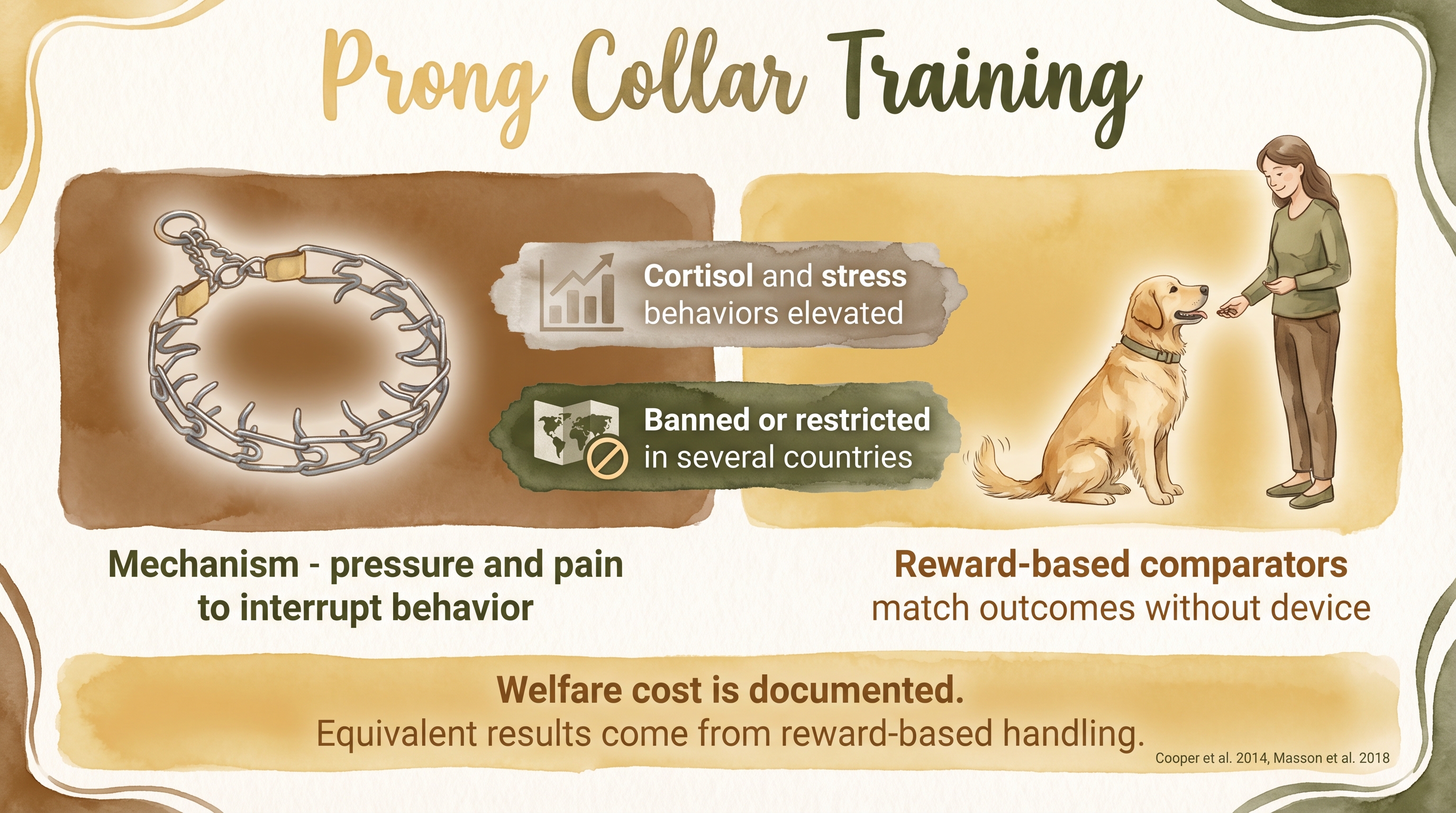
Welfare cost is documented - equivalent results come from reward-based handling.
Key Takeaways
- Prong collars are real aversive equipment, but the direct prong-specific research base is thinner than many people assume.
- The best-supported caution comes from the broader literature on correction-heavy and aversive training, plus a smaller pinch-collar comparison study.
- A prong can improve immediate handler leverage without necessarily building the dog's underlying leash composure.
- JB declines the tool because leash manners should grow from calm raising and practiced movement, not from more efficient neck-pressure delivery.
The Evidence
This entry uses documented claim-level tags beyond the dedicated EvidenceBlocks below. These claims should remain tied to the entry Sources and SCR references during the next evidence-chain authoring pass.
This entry uses estimated claim-level tags beyond the dedicated EvidenceBlocks below. These tags mark approximate ranges or timing claims that should remain bounded by the cited sources.
- Ziv (2017) and broader aversive literaturecompanion dogs
Support caution around methods that rely on aversive consequences, even when the exact equipment differs across studies. - Salgirli Demirbas et al. (2012)Belgian Malinois
Pinch-collar condition produced more stress than a quitting signal and less than an e-collar in a controlled recall protocol. - Vieira de Castro et al. (2020)companion dogs
Demonstrates welfare costs in aversive-based school contexts, which is relevant when prongs are embedded in broader correction systems. - Herron, Shofer, & Reisner (2009)companion dogs
Shows that confrontation-heavy handling can produce aggressive responses, underscoring the risk of escalation around correction tools generally.
- domestic dogs
No published long-term study directly compares prong collar training against structured relational raising and no-intervention controls across ordinary companion-dog homes.
SCR References
Sources
- Ziv, G. (2017). Journal of Veterinary Behavior.
- Salgirli Demirbas, Y., et al. (2012). Medycyna Weterynaryjna.
- Vieira de Castro, A. C., et al. (2020). PLOS ONE.
- Herron, M. E., Shofer, F. S., & Reisner, I. R. (2009). Applied Animal Behaviour Science.