E-Collar (Remote Collar) Training
Electronic-collar training sits at the center of one of the most polarized arguments in the modern dog world because it combines real short-term control with real welfare concern. The device is a remote collar fitted with contact points on the dog's neck and activated by a handheld transmitter. Depending on model and setting, it may deliver electric stimulation at low or high intensity, along with tone or vibration features. In training culture the same tool is described in radically different moral language: critics call it a shock collar, while advocates emphasize remote communication, low-level stimulation, and conditioned cues. Documented
Historically, the device entered mainstream dog discourse through working contexts rather than family puppy life. Hunting retrievers, field-trial dogs, livestock dogs, and police or protection dogs are the environments most commonly associated with remote-collar development. Civilian adoption followed later, usually for off-leash reliability, snake avoidance, predatory chasing, or dogs that owners felt could not be controlled around major distractions. By the 2010s the tool had become the symbolic center of the balanced-versus-force-free dispute.
The peer-reviewed evidence is more specific than either camp usually admits. Cooper and colleagues in 2014 compared remote-collar training with reward-based recall work and did not find superior recall efficacy for the e-collar groups, while observing more stress-related behavior. China, Mills, and de Souza Machado in 2020 likewise found that reward-based groups performed as well as or better than the e-collar group on recall-related outcomes, again with more stress behavior in the e-collar condition. Schalke's 2007 Beagle work showed that predictability and contingency modify stress response, which matters because modern e-collar advocates often argue for low-level, highly conditioned use rather than surprise punishment. Those findings support caution, not caricature.
JB does not use e-collars and does not view them as necessary for raising a family Golden Retriever. JB also avoids pretending the literature has already answered every question about every protocol variant. The evidence is strongest against routine, high-intensity, or poorly handled e-collar use and against claims of clear superiority over reward-based alternatives. The evidence is weaker against the narrower claim that some expert handlers can use low-level remote pressure successfully in specialized working contexts. That narrower claim should be discussed honestly, even while JB declines the tool for its own work.
What It Means
What the Device Is and How Trainers Frame It
An e-collar is a remote-operated collar that can deliver electric stimulation through neck contact points. The mechanical fact is simple. The training interpretations are not. One trainer uses the device as positive punishment, activating it after unwanted behavior. Documented Another uses it as negative reinforcement, applying low-level stimulation until the dog performs the desired response and then releasing it. A third uses it as a conditioned attention cue after extensive pairing. These differences matter because the welfare conversation depends heavily on intensity, predictability, and context.
Modern e-collar advocates often insist that critics are attacking an outdated picture. They point to educators such as Larry Krohn or working-dog schools that teach low-level conditioning protocols rather than hard corrections. In that story, the stim is comparable to tapping a shoulder. Critics answer that the analogy fails because the dog is still learning through aversive sensation and the tool still creates opportunities for escalation, misuse, or dependency.
What the Comparative Studies Actually Found
The best-known controlled work comes from the University of Lincoln research program and the later China 2020 study. Documented Cooper et al. in 2014 studied 63 pet dogs referred for recall problems and compared reward-based training with remote-collar conditions. Recall improved across groups, but the remote-collar groups did not show superior efficacy. They did show more yawning, lip licking, and tense body postures during training. China, Mills, and de Souza Machado in 2020 examined 63 dogs in a lure-chasing and recall-related paradigm and again found that reward-based groups matched or outperformed the remote-collar group by endpoint while the e-collar condition carried more stress indicators.
The stronger welfare evidence does not come only from those two papers. Schalke et al. in 2007 found higher cortisol and more avoidance when electric stimulation was unpredictable, with somewhat lower but still elevated responses when it was contingent. Schilder and van der Borg in 2004 observed stress-related behaviors even when police dogs later re-entered a training environment without receiving shocks, suggesting conditioned contextual fear. Salgirli Demirbas et al. in 2012 found higher cortisol and more avoidance in the electronic-collar group than in a quitting-signal comparison. Together these studies do not prove that every low-level protocol is equally harmful. They do show that the tool sits on aversive ground.
Why the Debate Stays Hot
The debate persists because both sides are reacting to a true piece of the picture. Balanced trainers are right that remote collars can produce fast interruption of dangerous or high-arousal behavior in some hands. The field data even suggest that suppression of predatory chasing can appear quickly in short-term trials. Force-free critics are right that the welfare costs are not theoretical and that comparative studies have not shown the kind of broad superiority that would justify casual family-dog use.
Methodology keeps the argument alive as well. Sample sizes are small. Protocols differ. Modern low-level advocates argue that the published studies do not capture the best current practice. Documented Critics reply that if a tool's humane status depends on rare expert handling, that is itself a consumer-welfare problem. Both points deserve to be stated plainly. The field has better evidence for caution than for exoneration, but not enough evidence to pretend every single variant has been directly tested.
JB does not solve off-leash reliability by adding a remote aversive. JB tries to raise dogs whose regulation, orientation to people, and rehearsal history make coercive emergency control far less necessary in the first place.
The Regulatory and Cultural Pressure Around the Tool
Remote collars also live under heavier public scrutiny than most dog equipment. Wales prohibited shock-emitting electronic collars in 2010 under the Animal Welfare (Electronic Collars) (Wales) Regulations. England later pursued 2018 consultation and 2023 statutory-instrument action directed at remote electric collars, showing how politically exposed the tool had become even beyond training circles. In many places the practical point is less the exact legal map than the direction of travel: electronic correction is under sustained welfare challenge in a way flat collars and even prongs are not.
That cultural heat shapes consumer understanding. Families often meet the tool through extreme claims. One camp says it is abuse full stop. The other says it is the only honest route to reliable freedom. The literature supports neither extreme. It supports a narrower statement: the tool can control behavior, but it brings aversive cost and has not demonstrated consistent superiority over reward-based alternatives for the family-dog tasks most owners care about.
Why It Matters for Your Dog
For a Golden Retriever family, this subject matters mostly because the sales pitch is so emotionally powerful. Owners are told they can get a dog that runs free, comes back instantly, ignores wildlife, and lives a larger life because the collar guarantees enforceability at distance. Documented That promise lands hardest with adolescents, high-drive retrievers, and dogs whose owners feel embarrassed after failed recalls.
The first practical question is whether the family's problem is truly remote control at distance or a much earlier developmental issue. Many Goldens with poor recall are not missing an electronic layer. They are missing repetition at the right difficulty, calmer arousal states, cleaner transition habits, and adults who stopped practicing "come" only when it was already time to leave the fun. If those foundations are weak, a remote collar may improve immediate compliance without solving the underlying picture.
A familiar Golden scenario makes the point. A ten-month-old retriever bolts toward geese at the edge of a field and ignores the recall cue. An e-collar trainer may say the dog needs an enforceable consequence because the environment is too powerful. Sometimes that argument is understandable. Yet the next questions matter more than families expect. How much off-leash freedom did the dog receive before recall was strong? How often was the cue repeated without follow-through? How much daily arousal is the dog carrying? How often does the family call the dog away from the best thing in the environment without enough reinforcement history to support success? By the time the dog is chasing geese, the training failure usually began long before the chase.
The welfare side matters too. Goldens are soft enough that some will absorb remote-collar training by becoming less adventurous, less expressive, or more handler-dependent around high-value situations. Owners may read that as maturity because the dog stays closer and checks in more. Sometimes it is indeed improved compliance. Sometimes it is caution layered over confusion or stress. Those outcomes are not visually identical, especially to families who badly want relief.
Remote collars can also distort owner judgment. Once a family believes reliability depends on the device, they may become less willing to do the slower work of environmental setup, reinforcement history, line work, or staged distractions. The collar can slide from emergency tool to identity. Then the question quietly changes from "Does my dog know how to succeed here?" to "Can I make my dog comply here?" That is not a small philosophical shift.
There are real narrow cases where the balanced camp raises fair concerns. Working retrievers at extreme distance, snake-avoidance programs in high-risk regions, or dogs whose failure around livestock would create immediate danger do not present the same picture as ordinary suburban off-leash life. JB acknowledges that competent professionals have used remote collars in some of those settings. It also maintains that those cases should not be used to normalize the tool for the average family Golden who pulls toward ducks on a Saturday walk.
This is where breed and household type matter. Goldens are raised primarily as family companions. Their biggest training failures are usually not edge-case field emergencies but overarousal, weak boundaries, adolescent selectivity, and inconsistent human follow-through. A collar built for remote electric control is rarely the right first answer to those problems. Even when it works mechanically, it tends to skip the more important work of building a dog who is emotionally organized enough to choose well without being remotely managed.
That difference is especially important for retrievers because freedom is often the emotional heart of the sales pitch. Families imagine beaches, fields, and wooded trails. JB wants those things too. The disagreement is about whether freedom is better purchased through remote enforceability or built through longer preparation and a dog whose ordinary orientation to people is already strong before distance is added.
JB also wants families to notice how easily remote-collar thinking can turn preparation into backup. Instead of asking how to build a dog who expects to reorient voluntarily, the household starts asking how far away enforcement can still reach. That change in mindset matters even before the stim button is pressed, because it rearranges what the adults spend their training energy on.
The more daily life has to be organized around that logic, the less the solution looks like true freedom.
That tradeoff should matter to families more than the sales language usually suggests.
It changes the whole meaning of reliability.
What This Means for a JB Family
There is also a hidden maintenance question families deserve to hear plainly. A dog may look reliable under an e-collar protocol while the owner's confidence remains tied to whether the remote is charged, fitted, and present. That is not meaningless reliability, but it is a different kind of reliability from a dog who has developed strong orientation and response habits without remote enforcement. The distinction matters because many sales pitches quietly blur the two.
The JB answer is straightforward. Do not build your family dog's development around a remote electric device. Raise the dog so recall, leash freedom, and everyday restraint grow out of orientation, prevention, repetition, and calmness. If a situation is too hard for that history, use a line, shorten the environment, or change the setup before reaching for remote control.
This does not require pretending the tool is fake or that no skilled person has ever used it competently. It requires keeping the family's actual context in view. A family Golden Retriever is not a police dog, a field-trial specialist, or a livestock guardian. The tool should not be normalized by examples taken from jobs the household dog does not have.
The second JB takeaway is to distrust urgency-based marketing. If a trainer says your dog needs an e-collar because nothing else can create reliable freedom, ask what foundation work has already been exhausted and how reliability will be maintained when the dog is tired, overstimulated, or in a new environment. Ask what the measured evidence is, not just the video evidence. Ask what stress signs the trainer watches for and what percentage of dogs truly end up not needing the device.
Most JB families will find that calmer raising and more disciplined setup solve the problem at a lower cost. Long lines, staged proofing, orientation games, practiced thresholds, and real management sound less dramatic than remote enforcement, but they build the kind of dog JB is trying to produce. The goal is not a dog who can be corrected at distance. The goal is a dog whose social and emotional organization makes distance control less necessary.
That is why JB leaves the tool on the shelf. The evidence gives good reason for caution, the family context rarely justifies the risk, and the larger developmental project points in a different direction anyway. Documented
If a family ever feels drawn toward the device, that temptation should function as diagnostic information first. Why does remote control feel necessary? Which freedoms were granted too early? Which distractions were never staged properly? Which parts of daily life are still too exciting for the dog to think? Those questions often reveal that the collar is being asked to solve a history problem, not just a present-moment obedience problem.
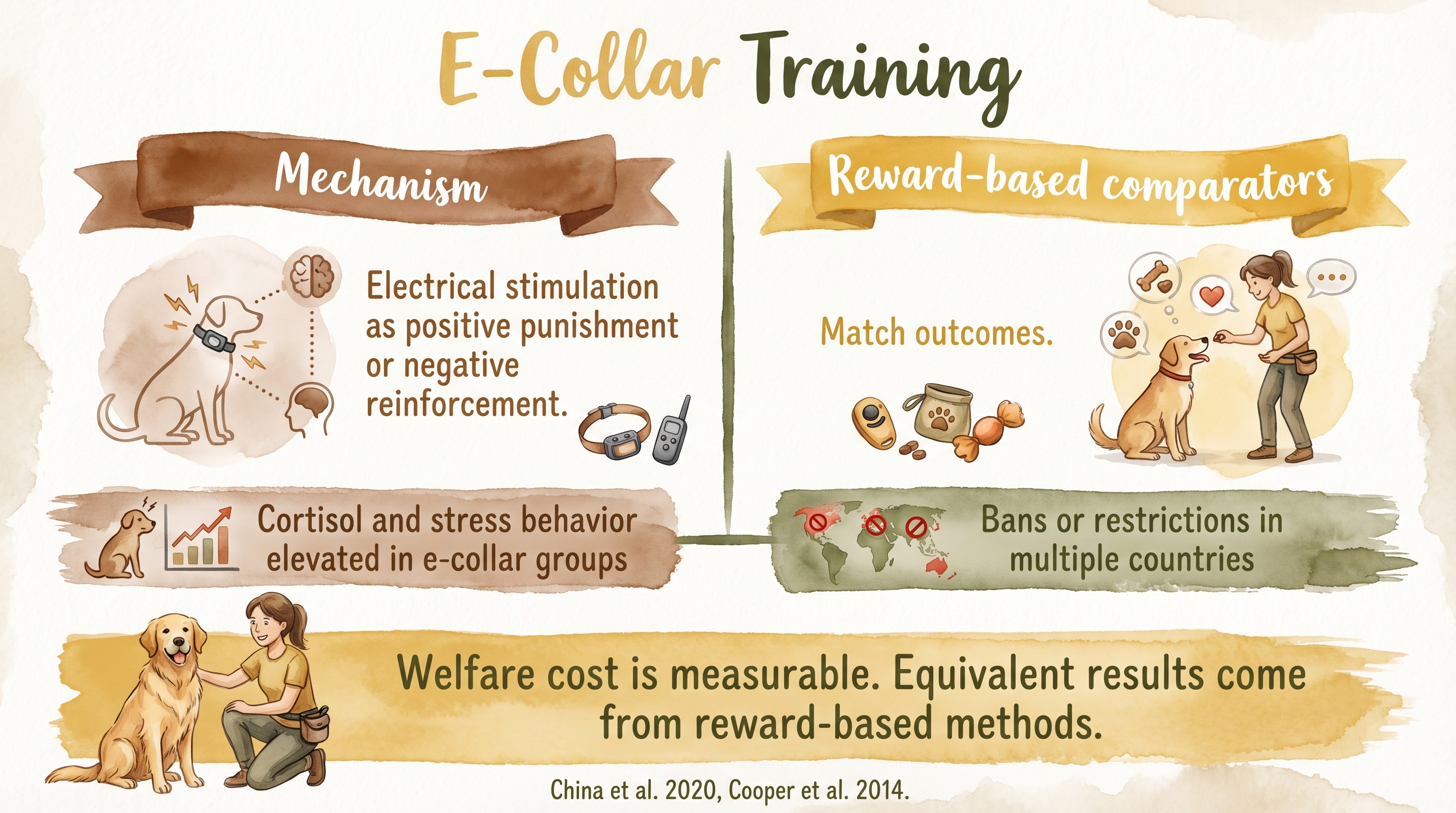
Welfare cost is measurable - equivalent results come from reward-based methods.
Key Takeaways
- E-collars are real behavior-control tools, not magic devices and not empty myths.
- The strongest comparative studies do not show broad recall superiority over reward-based alternatives, but they do show meaningful welfare concern.
- Predictability and handler skill matter, yet they do not remove the fact that the device works through an aversive channel.
- JB treats remote collars as outside the needs of family Golden raising, even while acknowledging narrow specialized contexts where professionals still defend them.
The Evidence
This entry uses documented claim-level tags beyond the dedicated EvidenceBlocks below. These claims should remain tied to the entry Sources and SCR references during the next evidence-chain authoring pass.
- Cooper et al. (2014)companion dogs
Controlled comparison found no significant efficacy advantage for e-collar groups in recall work, alongside more stress-related behavior. - China, Mills, & de Souza Machado (2020)companion dogs
Reward-based groups performed as well as or better than the e-collar group by endpoint, while the e-collar group showed more stress indicators. - Schalke et al. (2007)Beagles
Predictable stimulation produced lower stress than unpredictable stimulation, but both remained aversive relative to control conditions. - Schilder & van der Borg (2004)police dogs
Observed persistent stress-related behavior associated with shock-collar training environments, suggesting conditioned contextual fear.
- domestic dogs
No published long-term study directly compares e-collar (remote collar) training against structured relational raising and no-intervention controls across ordinary companion-dog homes.
SCR References
Sources
- Cooper, J. J., et al. (2014). PLOS ONE.
- China, L., Mills, D. S., & de Souza Machado, D. (2020). Animals.
- Schalke, E., et al. (2007). Applied Animal Behaviour Science.
- Schilder, M. B. H., & van der Borg, J. A. M. (2004). Applied Animal Behaviour Science.
- GOV.UK. "Animal welfare: banning the use of electronic training collars for cats and dogs" (2018 consultation and response).
- The Animal Welfare (Electronic Collars) (Wales) Regulations 2010.
- Draft The Animal Welfare (Electronic Collars) (England) Regulations 2023.