Negative Reinforcement in Dog Training
Negative reinforcement is the operant quadrant people misread most often because the word negative sounds moral when it is only functional. In operant language, negative reinforcement means something is removed after the desired behavior, and that removal makes the behavior more likely. The "negative" part means subtraction. The "reinforcement" part means the behavior increases. If a dog yields to leash pressure and the pressure disappears, and yielding becomes more likely in the future, negative reinforcement has occurred. Documented
This quadrant matters because it sits underneath many tools that trainers describe very differently. A mild steady leash cue used to teach movement can involve negative reinforcement. So can low-level remote-collar protocols designed around pressure on, pressure off. So can older compulsion systems in which the dog learns to turn off discomfort by complying. The quadrant itself does not tell you how strong the aversive is, how well the dog understands the contingency, or how costly the experience is for welfare. Documented
That last point is the whole ethical problem. Negative reinforcement always involves something the dog is motivated to escape or avoid. The open question is how intense, how clear, how brief, and how necessary that experience is. A light, predictable leash cue is not the same event as a high-intensity electronic stimulus or a harsh mechanical correction, even if the operant map places them in neighboring territory. The field often argues as if all negative reinforcement is the same thing or as if operant classification settles the welfare issue. Neither is adequate.
JB's position is narrow and concrete. It does not use deliberate negative reinforcement as a core raising tool for family Goldens. It also refuses to flatten the quadrant into one undifferentiated moral category. Mild pressure that the dog can understand and escape quickly is different from strong aversive control. The distinction matters, even when JB ultimately decides the family-raising phase should not rely on either version as a first answer.
What It Means
The Functional Definition Is Clearer Than the Culture Around It
Negative reinforcement has a simple textbook definition and a messy cultural life. The behavioral definition asks only one question: what made the behavior increase? If the answer is that an aversive or pressuring stimulus stopped when the dog responded, then the contingency qualifies.
Trainers often hide that clarity with softer language. They say they are "turning off pressure," "communicating through the leash," "stimulating lightly," or "giving the dog the answer." Some of those descriptions may be fair in context. None of them changes the operant mechanics. The reason to keep the definition clear is not to score moral points. It is to avoid confusion about what is actually happening.
Where It Appears in Real Dog Training
The classic everyday example is leash pressure. A dog feels tension on the collar or harness, moves with the pressure, and the tension disappears. In some hands this becomes a quiet guide. In other hands it becomes chronic nagging. The operant label alone does not tell you which one you are seeing.
The quadrant also appears in more formal systems. Traditional obedience and working-dog culture have long used pressure-release logic because it can create crisp responding. Remote-collar advocates often describe low-level stimulation in these terms as well: not punishment, they say, but a cue the dog learns to turn off through the desired response. That distinction is central to modern e-collar defense and is one reason the debate cannot be reduced to slogans.
The named research landmarks belong here too. Documented Schalke et al. 2007 examined predictability and stress in electronic-collar exposure, Cooper et al. 2014 and China et al. 2020 compared remote-collar protocols against reward-based alternatives, and Ziv 2017 synthesized aversive-training evidence more broadly. Those papers do not collapse every leash feel into every stronger aversive event, but they do keep welfare questions attached to any system built on escape from pressure.
Why Welfare Questions Begin Here
Negative reinforcement always imports welfare questions because the dog is moving to remove something unpleasant or pressuring. Predictability matters. Intensity matters. Duration matters. Clarity matters. Research on aversive methods shows that dogs display more stress indicators and, in the strongest welfare studies, more pessimistic cognitive bias when training relies on aversive-heavy conditions. Documented Those findings do not isolate negative reinforcement perfectly from related aversive practices, but they are highly relevant to any method that depends on escape from pressure.
The Schalke e-collar work also matters conceptually because it showed that predictable, contingent aversive events produce different responses than unpredictable ones. That does not make the predictable version welfare-neutral. It does show that contingency and control shape the dog's experience.
JB is not persuaded by the claim that pressure is harmless merely because it is technically escapable. The calmer and more developmentally prepared the dog is, the less need there usually is to organize teaching around escape from discomfort in the first place.
JB's Distinction Between Mild Guidance and Aversive Dependence
JB draws a practical line here. A brief, understandable physical cue that helps a dog organize movement is not identical to building a whole training system around discomfort and escape. Families recognize this intuitively. A gentle leash feel used once in a quiet lesson is a different event from repeated pressure that the dog must constantly solve to keep life comfortable.
That line matters because the debate often jumps from one extreme to another. Observed-JB One side acts as if any tactile guidance is abusive. The other acts as if because some low-level pressure can be humane, pressure-based teaching deserves broad first-line status. JB rejects both shortcuts. The ethical question is not only whether pressure can be used without catastrophe. It is whether the family's developmental plan needed to lean on that channel at all.
Equipment choice and handler skill complicate the question further. Pressure from a back-clip harness, a front-clip harness, a flat collar, a slip lead, or a remote collar is not felt in the same way or interpreted in the same learning history. Yet families often discuss all of it simply as communication. The more those differences are blurred, the harder it becomes to think clearly about magnitude, timing, and what the dog is actually escaping.
Why It Matters for Your Dog
For a Golden Retriever family, negative reinforcement matters because its mild forms show up in ordinary life even when nobody uses technical language. A puppy feels light leash tension and moves. A handler pauses at a doorway and the dog yields out of the space. A line goes taut and then softens when the dog chooses correctly. Families may be using pressure-release dynamics without ever naming them.
That is one reason the topic is worth reading carefully. The moment adults do not understand the quadrant, they cannot distinguish between light, understandable guidance and steadily escalating pressure that the dog is enduring rather than learning from. Goldens are socially tolerant enough that this distinction can be missed for a while. The dog may keep working while carrying more stress than the family realizes.
A concrete example helps. Imagine a young Golden who forges out the front door every morning. One adult starts using quiet leash pressure at the threshold and releasing it the instant the puppy steps back or softens. If the setup is calm, the cue is consistent, and the puppy is not already frantic, the lesson may stay mild and brief. If the adult is rushed, irritated, and repeating the pressure every few seconds while the dog is already over-aroused, the exact same quadrant turns into background friction.
That difference matters because dogs do not only learn the contingency. They also absorb the emotional climate around it. A family that lives in constant micro-pressure may produce a dog that looks compliant at moments and stays chronically wound underneath. Negative reinforcement is not uniquely responsible for that risk, but it can become one pathway into it.
Goldens also expose a second issue: families often use pressure where prevention would have worked better. Loose-leash problems, threshold explosions, frantic exits, and dragging toward guests frequently develop through rehearsal long before anyone reaches for leash pressure. By the time the family starts "communicating through pressure," the household is already cleaning up a pattern it helped build. That is the JB critique in miniature.
There is another practical risk in family homes. Pressure can become invisible to the handler. Adults habituate to holding the leash taut, guiding constantly, tightening and releasing without thought, and using the line as continuous low-grade management. The dog learns something from that, but often not what the family imagines. Instead of learning composure, the dog may simply learn to live against background tension.
This is why calm setup matters so much if pressure is ever used at all. A rested Golden in a quiet lesson can process a light cue differently from an adolescent dog already buzzing with anticipation, social hunger, or frustration. Families sometimes blame the tool when the bigger error was trying to teach through pressure in a state where the dog could barely think.
Negative reinforcement also matters because it can create an illusion of fairness that families find reassuring. The adult feels they are not punishing the dog, only showing the dog how to turn pressure off. Sometimes that is an honest description. Sometimes it hides the fact that the dog is spending large portions of training working to escape chronic physical information that never needed to become the main teaching channel in the first place. The distinction is subtle enough that households can miss it for months.
Another family-level issue is transfer. Dogs can learn pressure-release beautifully with one handler and then fall apart when another family member has different timing, tension, or emotional tone. That does not mean the dog is stubborn. It means the contingency was more handler-specific than the adults realized. Goldens often reveal this when they move neatly with one calm person and forge against another who carries urgency in the leash hand from the first step.
There is a developmental question underneath all of that. When pressure becomes a normal route to cooperation, the family can stop noticing how many problems were avoidable upstream. Threshold control, guest greetings, car exits, and loose movement are often easier to teach before the dog has months of self-rewarding rehearsal. Observed-JB Negative reinforcement can then feel like rescue when it is really late-arriving structure.
The question becomes sharper around adolescence. A thirteen-month-old Golden pulling like a freight train can make pressure-release training look indispensable because the adults remember how easy the dog was at four months and feel they are now in an emergency. Sometimes they are in a bind. Even then, the bind usually has a history. Pressure is being asked to solve momentum that prevention, earlier structure, and calmer daily pacing might have kept from hardening into habit.
What This Means for a JB Family
For a JB family, the first takeaway is not technical but sequential. Build a home that prevents the need for repeated pressure before you worry about how refined your pressure is. Calm entries, practiced thresholds, enough sleep, adult pacing of arousal, and clear access rules remove many of the situations in which negative reinforcement later gets marketed as essential.
The second takeaway is about honesty. If a family is using pressure-release in a small way, it helps to name it accurately rather than dressing it up or demonizing it theatrically. Accurate naming keeps the welfare question clear. How strong is the pressure? How often is it needed? Does the dog understand it quickly? Is the dog becoming calmer, or merely more practiced at escaping discomfort?
JB families generally do best by reserving this quadrant to the margins. A tiny amount of understandable physical guidance may appear in real life. That is different from building a training identity around escape from pressure. The latter is not how JB raises dogs, and it is rarely necessary for a well-raised family Golden.
That is the practical line: distinguish mild, occasional guidance from a pressure-dependent system, and then work upstream so even the mild guidance becomes less necessary over time. The healthier the raising environment, the less this quadrant has to carry.
Families can make that line concrete by watching frequency instead of arguing only about philosophy. If leash pressure is needed in nearly every doorway, every walk, and every greeting, the household has a systemic problem no matter how refined the pressure looks. If a quiet cue appears briefly in a carefully prepared lesson and then disappears as the dog understands the pattern, that is a very different picture. Counting how often the dog must escape pressure is often more revealing than debating what the tool should be called.
That practical audit can be surprisingly clarifying. A family may discover that the best week they have had with the dog involved less pressure not because technique improved but because sleep improved, guests were fewer, exits were slower, and the adults were calmer. Once they see that pattern, the quadrant falls into better proportion. Pressure stops looking like the hidden key and starts looking like a minor tool whose usefulness rises and falls with the quality of the rest of the dog's life.
That is a useful final test for JB families. If better household rhythm reduces the need for pressure faster than better pressure technique does, the main lesson is already visible. The dog's cooperation was waiting on adult organization more than on a more refined escape contingency.
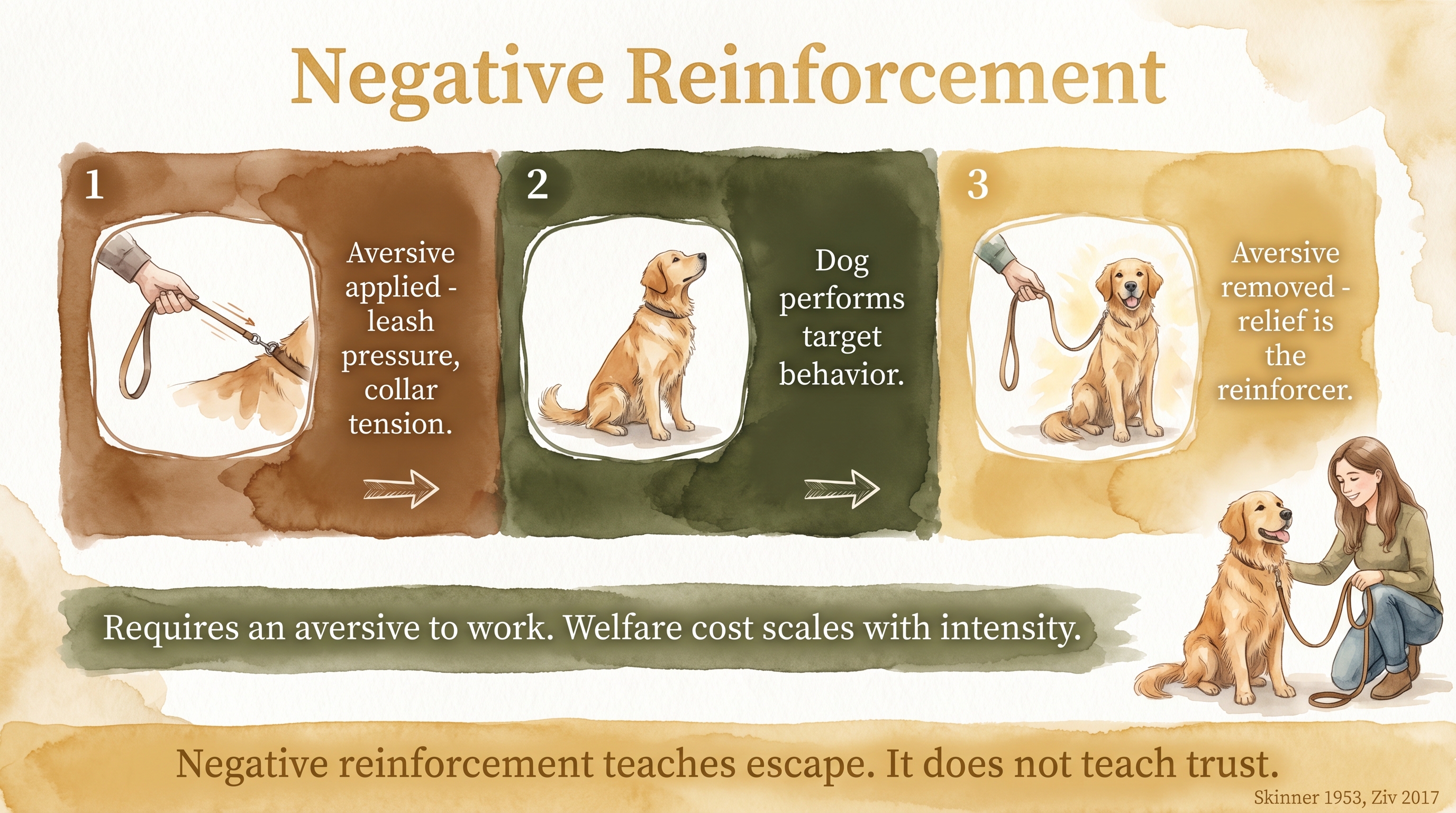
Negative reinforcement teaches escape - it does not teach trust.
Key Takeaways
- Negative reinforcement means the dog's behavior increases because pressure or discomfort stops when the dog responds.
- The quadrant includes very different real-world events, from mild leash guidance to stronger aversive systems, so the operant label alone does not settle the welfare question.
- Predictability and intensity matter, but they do not erase the fact that the dog is learning through escape from something unpleasant.
- JB keeps this quadrant at the margins by trying to prevent the situations that make pressure-based teaching attractive in the first place.
The Evidence
This entry uses observed claim-level tags beyond the dedicated EvidenceBlocks below. These tags mark JB program observation or practice-derived claims that need dedicated EvidenceBlock coverage in a later content pass.
- companion dogs
Documents the aversive-method welfare literature and the importance of distinguishing efficacy claims from stress and affective-state outcomes. - Schalke et al. (2007) as synthesized in the source layerdogs
Shows that predictability and contingency affect physiological stress response during electronic-collar exposure, which is relevant to escape-learning arguments. - Cooper et al. (2014) and China et al. (2020) as summarized in the source layercompanion dogs
Provide controlled e-collar comparisons showing that pressure-based systems do not clearly outperform reward-based alternatives while carrying welfare costs. - Ziv (2017) review and related synthesiscompanion dogs
Supports caution around methods that rely on aversive processes even when advocates describe them in low-level or contingent terms.
- domestic dogs
No published long-term study directly compares negative reinforcement in dog training against structured relational raising and no-intervention controls across ordinary companion-dog homes.
SCR References
Sources
- Schalke, E., et al. (2007). Applied Animal Behaviour Science.
- Cooper, J. J., et al. (2014). PLOS ONE.
- Ziv, G. (2017). Journal of Veterinary Behavior.