The Positive Reinforcement Revolution in Dog Training
Compound evidence detail1 SCR / 2 parts
- Documentedthe documented absence of any RCT establishing single-method superiority across canine behavioral domains, paired with the on-record organizational position statements (AVSAB 2008 and 2021, APDT 2020 and 2023, CCPDT 2025, IACP 2025, plus Ziv 2017 and Todd 2018 reviews) which constitute institutional policy rather than scientific consensus
- Heuristicthe JB characterization of professional ideological fragmentation across force-free, balanced, and compulsion approaches, carrying the load-bearing firewall that absence of method-superiority RCT does not equalize methods on welfare grounds where SCR-026, SCR-028, and SCR-036 document harm from aversive methods independently of the outcome comparison gap
The positive reinforcement revolution was one of the most important moral and practical shifts the dog training industry has ever undergone. It replaced a mid-century culture that often treated physical compulsion as ordinary with a new consensus that reward based methods should come first, welfare matters during training, and dogs do not need to be forced simply because older traditions were comfortable forcing them. That shift did not happen all at once, and it did not emerge from one person alone. It emerged from overlapping streams of theory, practice, public writing, organization building, and welfare research. Documented
Karen Pryor helped popularize the language. Ian Dunbar changed the timeline by putting puppyhood and prevention at the center. Jean Donaldson, Patricia McConnell, Karen Overall, Pat Miller, and many others helped articulate the new culture more broadly. Professional organizations such as the APDT, IAABC, Karen Pryor Academy, and later the Pet Professional Guild gave the new approach infrastructure, identity, and a pathway into everyday consumer advice.
The research stream mattered too. Documented Hiby, Rooney, and Bradshaw in 2004, Rooney and Cowan in 2011, Blackwell and colleagues across multiple papers, Ziv's 2017 review, and Vieira de Castro and colleagues in 2020 all contributed to the growing welfare critique of aversive methods. The details and limitations of that evidence matter, but the overall cultural effect is clear: the old assumption that compulsion was simply standard good practice became much harder to defend.
From a JB standpoint, this revolution deserves both appreciation and restraint. It was a real welfare advance. It also remained a revolution inside the training paradigm. It changed the preferred tools more than it changed the deeper assumption that dogs are fundamentally subjects of method. The stronger version of that critique is interpretive and should be voiced that way.
What It Means
The positive reinforcement revolution was not a single event. It was a layered realignment.
The Practical Bridge
Karen Pryor's clicker work showed that animals could learn complex tasks through reinforcement and timing rather than force. Her 1984 book gave the public a readable entry point into operant language. At the same time, Bob Bailey's workshops and the broader applied behavior tradition trained professionals to think more carefully about criteria, contingency, and reinforcement history. This practical bridge made the new culture mechanically credible.
The Developmental Bridge
Ian Dunbar added a second bridge by pulling puppyhood into focus. SIRIUS in 1982 and the later APDT in 1993 helped make early classes, family coaching, and preventive framing central to companion dog culture. The message was not only "use food." It was "start early, before the problem hardens."
That change was crucial because it gave positive reinforcement culture a different personality from older obedience traditions. Documented It sounded less like drilling and more like educating.
The Welfare Evidence
The research stream carried the revolution from preference to principle. Documented Hiby, Rooney, and Bradshaw in 2004 reported that punishment correlated with more behavior problems while reward based training associated with better owner reported obedience. Rooney and Cowan in 2011 found dogs trained with more rewards performed better on novel tasks and were more willing to interact with a stranger. Ziv's 2017 review, though still needing careful citation boundaries according to the SCR, reinforced the broad conclusion that aversive methods carry welfare concerns without a demonstrated superiority that would justify routine reliance on them. Vieira de Castro and colleagues in 2020 added behavioral, cortisol, and cognitive bias data pointing in the same direction.
The key is to keep the evidence honest. Much of it is cross sectional, retrospective, or vulnerable to self selection. The source notes insist on that caution. Still, the field did not need a perfect randomized trial to see enough consistent concern to shift professional norms.
The New Professional Identity
Once the welfare argument connected with organizations, the revolution became cultural, not just empirical. APDT, IAABC, Karen Pryor Academy, and especially PPG helped create a recognizable profession whose members could say not merely "I train dogs," but "I train in a humane, reward centered way." That identity mattered because it gave consumers a moral vocabulary for choosing trainers.
It also made later conflict more intense. Once a method becomes part of moral self description, disagreement feels ethical rather than merely technical.
The Limits Inside the Revolution
The source layer is disciplined about the revolution's boundaries. For basic obedience tasks, reward based methods look strong and humane. For severe aggression, predatory chasing, and complex pathology, the evidence is much thinner and mixed. Ambiguous The field also measures a narrow band of outcomes. It is better at measuring task compliance and acute welfare than at measuring broad developmental competence, relationship quality, or long term household maturity.
That matters because the positive reinforcement revolution did not fully answer the question of what kind of raising environment produces the most stable family dog. It answered a narrower and still very important question: do we need heavy compulsion to train dogs well? The emerging answer was often no.
The revolution also changed what humane ownership sounded like in public. Owners were taught to think about stress, frustration, reinforcement history, and emotional fallout, not only about obedience. Estimated That cultural shift is one reason the movement traveled so widely outside professional circles.
The positive revolution improved the industry's moral floor. JB values that. The additional JB claim is that prevention still has to move further upstream than method choice and into the ordinary architecture of the dog's early life.
Why It Matters for Your Dog
For a Golden Retriever family, this history matters because it explains why so much modern advice now begins with rewards, management, and humane language. That is not arbitrary fashion. It is the result of a real correction to an older culture that often tolerated pain, fear, and confrontation too casually.
Families benefit from that correction every time they meet a trainer who does not treat coercion as the default answer, every time a puppy class focuses on confidence instead of intimidation, and every time a professional pauses to ask what the dog is feeling instead of only what the dog is doing. Those are real gains.
But the revolution can also create a new misunderstanding if the family treats reward based work as the entire picture. A Golden puppy can earn food beautifully, learn markers quickly, and still become overaroused, socially juvenile, or hard to live with if the daily home environment teaches excitement, inconsistency, or endless rehearsal of unwanted patterns.
That is why this history helps families hold two truths at once. First, reward based training is often kinder and often effective. Second, kindness of method does not automatically produce maturity of dog. The family still has to raise.
A practical example shows why. Suppose a young Golden performs sits, downs, targets, and loose leash starts in class with cheerful accuracy. At home, though, the same dog barrels through children, races doorways, and melts down during evening activity. A family who knows only the positive revolution may think the answer is to add more treats, more shaping, or more classes. Sometimes that helps. Often the missing piece is that the dog is learning one set of rules in training and another set of emotional habits in life.
This matters especially for Goldens because people are tempted to equate friendliness with wellness. A reward based puppy can look bright, social, and engaged while still being under-mentored. JB's concern is not that the family is using rewards. It is that the family may stop the analysis there and fail to build the calm floor, structured routines, and non-initiation habits that actually support adult stability.
So the positive reinforcement revolution matters for your dog because it made the field less casually harsh. JB keeps that gain. What JB adds is the insistence that humane technique is not the same thing as complete developmental guidance.
For a Golden Retriever family, another practical effect of the revolution is that it raised expectations for owner involvement. Modern reward-based work often assumes the family will observe closely, mark precisely, manage carefully, and rehearse consistently. That can be a real advantage. It can also create a gap between what looks elegant in principle and what a busy household can actually sustain every day.
When that gap appears, families may think the answer is simply to add more training. Sometimes the answer is to simplify the dog's life instead. A Golden who is chronically over-threshold, over-greeted, overhandled, and over-stimulated may not need a more refined reinforcement plan first. The dog may need the household to stop manufacturing the arousal that the plan is then asked to repair.
The positive revolution therefore matters for your dog not only because it made training kinder, but because it can tempt families to believe kindness of method is the whole developmental answer. JB's response is to keep the kindness and then move farther upstream into the ordinary architecture of life with the dog.
The same issue appears in adolescent Goldens who look happy, social, and trainable right up until the house gets busy. The family may have a drawer full of treats, a good marker system, and a well-run class, yet still be living with a dog that ricochets through greetings and cannot settle. The revolution improved the method picture. It did not automatically solve the home-culture picture.
That is why JB families should read the positive revolution as a major welfare success and still ask harder developmental questions. Is the puppy learning how to wait? Is the home too exciting? Is every visitor turning into a reward event? Is the dog's day patterned in a way that teaches downshifting as seriously as task performance? Those are not anti-positive questions. They are upstream questions.
The revolution also changed what owners feel guilty about. In older eras, people were often shamed for being too soft. In newer eras, families can become anxious that any meaningful limit is morally suspect. Both pressures distort the work. JB wants a calmer middle. Keep the humane floor high, then build a stable dog through structure as well as reinforcement.
What This Means for a JB Family
For a JB family, the first response to this history should be gratitude without surrender. Gratitude, because the field did need to be pulled away from mid-century coercion. Surrender, no, because a better method is still not the same as a full raising philosophy.
The family can therefore use reward based techniques freely where they are helpful. There is nothing in JB that requires pretending rewards do not work. What JB refuses is the idea that the dog's development should be organized primarily around reinforcement delivery rather than around mentorship, calmness, structure, prevention, and subtle correction inside a real relationship.
This is where the breeder to family transition matters again. If a puppy comes from a breeder who has built calm and structure, the family should not assume a humane class alone will carry that work forward. The home still needs to continue it.
The practical takeaway is to keep the welfare advance and continue upstream. Choose humane help. Then ask the bigger question: what kind of day is this puppy living? That is where JB says the deepest work still happens.
For a JB family, the wisest reading of the positive revolution is generous and unsentimental. Be grateful that the field moved away from casual coercion. Use reward-based teaching where it serves the dog well. Then stay alert to the point where method talk starts substituting for family structure, calmness, and prevention.
That is how the movement's real gains are protected. They are not protected by turning reward-based language into a new orthodoxy. They are protected by letting humane technique serve a larger raising philosophy that still cares about maturity, not only about compliance.
That middle position is not a retreat from the revolution. It is one way of protecting its best achievement. Humane technique should make it easier for families to raise mature dogs, not harder for them to communicate clear limits or organize a calm household.
This is especially important for Goldens because their friendliness can mask overarousal for a long time. A family may feel ethically relieved that it is using humane methods and still miss the fact that the dog's whole life is running too hot. JB wants that blind spot closed without surrendering any of the revolution's real welfare gains.
The practical result is not less kindness. It is better organized kindness. A humane home is not only a home that avoids harsh tools. It is a home that raises the dog into steadiness instead of treating endless excitement as normal and then trying to train down from it later.
That is the JB extension of the revolution's humane achievement. That balance is one of the clearest ways to keep the movement's real achievements alive in ordinary family life, and it is a stronger and more durable reading than either nostalgia for coercion or ritualized loyalty to one method camp.
It is also kinder to families.
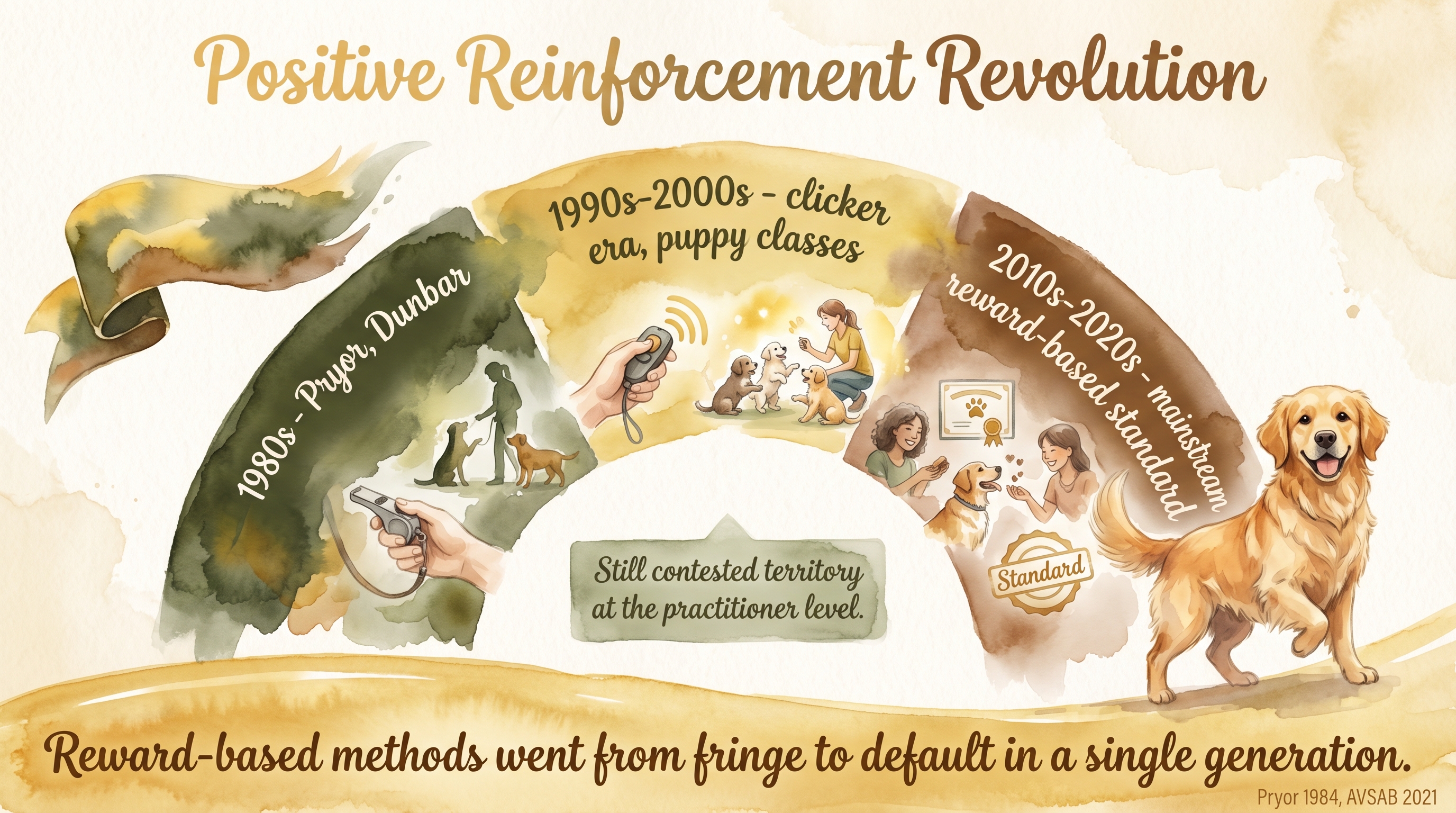
Reward-based methods went from fringe to default in a single generation.
Key Takeaways
- The positive reinforcement revolution was a real welfare advance that displaced the old assumption that coercion was normal or necessary.
- Its rise depended on practical innovation, developmental reframing, research, and professional organization building.
- The revolution answered an important method question without fully answering the larger raising question.
- JB keeps the humane gains of the revolution while insisting that a well-raised dog requires more than a better reinforcement system.
The Evidence
This entry uses estimated claim-level tags beyond the dedicated EvidenceBlocks below. These tags mark approximate ranges or timing claims that should remain bounded by the cited sources.
This entry uses ambiguous claim-level tags beyond the dedicated EvidenceBlocks below. These tags mark claims where the literature remains unsettled or multiple interpretations coexist.
- Pryor, Dunbar, and later organizational developmentdomestic dog profession
Mark the practical and professional spread of reward based training into mainstream companion dog culture. - Hiby et al. (2004), Rooney & Cowan (2011), and Blackwell's related workdomestic dogs
Support the broad conclusion that reward based methods perform well while punishment heavy methods correlate with worse behavioral and welfare related outcomes. - Ziv (2017) and Vieira de Castro et al. (2020)domestic dogs
Strengthen the welfare critique of aversive methods while still requiring methodological caution about causation and study design. - Source synthesis on limits and evidence gapsdomestic dogs
Shows that the strongest evidence concerns basic obedience and welfare, while questions about severe behavior problems and broader developmental outcomes remain less settled.
- domestic dogs
No published long-term study directly compares the positive reinforcement revolution in dog training against structured relational raising and no-intervention controls across ordinary companion-dog homes.
SCR References
Sources
- Hiby, E. F., Rooney, N. J., & Bradshaw, J. W. S. (2004). Dog training methods: Their use, effectiveness and interaction with behaviour and welfare. Animal Welfare, 13(1), 63-69.
- Rooney, N. J., & Cowan, S. (2011). Training methods and owner-dog interactions. Applied Animal Behaviour Science, 132(3-4), 169-177.
- Blackwell et al. (2008).
- Karen Pryor and Ian Dunbar's organizational development of the positive-reinforcement movement (APDT, KPA, related institutions). Biographical and organizational-history attribution; not empirical evidence for the comparative effectiveness of reward-based versus other methods. For comparative-method outcome evidence see Hiby 2004, Ziv 2017, and Vieira de Castro 2020 cited separately on this entry.
- Source synthesis on positive-reinforcement limits and evidence gaps supports the claim that the field's outcome measures remain incomplete. It should not be presented as proof that the reward-based movement is invalid.
- Ziv, G. (2017). The effects of using aversive training methods in dogs: A review. Journal of Veterinary Behavior, 19, 50-60.
- Vieira de Castro, A. C., Fuchs, D., Morello, G. M., Pastur, S., de Sousa, L., & Olsson, I. A. S. (2020). Does training method matter? PLOS ONE, 15(12), e0225023.