Lure and Reward Training
Lure and reward training is one of the most common ways ordinary families first experience dog training because it produces visible progress almost immediately. The handler places food at the puppy's nose, moves the food so the puppy's body follows it into position, then rewards the finished behavior. Sit, down, spin, kennel, hand target, and early recall games are all frequently introduced this way. The reason the method is so common is simple: it works fast enough for novices to feel successful in the first lesson. Documented
That speed explains its cultural reach. Group puppy classes, beginner obedience programs, and family how-to content often rely on luring because it is easier to demonstrate than free-shaping and easier for clients to imitate under time pressure. A food lure lets the trainer reduce abstraction. Instead of explaining how to capture or shape behavior in tiny slices, the trainer can show a visible hand path and the dog can follow it.
The method has real strengths. It is accessible, low equipment, and usually low welfare risk. Many puppies learn a rough first version of a behavior in a few repetitions. It is therefore an excellent doorway into formal teaching for families who have never trained a dog before. The problem is not the doorway. The problem is when the family never walks through it. If the lure remains in front of the dog's face for weeks, the dog may not actually understand the cue or the behavior in a stable way.
JB sees lure-reward training as a legitimate entry-level technique with a narrow and useful job. It can help a family create a first draft of a behavior quickly. It should not be mistaken for deep cooperation, and it should never become the adult's only way of getting the dog through ordinary life. A well-raised Golden should not need to be bribed into every calm household choice.
What It Means
The Mechanics Are Simple by Design
The food lure gives the dog an immediate physical reference point. Move the lure slightly up and back, and many dogs sit. Move it downward and forward between the front feet, and many dogs fold into a down. Move it toward the crate and toss reinforcement inside, and crate entry becomes easy to repeat. The method reduces cognitive load because the dog is following a concrete target rather than solving a puzzle from scratch.
That simplicity is the strength. It is also the trap. Because luring feels intuitive, many families stop thinking about what the dog is actually learning. Documented Is the dog responding to a verbal cue? Is the dog following a hand motion? Is the dog simply tracking the visible food? Those are three different learning pictures, and families often blur them together.
Why Trainers Use It So Much
Luring solves a classroom problem elegantly. In a room full of distracted puppies and worried owners, the trainer needs something that generates success fast. Documented A shaping exercise may stall. A capture-based lesson may feel too passive for beginners. A lure gets the room moving. The owners feel competent, the puppies earn rewards, and the class can produce a recognizable behavior before frustration spreads.
This is one reason lure-reward training is foundational in so many family-facing programs. It scales well. The trainer can demonstrate with one puppy, then ask ten owners to copy the hand path. That is a powerful teaching format even if it does not produce the deepest long-term understanding on its own.
Its spread also has a recognizable historical path. Karen Pryor's 1984 popular reinforcement writing, Ian Dunbar's SIRIUS puppy-class model in the late 1980s, and the growth of family pet-dog classes through the 1990s and 2000s all normalized fast food-guided acquisition as the beginner default. Later comparative work, including Fugazza and Miklosi 2015, helps explain why that first-step efficiency does not automatically predict the strongest later generalization.
What the Method Does Well and Poorly
Lure-reward training is strongest at first acquisition. It helps a dog enter position, creates quick repetition, and lowers the skill barrier for the human. For very young puppies and busy households, those advantages are not trivial. A family that can get three clean repetitions of sit or crate entry may stay motivated long enough to keep engaging with the dog constructively.
The weaknesses emerge after that first success. If the lure is not faded, the dog can become dependent on seeing the food. If the hand motion remains oversized, the dog learns a prompt rather than a cue. If the behavior is only practiced in one room, generalization is weak. This is the root of the classic complaint that the dog "knows it but only when I have food."
Some shaped behaviors also generalize more robustly because the dog has to solve more of the behavior actively. Documented Lured behaviors can be cleaner later if the fade is skillful, but they are often more fragile early because the visible food carried too much of the picture.
That is why the fade is really part of the method, not an optional cleanup step. Good luring usually moves from food in the guiding hand, to the same hand path with no food visible, to a smaller signal, and then to reward delivered from the other hand or from the environment after the response. Families who skip those transitions often think the lure failed, when in reality they never completed the technique.
The humane problem with lure-reward work is rarely the lure itself. It is the failure to fade it. When adults keep solving the picture with visible food, they accidentally teach dependence and then blame the dog for not acting independently later.
JB's Reading of the Technique
JB does not object to luring. It objects to inflated expectations around luring. The technique can help teach a position or transition. It cannot substitute for a relational home in which the dog already experiences calm pacing, clear thresholds, and adults who do not invite frenzy casually.
This is especially important because lure-reward work can look deceptively successful. A Golden puppy may sit, down, and touch beautifully in a session while still being wildly under-regulated in the rest of the day. The family thinks the dog is progressing because the visible exercises look good. Meanwhile the actual household problems remain in place because nobody has reduced the rehearsal of chaos.
Why It Matters for Your Dog
For a Golden Retriever family, lure-reward training is often useful precisely because the breed tends to be food-motivated and eager to follow a human hand. That makes it a friendly first teaching channel. A family can often teach simple positions without tension, and that is a good thing.
The method becomes especially practical in the first weeks after a puppy comes home. A lure can guide a puppy into the crate, onto a bed, into a sit before going out the door, or toward the handler during recall foundations. These are all real uses. They lower conflict and help the family get organized quickly.
The trouble starts when the family confuses "easy to teach" with "fully learned." A Golden puppy who sits when following a piece of kibble is not necessarily sitting because the cue has meaning. The puppy may simply be good at chasing food. When the family later removes the visible treat, the dog appears to disobey, and the owners feel misled by the whole idea of reward training. Documented
That confusion matters because it creates discouragement at exactly the stage where the family most needs steadiness. A six-month-old Golden may have a pretty "sit" in the kitchen and still explode through thresholds, body-slam guests, and ignore the same cue outdoors. The family then concludes that the lure created bribery. Often the real problem is that the lure was never faded thoughtfully and the behavior was never practiced under graduated distraction.
There is another family-level issue too. Lure-reward training can encourage adults to interact with the puppy only when they have food in hand. Then the puppy starts orienting to the pocket instead of the person. Goldens are social enough that this does not always look cold or transactional, but it can still weaken adult presence if every cooperative moment is organized around visible reinforcement.
A concrete example helps. Imagine a Golden who has learned "down" through a lure at home. The family asks for it when visitors arrive. The puppy stares, jumps, and grabs sleeves instead. The failure may seem like proof that the dog ignored the training. In reality the puppy may be facing three untrained variables at once: the cue was learned only in a calm kitchen, the lure was never fully faded, and the visitor scene is much more exciting than anything the puppy practiced around. The method did not lie. The family simply overestimated what first-stage learning meant.
This is why lure-reward work belongs inside a broader understanding of arousal and development. It is fine for teaching a behavior outline. It becomes frustrating when families ask it to compensate for poor sleep, overstimulation, inconsistent boundaries, or emotionally noisy adults. A lure can move the body. It cannot by itself settle the nervous system.
For Goldens, that distinction is especially useful because they can look happy while still being over-full. Their friendliness can trick the family into seeing exuberance as proof that all is well. Then a lure is used to manage scenes that should first have been simplified. The family ends up treating a lifestyle issue as a prompt issue.
Luring can also accidentally teach the wrong kind of anticipation around everyday movement. A puppy who is repeatedly guided into place with food before doors, greetings, or crate entry may start scanning the hand instead of reading the situation. Then when the hand is empty, the dog behaves as if the whole picture changed. Families experience this as stubbornness, but from the dog's view the most informative part of the old picture has actually disappeared.
The method is still worth keeping because it gives novices an easy starting point. The key is to graduate from it quickly enough that the dog learns to respond to the cue, the context, and the adult, not only to the food magnet. In that sense lure-reward work is almost like training wheels. They are useful partly because everyone expects them to come off.
Guest greetings show the issue clearly. Many families can lure a Golden into a sit before the door opens, then lose the dog the instant the visitor's voice or body movement raises the emotional value of the scene. The lesson there is not that the sit was fake. It is that the early lure-built version was never enough on its own for a much harder social picture. Families who understand that are less likely to feel betrayed by the method and more likely to build the middle steps it needed.
What This Means for a JB Family
For a JB family, lure-reward training is easiest to use well when it stays modest. Use it to create a first picture of a behavior. Fade the visible food early. Convert the lure into a hand signal or cue. Reinforce generously once the dog is actually offering the behavior rather than merely chasing the treat.
The family should also keep one bigger question alive: does this dog need a lure here because we are teaching a new skill, or because the broader home picture is too disorganized for cooperation to happen naturally? That question often reveals whether the method is being used in the right place.
JB families do not need to fear luring, but they do need to retire it on time. A Golden who must constantly be guided by food into every ordinary choice is not becoming freer or more mature. The dog is staying dependent on adult props. That is sometimes appropriate in a new teaching phase and counterproductive once the behavior should be part of normal life.
The healthiest use of the technique is therefore temporary, clear, and unsentimental. Teach the movement, fade the bait, widen the context, and return the family's main attention to the structure of daily life. A lure is a shortcut into the first draft. It is not the final form of cooperation.
When families understand that, lure-reward training becomes much less controversial and much less disappointing. It does exactly what it is built to do, and nothing more. That is a good reason to use it and an equally good reason not to build an entire household around it.
Many JB families find it helpful to make the fade explicit on paper. Decide before the session what will count as stage one, when the food will leave the guiding hand, and what ordinary-life version of the behavior will replace the training picture. Documented That small planning habit prevents the family from accidentally living for months in a permanent beginner stage.
That planning also protects the relationship from becoming too food-forward. Once the family knows when the lure is ending, it becomes easier to keep ordinary cooperation socially grounded. The adults stop performing the role of human hand target and return to being the calm organizing center the dog actually needs in daily life.
The technique becomes much more satisfying once families stop judging it by whether it solves the entire dog. Its job is smaller and cleaner than that. A lure starts a movement efficiently, then hands the behavior back to ordinary cueing, reinforcement, and household structure. Used with that humility, it does not have to disappoint anyone.
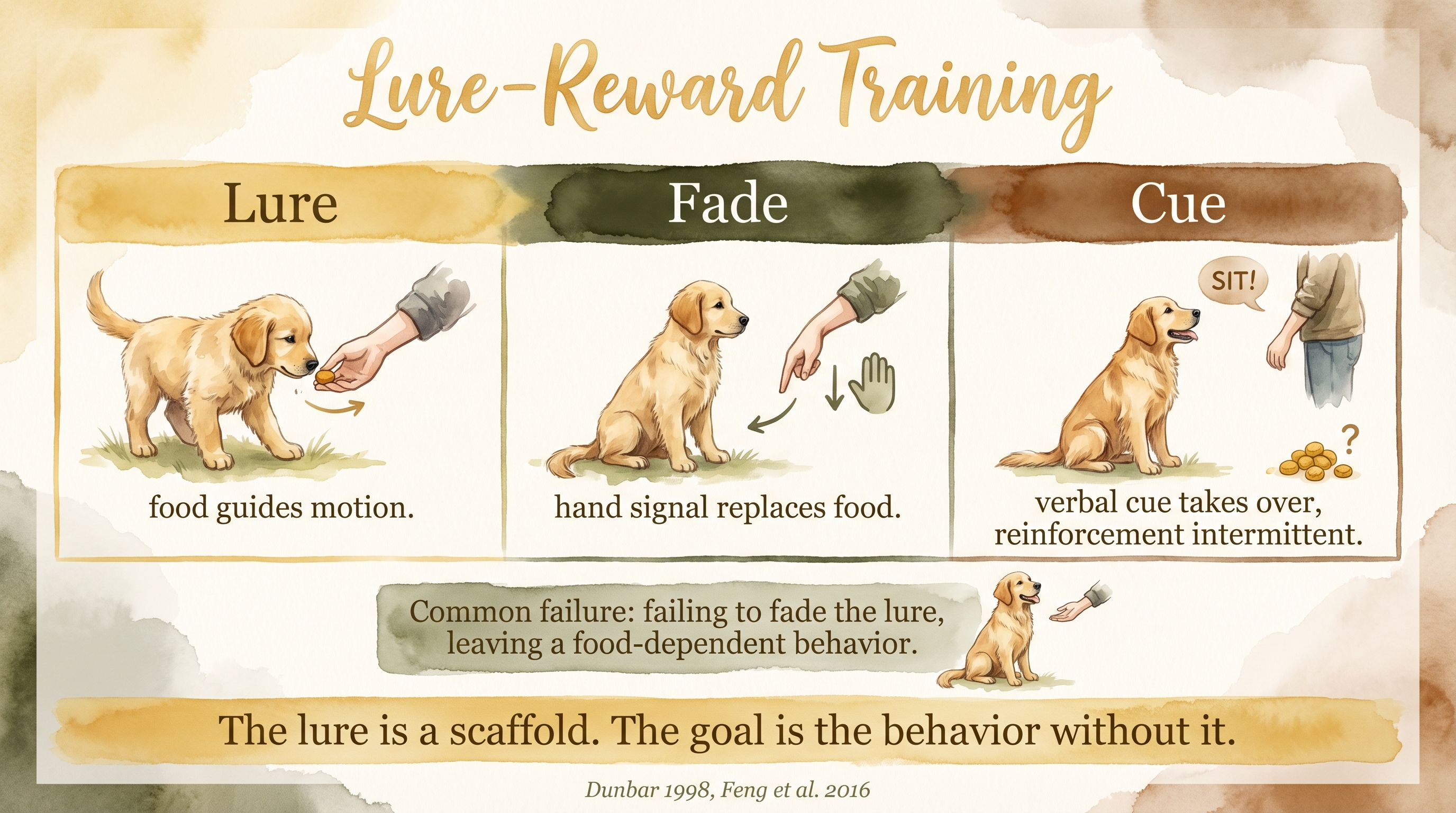
The lure is a scaffold - the goal is the behavior without it.
Key Takeaways
- Lure-and-reward is popular because it creates quick visible success for both dogs and novice owners.
- Its most common problem is not use but overuse, especially when the visible food is never faded.
- A dog following a lure is not automatically a dog who understands the cue in a durable way.
- JB accepts luring as a temporary teaching tool and rejects the idea that it can replace calm, structured raising.
The Evidence
- companion dogs
Supports the broader point that reward-based acquisition methods are effective for teaching discrete behaviors with lower welfare cost than aversive-heavy alternatives. - companion dogs
Documents the real-world compliance and transfer problems that explain why first-stage class success often does not become durable household performance. - Ian Dunbar-era puppy-class lineage as reflected in the source layercompanion dogs
Explains why family-facing puppy programs normalized fast, accessible teaching procedures for novice owners. - Fugazza & Miklosi (2015)companion dogs
Provides a comparison point showing that some socially learned behaviors may generalize more broadly than behaviors acquired through operant construction alone.
- domestic dogs
No published long-term study directly compares lure and reward training against structured relational raising and no-intervention controls across ordinary companion-dog homes.
SCR References
Sources
- Pryor, K. (1984). Don't Shoot the Dog!
- Fugazza, C., & Miklosi, A. (2015). Applied Animal Behaviour Science.