Jean Donaldson and The Culture Clash
Compound evidence detail2 SCRs / 4 parts
- Documentedthe wolf-side scientific record on the dominance model - Schenkel 1947 captive-pack methodology limitations, Mech 1999 wild-pack family-unit field data, and the AVSAB 2008 position statement against dominance-based training
- Heuristicthe JB application transferring the wolf family-unit framing to the dog-human relational architecture, an interpretive bridge that Mech's wolf data does not directly test in training contexts
- Documentedthe documented absence of any RCT establishing single-method superiority across canine behavioral domains, paired with the on-record organizational position statements (AVSAB 2008 and 2021, APDT 2020 and 2023, CCPDT 2025, IACP 2025, plus Ziv 2017 and Todd 2018 reviews) which constitute institutional policy rather than scientific consensus
- Heuristicthe JB characterization of professional ideological fragmentation across force-free, balanced, and compulsion approaches, carrying the load-bearing firewall that absence of method-superiority RCT does not equalize methods on welfare grounds where SCR-026, SCR-028, and SCR-036 document harm from aversive methods independently of the outcome comparison gap
Jean Donaldson became one of the defining intellectual voices of the positive reinforcement era because she did more than promote rewards. She changed the way trainers and owners were taught to think about dogs. Her 1996 book The Culture Clash argued that many owner errors begin when people read canine behavior through a human moral lens instead of through learning, motivation, ethology, and reinforcement history. In the 1990s, that was a major intervention. The public conversation still carried heavy residues of dominance folklore, sentimental anthropomorphism, and mid-century obedience culture. Donaldson gave the newer movement a sharper vocabulary and a more confrontational intellectual style. Documented
The institutional side mattered too. The Academy for Dog Trainers traces its origin to 1999, first as a residential program at the San Francisco SPCA and later as the independent Academy for Dog Trainers. That school became one of the clearest pipelines for positive reinforcement trainers in North America and helped transmit Donaldson's way of framing dogs, owners, methodology, and evidence into the profession itself. The Academy's own history presents the school as a deliberate answer to the need for more comprehensive trainer education, not simply another short course or club membership. That matters historically because it shows how the positive revolution moved from books into professional formation. Documented
From a JB perspective, Donaldson deserves careful historical credit. Her critique of popular dominance theory was timely and often well founded. Her insistence that dogs are not tiny, furry people corrected real sentimental confusion. At the same time, her operant-first framing remained a framing inside the training paradigm. It improved the field's explanatory language without fully leaving the command-and-intervention mindset behind. That second claim is interpretive, so it should be read as JB's lens rather than as settled historical consensus. Heuristic
What It Means
The Book That Reset the Tone
When The Culture Clash appeared in 1996, it arrived at exactly the moment when companion-dog culture was ready for a different argument. Karen Pryor had already made operant language accessible to the public, and Ian Dunbar had already shifted attention toward puppyhood and prevention. Donaldson's contribution was different. She gave the movement a disciplined polemic. She argued that owners routinely misread dog behavior because they projected human ideas of guilt, fairness, revenge, stubbornness, and status politics onto an animal working from much simpler motivational and learning processes. Documented
That mattered because older mass-market dog writing often drifted between two bad models. One model treated dogs as challengers in a rank contest who needed to be dominated. The other treated them as child substitutes who were somehow choosing misbehavior for emotional or moral reasons. Donaldson attacked both. In practice, she told readers to stop telling fairy tales about what the dog "meant" and start looking at antecedents, consequences, reinforcement history, competing motivations, and management.
The Academy as Infrastructure
The 1999 founding of the Academy for Dog Trainers turned Donaldson from author into institution builder. The Academy's own history states that it began at the San Francisco SPCA, gained a national reputation quickly, and later evolved into an independent program with video coaching and continually updated curriculum. That path matters for industry history because it shows how a method stops being just a set of ideas and becomes a professional lineage. Trainers were not only reading Donaldson. They were being formed by a school built around her assumptions about behavior, training mechanics, and intellectual standards.
That school also sat inside a broader late-1990s and early-2000s realignment. The APDT had been founded in 1993. Karen Pryor's work had normalized marker training. Veterinary behavior and welfare research were becoming more visible. Documented Donaldson's Academy gave the positive movement something it badly needed, a place where trainers could be socialized into a coherent way of reasoning. Historically, that is a large part of why her influence outlasted any single book title.
The Anti-Dominance Intervention
Donaldson is inseparable from the collapse of dominance theory in mainstream pet-dog education. The source layer places her alongside the broader correction led by Bradshaw, Casey, Blackwell, and Mech's own public retreat from the alpha model. Popular dominance language had already overreached by treating dogs as if they were captive wolves locked in rank warfare with their owners. Documented Donaldson pushed hard against that folk science and helped move a generation of trainers toward operant explanations instead.
Her correction was influential because it was usable. Owners could replace fuzzy talk about defiance with concrete questions. What is reinforcing the behavior? What skill has not been taught? What antecedent arrangement keeps the dog under threshold? What management prevents rehearsal? Those are operational questions, and they gave the profession a cleaner grammar.
What Her Framework Did Not Fully Solve
The honest reading cannot stop at praise. Donaldson's framework also helped cement an operant-centered intellectual style that often treated explanation as if it were complete once behavior had been mapped onto contingencies. Observed-JB JB reads that as an advance and a narrowing at the same time. It was an advance because it displaced sentimentality and bad wolf mythology. It was a narrowing because it still tended to foreground method over maturation, intervention over ordinary social apprenticeship, and training mechanics over the total developmental climate of the dog's life.
That limitation matters most in family-dog contexts. A trainer can explain jumping, barking, resource guarding, or leash reactivity in operant terms and still leave underdescribed the calm adult modeling, emotional regulation, routine, social scaffolding, and prevention architecture that make many of those problems less likely to take root in the first place. JB does not deny the value of Donaldson's framework. JB says it solved one layer of the problem, then too often got treated as the whole map.
Donaldson helped strip away human sentimental stories and replaced them with cleaner observational language. JB shares that respect for precision, while adding that social mammals also learn through relationship, modeling, and developmental climate, not only through contingency management.
Why It Matters for Your Dog
For a Golden Retriever family, Donaldson's historical role matters because Goldens may be the breed most vulnerable to sentimental misreading. Their softness, sociability, expressiveness, and eagerness to stay near people invite projection. A family sees the puppy steal a sock and assumes the dog is being cheeky. A young dog guards a chew and the family calls it domination. A six month old barrels through guests and everyone says he is "just excited because he loves people." Donaldson's work helps puncture that haze.
That is useful because many family mistakes begin with a wrong story. If a Golden puppy is mouthing hands, surfing counters, rehearsing frantic greetings, or melting down when left alone, the family often reaches for a moral explanation first. The puppy is testing us. He knows better. He feels guilty. He is jealous of the baby. Donaldson's contribution was to push owners away from those emotional narratives and toward clearer functional questions. What behavior has the environment been rewarding? What pattern keeps getting rehearsed? What skill has never been taught? What management hole keeps inviting failure?
Those questions can immediately improve daily life. A family that stops calling counter surfing "stubbornness" is more likely to manage food access. A family that stops calling resource guarding "status" is more likely to take prevention and trade protocols seriously. A family that stops treating overarousal as cute personality is more likely to protect the calm floor before adolescence turns the habit into household chaos.
That said, this history matters just as much because Donaldson's framework can be overapplied in modern family life. Goldens do not live in diagrams. They live in kitchens, living rooms, yards, carpools, school pickups, and weekends full of stimulation. A family can become mechanically skilled, even admirable, and still miss the developmental whole. The dog earns food for sits, nails cues in class, and still lacks a quiet sense of household place because nobody is mentoring the emotional texture of ordinary life.
A familiar Golden example makes the limit clear. Imagine a young retriever who performs beautifully on cue in structured sessions yet becomes rowdy every evening when the children get louder, visitors arrive, and movement in the house accelerates. Donaldson's framework helps the family map triggers, identify reinforcement history, and train alternative responses. All of that is good. But if the family's ordinary rhythm remains busy, permissive, noisy, and inconsistent, the dog is still living inside an environment that breeds overarousal faster than any short training session can calm it.
This is where JB's reading becomes practical. Donaldson helps families remove false stories. JB then asks what fills the space that is left. The answer is not vague affection. It is mentorship, calm routines, structured transitions, non-initiation of bad habits, and precise communication that does not flood the dog with chatter. A Golden who is constantly praised, constantly amped up, and constantly invited into chaotic emotional traffic may look loved and still be under-raised.
So the family-level takeaway is twofold. First, use Donaldson's clarity. Stop moralizing ordinary dog behavior. Stop treating impulse problems as character flaws or status contests. Second, do not assume that a cleaner operant explanation by itself creates a mature dog. A Golden Retriever still needs a household culture worth growing up inside.
This distinction matters during the breeder-to-home transition too. If a puppy leaves a calm, structured raising environment and enters a home where every behavior is analyzed only through reward mechanics, the family may preserve the training language and still lose the developmental pattern. Documented Goldens often hide that gap for a while because they remain socially willing. The cost appears later, usually as excitability, dependency, or chronic social juvenility. Donaldson helps prevent one class of mistakes. JB asks the family to prevent the next class as well.
It matters in small domestic moments as well. Goldens are often given extra indulgence because their social nature reads as sweetness. Laundry stealing becomes comedy. Demand barking becomes personality. Restlessness becomes "he just loves us so much." Donaldson helps strip away those sentimental stories. JB then asks what the household is doing once the story is gone. If the answer is still a busy, indulgent, overstimulating environment, the family has improved its interpretation without yet improving the life that interpretation is supposed to serve.
That is especially useful for Goldens because their sweetness makes projection feel harmless. Donaldson helps remove the fantasy. JB then insists that the family replace fantasy with a whole social structure worth growing up inside, not merely with cleaner terminology.
What This Means for a JB Family
For a JB family, Jean Donaldson is best read as an ally at one historical level and an incomplete guide at another. She is an ally because she trained owners to look at dogs more honestly. She reduced the industry's dependence on bad folk psychology and pushed families to describe what is actually happening instead of what they imagine the dog secretly intends. That intellectual hygiene is valuable. It keeps the family from building a whole raising plan on superstition, resentment, or wounded ego.
Where JB parts company is not in the demand for clarity. It is in the level at which clarity is located. Donaldson often directs the eye toward behavior mechanics and training process. Observed-JB JB wants the family to zoom one layer wider and ask what kind of social world is shaping this puppy every hour. Is calmness being built as a baseline? Is the dog learning from composed adults, canine and human? Are the household's signals rare and meaningful, or constant and diluted? Is prevention upstream enough that the family is not repeatedly rehearsing the same behavior they later hope to fix?
That difference changes how a family uses the good parts of Donaldson. If the puppy steals laundry, JB does not replace one fantasy with another. The family still uses management and clear teaching. But the family also asks why the puppy is moving through the house with that much impulsive freedom, what routines need tightening, and whether the home has been organized around amusement rather than mentorship. If the puppy grows possessive around food, JB does not default to rank stories. It also does not stop at an exchange protocol. It asks what broader atmosphere of regulation, trust, and guidance the dog is living inside every day.
The same is true for communication. Donaldson's rejection of sentimental noise fits well with JB's Signal Precision position. Goldens do not need endless praise for existing. They need clean information. Yet JB also says that clean information works best when it comes from a human who is acting like a parent, not a vending machine and not a debating partner.
So the practical JB takeaway is simple. Keep Donaldson's honesty. Lose the sentimental fictions, the guilt stories, and the dominance theater. Then continue farther than her framework usually goes. Raise the Golden in a calm, structured, mentored life so that fewer behaviors need to be interpreted and managed after the fact. That is the point where training history becomes raising wisdom.
That widening move is the JB use of Donaldson.
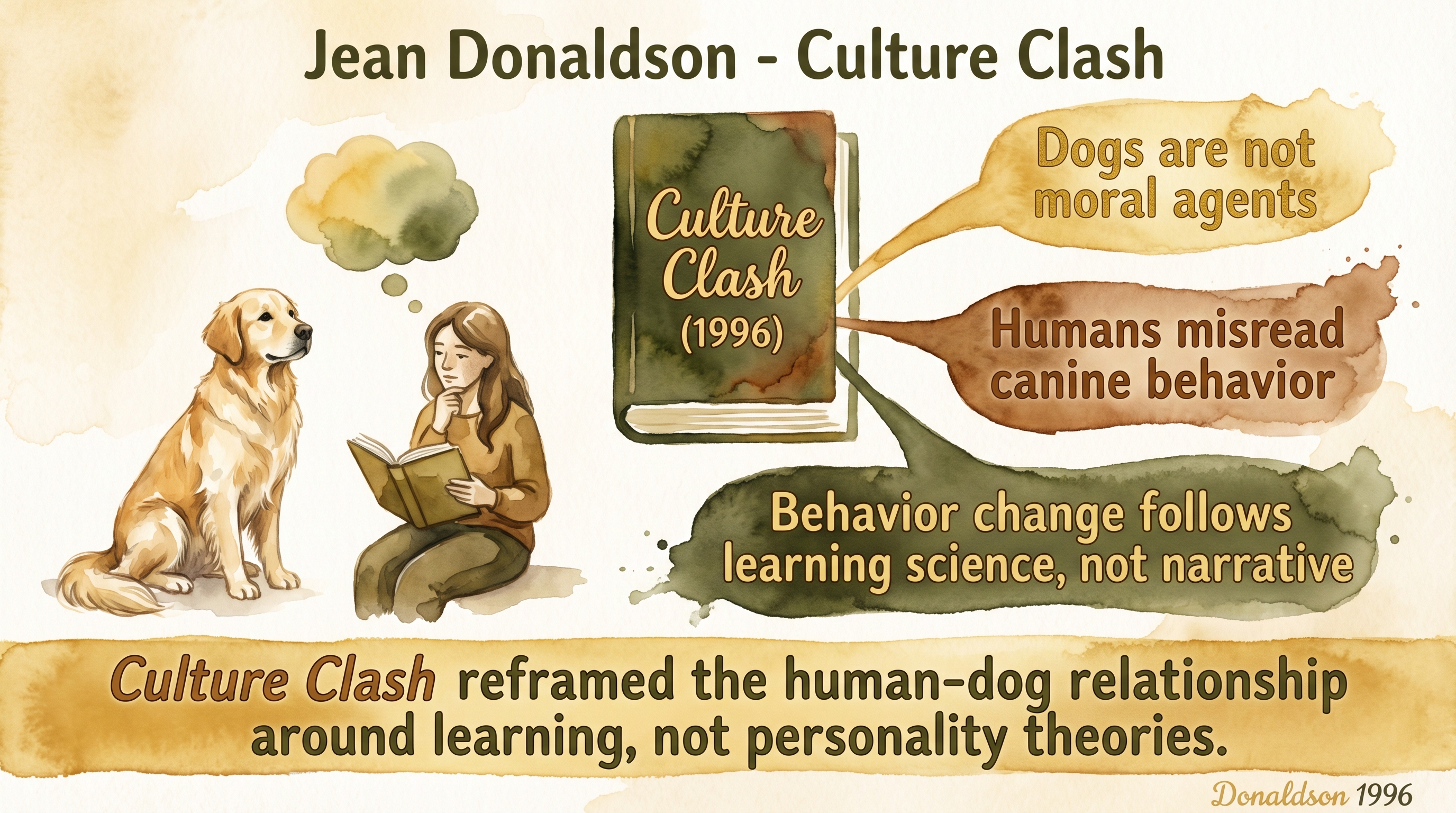
Culture Clash reframed the human-dog relationship around learning, not personality.
Key Takeaways
- Jean Donaldson helped give the positive reinforcement era its sharpest anti-anthropomorphic and anti-dominance vocabulary.
- The Culture Clash and the Academy for Dog Trainers shaped both public owner education and trainer formation.
- Her framework improved clarity about behavior without fully escaping the training paradigm's focus on method and intervention.
- JB families can keep Donaldson's observational honesty while adding the wider raising lens of calmness, mentorship, and prevention.
The Evidence
This entry uses observed claim-level tags beyond the dedicated EvidenceBlocks below. These tags mark JB program observation or practice-derived claims that need dedicated EvidenceBlock coverage in a later content pass.
This entry uses heuristic claim-level tags beyond the dedicated EvidenceBlocks below. These tags mark JB interpretive application rather than direct study findings.
- dog training profession
Places Donaldson among the central figures who translated operant conditioning into mainstream companion-dog culture and helped displace popular dominance theory. - domestic dogs and training profession
Locates Donaldson inside the larger positive reinforcement shift that linked welfare concerns, reward-based methods, and professional identity. - Academy for Dog Trainers official historydog training profession
Documents the Academy's formation by Jean Donaldson in 1999 and its roots at the San Francisco SPCA. - Bradshaw, Blackwell, Casey, and Mech correction literaturewolves and domestic dogs
Supports the historical collapse of popular dominance theory that Donaldson helped translate into owner-facing education.
- domestic dogs
No published study directly isolates the long-term dog-level and family-level effects of jean donaldson and the culture clash across ordinary companion-dog contexts.
SCR References
Sources
- Academy for Dog Trainers. About the Academy for Dog Trainers.
- Academy for Dog Trainers. Books & Publications.
- Bradshaw, J. W. S., Blackwell, E. J., & Casey, R. A. (2009). Journal of Veterinary Behavior.
- Mech, L. D. (1999). Canadian Journal of Zoology.