Karen Pryor and the Clicker Training Revolution
Karen Pryor is the person most responsible for making marker based positive reinforcement feel normal to ordinary dog owners. Before her influence spread, consequence based learning already existed in laboratories and in specialized training circles. After her influence spread, people who had never heard of Skinner were talking about shaping, timing, bridges, reinforcement, and why punishment often backfires. That is why Pryor belongs near the center of any honest history of the industry. Documented
Her importance does not begin with dogs. The source notes place Pryor at Sea Life Park in Hawaii from 1963 to 1972, training dolphins and other marine mammals in a context where physical compulsion was not available as a practical option. Estimated That constraint matters. The trainer could not drag a dolphin into position with a leash and collar. Precision timing, secondary reinforcers, and voluntary repetition became central because they had to.
Pryor then translated that world into public language. Don't Shoot the Dog! appeared in 1984, not as a dog-only manual, but as a broad popular explanation of operant principles. In the 1990s, practitioner networks, seminar tours, and Karen Pryor Clicker Training helped move the clicker into mainstream dog culture. What followed was not just a new tool. It was a new sensibility: training as communication, feedback, and skillful arrangement rather than as coercive control.
From the JB perspective, Pryor represents a genuine welfare advance and also a meaningful limit. Clicker training is real, effective in many contexts, and historically important. It is not identical to natural canine development, and it should not be confused with a full raising philosophy. That stronger caution belongs in the heuristic layer and should stay there.
Pryor also changed the emotional tone of serious dog advice. She demonstrated that rigor did not have to sound punitive. For families used to older obedience culture, that shift mattered almost as much as the clicker itself.
What It Means
Karen Pryor matters because she changed both technique and tone.
Marine Mammal Origins
At Sea Life Park, Pryor worked with animals that could not be physically managed the way land-based domestic animals often had been. Dolphins move at distance, in water, and outside the reach of ordinary compulsion tools. That pushed training toward conditioned reinforcers, accurate timing, shaping by successive approximation, and a practical respect for what the animal can choose.
This context is historically important because it explains why clicker culture entered dog training with such moral force. It looked like proof that complex behavior could be built without the correction heavy logic that dominated earlier civilian dog culture.
The Book That Changed the Conversation
Don't Shoot the Dog! in 1984 was the cultural turning point. The source notes are careful here. The book is a popular synthesis, not a peer reviewed dog training experiment. Its importance is philosophical and educational, not that it presented new canine trial data. Still, that distinction does not reduce its historical weight. A public that could understand positive reinforcement, punishment side effects, shaping, extinction, and bridging stimulus mechanics was a public newly prepared to question Koehler style assumptions.
The book also changed who felt entitled to talk about training. Trainers no longer needed to sound like drill instructors. They could sound like teachers of timing, mechanics, and behavior design. Documented
The Clicker as a Tool
The clicker itself is usually described as a conditioned secondary reinforcer or bridging stimulus. In plain language, it is a distinct signal paired with reinforcement closely enough and often enough that it gains value and informational clarity. Pryor's argument for it was practical. Human voice is emotionally noisy, inconsistent, and overused. A click is brief, novel, clean, and easier to time precisely.
That practical case remains strong. There really are tasks where a fast, distinct marker helps the dog understand which split second mattered. Detection work, shaping chains, and some complex physical tasks are obvious candidates.
What the Canine Evidence Shows
The source layer is notably disciplined here. Chiandetti and colleagues in 2016 found no significant difference in learning speed between clicker plus food, verbal marker plus food, and food alone for a simple task. Estimated Feng, Howell, and Bennett in 2016 found that the clicker's function may be informational more than magically reinforcing. Thorn and colleagues' shelter dog work also failed to show a consistent acquisition speed advantage. Pfaller-Sadovsky and colleagues in 2020, in a systematic review and meta-analysis, found conditioned reinforcers generally facilitated learning, but the evidence base was heterogeneous and limited in quality.
So the careful historical conclusion is not "clickers were oversold and do not work." It is that clickers became culturally huge before canine research showed broad superiority across ordinary tasks. In dogs, the best supported claim is task specific usefulness, not universal superiority.
Pryor's Legacy
Pryor changed the industry even where the strict evidence remained narrower than the marketing. She reframed training as a timing problem and a human skill problem. She pushed trainers to think about what they were actually reinforcing instead of assuming the dog would simply yield to authority. She also set the stage for credentialed positive reinforcement culture through the later Karen Pryor Academy.
That is why she deserves a balanced reading. The legacy is substantial and real. The mythology around the clicker sometimes ran ahead of the evidence. Both statements can be true at once.
That same elegance, however, is part of why people can overread the system. The mechanical clarity is so satisfying that owners may begin assuming that enough well-marked repetitions can compensate for a disorderly home life. JB values the precision and rejects the overreach.
Pryor's strongest enduring contribution may be signal discipline itself. She forced trainers to care about timing. JB agrees that timing matters, while also insisting that precise timing alone does not amount to a developmental philosophy.
Why It Matters for Your Dog
For a Golden Retriever family, Karen Pryor matters because clicker culture still shapes what many people expect training to feel like. Families hear that training should be upbeat, clear, reward driven, and mechanically precise. Much of that inheritance is good. It moved the field away from casual harshness and toward more thoughtful handling.
At the same time, the family can get misled if it treats marker work as the whole answer to puppy development. A clicker can tell a puppy exactly when it sat, touched a hand, went to a mat, or held position for a moment. It cannot by itself provide calmness, social maturity, household rhythm, or the breeder to family continuity that JB calls a soft landing.
This becomes obvious in ordinary life. Imagine a Golden puppy who performs beautifully in a short clicker session for hand targets, stationing, and loose leash starts, then becomes wild when visitors arrive and dissolves into overarousal at the evening family rush. That does not mean the clicker failed. It means the family trained a skill and still has a whole puppy to raise.
The distinction matters because families often judge themselves too harshly here. They see that the puppy can learn discrete behaviors and assume broader household instability means they are applying the method badly. Sometimes that is true. Often the deeper issue is that the household is asking a technique to substitute for environmental organization, emotional pacing, and adult example.
Clicker culture can also subtly flatten the meaning of communication. If the family begins to think every useful exchange with the dog must be captured, marked, and reinforced, it may miss other channels that are fully real for dogs: following movement, observing routine, reading posture, settling into repetition, and orienting to social tone. Goldens are especially sensitive to those broader channels because they are cooperative dogs who watch people closely.
So this entry matters for your dog because it helps families keep a valuable tool in proportion. Use the clicker when it makes learning cleaner. Do not mistake a clean tool for the entire architecture of a well-raised dog.
A family-level limit appears when the clicker becomes the center of gravity instead of an aid. Goldens are often so eager and food-responsive that owners can get a flattering picture of progress in sessions while missing the dog's daily emotional habits. A marker can sharpen communication beautifully. It cannot by itself create a calm household, mature greetings, or a lower-arousal way of living.
The family-level limitation is easiest to see in highly social dogs like Goldens. A retriever can become brilliantly responsive to a marker and still be hard to live with when the house is busy. The owner feels skilled because the session looks good, and in one sense the owner is skilled. But the dog's off-duty life may still be teaching impatience, demand behavior, frantic greetings, and dependence on constant interaction. The clicker does not create those problems, and it does not automatically solve them either.
This is also where praise clutter becomes relevant. Pryor helped people understand the value of a novel, precise marker because ordinary human speech is noisy. JB agrees with that insight. Yet if the family keeps the clicker precise while flooding the rest of the dog's day with chatter, the larger communication problem remains. Goldens especially can become saturated with human language and human excitement. The marker sharpens one channel. The home still has to stop drowning the others.
A Golden family can therefore appreciate the marker without centering the whole relationship on it. The clicker is excellent at clarifying brief moments. The rest of the day still depends on the adults' steadiness, not on a sound.
Another practical benefit is that Pryor's legacy can teach owners to become less noisy. Once families learn how much cleaner one precise marker is than a flood of repeated praise, they often begin communicating better in general. That is one of the quieter ways her influence can improve household life beyond formal training sessions.
It also helps families remember that precision is not the opposite of warmth. Pryor's legacy showed owners they could be technically clear without becoming hard. Documented JB keeps that gain and then asks the family to extend the same clarity into routines, boundaries, and the emotional climate of the home.
That is one reason Pryor's history still helps modern homes. It teaches precision without demanding hardness, and that combination remains rare and useful.
It also reminds the family that calmness cannot be clicked into existence if the home keeps rehearsing chaos. The marker can clarify moments. It cannot substitute for a whole social atmosphere.
What This Means for a JB Family
For a JB family, Karen Pryor's legacy is something to keep, refine, and place. Keep the respect for timing. Keep the refusal to normalize harshness. Keep the understanding that humans often create confusion by being late, inconsistent, and noisy. Those were genuine improvements.
Place the tool, however, inside a larger raising model. A clicker can help teach a recall game or a station behavior. Documented It cannot replace calm house entry, steady meal routines, supervised freedom, intentional rest, or adult mentorship. Those broader pieces are what let the dog use any learned skill in a meaningful life.
This is also where JB parts company with the stronger operant worldview. If the puppy becomes too much of a project, the human can start living in a constant loop of watch, mark, reward, reset. That can sharpen mechanics while thinning relationship. JB wants the family to remain legible as calm adults, not only as reinforcement technicians.
So the practical takeaway is simple. Use marker training as a sharp instrument, not as your whole religion. A Golden Retriever puppy needs good information. It also needs a good world.
For a JB family, that means keeping the craft and resisting the totalization. Marker training can serve the relationship extremely well when it is one tool inside a larger developmental plan. It becomes less helpful when the family starts expecting session skill to stand in for social maturity.
For a JB family, Pryor's work is at its best when it restores precision without shrinking the relationship. Use the marker for clear teaching. Then let the rest of the home life be governed by calmness, boundaries, and mentorship rather than by the expectation that every meaningful moment must become a mini training session.
That is how JB keeps the welfare and craft gains of clicker training without turning the whole raising project into a string of technically elegant transactions.
JB families can take that improvement and continue farther. Use the tool to make teaching cleaner, then let the dog's larger education happen through calm routines, quiet leadership, and life that does not need constant marking to stay coherent.
The tool is small, and the household still does the larger work. The marker can sharpen teaching, but the family still has to shape the life around the dog. That larger education is where the dog's maturity is either protected or lost. Keeping that distinction in view is what keeps the clicker useful, humane, and properly sized inside the larger work of raising. That scale is worth protecting, clearly.
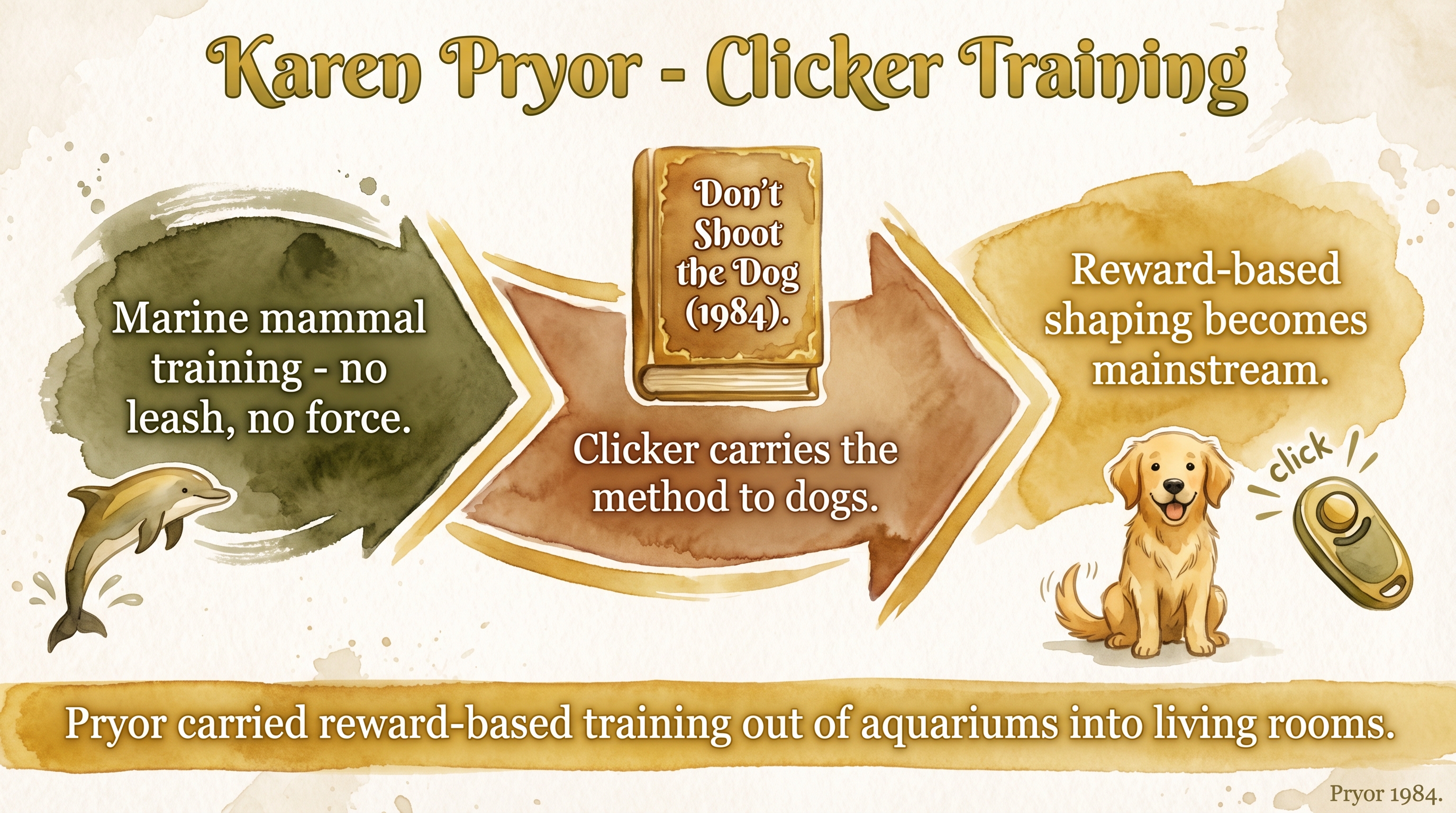
Pryor carried reward-based training out of aquariums into living rooms.
Key Takeaways
- Karen Pryor helped make positive reinforcement and marker precision mainstream in dog culture.
- The clicker is a legitimate tool, especially for timing sensitive tasks, but canine studies do not show universal superiority across ordinary behaviors.
- Pryor's real historical contribution was as much philosophical as technical: she changed the tone of training.
- JB keeps the lessons about clarity and timing while refusing to confuse marker work with the whole task of raising a puppy.
The Evidence
This entry uses estimated claim-level tags beyond the dedicated EvidenceBlocks below. These tags mark approximate ranges or timing claims that should remain bounded by the cited sources.
- Pryor's Sea Life Park work and *Don't Shoot the Dog!* (1984)marine mammals and multiple species
Provide the historical bridge through which marker based reinforcement moved into mainstream public awareness. - Chiandetti et al. (2016) and Feng et al. (2016)domestic dogs
Show that clickers do not consistently outperform food alone or verbal markers for simple acquisition tasks. - Pfaller-Sadovsky et al. (2020)dogs and horses
Found that conditioned reinforcers can facilitate learning while also noting heterogeneous methods and limited evidence quality. - SCR-004 boundary claimdomestic dogs
Supports the JB caution that engineered operant marker systems should not be casually described as natural canine development.
- domestic dogs
No published long-term study directly compares karen pryor and the clicker training revolution against structured relational raising and no-intervention controls across ordinary companion-dog homes.
SCR References
Sources
- Chiandetti, C., Avella, S., Fongaro, E., & Cerri, F. (2016). Can clicker training facilitate conditioning in dogs? Applied Animal Behaviour Science, 184, 109-116.
- Feng, L. C., Howell, T. J., & Bennett, P. C. (2016). How clicker training works: Comparing reinforcing, marking, and bridging hypotheses. Applied Animal Behaviour Science, 181, 34-40.
- Pfaller-Sadovsky, N., Hurtado-Parrado, C., Cardillo, D., Medina, L. G., & Friedman, S. G. (2020). What's in a click? The efficacy of conditioned reinforcement in applied animal training. Animals, 10(10), 1757.
- Karen Pryor's Sea Life Park marine-mammal operant work and Don't Shoot the Dog (1984, 1999 ed.). The book is a primary-source anchor. The historical transfer from marine-mammal operant to dog clicker training is biographical and organizational-history attribution; for empirical clicker effectiveness see Chiandetti 2016, Feng 2016, and Pfaller-Sadovsky 2020 cited separately on this entry.