Ian Dunbar and the Rise of Puppy Classes
Ian Dunbar changed dog culture by moving the center of gravity backward in time. Instead of asking what to do with the adolescent or adult dog who already had a problem, he asked what should happen during the puppy's earliest weeks so fewer problems formed in the first place. That move sounds obvious now only because he made it obvious. In historical terms, it was a major shift. Documented
Dunbar's credentials mattered to that shift. The source notes describe him as a veterinarian from the Royal Veterinary College with a PhD in animal behavior from UC Berkeley, and they credit him with founding SIRIUS Puppy Training in Berkeley in 1982 as the first off leash puppy class. Documented He later founded the Association of Professional Dog Trainers in 1993. Those biographical facts mattered because they let him argue not merely as a trainer, but as a veterinarian and behaviorist speaking about developmental timing.
His central claim was simple and powerful. If the primary socialization window sits roughly in the 3-14 week period, then waiting until six months for formal training means arriving after much of the most plastic period has already passed. Estimated That insight reorganized what owners, trainers, and veterinarians thought puppyhood was for.
JB reads Dunbar as both an ally and a point of departure. He was right that prevention matters and that many later problems are easier not to build than to extinguish. But his prevention logic remains inside a training and exposure framework, while JB's Prevention pillar is also about non-initiation, arousal management, and household structure. That comparison is interpretive and must be stated as such.
That timing shift was not a small curricular tweak. It changed what owners, veterinarians, and trainers were supposed to notice during the earliest months of life. Once Dunbar reframed puppyhood as the primary window rather than as a waiting period, early guidance stopped looking optional and started looking urgent.
What It Means
Ian Dunbar matters because he changed the timeline, the target, and the public vocabulary.
The Timeline Shift
For older training culture, serious work often started at six months or later, once the dog was old enough to attend more formal classes. Dunbar challenged that default by pointing to the socialization period documented by Scott and Fuller in 1965 and foreshadowed by Freedman, King, and Elliot in 1961. If the dog is especially open to forming social bonds and responses to novelty in the first months of life, then the industry was waiting too long.
That argument was not a minor scheduling tweak. It redefined puppyhood from a holding period before training to the most important phase of the whole process.
SIRIUS and the Off Leash Puppy Class
The founding of SIRIUS in 1982 is historically important because it operationalized the idea. Dunbar did not only publish about timing. He created a format in which puppies could meet people, dogs, surfaces, sounds, and handlers early. The class itself became a social technology: part education, part exposure, part early manners, part family coaching.
That helped puppy class become a normal expectation in companion dog culture. What had once looked radical, bringing young puppies into organized classes, became mainstream advice.
The Scientific Case for Early Socialization
The source layer is strong here. Scott and Fuller identified the sensitive period for socialization in controlled developmental work. Freedman and colleagues showed that puppies isolated from human contact until 14 weeks struggled to form normal social bonds. Documented Appleby, Bradshaw, and Casey in 2002 linked limited early experience to later avoidance and aggression in retrospective data. Howell, King, and Bennett in 2015 reviewed the evidence and concluded that earlier controlled socialization is generally associated with better adult outcomes, though the literature remains methodologically uneven.
AVSAB's position statement later gave professional momentum to the same general view by arguing that controlled early classes after initial vaccination provide more behavioral benefit than infectious disease risk in well run settings. Documented
Prevention, but in a Particular Sense
Dunbar's prevention model focused on exposure, socialization, bite inhibition, and getting ahead of future fear or aggression. That is why he belongs in this category. He helped move dog culture from reactive correction toward upstream thinking.
At the same time, the source notes are careful about the distinction with JB. Dunbar's prevention is largely "prevent fear and future problems by using the sensitive period well." JB's prevention includes that logic, but it also asks a different question: what behaviors should never be initiated in the first place because rehearsal itself builds circuitry? These are allied ideas, not identical ones.
Professional Legacy
Dunbar's influence extends beyond puppy classes. Founding the APDT in 1993 helped professionalize a new style of trainer who saw early intervention, reward based methods, and education for owners as central. In that sense, Dunbar helped build not only a method cluster but a profession with a different self image from the Koehler era.
The institutional side mattered too. SIRIUS in 1982 and the APDT in 1993 gave the early-puppy message somewhere to live professionally. Documented Dunbar's influence was therefore not just the slogan of socialization. It was the creation of a culture in which owners were expected to do serious developmental work before adolescence, not after it.
There was also a social effect. Once Dunbar's message spread, puppyhood stopped being a period families merely endured. It became a stage at which owners were expected to teach, expose, manage, and prevent. That expectation changed veterinary conversations, breeder recommendations, and the whole emotional posture of early dog ownership. Families were no longer told to wait for the dog to become trainable. They were told that the early months were already shaping the adult.
Dunbar belongs in JB history because he saw the timing problem clearly. He understood that once a pattern is built, later repair is harder. JB keeps that timing insight and pushes it further into the ordinary architecture of home life.
Why It Matters for Your Dog
This history matters for a Golden Retriever family because it explains why puppyhood cannot be treated as a neutral waiting room. The first months are not empty time before the real work starts. They are the real work.
Families often underestimate how quickly a puppy builds expectations about the world. What people feel like, what dogs feel like, what doors mean, what strangers mean, what novelty means, what handling means, what being left alone means, and what excitement level counts as normal all start taking shape early. Dunbar's lasting contribution was to make that visible to ordinary families.
That is deeply relevant to Goldens because they are social, people oriented, and likely to encounter heavy emotional loading in family homes. A Golden puppy that is passed around frantically, overexposed without structure, or alternately indulged and overwhelmed can end up carrying the label "friendly" while actually becoming brittle, overexcited, and hard to settle. Early socialization by itself is not enough if it is unstructured. But absence of early thoughtful exposure can leave avoidable fear and confusion in its place.
This is one area where modern families can make a mistake in both directions. Some hear "socialization window" and keep the puppy too isolated out of disease fear, even in circumstances where controlled exposure would be safe and beneficial. Others hear the same phrase and treat socialization as an exposure quota, dragging the puppy through endless novelty, puppy parties, store visits, and greetings without protecting the puppy's nervous system.
Dunbar's history helps the family see the good instinct underneath both mistakes. People correctly sense that early life matters. The challenge is learning what kind of early life helps. JB agrees that well run early socialization is valuable. It also insists that calmness, pacing, and non-initiation matter just as much as novelty count.
A family level example shows the distinction. Suppose an eleven week old Golden has been to a puppy class, met many people, and can perform a sit for food, but at home it still launches into frantic greeting behavior every time a family member reenters the room. Dunbar's framework correctly says the puppy benefits from early structured work. JB adds that the household itself must stop teaching reunion chaos. The class and the kitchen must speak the same language.
So this entry matters because it protects families from a narrow reading of puppyhood. Early intervention is right. Early intervention is also more than attendance. It is the total emotional and social shape of the puppy's world.
Goldens make this especially clear because they can look socially successful while still becoming harder to live with at home. A puppy may enjoy class, meet people happily, and move through socialization outings with apparent confidence, yet still grow increasingly wild at doorways or unable to settle after stimulation. Dunbar's history helps families start early. JB's addition is that they must also stay deep, treating the home itself as part of the developmental program rather than assuming the weekly class carries that whole burden.
That is why the history still matters for Goldens today. Families often assume that if they socialize widely enough, attend class early enough, and expose the puppy to enough stimuli, the developmental job is basically done. Goldens can make that false confidence easy because they are so outwardly social. Yet a puppy can be comfortable in class and still learn a home life full of overexcitement, weak transitions, and endless human stimulation. Dunbar helps families respect timing. JB helps them respect depth.
Another practical point is that early classes can sometimes teach owners the wrong lesson if they are read too narrowly. The family may begin to think the puppy's real life happens in class and the rest of the week is just downtime. For JB, the opposite is closer to the truth. Class is a supplement. The real raising program is what the puppy lives when nobody is handing out name tags and treat pouches.
Families can also misuse early socialization by turning it into nonstop novelty. Dunbar's history is often remembered as "start sooner," but JB families should also hear "shape the quality of the early world." A Golden puppy who is constantly stimulated without enough quiet structure may become socially experienced and still emotionally ragged.
For Goldens, that means using early class culture to support the home rather than to replace it. The puppy who learns to enjoy people still has to learn how not to lose its mind around them.
In other words, Dunbar helps families respect the calendar. JB then teaches them what to do with the days inside that calendar. Goldens benefit most when early exposure and early structure mature together.
What This Means for a JB Family
For a JB family, Ian Dunbar is one of the historical figures most worth taking seriously. He correctly saw that waiting too long wastes developmental opportunity. He correctly saw that many adult problems are puppyhood problems viewed late. He correctly gave families permission to care about prevention before pathology appears.
Where JB differs is in what fills that preventive window. A JB family does not count socialization only in outings, strangers, and class attendance. It also counts the home's emotional tempo, the steadiness of adult responses, the amount of overarousal rehearsal, the use of rest, and the way the puppy is introduced to ordinary life without drama.
This is what soft landing looks like in practice. The breeder starts the process. The family does not reset it to zero. Instead, the family continues structure, calm routines, measured exposure, and mentorship so the puppy experiences continuity rather than rupture.
The practical takeaway is that a Dunbar style early class can be a good tool for a JB family. It is just not the whole answer. The puppy does not need a stack of experiences alone. The puppy needs an organized world in which those experiences make sense.
That is why JB reads Dunbar as a valuable precursor, not a final map. He was right to move the conversation into the sensitive period. JB then widens the question from class timing to life architecture. Prevention is strongest when the puppy class, the breeder environment, and the family home all point in the same direction instead of operating as separate worlds.
For a JB family, Dunbar's legacy becomes strongest when it is paired with continuity. The breeder starts the puppy in calm structure, the family continues that structure, and the class supports both without replacing either one. That is a much more powerful use of early socialization than treating puppy class as a weekly antidote to an otherwise chaotic life.
That balance is where Dunbar's preventive instinct and JB's raising philosophy can actually meet. Start while the puppy is open, yes. Then protect calmness just as seriously as exposure so the early window builds steadiness rather than only stimulation tolerance.
That is a very practical inheritance for any Golden family to keep. That is why the family should read Dunbar as a timing teacher and then let JB finish the developmental picture. It is a modest but important historical lesson for families to keep, and it still deserves to be remembered accurately.
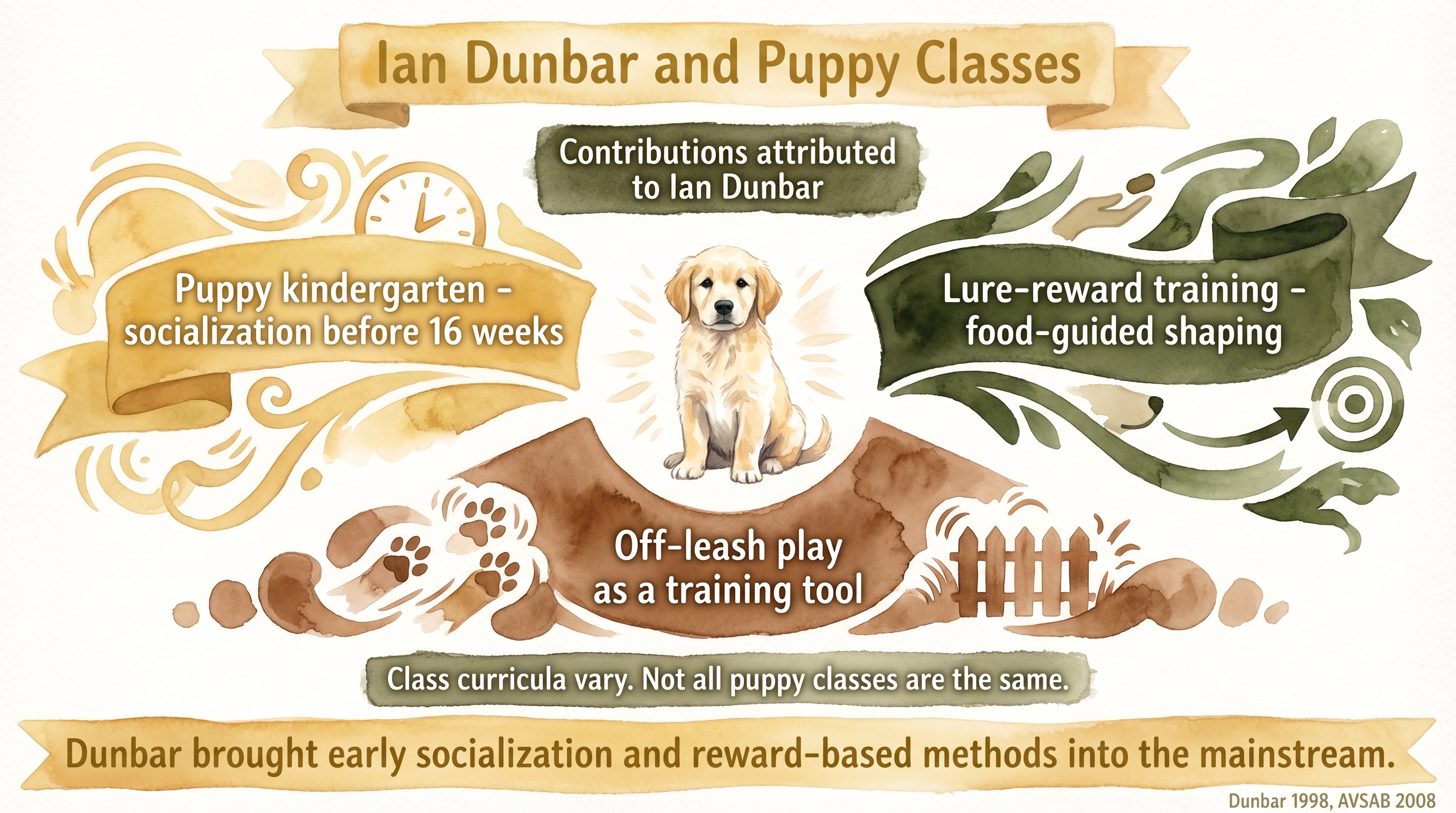
Dunbar brought early socialization and reward-based methods into the mainstream.
Key Takeaways
- Ian Dunbar changed modern dog culture by moving the focus from later correction to early prevention.
- His key insight was developmental timing: the puppy months matter more than older training culture had admitted.
- JB strongly overlaps with Dunbar on timing while differing on what prevention must include inside the home.
- A puppy class can be helpful, but it cannot substitute for a calm, structured family environment that continues the breeder's work.
The Evidence
This entry uses estimated claim-level tags beyond the dedicated EvidenceBlocks below. These tags mark approximate ranges or timing claims that should remain bounded by the cited sources.
- Dunbar's SIRIUS founding (1982) and APDT founding (1993)domestic dog profession
Mark the historical move that put early puppy classes and preventive thinking at the center of modern dog culture. - Scott & Fuller (1965) and Freedman et al. (1961)domestic dogs
Provide the foundational evidence for a sensitive early socialization period. - Appleby et al. (2002), Casey et al. (2014), and Howell et al. (2015)domestic dogs
Support the general conclusion that early socialization practices are associated with later behavioral outcomes, while also showing the evidence is often retrospective and correlational. - AVSAB and SCR-071domestic dogs
Support the claim that controlled early socialization settings after initial vaccination can be behaviorally valuable without documented excess parvovirus risk in well run conditions.
- domestic dogs
No published study directly isolates the long-term dog-level and family-level effects of ian dunbar and the rise of puppy classes across ordinary companion-dog contexts.
SCR References
Sources
- AVSAB/SCR-071 professional-position materials support early socialization consensus and professional recommendation language. They do not independently prove every puppy-class protocol or Dunbar-specific practice.
- Appleby, D. L., Bradshaw, J. W. S., & Casey, R. A. (2002). Relationship between aggressive and avoidance behaviour by dogs and their experience in the first six months of life. Veterinary Record, 150(14), 434-438.
- Casey et al. (2014).
- Howell, T. J., King, T., & Bennett, P. C. (2015). Puppy parties and beyond. Veterinary Medicine: Research and Reports, 6, 143-153.
- Ian Dunbar's SIRIUS Puppy Training program and his role in founding the Association of Pet Dog Trainers. Biographical and organizational-history attribution; not empirical evidence for puppy-class outcomes. For empirical puppy-class outcome evidence see Seksel 1999, Duxbury 2003, and Howell 2015 cited separately.
- Scott, J. P., & Fuller, J. L. (1965). Genetics and the Social Behavior of the Dog.
- Freedman, D. G., King, J. A., & Elliot, O. (1961). Critical period in the social development of dogs. Science, 133(3457), 1016-1018.