The Modern Dog Training Industry: Fragmentation
Compound evidence detail2 SCRs / 4 parts
- Documentedthe documented absence of any RCT establishing single-method superiority across canine behavioral domains, paired with the on-record organizational position statements (AVSAB 2008 and 2021, APDT 2020 and 2023, CCPDT 2025, IACP 2025, plus Ziv 2017 and Todd 2018 reviews) which constitute institutional policy rather than scientific consensus
- Heuristicthe JB characterization of professional ideological fragmentation across force-free, balanced, and compulsion approaches, carrying the load-bearing firewall that absence of method-superiority RCT does not equalize methods on welfare grounds where SCR-026, SCR-028, and SCR-036 document harm from aversive methods independently of the outcome comparison gap
- Documentedthe structural absence of an industry-wide standardized canine behavioral outcome measurement and reporting system, supported by Hsu and Serpell 2003 (C-BARQ instrument), Lamb 2018 (LAIR clinician-overestimate finding), Mills 2020 (LCAS validation), Wright 2012 (DIAS validation), Daniels 2022 (UK client-rated equivalence regardless of method), and the IAABC Foundation Journal 2023 review of informal-assessment dependence
- Heuristicthe JB framing comparing the dog-training industry's outcome-measurement vacuum to adjacent helping professions (veterinary medicine, human psychology, education) where outcome measurement is regulatorily mandated or conventionally standardized, with the qualifier that the structural claim concerns industry-scale practice and does not deny that individual trainers measure outcomes in their own work
The modern dog training industry is fragmented in a way most families do not see at first glance. On the surface, it looks like a service market full of trainers, classes, credentials, and confident advice. Underneath, it is a profession with no state licensure in the United States, no shared educational pipeline, no universal assessment standard, and no consensus on what the best method even is. The same dog can be described as needing force-free confidence building, LIMA-guided behavior modification, balanced accountability, or relationship-centered handling depending on which professional the family contacts first. Documented
This is not just a matter of personality. The source layer documents a field split by ethical frameworks, epistemic loyalties, marketing language, and business structure. Cavalli and Fenwick's 2025 survey found Canadian trainers reporting qualifications from 138 different training programs and 39 exam-based certifications, with a third entirely self-educated. DeLeeuw and Williams in 2026 found that reward-based and mixed-methods trainers differed not only in tools but in how they reasoned about evidence, ethics, and risk. Johnson and Wynne in 2023 found the divide visible in marketing language itself, with some websites invoking science while others invoked nature or balance. Documented
From a JB standpoint, that fragmentation matters for two reasons. First, it means a family cannot outsource judgment to the market and assume consensus exists somewhere behind the scenes. Second, it suggests that the method debate may be downstream of a deeper category problem. If the industry cannot agree on which training philosophy should organize family-dog life, JB asks whether the training frame itself is too narrow for the problem most families are actually trying to solve. That second point is interpretive, and should be read as JB's philosophical diagnosis rather than as an empirical claim settled by the literature. Heuristic
What It Means
The Main Camps
The first layer of fragmentation is methodological. The source document identifies at least three large camps plus a smaller relationship-centered stream. Reward-based or force-free trainers emphasize positive reinforcement, negative punishment, and active opposition to aversive tools. Organizations like the Pet Professional Guild, along with AVSAB's 2021 humane training statement and IAABC's published ethics language, anchor that camp institutionally. Documented
Balanced trainers present themselves differently. They describe their method as pragmatic, argue for access to all four operant quadrants, and often frame themselves as dealing more directly with high-risk behavior cases. The source layer is careful here: no peer-reviewed study demonstrates that balanced methods produce superior long-term outcomes, and no major veterinary behavior medicine program formally endorses the balanced label. Still, the identity is culturally powerful and highly visible in the consumer market.
LIMA occupies a middle administrative position. It is less a separate method than an ethical decision structure, one that says the least intrusive, minimally aversive intervention should be attempted before escalation. IAABC has historically endorsed LIMA, and until 2025 the CCPDT did as well before switching to Susan Friedman's Humane Hierarchy. That switch itself triggered public conflict, which reveals how charged even framework language has become inside the field.
There is also a less centralized relationship-focused stream that emphasizes body language, observation, context, and relational steadiness more than formal operant vocabulary. It is harder to map because it is not organized around a single certification or national body. Families often meet it through books, workshops, or individual trainers rather than through a dominant institution.
Fragmentation of Training Pathways
The second layer is educational. Cavalli and Fenwick's 2025 survey documented a profession with an extraordinary number of educational routes. Some trainers come through exam credentials such as CCPDT or IAABC. Others come through proprietary schools. Others apprentice. Others teach themselves through books, videos, clubs, and personal dog ownership. That produces wide variation not only in competence but in what even counts as competence.
DeLeeuw and Williams sharpen this point. In their 2026 US interviews, reward-based trainers were more likely to anchor themselves in learning theory education and credentialing bodies such as CCPDT and IAABC. Mixed-methods trainers more often described vocational, mentorship, or experiential pathways. The difference was not merely bureaucratic. It shaped ethical reasoning and evidence interpretation. In other words, trainers are often trained into different ways of knowing.
Fragmentation of Consumer Information
The third layer is the owner-facing information market. Browne and colleagues in 2024 found that only 5 percent of surveyed US owners used a professional trainer for behavior concerns, while 60 percent would go first to online sources, friends, or family. That matters because the profession's internal arguments are being filtered through a public sphere that is even less regulated than the profession itself. The most popular books in that sample were by Cesar Millan. The most popular television show was The Dog Whisperer. DeLeeuw and Williams also documented that leading method advocates on YouTube command audiences in the millions.
So fragmentation is not just a problem inside conference rooms. It is how most families meet the topic. They encounter clips, slogans, before-and-after stories, and method identities long before they ever see a case report, an ethics code, or a comparative study. Documented
Why the Debate Stays Polarized
The source layer does not portray this as simple ignorance. DeLeeuw and Williams describe "politicization of method," where technical choices become moral identity. Reward-based trainers often reason deontologically, treating intentional fear or pain as wrong regardless of claimed efficiency. Mixed-methods trainers more often reason consequentially, justifying some aversive techniques when they believe the outcome benefit is large enough. Observed-JB Those are not minor stylistic differences. They are competing moral frameworks.
Johnson and Wynne show the same split in public branding. Some trainers sell science. Others sell nature, instinct, or balance. Once methods become identity packages, disagreement becomes self-protective. Confirmation bias follows. So does tribal sorting. That is part of why the field can hold abundant confidence and limited consensus at the same time.
What the Fragmentation Reveals
Historically, the most important fact may be what this fragmentation says about the profession itself. If there were a single credential with demonstrated predictive value, a licensed scope of practice, and a validated outcome framework, families would at least have a common floor. The dog training field does not have that. SCR-170, SCR-174, and SCR-177 together describe a profession with no licensure, weak evidence that credentials predict outcomes, and limited standardized outcome measurement.
That does not mean all methods are equal. SCR-176 explicitly warns against that lazy conclusion. It means there is no settled professional architecture that allows a family to assume a trainer has been filtered through a common evidentiary standard. JB reads that condition as a sign that the industry's most public argument, which method to use, may be obscuring a more basic upstream question about how dogs should be raised before method becomes necessary at all.
Fragmentation is not only a market problem. JB reads it as evidence that modern dog culture is arguing over interventions after the relationship has already been translated into a technical service problem.
Why It Matters for Your Dog
For a Golden Retriever family, this history matters because fragmentation shows up as confusion in real life. A family with a bright, overfriendly, jumping, leash-pulling adolescent Golden can call four professionals and hear four incompatible diagnoses. One says the dog needs confidence and pattern games. One says the dog needs clearer consequences. One says the family should avoid all correction. One says the core issue is arousal and missing structure in the home. The family assumes someone in that chain must represent the obvious standard answer. Often there is no such answer waiting in the background.
That reality changes how the family should shop for help. The first question cannot be "Which trainer has the most letters?" because the source layer is clear that credential status and method orientation correlate imperfectly, and no comparative study shows certification reliably predicts better dog outcomes. Documented The first question also cannot be "Which trainer sounds most confident?" because fragmented industries often reward confidence exactly where standardization is absent.
A Golden-specific observation makes this easier to see. Goldens are popular family dogs, so they attract the widest variety of advice. One trainer treats the dog as a basic obedience project. Another treats the same dog as a behavior modification case. Another sees a social adolescent who mainly needs calmer household leadership, clearer transitions, and less rehearsal of frantic greetings. The dog has not changed. The professional lens has.
That is why method labels alone are not enough. If a family chooses strictly by label, they may end up buying a philosophy package rather than a developmental plan. The dog then becomes a site where the trainer's camp is enacted. The reward-heavy trainer teaches mechanics well but does not address total household arousal. The balanced trainer talks decisively about respect but underdescribes calmness and prevention. The relationship-centered trainer sees the dog clearly but provides little actionable structure. These are not caricatures of every practitioner. They are the risks of shopping inside a fragmented market.
A practical family question works better: what is this person's picture of a stable adult Golden Retriever living in a family home? If the answer is mostly about cue performance, the family is hearing a training-first lens. If the answer includes emotional regulation, transition management, household structure, prevention of rehearsal, and the human's own steadiness, the family is closer to what JB regards as the real developmental work.
Fragmentation also affects timing. Because owners often seek online help first, as Browne and colleagues documented, they may absorb hours of conflicting content before the dog is even six months old. By then the puppy has already been shaped by inconsistent expectations. One day the family is scattering treats for every approach. The next day they are attempting a social-media correction drill. The day after that they are trying to be "neutral" and detached. The puppy is being raised inside methodological churn.
Goldens are especially sensitive to that churn because they are so responsive to human affect and routine. They do not need a household that keeps changing theories every weekend. They need a stable social environment. That is exactly why JB keeps pushing the question upstream. Fragmentation in the trainer marketplace is a reason to raise more clearly, not a reason to become a more frantic consumer of technique.
The same issue appears when families compare service formats. A board-and-train, a private lesson package, a video subscription, and a group class can all sound like interchangeable entries on a menu. In reality, each format carries an assumption about where change happens. A Golden whose problem is mostly household arousal may improve quickly inside a trainer's structure and then fall apart again if the home remains noisy and inconsistent. Fragmentation makes that easy to miss because the market often sells format as if it were the whole answer.
One final practical consequence of fragmentation is that families can become methodological refugees, moving from one camp to another every time the dog hits a new developmental phase. A Golden does not benefit from that drift. The dog benefits from adults who can stay coherent even while borrowing help from a mixed marketplace.
The hidden goal is not to become an expert in every camp. It is to become stable enough as a family that outside help can be evaluated without panic. Fragmentation hurts most when the home itself has no center.
That center is one of the few things the market cannot hand the family ready-made.
What This Means for a JB Family
For a JB family, the first implication is practical humility. You should not expect the dog training market to resolve the problem for you by presenting one obvious expert consensus. The market is fragmented because the profession is fragmented. That means the family has to evaluate fit, philosophy, developmental understanding, and lived practice, not simply logos and credentials.
The second implication is that prevention becomes more valuable, not less. In a field where professionals disagree about intervention, the safest household advantage is to reduce the number of downstream interventions your dog needs. That means calm routines from the start, social learning through stable adults, precise limits, low-drama correction, and careful non-initiation of habits that later turn into paid behavior problems.
The third implication is that when you do seek help, you should look for a person who can describe the whole dog rather than only a toolset. Ask how they think about arousal, household pacing, developmental transitions, attachment, overexcitement, and the movement from puppyhood into adult social maturity. Documented Ask what success looks like six months after classes end. Ask how they handle problems that begin in everyday life rather than in a formal training session.
JB does not claim that every trainer is missing the point. Many are doing excellent work inside a difficult, unregulated structure. The JB claim is narrower and more important: if a family's entire strategy depends on choosing the right camp in a fragmented industry, the family is already too far downstream. Raise the dog well enough that any later professional help is support, not rescue. That is how fragmentation becomes a caution rather than a destiny.
That is why coherence matters more than branding for a JB home. A trainer's camp label matters less than whether the advice can live peacefully inside the household you are trying to build. If the guidance leaves everyone more agitated, more inconsistent, or more dependent on constant intervention, the fit may be wrong even if the method brand is fashionable.
That is the hidden consumer skill this entry is trying to teach. In a fragmented field, the family must become more thoughtful about coherence than the market itself often is. JB sees that as part of responsible raising, not as an unfair burden.
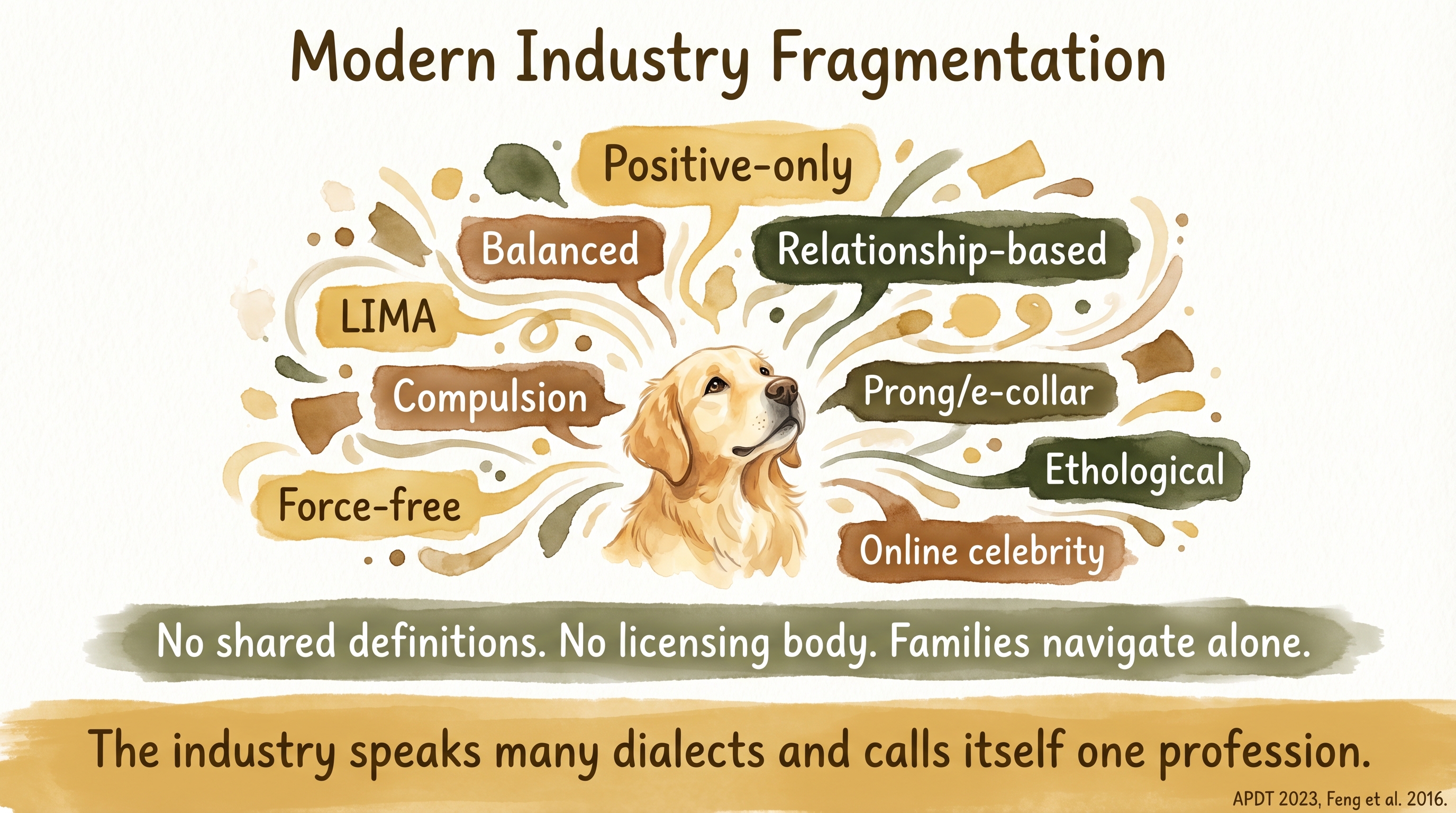
The industry speaks many dialects and calls itself one profession.
Key Takeaways
- The modern dog training market is fragmented because the profession lacks licensure, common education, and shared outcome standards.
- Method disagreements are reinforced by different ethical frameworks, training pathways, and public branding, not only by different tools.
- Credentials and labels provide useful clues, but they do not create the kind of consensus families often assume exists.
- JB responds to this landscape by pushing families upstream toward raising, prevention, and developmental clarity before intervention markets become necessary.
The Evidence
This entry uses observed claim-level tags beyond the dedicated EvidenceBlocks below. These tags mark JB program observation or practice-derived claims that need dedicated EvidenceBlock coverage in a later content pass.
This entry uses heuristic claim-level tags beyond the dedicated EvidenceBlocks below. These tags mark JB interpretive application rather than direct study findings.
- Cavalli & Fenwick (2025)professional dog trainers
Documents extensive fragmentation in educational pathways and certification uptake, including 138 training programs and 39 exam-based certifications in one survey. - DeLeeuw & Williams (2026)professional dog trainers
Shows that reward-based and mixed-methods trainers differ in ethical reasoning, evidence interpretation, and educational pathway, not only in tools. - Johnson & Wynne (2023)trainer marketing websites
Finds the method divide encoded in marketing language, with science and balance functioning as competing public identities. - Browne et al. (2024)US dog owners
Shows that most owners do not begin with a professional trainer, making online and cultural transmission central to how fragmentation reaches families.
- domestic dogs
No single dataset directly resolves the full population picture for the modern dog training industry: fragmentation without the usual survey, sampling, and threshold limitations.
SCR References
Sources
- Johnson, A. C., & Wynne, C. D. L. (2024). Training methods used by dog guardians in the United States: Prevalence, sources of information, and reasons for use. Animals, 14(9), 1310.
- Cavalli, C., & Fenwick, N. (2025). A survey of the professional characteristics and views of dog trainers in Canada. Animals, 15(9), 1255.
- DeLeeuw, J. L., & Williams, T. J. (2026). Professional dog trainers' perspectives on training methods: Ethical and evidentiary insights. Frontiers in Veterinary Science, 13, 1744448.
- Johnson, A. C., & Wynne, C. D. L. (2023). Training dogs with science or with nature? An exploration of trainers' word use, gender, and certification across dog-training methods. Anthrozoos, 36(1).