Online vs In-Person Dog Trainer Education
Compound evidence detail1 SCR / 2 parts
- Documentedthe Cavalli and Fenwick 2025 Animals survey evidence on dog-trainer professional learning channels showing mentors, workshops, and self-study as the dominant pathways
- Heuristicthe JB framing characterizing training methods as propagating primarily through media exposure, mentor lineage, and organizational affiliation rather than peer-reviewed evidence, with the qualifier that this describes the dominant pathway, not universal practice
Dog-trainer education now happens across three very different formats: fully online programs, in-person apprenticeship or workshop models, and hybrids that combine remote coursework with direct skill coaching. That format difference matters more than many families realize because it shapes not just what a trainer knows, but how well the trainer can handle a dog, coach a person, read body language in motion, and adapt when the live picture changes. In a fragmented profession, delivery format is part of the credential story, not an administrative detail. Documented
The rise of online education is easy to understand. It lowers geographic barriers, opens the field to career changers, makes expert instruction available across borders, and lets students learn while working. The JB source base also shows why online routes expanded so quickly: the profession has no single required schooling pathway, methods often propagate through decentralized networks, and a large share of trainers are self-educated or semi-formally educated through mixed channels. Observed-JB In that environment, scalable online schooling has a natural advantage.
The trade-off is equally real. Many of the most important trainer skills are embodied and interactive. Leash handling, timing under motion, movement through space, group-class flow, safety positioning, and reading subtle shifts in tension all benefit from live observation and correction. A student can understand threshold in theory yet still miss it repeatedly in practice. That is why this topic carries a mixed evidence level. The case for online access is strong. The case for hands-on refinement is just as strong.
The practical conclusion is not that one format is always superior. It is that the strongest trainer education usually combines conceptual depth with real-time feedback. Families evaluating trainers should therefore ask not only what certificate a person has, but how that person was taught to work in live space with real dogs and real people.
What It Means
Why Online Education Expanded So Fast
Online education solved several structural problems in one move. It let students in rural areas access schools they could never physically attend. It allowed mid-career adults to retrain without relocating. It made niche expertise available at scale. It also fit an unregulated profession where no state board was requiring apprenticeships, clinic hours, or standardized practical examinations before someone could start charging clients.
The broader source layer explains why this was almost inevitable. Cavalli and Fenwick's 2025 survey found 138 different training programs and 39 exam-based certifications among Canadian dog trainers, with a full third of respondents entirely self-educated. Documented DeLeeuw and Williams in 2026 documented that trainers reached their methods through widely varied routes including formal programs, mentorship, workshops, and independent study. Once a profession looks like that, online schooling becomes not a fringe option but one of the main organizing forms.
What Online Programs Do Well
Online learning has real strengths that should not be dismissed. It can deliver strong theory instruction, consistent faculty messaging, replayable demonstrations, written feedback, quizzes, case-analysis exercises, and a broader reading list than many local apprenticeships provide. For learning history, welfare evidence, learning theory, counseling basics, and structured case reasoning, a good online program may actually outperform a loose apprenticeship where the student mostly watches one trainer improvise. Documented
It also democratizes access to recognized schools. A student in New England can learn from a faculty based elsewhere, attend webinars from specialists they would never otherwise meet, and build a cross-regional professional network. In a field where local quality varies wildly, that access is genuinely important.
Where In-Person Learning Still Has an Edge
The harder truth is that dogs are not PDFs. The key limits of online-only training education appear when the student must act under live pressure. Timing looks different when the dog is moving fast. Body language is easier to miss in person than in paused video, not easier to catch. Group-class teaching requires room management, split attention, and emotional steadiness under social noise. Safety handling requires motor skill, not only conceptual agreement.
Those are the skills that apprenticeship and in-person coaching can sharpen. A mentor can stop a student mid-movement and show that the leash hand is too tight, the body is crowding the dog, the family is being given too many instructions at once, or the trainer missed the first signs of escalation thirty seconds before the visible blow-up. Documented That kind of correction is difficult to replicate fully in asynchronous formats.
Some forms of knowledge can be downloaded. Others need to be watched, attempted, corrected, and watched again. Mechanical dog-handling skill usually belongs in the second category.
Why Hybrid Education Often Makes the Most Sense
Hybrid programs usually come closest to resolving the tension honestly. They let students learn theory, case framing, and foundational vocabulary online while still requiring live assessments, workshops, intensives, or mentored handling. That model respects both truths at once: modern life needs access and flexibility, but animal work still depends on live skill.
From a family point of view, this is the most useful insight. The best question is rarely "online or in-person?" in the abstract. The better question is what parts of the trainer's education were taught remotely, what parts were directly assessed in live or video-reviewed practice, and whether the person has enough real-world repetition to make their knowledge usable.
Why It Matters for Your Dog
Golden Retriever families often meet trainer credentials at the exact moment they are most vulnerable to being impressed by labels. The puppy is jumping, biting, dragging, counter-surfing, or melting down in adolescence, and the family wants reassurance that the person they hire actually knows what they are doing.
Delivery format matters here because it influences what kind of help shows up in the room. A trainer who learned mostly from online lectures may be able to explain reinforcement beautifully and still struggle to manage a flailing leash, three excited children, a ringing doorbell, and a twelve-month-old retriever who has just discovered the thrilling social reward of launching at guests. A trainer who came through a strong apprenticeship may move more smoothly through that chaos but may have gaps in theory or in broader scientific literacy if their mentorship was narrow.
The family therefore benefits from looking past false simplicity. Online training does not automatically mean weak skill, especially when the program includes live feedback and the trainer has since accumulated solid experience. In-person exposure does not automatically mean insight, especially if the person mostly copied one mentor's habits without learning how to reason about new cases.
A Golden-specific example makes the distinction concrete. Imagine a trainer working on leash walking with a strong adolescent retriever who surges toward every squirrel and every dog. The online-schooled trainer may know exactly which criteria to explain but may stand too still, feed too late, or keep the family too close to triggers. The purely apprentice-trained trainer may move better through the scene but struggle to explain why the dog keeps failing or how the family should adjust the environment between sessions. The strongest help often comes from someone who has both conceptual vocabulary and practiced movement.
Body-language reading is another place where format matters. Goldens are expressive, social dogs, but that does not mean they are simple to read. Soft-eyed friendliness can flip into arousal, frustration, or social overcommitment quickly. A trainer whose education included direct feedback on live body language is often better positioned to catch the earlier part of that change. Observed-JB
Families can ask revealing questions without sounding technical. Was your practical handling ever directly assessed? Did someone watch you teach a group class? Were your coaching sessions reviewed? How much of your education happened with live dogs rather than written assignments? Can I observe you working before I hire you? Those questions often tell a family more than the badge itself.
This is especially relevant because the market now contains many online-only credentials that sound polished and professional. Some are meaningful. Others are mostly content-delivery systems attached to attractive branding. Since SCR-171 makes clear that certification outcome data do not exist, families need to look for practical proxies. Directly assessed handling is one of the better proxies available.
The family should also notice what the trainer does when the dog deviates from the plan. In real houses, dogs do not follow lesson scripts. A capable trainer adjusts the room, changes distance, simplifies the task, lowers social intensity, and keeps the humans calm. That adaptability is often where live training experience reveals itself.
For a Golden family, then, the best takeaway is not suspicion of online learning. It is respect for the limits of theory alone. Trainer education works best when the adult has had their understanding tested against motion, emotion, noise, and unpredictability.
Adolescence is where those differences often become impossible to hide. A retriever who looked easy at sixteen weeks can become physically forceful, socially reckless, and environmentally distracted by ten or twelve months. Trainers educated only in polished theory sometimes sound strong until they must coach a real family through that moving target. The adults do not need a lecture about operant terms in the moment their dog is pinwheeling at the end of the leash. They need someone whose education prepared them to stay organized while everything in the room gets louder.
Human teaching skill belongs in the same conversation. Many online courses transmit concepts well but give limited direct correction on how the trainer speaks, sequences instructions, notices confusion, or recovers when clients are embarrassed. Yet most companion-dog work is really two jobs at once: handling the animal and teaching stressed adults. A trainer who has been watched while coaching real families often shows a different kind of steadiness than one whose assessments lived mostly in worksheets, quizzes, or polished demonstration clips.
Live assessment also exposes whether the trainer can think on their feet without hiding behind a prepared demo. Real dogs stall, surge, bark, sniff, disengage, and startle at inconvenient times. Real owners interrupt, mis-time, cry, overtalk, and forget instructions. Education that includes direct observation under those conditions tends to produce trainers who can simplify the plan instead of blaming the dog or the family when the scene stops cooperating.
What This Means for a JB Family
For a JB family, this entry sharpens a very practical screen. When evaluating a trainer, do not ask only which school they attended. Ask how their learning was embodied. Did anyone correct their handling? Did anyone assess their work with families? Did anyone watch how they read dogs in live space?
That matters because JB care is not impressed by abstraction for its own sake. A trainer can recite modern behavior language and still fail to make a kitchen calmer. Another can have rougher vocabulary but excellent live timing. The best fit is the person who combines humane conceptual clarity with practiced, low-drama competence around real dogs.
JB families also have reason to value apprenticeship-type learning because so much raising depends on adult presence and example. Watching a capable professional manage movement, boundaries, greetings, transitions, and arousal in real time can be more instructive than hearing a perfect verbal description of those same ideas.
The safest conclusion is therefore balanced. Online learning has opened valuable doors and will remain part of the profession. Families should simply make sure there is real assessed practice somewhere in the trainer's story. The more the problem involves live household chaos rather than textbook obedience, the more that practical layer matters.
That balance protects against the wrong shortcut in either direction. A weak apprenticeship can teach bad habits just as surely as a weak online course can produce brittle theory. What matters is whether another competent adult ever watched the trainer work and corrected what was missing. Families who ask that question are usually screening for the right thing, even if they never use the phrase educational format.
The JB preference is therefore not nostalgia for old-school apprenticeship or fashionable praise for remote schooling. It is accountable transmission. Who saw you teach? Who saw you handle a struggling dog? Who told you when your timing, spacing, or coaching was not good enough yet? The trainer who can answer those questions concretely is often the one whose education has been tested where companion-dog work actually happens.
Families can make that screen practical by asking to observe a class, review an intake process, or hear how a recent difficult case was adjusted in real time. The answer will not prove everything, but it often reveals whether the trainer's schooling produced flexible competence or only polished language.
That makes the family's role refreshingly concrete. Instead of debating online versus in person as an abstract ideology, they can ask whether the trainer's education created observable steadiness in live work.
That is usually enough to separate a real practitioner from a well-spoken graduate.
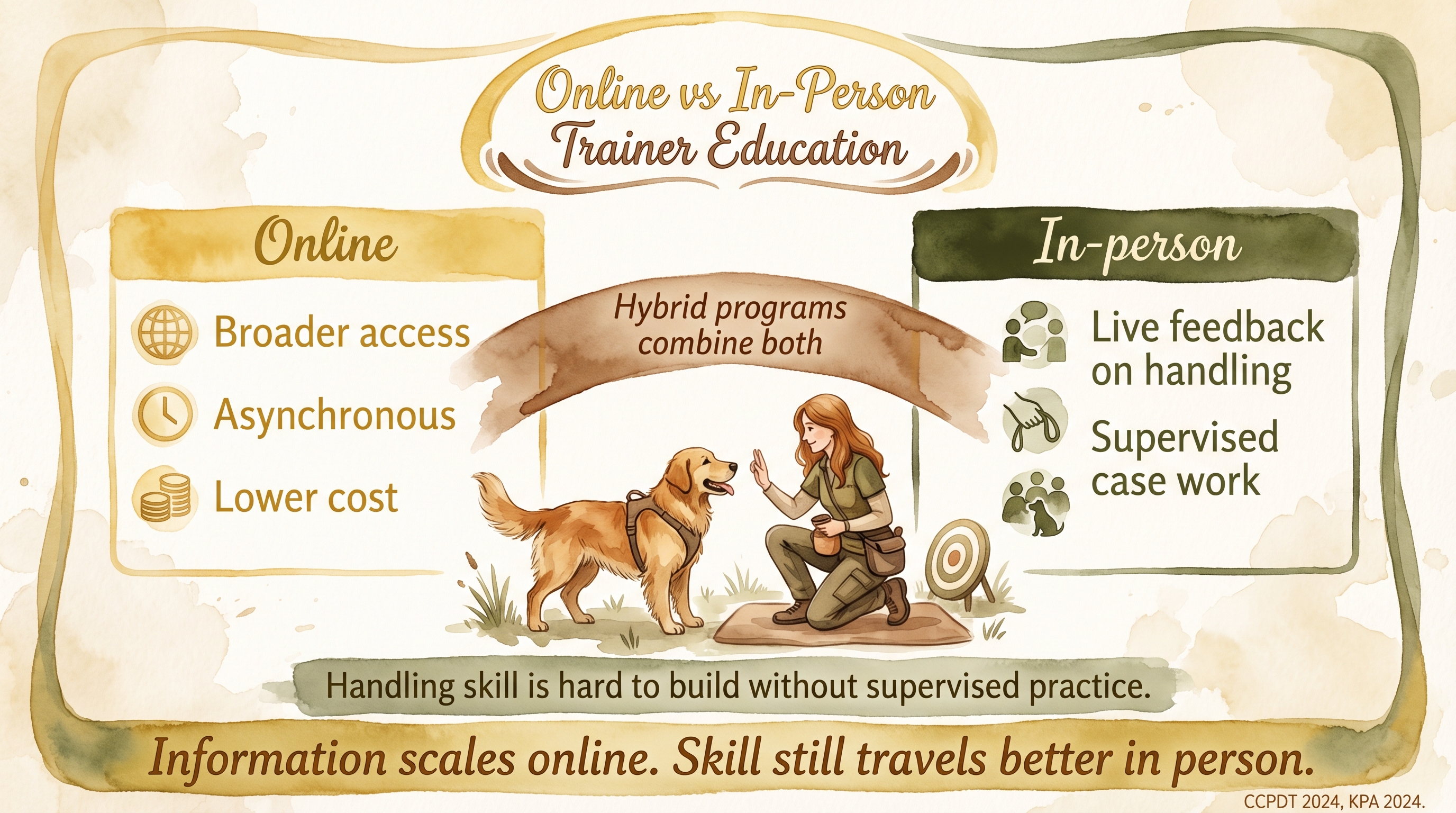
Information scales online - skill still travels better in person.
Key Takeaways
- Online education improves access and can teach theory very well, but it does not automatically assess live handling skill.
- In-person apprenticeship improves movement, timing, and live case adjustment, but it can be narrow if not paired with broader theory.
- Hybrid models often come closest to what families should want: conceptual depth plus directly assessed practical work.
- For JB families, one of the best evaluation questions is whether the trainer's handling and coaching were ever directly observed and corrected.
The Evidence
This entry uses observed claim-level tags beyond the dedicated EvidenceBlocks below. These tags mark JB program observation or practice-derived claims that need dedicated EvidenceBlock coverage in a later content pass.
- Cavalli & Fenwick (2025)professional dog trainers
Documents a highly fragmented educational landscape with 138 training programs, 39 certifications, and a large self-educated minority. - DeLeeuw & Williams (2026)professional dog trainers
Shows that methodological differences often track educational pathway, including formal schooling, mentorship, and informal routes. - trainer education structure
Supports the claims that the field is unregulated, distributed across mixed learning channels, and lacking outcome-comparison evidence for credentials. - KPA, Academy, and similar program structures as summarized in the source layerprivate trainer schools
Illustrate the practical difference between theory delivery, live assessment, and hybrid learning formats.
- domestic dogs
No published study directly isolates the long-term dog-level and family-level effects of online vs in-person dog trainer education across ordinary companion-dog contexts.
SCR References
Sources
- Cavalli, C., & Fenwick, N. (2025). A survey of the professional characteristics and views of dog trainers in Canada. Animals, 15(9), 1255.
- DeLeeuw, J. L., & Williams, T. J. (2026). Professional dog trainers' perspectives on training methods: Ethical and evidentiary insights. Frontiers in Veterinary Science, 13, 1744448.
- Karen Pryor Academy and Academy program documents support the structure of specific online/in-person trainer-education programs. They are institutional sources, not evidence that those programs produce superior dog outcomes.