A Family Framework for Evaluating a Dog Trainer
Compound evidence detail1 SCR / 2 parts
- Documentedthe documented absence of any RCT establishing single-method superiority across canine behavioral domains, paired with the on-record organizational position statements (AVSAB 2008 and 2021, APDT 2020 and 2023, CCPDT 2025, IACP 2025, plus Ziv 2017 and Todd 2018 reviews) which constitute institutional policy rather than scientific consensus
- Heuristicthe JB characterization of professional ideological fragmentation across force-free, balanced, and compulsion approaches, carrying the load-bearing firewall that absence of method-superiority RCT does not equalize methods on welfare grounds where SCR-026, SCR-028, and SCR-036 document harm from aversive methods independently of the outcome comparison gap
Choosing a dog trainer is harder than it should be. Families are handed a market full of initials, promises, philosophies, websites, and social proof, but the profession has no universal licensure floor and no published outcome-comparison research proving that one credential path reliably predicts better family-dog results. That means families still have to use judgment even after they learn what the letters mean. Evidence Gap
This entry is therefore not a scientific ranking system. It is a JB family framework. It is interpretive guidance built from the structure of the industry, the limits of certification, and the practical realities of living with companion dogs. The goal is not to tell families that credentials do not matter. The goal is to help them read credentials in the right proportion.
From the JB perspective, the strongest trainer is not necessarily the most decorated one and not necessarily the one with the smoothest public persona. The strongest trainer is the one whose preparation, scope awareness, transparency, and relational posture fit the actual dog and the actual family in front of them. That is a heuristic claim, not a settled empirical theorem.
The framework below is meant to make families calmer, not more suspicious. A good decision usually comes from a few disciplined questions asked clearly and early, not from endless internet comparison or surrender to charisma. Observed-JB
That matters because the market now rewards legibility and confidence almost as much as competence. Heuristic Families can therefore do something genuinely protective by slowing the choice down long enough to ask who this person really is as a working professional, not just how polished the website or social feed looks. That alone makes proportion and clarity protective for buyers.
What It Means
Start With Credentials, but Do Not Stop There
Credentials are useful because they narrow uncertainty. A CTC, CPDT, KPA-CTP, IAABC credential, CAAB, or DACVB tells a family something about training pathway, educational depth, or scope of practice. SCR-174 supports the narrower claim that credentials do function as real professional signals. Heuristic What credentials do not do is replace evaluation of fit, honesty, and practical competence.
The first question is therefore basic but specific: what credentials does the trainer hold, and what did those credentials actually require? Exam only? Hands-on assessment? Long-form curriculum? Graduate study? Veterinary training? A family who knows that difference is already harder to mislead.
Ask the Trainer to Describe Their Philosophy in Ordinary Language
A useful trainer should be able to explain what they do without hiding behind slogans. Families can ask: How would you describe your method in plain English? What tools do you normally use? What do you avoid? What would you do if my dog did not respond the way you expected? Do you ever refer out?
The answers matter less as ideology tests than as transparency tests. A trainer who cannot describe their own approach clearly, or who reacts defensively to ordinary questions, is already giving the family useful information. Likewise, a trainer who speaks only in abstractions may be less grounded than the website suggests.
Look for Scope Awareness and Humility
One of the best green flags in the whole industry is willingness to say, "That case is outside my scope." A trainer who refers to a veterinary behaviorist, veterinarian, or higher-level consultant when appropriate is usually safer than a trainer who insists they can fix everything. SCR-170 and SCR-171 make this especially important because regulation is weak and no credential body has outcome data proving blanket superiority. Documented
Humility also appears in smaller ways. Does the trainer promise a process or a guarantee? Do they talk about the family's role honestly? Do they acknowledge uncertainty? Do they treat the dog like a live animal inside a household or like a marketing demo?
Families do not need a perfect ranking system. They need a few precise questions that expose whether the trainer is transparent, limited in the right ways, and trustworthy under ordinary scrutiny.
Observe How the Trainer Handles Transparency
Families should ask whether they can observe a class, watch part of a lesson, review a written contract, hear how methods are chosen, and contact recent references whose dogs resemble their own. They should ask about liability insurance, cancellation terms, follow-up support, and what happens if the case gets more serious than expected.
This is not adversarial behavior. It is normal adult due diligence in an under-regulated service sector. A trainer who welcomes these questions is often easier to trust than one who leans on confidence and reputation alone.
References deserve the same precision. A glowing testimonial from a family whose dog attended puppy kindergarten tells you little about a trainer handling adolescent over-arousal, fear, or multi-dog chaos in a home with children. Ask for recent clients with similar dogs, similar goals, and similar household pressures. Relevant references are more valuable than impressive ones.
Cost and package design belong in the same conversation. A trainer who pushes a large prepaid package before clearly defining the problem may be selling certainty rather than offering judgment. Transparent pricing does not guarantee quality, but it does tell the family whether the business model leaves room for individualized thinking or depends on locking clients in fast.
Why It Matters for Your Dog
A Golden Retriever family usually hires a trainer in one of two emotional states: hopeful and proactive, or overwhelmed and behind. The second state is where bad choices happen. Adults who feel embarrassed, tired, or frightened are much more likely to overvalue charisma, quick promises, and strong certainty.
That is why a framework helps. It gives the family a steadier way to choose under pressure. Instead of asking, "Who sounds the most convincing?" the family can ask, "Who is clear about scope, methods, practical coaching, and follow-up?" Those questions tend to cut through branding quickly.
Consider a common Golden scenario. The dog is friendly but chaotic: jumping on guests, shredding the kitchen at dusk, dragging toward every person on walks, and exploding with excitement when the children come home. One trainer guarantees results in two weeks, will not explain methods until after payment, and says observation is unnecessary because the family should trust expertise. Another trainer explains their credential, invites observation, describes what they would start with, asks detailed questions about rest, routine, and rehearsal, and notes that some cases need referral if anxiety looks deeper than ordinary training. The second trainer may look less dramatic. For a family dog, they are often the safer bet.
This framework also matters because Goldens are socially persuasive dogs. Their sweetness can cause both trainers and owners to minimize early warning signs. A trainer who understands scope and household development will pay attention to the whole picture, not just to whether the dog can be made to perform in session.
Families should also ask whether the trainer works with the humans or mainly performs on the dog. A good family trainer should coach the adults as much as the animal. If the plan depends on the trainer doing all the competent handling while the household watches, the family may be buying a performance rather than a solution.
Observation rights are especially revealing. If a trainer refuses to let clients observe classes, refuses to describe tools, or becomes irritated by questions about what they would and would not do, the family should take that seriously. Transparency is not a luxury add-on. In this market it is a core safety feature.
Scope questions help too. Ask what kinds of cases the trainer refers out. Ask whether they have relationships with veterinarians or veterinary behaviorists. Ask whether they have worked recently with dogs similar to yours. Ask what success would look like in six weeks and what would make them change course. Those questions often surface maturity faster than any credential list.
The family should also notice how the trainer speaks about the dog. Are they talking only about control, or are they talking about development, stress, environment, and the adults' own behavior? JB families usually need the second voice more than the first.
Early consult structure can be revealing in another way. A steady trainer usually has a coherent first-step plan before they meet the dog in person. That does not mean a rigid script. It means they can explain what they would want to observe, what management changes might come first, what information they would gather from the family, and what would count as progress. Vagueness at this stage often predicts vagueness later.
Disagreement is informative too. If the family raises a concern about tools, pace, household fit, or prior bad experience, does the trainer respond with curiosity or with ego? A trainer who can tolerate thoughtful questions without becoming defensive is often easier to work with once the dog hits a setback. Companion-dog raising is messy, and families need professionals who stay collaborative when the neat plan breaks down.
Homes with children or multiple caregivers should ask one more thing: can this trainer coach a system, not just a handler? Many family-dog failures happen because one adult understands the lesson while everyone else continues the old pattern. A trainer who can translate the plan across parents, teenagers, grandparents, or pet sitters often produces more durable change than a trainer who works beautifully one-on-one with the dog in isolation. Observed-JB
Most importantly, this framework protects families from false certainty. Because the profession lacks a single validated ranking system, the safest choice is often the trainer who is legible, modest, specific, and willing to involve the family fully. That may not be the loudest person in the market. It is often the most useful one.
Families can also listen for whether the trainer offers a philosophy that is stable under pressure. It is easy to sound humane or scientific on a homepage. The better test is what the trainer says they will do when the dog regresses, when the family falls behind, or when the case proves more serious than expected. A coherent answer here often tells you more than a page of mission language.
What This Means for a JB Family
For a JB family, evaluating a trainer is ultimately relational judgment informed by credentials, not a credential lookup pretending to be certainty. JB reads the market through the questions of raising: Will this person help us become steadier adults around our dog? Will they lower confusion? Will they coach us honestly? Will they tell us when the case exceeds their scope?
That means the family should treat credentials as the start of the conversation, philosophy as the middle, and transparency as the deciding layer. A trainer may hold excellent letters and still be wrong for a family home. Another may hold fewer letters yet be unusually clear, humane, and effective within ordinary companion scope. The point is not anti-credential skepticism. It is proportion.
JB also gives special weight to the trainer's willingness to work with the household as a system. If the trainer sees only dog mechanics, the fit is often weaker. If the trainer can coach routines, transitions, arousal management, boundaries, and follow-through with the adults, the help is usually more durable.
So the framework is simple on purpose. Ask what the letters mean. Ask how the trainer works. Ask what they will not do. Ask what they would refer out. Ask whether you can observe. Ask whether they can explain the first month clearly. The adult who answers calmly is often telling you as much as the content of the answer itself.
This also frees families from the fantasy of a perfect ranking system. In a market like this, the goal is not to prove that one trainer is universally best. The goal is to choose a trainer who is clear enough, skilled enough, and bounded enough for the actual case in front of you. Good discernment often looks less like certainty and more like eliminating the obvious mismatches early.
Breeders and veterinarians can sometimes help with that narrowing process. They may know who communicates well, who refers appropriately, who works gently with family dogs, and who tends to create fallout. Their input should not replace the family's own questions, but it can keep overwhelmed adults from starting at random in a market built to reward performance.
The result is not a perfect system, but it is a workable one. Families who combine credentials, transparency, references, scope awareness, and household fit usually make far better choices than families who chase status or certainty alone. Most companion homes do not need the best trainer on earth. They need a trustworthy trainer who fits their dog, their home, and the real problem in front of them. That is often how calm discernment beats impressive branding in the end in real life.
That is often how calm discernment beats impressive branding in the end.
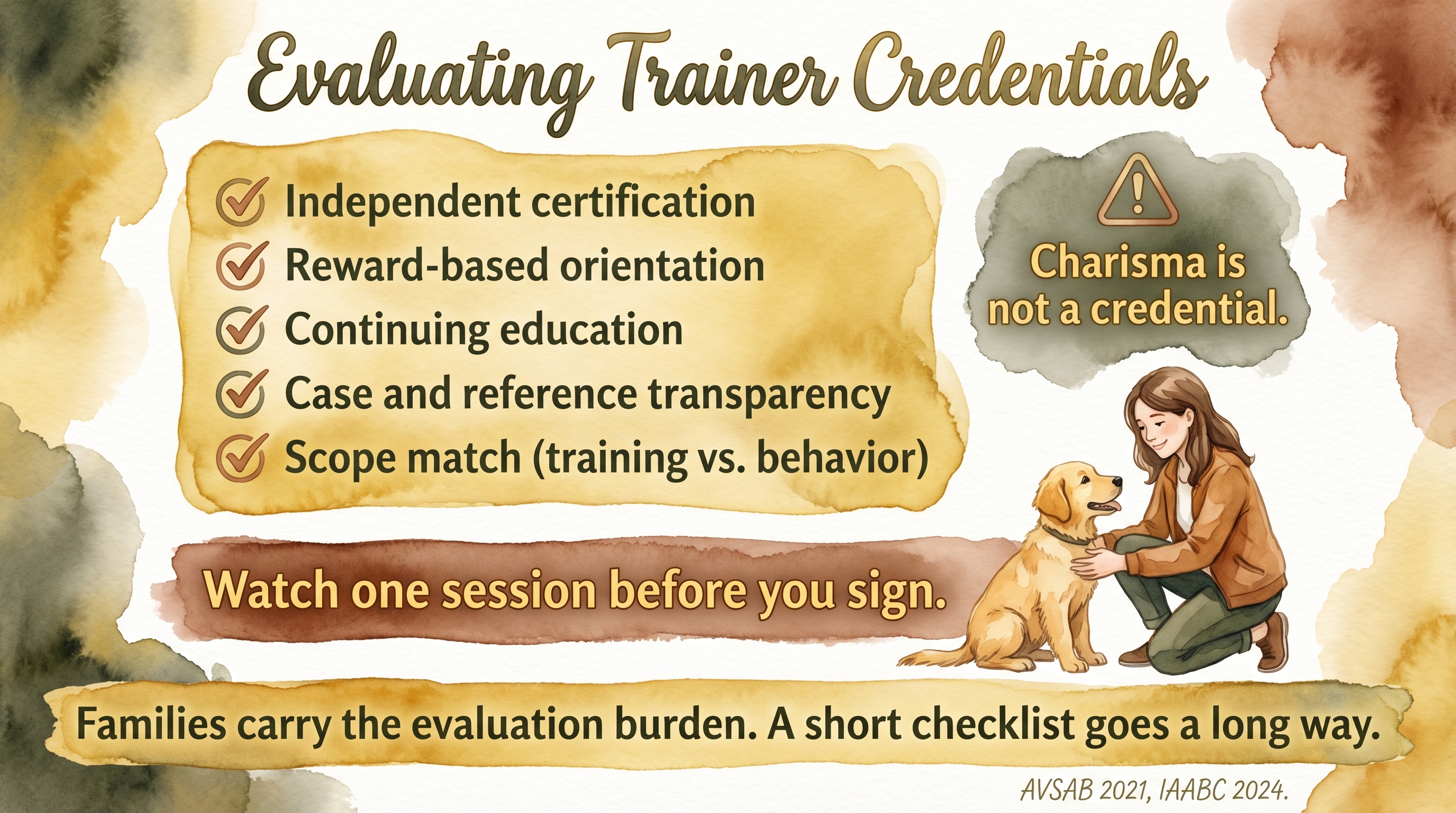
Families carry the evaluation burden - a short checklist goes a long way.
Key Takeaways
- This framework is interpretive guidance, not a scientific ranking of trainers.
- Credentials matter, but families should ask what those credentials required and how the trainer works in practice.
- Transparency, scope awareness, observation rights, and humility are among the strongest green flags in the current market.
- For JB families, the best trainer is usually the one who can help the adults become clearer and steadier, not the one who sounds most certain online.
The Evidence
This entry uses documented claim-level tags beyond the dedicated EvidenceBlocks below. These claims should remain tied to the entry Sources and SCR references during the next evidence-chain authoring pass.
This entry uses observed claim-level tags beyond the dedicated EvidenceBlocks below. These tags mark JB program observation or practice-derived claims that need dedicated EvidenceBlock coverage in a later content pass.
- dog training profession
Documents the unregulated structure of the field, the mixed value of credentials as signals, and the absence of certification outcome research. - SCR-170 and SCR-171regulation and evidence gaps
Support the need for family judgment by showing that regulation is thin and credential-outcome data remain absent. - SCR-174professional signaling
Supports the narrower point that credentials convey useful information even though they do not settle competence by themselves. - SCR-176industry fragmentation
Supports the claim that method disagreement persists, which is why plain-language transparency matters so much to families.
- domestic dogs
No published study directly compares the long-term dog-level and family-level outcomes associated with professionals trained through a family framework for evaluating a dog trainer versus other educational pathways.