The China 2020 E-Collar Study
The China 2020 paper matters because it addressed one of the most emotionally charged claims in dog training with a more direct design than most method debates ever receive. The paper, "Efficacy of Dog Training With and Without Remote Electronic Collars vs. a Focus on Positive Reinforcement," was published in Frontiers in Veterinary Science in July 2020 by Lucy China, Daniel S. Mills, and Jonathan J. Cooper. Its central question was practical rather than ideological: do remote electronic collars actually produce better training outcomes than reward-based alternatives for recall and general obedience? Documented
The study included sixty-three pet dogs with owner-reported recall problems. Documented They were divided into three groups. One group was trained by e-collar-manufacturer-nominated trainers using electronic stimulation as part of the program. A second control group used the same trainers following their usual methods without electronic stimulation. A third control group used independent professional trainers who focused primarily on positive reinforcement. That structure is important because it tried to avoid a common criticism in this literature, namely that the e-collar method was being compared only against amateur or weak reward-based work.
The headline result was uncomfortable for advocates of remote-collar necessity. The positive-reinforcement groups performed as well as or better than the e-collar group on the study's practical outcomes. Documented The e-collar group did not show the superiority claim that often drives sales of the device. At the same time, the dogs in the e-collar condition showed more signs associated with training stress.
JB treats this paper as the strongest direct evidence against one specific claim: that remote collars are needed to produce reliable recall and obedience in family dogs. The study does not prove that no skilled person can ever use a remote collar competently. It does show that when industry-standard remote-collar training was compared against professional reward-based training, the electronic route did not earn the performance premium its defenders often promise.
What It Means
Why This Study Was So Important
Remote-collar debates had long suffered from a simple problem. Advocates would say critics had never tested the best versions of e-collar work, while critics would say the very need for the tool was the problem. China 2020 tried to move that argument onto stronger ground. The study did not compare professional e-collar work against random owner fumbling. It compared e-collar training delivered by trainers nominated by the manufacturer with two reward-based control conditions, including a group using the same trainers without electronic stimulation.
That design gave the e-collar case a fair chance. If the tool truly delivered unique efficacy, the study gave it room to show that. Documented This is one reason the paper keeps returning in policy arguments and trainer disputes. It asked the right practical question in a more disciplined way than most anecdotal debates do.
What the Study Found
The central finding was that the reward-based groups matched or exceeded the e-collar group on the measured obedience and recall outcomes. That matters because the strongest public defense of remote collars is usually not merely that they work at all. It is that they work better, more reliably, or more necessarily than reward-based alternatives when distraction is high.
The paper did not support that superiority claim. It also found more stress-related behavior in the e-collar dogs during training. That pushes the interpretation toward a familiar pattern in the wider literature: aversive channels may impose measurable cost without buying a clear outcome advantage. The paper therefore speaks to both efficacy and welfare in the same direction.
What Critics and Defenders Say About It
Defenders of remote collars often point to the study's limitations. Observed-JB The sample was small. The work occurred in the United Kingdom rather than across multiple training cultures. The protocol reflected industry-standard methods at the time, not necessarily every newer low-level conditioning approach promoted later. Those are fair points and belong in any honest reading.
At the same time, the study still matters because it targets a claim of necessity. Documented A tool marketed as uniquely indispensable should be able to show a meaningful advantage under fair comparison. China 2020 did not show that. Families should not allow protocol-specific caveats to erase the core result. If reward-based professionals can achieve comparable or better outcomes in the studied context, the "you need this collar" pitch already looks weaker.
That is the reason this paper remains so awkward for polarized camps. It is not broad enough to satisfy activists who want a total verdict on every remote-collar case, and it is not weak enough to comfort sellers who want the device treated as obviously necessary. The study sits in the more demanding middle ground, where a specific marketing claim has been tested and did not come out well for the tool. Documented
The paper matters to JB because it undercuts a common industry story. If a family dog can be taught reliable recall through lower-cost means, there is less reason to move toward remote aversive enforcement as a normal step in development.
What the Paper Does Not Prove
This study is not a universal referendum on every remote-collar case. Documented It does not decide extreme livestock-risk situations, every modern low-level protocol, or every working-dog context. It also does not answer a broader developmental question about why so many family dogs reach adolescence with recall already weak. The paper is narrower than that.
Its value lies in being narrow. It tests a direct, concrete, consumer-relevant claim. Are e-collars needed to outperform reward-based methods for the sort of obedience and recall problems that bring pet owners to trainers? In this study, no. Documented That is a very useful answer even if it does not close the entire philosophical argument.
Why It Matters for Your Dog
For a Golden Retriever family, this study matters because recall is one of the places where fear and hope collide hardest. Families want freedom, safety, and a dog who can enjoy fields, beaches, and trails without becoming impossible to call back. When recall fails, anxiety rises quickly. That is exactly the emotional moment when e-collar marketing sounds most convincing.
China 2020 gives families a firm pause point. If professional reward-based trainers can match or beat remote-collar performance in a controlled comparison, then the family should not assume the collar is the price of reliability. That does not mean recall is easy. It means the burden of proof moves back onto the trainer recommending electric stimulation.
A practical Golden example helps. Imagine a ten-month-old retriever who rockets after birds and ignores the owner once excitement spikes. An e-collar trainer says the dog needs an enforceable consequence at distance because food cannot compete with prey drive. China 2020 does not magically solve the case, but it does challenge the fatalism of that statement. The paper says that in a direct comparative design, professional reward-focused training was fully competitive with the electronic option. Families should hear that before consenting to a remote aversive device.
This matters because Goldens often have a double problem at once. They are highly social and highly distractible. Owners can mistake that combination for proof that the dog needs stronger hardware, when the deeper issues are usually proofing history, overused cues, premature freedom, and too much recall only when fun is ending. A study like China 2020 does not eliminate those difficulties. It warns against solving them first with an aversive shortcut whose superiority has not been demonstrated.
There is also a welfare reading that families need. A dog may come back faster under a pressure channel and still be paying a cost in training stress. Goldens, being forgiving and biddable, may mask that cost better than some dogs. Owners then think the collar is both kind and necessary because the dog still seems cheerful. The paper reminds us that visible willingness is not enough to settle the welfare question.
The study also protects families from exaggerated positive-only rhetoric, though in a different way. Reward-based trainers should not misread the paper as proof that every reward plan works automatically. The study used professionals, structure, and deliberate training design. The practical lesson is not "just bring treats." It is that lower-welfare-cost training can compete successfully when done well, which is a much more serious claim.
For JB, the family implication is straightforward. If recall reliability can be built through humane, professionally executed reward-based methods, then the family should exhaust those routes and the upstream preventive work that supports them before entertaining an electronic tool. That fits both the evidence and the larger JB philosophy of not solving developmental problems with stronger downstream control.
The study also clarifies a point many families find emotionally difficult: recall reliability is not only a technology problem. It is a history problem. Dogs come into the study with rehearsal histories, distraction histories, and patterns of what the cue predicts. A remote collar may promise to cut through that history by adding enforceability. China 2020 matters because it says that professionally run reward-based work can still match that outcome in the kinds of cases owners actually bring in.
That is especially relevant for adolescent Goldens. They often look most unreliable precisely when their off-leash dreams are becoming emotionally important to the family. The paper gives those families reason to slow down and keep building rather than assuming adolescence has already proven the need for electric backup.
Just as importantly, the study helps families separate "distance control" from "device dependence." Documented A recall system deserves more trust when it generalizes across locations, handlers, and ordinary household life than when it works mainly because a piece of equipment remains part of the picture. China 2020 does not solve the collar-off question completely, but it pushes families to ask it. If the promised reliability depends on permanent technological enforcement, the household should recognize that as a different kind of result from a cue that has become deeply rehearsed, rewarding, and socially meaningful on its own.
Seen in family terms, this is really a question about what kind of dog the household is building. Is the dog learning that coming back is deeply worthwhile and well practiced, or learning that distance now carries a stronger consequence channel? China 2020 matters because it suggests the humane route can remain fully competitive on the behavior itself, which keeps the more coercive story from presenting itself as the only realistic adult option.
What This Means for a JB Family
The first JB takeaway is not to let "distance" automatically license "electric." Recall is emotionally important, but that importance does not create proof that remote stimulation is necessary. China 2020 is one of the best direct reasons to resist that leap.
The second takeaway is to scrutinize the exact claim a trainer is making. If the claim is "e-collars can produce behavior change," the paper does not deny it. If the claim is "e-collars are needed to beat reward-based training for family-dog recall," the paper gives strong reason for skepticism. That distinction keeps conversations clear.
Third, keep the developmental lens active. If a Golden is chronically failing recall, examine freedom history, line work, distraction staging, arousal levels, and the emotional meaning of the recall cue itself. A family that only asks how to enforce recall at the farthest point is already downstream of several earlier preventable mistakes.
Finally, use this study to set the default burden of proof. Lower-cost, lower-risk approaches do not have to be perfect to deserve first position. They only have to be good enough that a higher-cost aversive alternative has not demonstrated superiority. That is exactly the picture China 2020 gives.
In practice, that means a JB family can ask very concrete questions before consenting to a remote collar. What would the trainer do first with a long line? How do they stage distractions? How much of their success rate depends on wearing the device indefinitely? What happens if the collar comes off? China 2020 does not answer every one of those questions directly, but it gives families a legitimate reason to demand answers before accepting the story that electricity is the serious option and preparation is the naive one.
Equally useful, the paper can help families hear sales language more accurately. When someone says the collar is merely a communication tool, the next question is still whether that tool improved outcomes beyond well-run reward-based work in the kinds of cases being discussed. This study says the superiority claim was not demonstrated. That does not end every conversation, but it prevents the family from treating remote stimulation as the adult option and slower foundational work as sentimental delay.
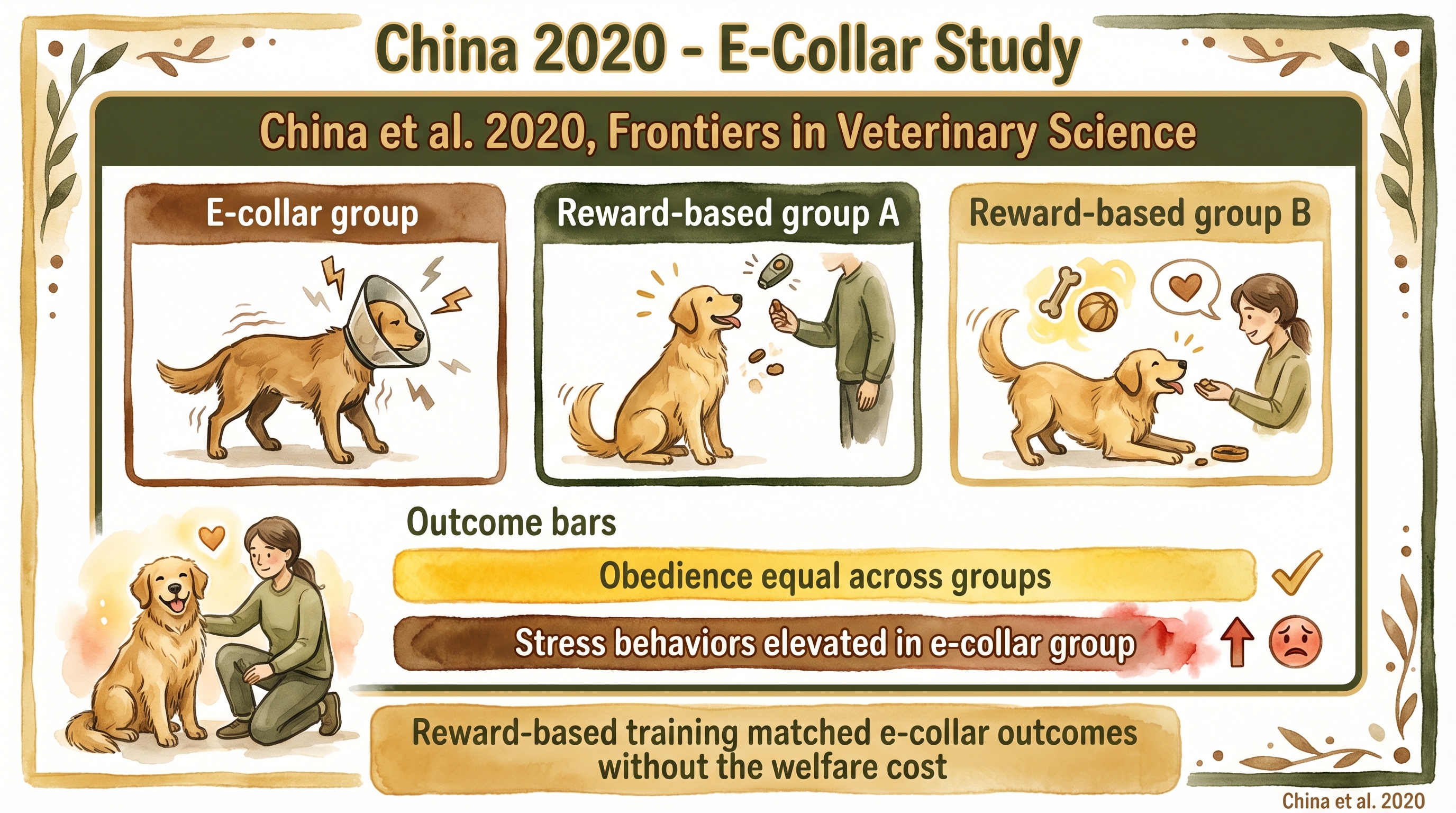
Reward-based training matched e-collar outcomes without the welfare cost.
Key Takeaways
- China 2020 is important because it gave professional remote-collar training a fair comparison against professional reward-based alternatives.
- The study did not show the performance superiority claim that often drives e-collar recommendations for family dogs.
- It also found more stress-related behavior in the e-collar group during training.
- For families, the paper is strong evidence against treating remote collars as the necessary route to reliable recall.
The Evidence
This entry uses observed claim-level tags beyond the dedicated EvidenceBlocks below. These tags mark JB program observation or practice-derived claims that need dedicated EvidenceBlock coverage in a later content pass.
- China, Mills, & Cooper (2020)companion dogs
Sixty-three pet dogs with recall problems were compared across e-collar and reward-based groups, with no clear efficacy advantage for the e-collar group and greater stress indicators during training. - PubMed and Frontiers recordcompanion dogs
Confirms the three-group design using manufacturer-nominated e-collar trainers, same-trainer non-electronic controls, and independent reward-focused trainers. - companion dogs
Places the study in the wider pattern of comparable task outcomes with higher aversive cost. - Cooper et al. (2014)companion dogs
Provides earlier controlled work in the same overall direction, strengthening the interpretation of China 2020.
- domestic dogs
No published follow-up study directly tests how the findings summarized under the china 2020 e-collar study generalize across breeds, households, and long-term outcomes.
SCR References
Sources
- China, L., Mills, D. S., & Cooper, J. J. (2020). Frontiers in Veterinary Science.
- PubMed. "Efficacy of Dog Training With and Without Remote Electronic Collars vs. a Focus on Positive Reinforcement."
- Cooper, J. J., et al. (2014). PLOS ONE.