Negative Punishment and Time-Outs
Compound evidence detail1 SCR / 2 parts
- Documentedcanine welfare evidence on aversive training methods (Vieira de Castro 2020, Ziv 2017, Hiby 2004) and attachment-mediated stress modulation evidence (Schoberl 2015, Asher 2020, Brubaker and Udell 2023)
- HeuristicJB claim that secure attachment context measurably alters how dogs experience mechanically operant-identical correction procedures, RF-flagged in the SCR and formally untested in controlled canine studies
Negative punishment is the quiet quadrant of dog training, which is one reason families use it constantly without naming it. In operant language, the definition is simple: remove something the dog wants after a behavior, and that behavior becomes less likely in the future. The removed thing is usually attention, play, access, forward movement, or social contact. If a puppy jumps, the person turns away, and jumping declines over time, negative punishment has occurred. Documented
Modern reward-based training accepts this quadrant far more comfortably than positive punishment because the welfare profile is usually milder. A trainer can withhold attention, stop a game, or end access to the couch without adding pain, startle, or fear. That low-cost reputation is deserved in many ordinary household uses. Yet the method is not neutral simply because it is quiet. Timing matters. Clarity matters. Duration matters. A dog who loses access for two seconds in a clear social moment is having a different experience from a dog who is repeatedly isolated, ignored for long stretches, or removed from the group in a way that creates confusion rather than information.
The most common family applications are easy to picture. Attention is withdrawn for mouthing. Play stops when arousal goes too high. The leash walk pauses when pulling begins. A brief time-out follows wild greetings. These are all ordinary pieces of the positive-reinforcement toolkit because they reduce unwanted behavior without requiring aversive additions. In comparative research, negative punishment also matters because it sometimes functions as the lower-stress alternative to e-collars or leash corrections. Salgirli Demirbas and colleagues in 2012, for example, found that a quitting signal involving loss of attention could improve recall with lower stress markers than e-collar or pinch-collar use in a military-breed protocol.
JB accepts the practical legitimacy of brief disengagement while refusing to reduce it entirely to reinforcement arithmetic. A socially oriented puppy is not only experiencing the subtraction of a reinforcer. The puppy is also reading a change in relationship tone, access, and approval. That wider meaning is why JB places quiet disengagement close to Indirect Correction. The mechanism can be described operantly. The lived event, especially in a bonded household, is relational and communicative as well.
What It Means
The Functional Logic Is Straightforward
Negative punishment removes something desirable after behavior. Documented The dog loses a social or environmental good, and the behavior drops. In practice, the removed consequence is usually not exotic. It is eye contact, touch, the continuation of a game, access to a person, or permission to keep moving toward a valued place.
That simplicity is one reason the quadrant is so common in family-dog instruction. It does not require a special tool. It can be implemented by almost any owner. It also fits the moral framing of modern reward-based schools, which want a consequence available for inappropriate behavior without relying on pain or fear. Documented
How Trainers Commonly Use It
The classic examples are puppy-class staples. Jump and the person turns away. Mouth skin or clothing and the game ends. Pull on leash and forward movement stops. Demand bark at the door and access to the exciting thing pauses. A crate cover goes down for a moment after frantic barking. A brief separation behind a baby gate follows overaroused play. These are not obscure techniques. They are the ordinary grammar of many humane training plans.
The literature also shows up at the edges of the quadrant in more structured comparisons. Salgirli Demirbas et al. in 2012 compared electronic collars, pinch collars, and a quitting-signal approach for recall in Belgian Malinois and found lower stress indicators in the quitting-signal condition. China and Cooper's comparative e-collar studies matter indirectly as well because they help show why trainers reach for response-cost strategies when they want behavior reduction without the sharper welfare cost of aversives.
That logic also appears in professional guidance. CCPDT's LIMA framework keeps lower-intrusion options in front of trainers before harsher escalation, AVSAB's 2021 humane-training statement favors lower-welfare-risk methods as first-line, and comparative studies such as Cooper 2014, China 2020, and Salgirli Demirbas 2012 help explain why quiet access removal remains attractive in family-dog work. Documented
Why Low Risk Does Not Mean No Risk
Negative punishment is usually safer than positive punishment, but confusion changes the picture quickly. If the dog cannot tell what caused the loss of access, the event becomes noise. If the removal lasts too long, the dog may shift from information to frustration. If the behavior is driven by panic, separation distress, or high unmet need, taking social contact away may intensify the emotional state rather than teach the intended lesson.
The compliance literature adds another layer. Many household plans fail because the humans cannot implement them consistently. One adult turns away for jumping, another laughs and pets, a child squeals and runs, and a grandparent scolds from across the room. In that setup, attention removal is not functioning as a coherent contingency. The family may then conclude that "time-outs do not work," when the real issue is inconsistency and emotional clutter.
JB treats brief disengagement as a social message before it treats it as a training formula. The dog is not only losing reinforcement. The dog is learning that a certain choice cools the relationship and closes the social door for a moment.
Where JB Agrees and Where It Reframes
JB agrees with the mainstream point that a short, calm withdrawal of access is often far preferable to adding aversive pressure. That agreement is practical and important. Families need a humane way to mark lines when puppies become mouthy, pushy, or frantic. Quietly ending the moment is often the cleanest answer.
The JB reframing starts with meaning. In a social species, the withdrawal of engagement is not just subtraction. It communicates. The puppy who mouths too hard and suddenly loses the adult's social availability has encountered a relational limit that resembles what other mammals do inside ordinary interaction. JB therefore places the value of the moment less in "reducing reinforcement history" and more in "making social consequence intelligible." That is a philosophical emphasis, not a claim that behavior analysis is wrong.
That meaning weakens quickly if the family cannot restore contact clearly.
The return carries meaning too.
Why It Matters for Your Dog
Duration is part of the method's meaning. A useful time-out is usually brief enough that the dog can still connect it to the preceding conduct and calm enough that re-entry remains possible. Very long removals often stop teaching and start becoming exile. Families sometimes overestimate how much silence or separation is needed because they are still feeling angry long after the dog has lost the thread of the event. Goldens usually feel that difference quickly, and overwhelmed families do too, which is one reason timing and return matter as much as the withdrawal itself.
For a Golden Retriever family, negative punishment matters because Goldens are so socially hungry. They care about access, attention, movement, and inclusion. That makes quiet disengagement one of the few consequence tools that can carry real weight without much drama. A Golden puppy who is bouncing up a parent's body for attention often changes faster when attention disappears cleanly than when the human keeps talking, touching, and negotiating.
This becomes especially useful in the first year, when many Golden problems are excitement problems rather than defiance problems. Mouthing during greeting, slamming into legs, climbing on children, exploding out of crates, and shrieking for play are behaviors that feed on interaction. Ending the interaction briefly can reduce the payoff while also lowering the room's emotional temperature.
A concrete example shows the difference. Picture a four-month-old Golden who turns every reunion into frantic nipping. The adults have already tried verbal no's, pushing the puppy off, and waving toys. None of it helps because all of it keeps the social theater going. A cleaner plan is to become still, remove hands, stand up or step behind a gate for a few seconds, then return as soon as the puppy softens. If done consistently, the puppy gets a much clearer picture: hard mouth makes the social contact vanish; calm body brings it back.
Yet this is also where families can get sloppy. If the withdrawal lasts too long, the puppy may not connect it to the behavior. If the adult leaves in anger, slamming doors and radiating frustration, the event no longer feels like calm information. If the dog is already overtired and dysregulated, repeated time-outs may become evidence that the household is trying to correct the wrong level of problem. Goldens who miss naps, run too hot, or greet guests in a flooded state do not always need a better consequence. They often need adults who managed the hour before the incident better.
The method also matters for children. Children can be taught to become boring and still when a puppy gets mouthy, but the heavier work remains with adults. A family should not leave a child in charge of "timing the time-out" or dealing with a spiraling adolescent retriever. The adult changes access, manages movement, and decides when the social door reopens. That protects the child and keeps the consequence calm instead of punitive.
Negative punishment also highlights one of the central differences between training plans and raising plans. In a pure training frame, the family asks whether access was removed contingently enough to decrease the target behavior. Documented In a raising frame, the family also asks why the dog was running hot enough to keep needing access removal in the first place. The first question is valid. The second prevents the household from living inside endless cycles of excitement and social withdrawal.
Goldens make that distinction easy to miss because they recover quickly. A puppy may lose access, reset, and then bounce back into the same problem five minutes later. Families can feel busy and productive because they are using humane technique. Meanwhile the same overarousal loop is repeating all evening. JB reads that pattern as a prompt to go upstream, not to get more sophisticated about time-out timing.
Still, when the household is otherwise calm, brief removal of access can be exactly right. It protects the relationship from the escalation that positive punishment often brings. It teaches that social life has edges. It gives the dog a consequence that is easy to understand without becoming harsh. That is a strong role, especially for a breed that wants closeness and reads social tone so quickly.
Overuse creates its own distortion. If the dog is constantly being put behind a gate, sent out of the room, or frozen out after every rough or noisy moment, the method stops functioning like a crisp social signal and starts becoming the general weather of the home. Families then feel as if they are always correcting gently, when what they have really built is a relationship full of repeated mini-disconnections.
Children make this point sharper. A child may learn to go still when mouthed, but the family should not build a system where children repeatedly withdraw from the dog as the main form of household order. The dog needs adult-managed calm, not an emotional game of access toggling. Otherwise the home can become socially confusing even while staying technically within the bounds of humane training.
What This Means for a JB Family
The JB takeaway is to use negative punishment sparingly, clearly, and socially. If access needs to close, close it without lectures, wrestling, or emotional spill. Make the message simple. Wrong choice, social door closes for a moment. Softer choice, social door opens again.
At the same time, do not let the existence of a humane consequence tempt the family into living in a consequence-driven household. If the dog needs constant time-outs, something upstream is too loose, too stimulating, too inconsistent, or too exhausting. Prevention should do more of the work than disengagement.
This is where the relational frame helps. Instead of treating every problem as a contingency puzzle, the adults can ask what the dog is learning about human availability, composure, and group life. Documented The dog should not experience the home as an unpredictable faucet of attention that keeps switching on and off. The home should feel steady enough that a brief withdrawal carries information precisely because it is rare.
In practice that means short duration, clean timing, quick re-entry when the dog softens, and strong management of sleep, transitions, and guest intensity. A Golden raised that way usually needs only light social consequences. The heavier and more frequent the time-outs become, the louder the household should hear the warning that the real work is elsewhere.
Negative punishment is therefore a valid tool, but its best use in JB life is modest. It sits beside Prevention and Indirect Correction, not in place of them. Used in that role, it helps a dog learn that access and attention are shaped by conduct while preserving the calm tone a family dog needs.
Many families benefit from making re-entry part of the plan rather than improvising it. The dog softens, the gate opens, the adult re-engages quietly, and life resumes without speeches. That rhythm prevents the consequence from becoming emotional theater and helps the puppy understand that calmer conduct restores contact more quickly than noisy conduct does.
It also keeps the home from feeling like a place where connection disappears unpredictably.
That small predictability is part of the method's humane value.
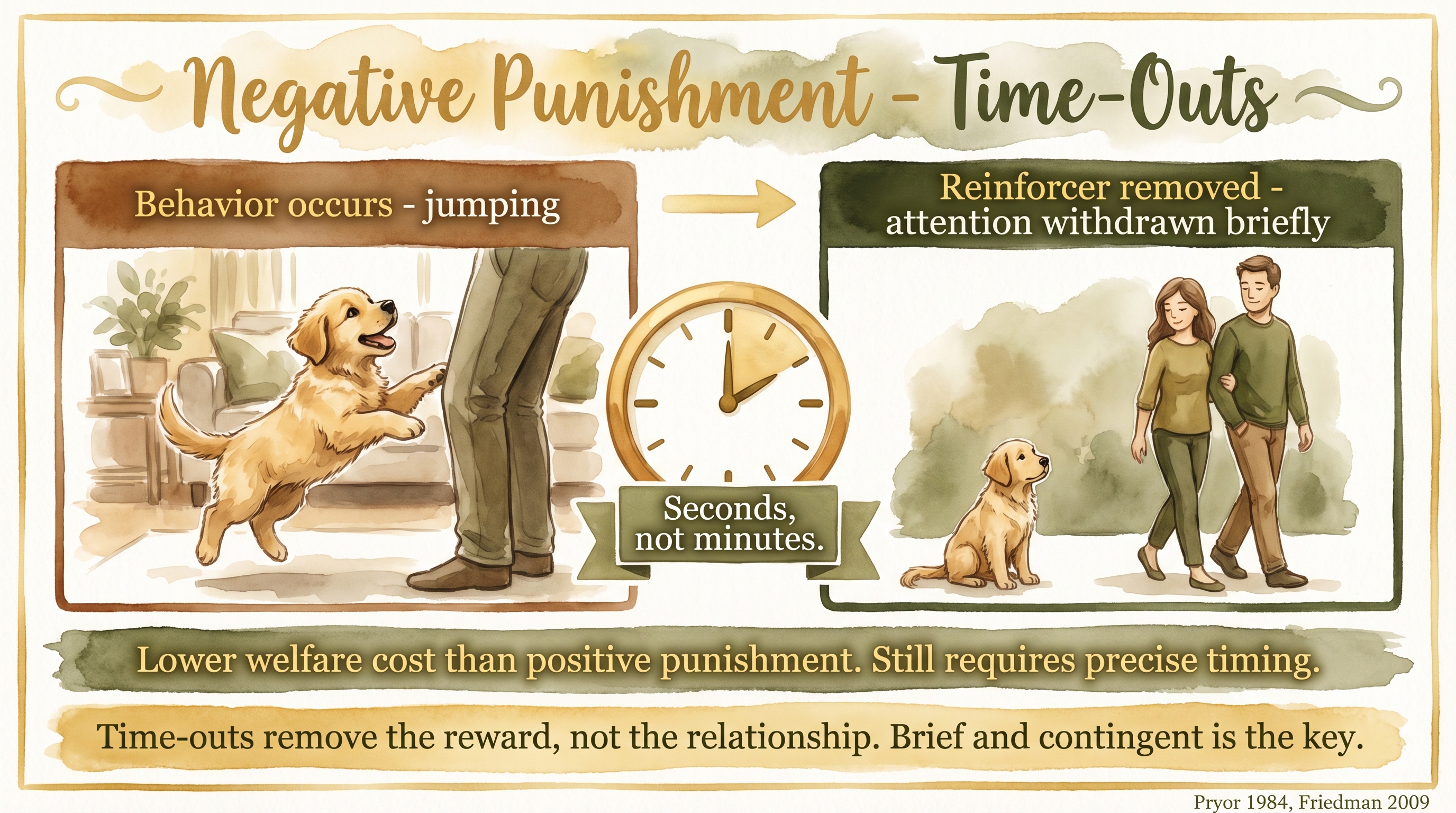
Time-outs remove the reward, not the relationship - brief and contingent is the key.
Key Takeaways
- Negative punishment reduces behavior by removing something the dog wants, usually attention, access, play, or movement.
- It is widely used because it can draw a line without adding pain or fear, but it still depends on timing, clarity, and short duration.
- For socially motivated Goldens, brief disengagement can be powerful when the rest of the household is calm.
- JB treats quiet withdrawal as communication inside a relationship, while still acknowledging that the event can be described in operant terms.
The Evidence
- companion dogs
Summarizes the comparative logic by which trainers use response-cost and quitting-signal strategies as lower-stress alternatives to aversive control. - Salgirli Demirbas et al. (2012)dogs
Found lower stress indicators with a quitting-signal approach than with electronic-collar or pinch-collar use in recall training. - companion dogs
Documents the structural problem of owner inconsistency, which weakens any consequence-based plan even when the method itself is humane. - Aversive-welfare comparison literaturecompanion dogs
Supports the practical conclusion that removing access is generally less welfare-costly than adding aversive stimulation when behavior reduction is needed.
- domestic dogs
No published long-term study directly compares negative punishment and time-outs against structured relational raising and no-intervention controls across ordinary companion-dog homes.
SCR References
Sources
- Salgirli Demirbas, Y., et al. (2012). Medycyna Weterynaryjna.
- Lamb, L., et al. (2018). Frontiers in Veterinary Science.
- Powell, L., Stefanovski, D., Siracusa, C., & Serpell, J. A. (2021). Frontiers in Veterinary Science, 7, 630931. https://doi.org/10.3389/fvets.2020.630931