Is the Modern Dog More Behaviorally Compromised Than Earlier Dogs?
This entry is intentionally heuristic. There is no clean century-long behavioral census of owned dogs that would let anyone answer the title question with hard empirical finality. The field lacks standardized longitudinal population data for most of the twentieth century, definitions of "behavior problem" have changed, and the social role of pet dogs has changed with them. So the honest starting point is restraint: we cannot document in a strict sense that the modern dog is behaviorally worse than earlier dogs in one simple numeric way. Heuristic
What we can document is a surrounding landscape that makes the question hard to dismiss. Large modern datasets find high prevalence of fear, anxiety, and behavior problems. Dinwoodie et al. 2019 found at least one problem in 85 percent of dogs in a U. EstimatedS. survey. Meyer et al. 2023 found at least one problem in 34 percent of a representative Danish sample. Salonen et al. 2020 found noise sensitivity in 32 percent of more than 13,700 Finnish dogs. Blackwell et al. 2008 reported a mean of 11.3 undesirable behaviors per dog in their sample. Shelter and surrender studies repeatedly identify behavior as a major reason dogs lose homes. The training and behavior industries have also become large, specialized, and economically meaningful. None of those facts proves historical worsening. Together they raise the possibility that the modern companion dog is carrying a behavior burden visible enough to support a whole economy around it.
JB's interpretive answer is yes, probably, but only as a heuristic claim. Modern dogs are often socially isolated from stable adult canine groups, physically confined, behaviorally overmanaged, emotionally overstimulated, and raised by humans who may have never watched calm adult dogs raise young. The training industry then meets the resulting dog as if the solution begins at the level of method. That is a coherent hypothesis. It is not the same as settled historical science.
The value of the question is therefore not triumphalist certainty. It is orientation. If the answer is even partly yes, then the Five Pillars are best read as a response to a modern developmental problem rather than as just another training ideology.
What It Means
What We Can Actually Document
We can document that modern companion dogs show a substantial burden of behavior problems in current datasets. Fear and anxiety are common. Aggression is meaningful at population level. Surrender data repeatedly implicates behavior. Documented Veterinary behavior medicine exists because the case load exists. Psychopharmacology for dogs exists because anxiety, panic, and related syndromes are clinically important enough to justify it. These are present-tense facts.
We can also document that the dog-training profession expanded dramatically across the late twentieth and early twenty-first centuries, that behavioral specialization emerged as a recognizable veterinary niche, and that substantial sectors of the pet economy now market solutions for reactivity, separation distress, confidence-building, and emotional regulation. Those developments do not by themselves prove worsening. They do show visibility, demand, and market concentration around canine behavior trouble.
Why Historical Comparison Is So Hard
The historical comparison problem is genuine. Earlier eras often lacked formal measurement, used different expectations for pet behavior, tolerated different levels of nuisance, and kept dogs in different physical and social arrangements. Observed-JB A dog living partly outdoors, surrounded by other dogs, with lower expectations for public access and domestic refinement might have displayed less visible conflict under those conditions even if the underlying animal was not intrinsically more resilient. Conversely, an older household might have simply tolerated behavior that a modern family now labels unacceptable.
This is why direct comparisons are so difficult. We are not only comparing dogs across time. We are comparing dogs, homes, expectations, and observation systems across time.
The Indirect Evidence That Suggests Trouble
Even with those caveats, several indirect indicators are suggestive. First, the prevalence literature is heavy. Documented Second, the relinquishment literature says behavior repeatedly threatens placement. Third, the working-dog and guide-dog literature shows that even highly selected and carefully raised dogs are filtered heavily on behavioral grounds. Fourth, the ethological critique in the JB source base argues that modern dogs are often raised with less organic canine mentorship and more human-designed method. Fifth, the Coppinger line repeated in the source base, that most dogs in the world remain free-ranging and untrained, puts pressure on the assumption that formal training is a necessary baseline for dog functionality.
Taken together, those facts do not prove a historical curve. They do make the hypothesis of modern behavioral compromise intellectually serious rather than melodramatic.
JB's deeper argument is not merely that modern dogs have many problems. It is that the relationship shifted when life with dogs was increasingly organized around methods rather than around mature social raising. That is a philosophical reading supported indirectly, not a documented settled conclusion.
What JB Thinks Is Probably Happening
JB's heuristic interpretation is that modern family dogs are often more behaviorally compromised because they are raised in conditions that pull them away from the kind of developmental ecology that once helped dogs become functional companions more naturally. More only-dog homes, less adult-dog mentorship, more human emotional volatility, more confinement, more chronic excitement, more fragmented routines, and more training cultures that start by generating arousal and then attempting to regulate it later all plausibly contribute.
The thesis of "social puppies in adult bodies" belongs here. Many modern dogs may be physically mature while remaining behaviorally juvenile because the systems around them never pulled them upward into steadier social adulthood. That is a recognizable pattern in family life even if it has not been measured over a century with the rigor a historian would want.
Why It Matters for Your Dog
For a family raising one dog in one house, this question matters because it changes what the everyday work is understood to be. If modern behavior trouble is mainly a matter of bad techniques and better techniques, then the task is to shop well. If modern behavior trouble is partly a developmental and cultural problem, then the task is broader. The family has to build a life that gives the dog better social and emotional footing than the modern default often provides.
Think about what many companion dogs actually experience. They may spend much of early life without stable adult canine models. They may be moved from breeder to home into an only-dog environment where the main social teachers are inexperienced humans, children, social-media advice, and brief class sessions. They may have intense bursts of stimulation, frequent novelty, inconsistent rest, and fragmented household rhythm. They may be praised for excitement and corrected for its consequences. None of that proves historical worsening, but it does describe a developmental ecology that could plausibly manufacture the very problems the modern dog market keeps trying to fix.
Goldens are especially revealing here because they often start with social optimism. A good Golden wants to connect, is quick to engage, and can seem behaviorally resilient in puppyhood. In a well-structured environment, those qualities can mature beautifully. In a chronically excited, inconsistent, or mentorship-poor environment, the same qualities can disperse into jumping, overattachment, poor settling, impulsive greetings, and emotional overavailability. The breed's warmth can therefore either become composure or remain juvenile enthusiasm in a larger body.
This question also matters because it lowers the glamour of method-switching. If the dog's difficulties are partly products of the whole social atmosphere, then technique changes alone will often disappoint. A family may rotate from positive to balanced to relationship-based vocabulary and still keep producing the same dysregulated dog because the underlying ecology has not changed.
The heuristic reading also encourages sympathy. Many families did not create these conditions maliciously. They inherited a culture that treats dogs as both emotional companions and behavior projects, often without giving adults much model of calm, socially mature dog raising. Recognizing that does not excuse avoidable mistakes. It does explain why so many decent people end up needing help.
For the dog, the real gain from this perspective is that it moves intervention earlier and wider. Instead of asking only how to stop barking, lunging, mouthing, or panicking, the family asks what kind of life is teaching the nervous system to live that way. That is a deeper question, and it is often the more compassionate one.
There is also a sobering retention angle. If the modern dog is indeed carrying more behavioral fragility, then families are adopting into a system where more support is needed than the culture admits. Without that support, many dogs will keep cycling through classes, management tools, medications, or even homes without ever getting the kind of developmental reset the problem may actually require.
That is why this entry closes the category. The question is not only academic. It points back to the whole thesis of Category 6: maybe the field's growth is itself partly evidence that too many dogs are not being raised in a way that reliably produces stable family companions. Documented That is not proved in the strongest sense. It is still a powerful lens for what families see in real life.
It also reframes what counts as innovation. If the root problem is partly that modern dogs are missing older forms of social and developmental stability, then the answer may not be a newer gadget, a sharper protocol, or a more persuasive brand story. The answer may be a more faithful reconstruction of calm social raising inside the modern home.
That possibility is uncomfortable for a market built on novelty, because it suggests the deepest solution may look less like invention and more like recovery. Still, many families already recognize that feeling intuitively when calmer, simpler structure works better than a new technique package did.
It also helps explain why many families feel relief when they simplify rather than intensify. If modern dog trouble is partly a problem of overstimulation, under-mentorship, and socially immature daily life, then calmer routines can work not because they are magical but because they stop feeding the exact ecology that may be producing the problem.
That gives the family a practical benchmark for success: not only sharper technique, but a dog whose daily life looks more mature, more settled, and less socially frantic than it did before.
What This Means for a JB Family
JB families should hold this entry with disciplined humility. The project is not claiming to have empirically proven that today's dogs are categorically worse than yesterday's dogs. It is claiming that the available evidence and the visible modern landscape make that interpretation plausible enough to guide action.
The practical action is to reject the modern defaults most likely to produce behavioral fragility. Build calm. Protect the transition from breeder to home. Let structure mature the dog. Do not confuse constant stimulation with development. Do not expect technique to replace missing early ecology.
This is where the Five Pillars become most coherent as a set. They are not simply tricks for getting a better-behaved pet. They are an attempt to recreate, inside a modern family home, some of the stabilizing conditions many dogs may now be missing.
If that heuristic is even partly right, then JB is not adding one more training method to a crowded market. It is trying to answer why the market became so crowded in the first place.
That is a bold claim. It should stay tagged as bold, interpretive, and incomplete. But it is also the claim that best explains why the project exists at all.
For families, the practical value of that claim is that it redirects attention away from endless method shopping and back toward how the dog is actually being lived with. Even a heuristic can be extremely useful when it points adults toward a better set of daily questions.
Those questions are concrete. Is this dog getting calm adult guidance or mostly peer-style excitement from humans? Is the house giving enough rest and predictability? Is social maturity being pulled upward or accidentally kept juvenile because the dog is charming, entertaining, and easy to indulge? A heuristic becomes practical when it reorganizes attention around those details.
It also makes the family less dependent on industry fashion. If the core issue is developmental ecology, then the most useful improvements may come from steadier adults, simpler routines, and stronger prevention rather than from whatever new method language is currently trending. That is a liberating possibility for homes that feel exhausted by constant expertise shopping.
It also suggests that some of the most important modern dog work may be quietly cultural rather than technically novel. A family may help its dog most by living more steadily, more clearly, and more developmentally honestly than the surrounding culture usually encourages.
That does not answer every historical question, but it does answer a practical one. If a family suspects modern dogs are being raised into preventable fragility, it can choose not to reproduce that pattern. In that sense, the heuristic is actionable even before it is conclusive. It points the household toward calmer mentorship, stronger transition care, and less faith that stimulation and technique alone will mature the dog.
That interpretation is worth taking seriously because it restores agency without pretending to restore certainty. A family may not be able to solve the whole historical question, but it can still decide whether its own home will reproduce the overstimulated, under-mentored pattern JB is criticizing or offer the dog something more stabilizing instead.
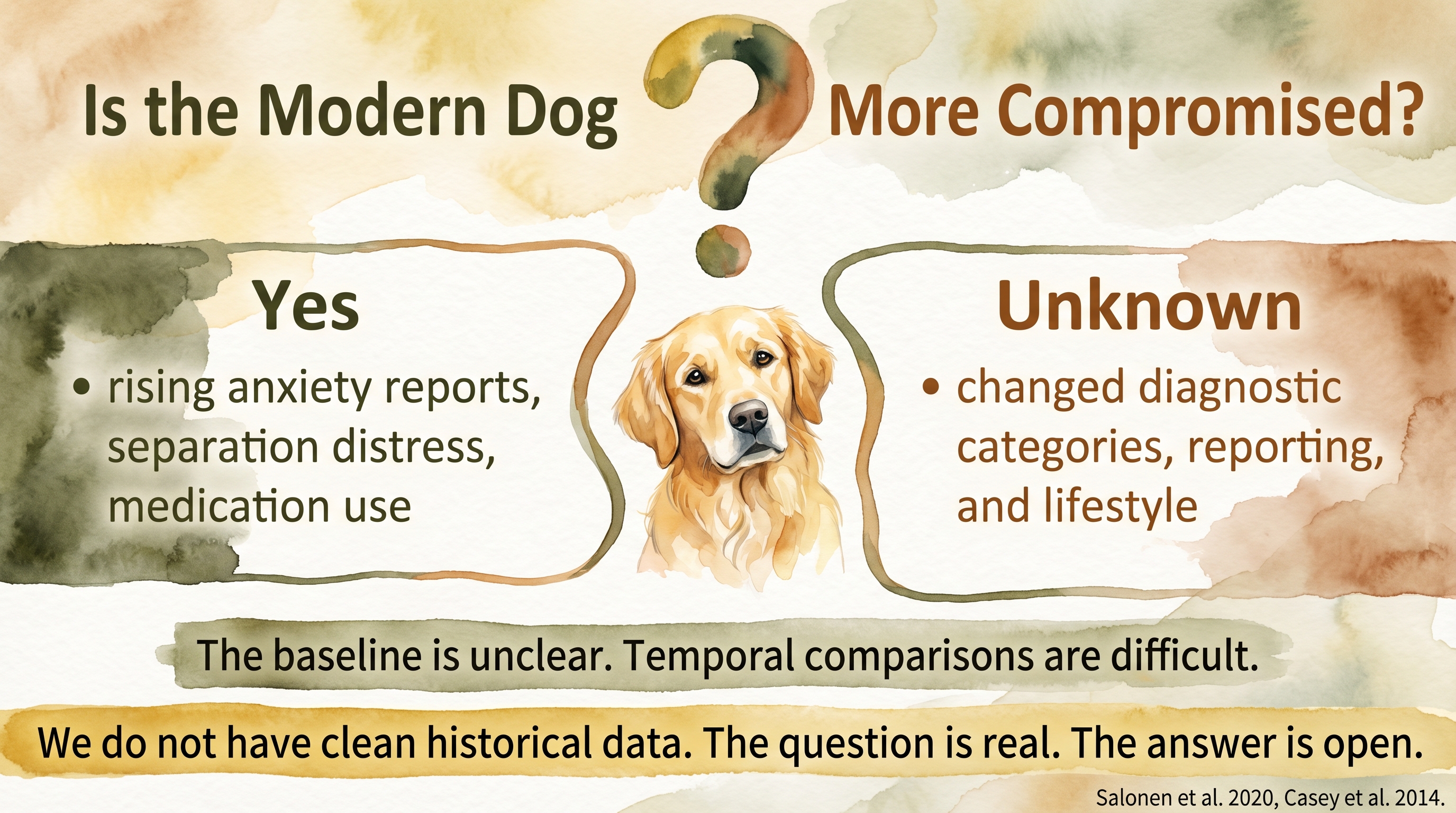
We do not have clean historical data - the question is real, the answer is open.
Key Takeaways
- The claim that the modern dog is more behaviorally compromised than earlier dogs is heuristic, not documented settled science.
- Current datasets, surrender data, and the size of the behavior-help economy make the hypothesis serious enough to consider.
- JB interprets the problem as partly developmental and cultural, not merely technical.
- The Five Pillars are presented as a response to that modern ecology, not as proof that the question has been conclusively answered.
The Evidence
This entry uses documented claim-level tags beyond the dedicated EvidenceBlocks below. These claims should remain tied to the entry Sources and SCR references during the next evidence-chain authoring pass.
This entry uses observed claim-level tags beyond the dedicated EvidenceBlocks below. These tags mark JB program observation or practice-derived claims that need dedicated EvidenceBlock coverage in a later content pass.
This entry uses estimated claim-level tags beyond the dedicated EvidenceBlocks below. These tags mark approximate ranges or timing claims that should remain bounded by the cited sources.
- Dinwoodie et al. (2019), Meyer et al. (2023), Salonen et al. (2020), and Blackwell et al. (2008)companion dogs
Show that current dog populations carry a substantial burden of behavior problems across multiple countries and methods. - Surrender and return literaturecompanion dogs
Shows that behavior problems remain a major reason dogs lose homes. - Working-dog and guide-dog outcome literatureselected dogs in high-investment systems
Shows that even carefully selected and heavily supported dogs are frequently lost on behavioral grounds. - companion dogs
Supports the interpretive argument that modern dogs may be missing social and developmental conditions that once buffered everyday functionality.
- domestic dogs
No single dataset directly resolves the full population picture for is the modern dog more behaviorally compromised than earlier dogs? without the usual survey, sampling, and threshold limitations.
SCR References
Sources
- Dinwoodie, A. T., et al. (2019). Animals.
- Meyer, I., et al. (2023). Scientific Reports.
- Salonen, M., et al. (2020). Scientific Reports.
- Blackwell, E. J., Twells, C., Seawright, A., & Casey, R. A. (2008). Veterinary Record.