What We Do and Do Not Know About Training Methods
Compound evidence detail1 SCR / 2 parts
- Documentedthe structural absence of an industry-wide standardized canine behavioral outcome measurement and reporting system, supported by Hsu and Serpell 2003 (C-BARQ instrument), Lamb 2018 (LAIR clinician-overestimate finding), Mills 2020 (LCAS validation), Wright 2012 (DIAS validation), Daniels 2022 (UK client-rated equivalence regardless of method), and the IAABC Foundation Journal 2023 review of informal-assessment dependence
- Heuristicthe JB framing comparing the dog-training industry's outcome-measurement vacuum to adjacent helping professions (veterinary medicine, human psychology, education) where outcome measurement is regulatorily mandated or conventionally standardized, with the qualifier that the structural claim concerns industry-scale practice and does not deny that individual trainers measure outcomes in their own work
The dog-training field contains both real evidence and a remarkable amount of rhetorical overshoot. That combination makes synthesis unusually important. Families are not well served by being told either that everything is opinion or that the science has already settled every major dispute. The literature does support some claims with meaningful confidence. Reward-based training is associated with fewer stress signals and fewer aggression-related concerns than aversive-heavy handling in the published studies reviewed by Ziv 2017 and expanded by later work such as Vieira de Castro 2020 and China 2020. Handler skill and owner variables clearly matter, as Powell et al. 2021 showed. Adherence matters, as Takeuchi et al. 2000 and the broader habit literature make plain. At the same time, the field remains weak on long-term whole-dog outcomes, on clean causal separation between method and owner factors, and on decisive comparisons between formal training paradigms and prevention-oriented raising systems. Documented
This entry exists to keep those lines visible. The point is not to water down meaningful welfare findings. The point is to stop the field from speaking as if a directional pattern were the same as complete closure. A method can be directionally supported, ethically preferable as a first line, and still not proven superior on every outcome a family cares about.
That distinction matters especially because dog training often markets itself through absolutes. One camp says rewards solve the problem if applied correctly. Another says humane methods fail without stronger consequences. A third says relationship, leadership, or mindset matters more than both. The evidence does not fully vindicate any of those slogans as slogans.
JB's task is therefore not to declare victory for a tribe. It is to read the literature at the right level of confidence and then say, clearly, where interpretation begins.
What It Means
What the Evidence Supports Fairly Strongly
The field supports several conclusions more strongly than others. First, aversive-heavy handling carries welfare concerns that should be taken seriously. Ziv 2017 reviewed seventeen studies and concluded that aversive methods were associated with stress, fear, and aggression risk while recommending reward-based methods as first-line. Documented Vieira de Castro et al. 2020 did not rely only on owner impressions; they combined behavioral coding, salivary cortisol, and cognitive-bias testing and again found poorer welfare indicators in dogs from aversive schools. Cooper et al. 2014 and China et al. 2020 found no convincing performance superiority for remote-collar groups over reward-based alternatives while still documenting higher stress-related signals.
Second, the handler matters enormously. Powell et al. 2021 showed that owner personality and attachment are associated with treatment outcome in behavioral-medicine cases. Takeuchi et al. 2000 showed that owners only partially implemented treatment plans. These results do not dissolve method differences. They do mean that outcome claims built purely around method labels are incomplete by design.
Third, long-term evidence is thin. The notebooks underlying this dispatch repeatedly note the scarcity of multi-year follow-up, the weakness of transfer measures, and the instability of owner-report outcome data. That is a positive conclusion too, in the sense that it tells us something real about the field's boundaries.
What the Evidence Does Not Actually Prove
The literature does not prove that one branded approach produces the best dog in every household. It does not prove that reward-based work by itself resolves every serious behavior problem. It does not prove that every use of aversive pressure is identical in welfare effect across dose, timing, context, or dog. It does not prove that visible task success in a short study equals long-term maturity, household calm, or emotional security.
These missing proofs matter because they are exactly where public conversation becomes most inflated. A reward-based advocate may correctly cite welfare findings and then drift into saying all better outcomes follow naturally from that. A balanced trainer may correctly note research gaps and then drift into implying there is therefore no meaningful welfare asymmetry. Documented Neither move is justified by the literature as it stands.
What Families Can Reasonably Infer
Reasonable inference lives between overclaiming and paralysis. It is reasonable to infer that lower-stress, lower-threat methods are a safer ethical starting point in companion dogs. It is reasonable to infer that handler skill and plan adherence will determine much of what happens next. It is reasonable to infer that short-term performance findings should not be sold as if they settled long-term family-dog development. It is also reasonable to infer that prevention-oriented systems deserve more study because the field spends far more energy comparing response methods after problems emerge than comparing upstream ways of preventing them. Documented
The ethological-critique notebook adds another useful limit. Puppy classes may help because they provide both training and socialization, and the field has not cleanly separated those factors. That means even some seemingly straightforward findings about "training effectiveness" may partly be findings about exposure, owner engagement, or environmental enrichment.
The literature more clearly supports avoiding unnecessary welfare cost than it does any grand promise about technique. That directional pattern fits JB's emphasis on Prevention and Calmness, but it does not remove the need to distinguish evidence from interpretation.
Where JB Stands, Carefully
JB can say some things firmly. Prevention is compatible with the evidence in ways that correction-heavy intervention is not. Calmness as a household baseline fits what the welfare literature implies about arousal, fear, and stress. Heavy reliance on aversive tools during the raising phase looks poorly aligned with the direction of the published evidence.
JB should say other things more modestly. The field has not directly proven that the Five Pillars produce superior adult family dogs compared with all alternative systems. It has not run the decisive relational-raising versus formal-training versus control experiment over years. JB may argue that its model is consistent with available evidence and with mammalian developmental logic. Heuristic It should not pretend the field has already tested every deep JB thesis.
Why It Matters for Your Dog
For a family living with a real dog, this synthesis matters because nearly every major decision in the marketplace asks you to buy more certainty than the literature can honestly provide. A trainer may promise reliability, emotional balance, or lifelong manners through one protocol. A humane school may imply that choosing rewards is all the family needs to do. Another voice may insist that all modern methods fail without some stronger consequence. The literature can help you sort these claims, but only if you know what it does and does not cover.
Suppose your Golden Retriever is entering adolescence and suddenly feels louder, springier, and less cooperative than he did two months ago. If you hear only slogans, you may think the issue is now a referendum on philosophy. The reward-based camp says double down on reinforcement. The correction camp says the dog needs accountability. A relationship-oriented trainer says the household's emotional tempo is the actual problem. The evidence does not fully settle that specific family question. It does give you boundaries. It says welfare risk is meaningfully higher in aversive-heavy handling. It says owner behavior will heavily influence results. It says long-term comparative certainty is weaker than the market sound suggests.
That combination is useful because it narrows the field without pretending to solve the whole case. Families can reasonably start with lower-risk teaching strategies, simpler plans, more household consistency, and stronger prevention. They do not need to accept a harsh tool because someone says that science proves it is necessary. They also do not need to believe that method label alone will compensate for chaotic routines or weak follow-through.
The entry also protects families from disappointment built on category mistakes. If a six-week program improves visible obedience, that does not automatically mean the dog has become calmer in the deeper sense a family wants. If a reward-based plan avoids stress, that does not automatically mean it has already solved durability, generalization, or owner adherence. When owners confuse one measured outcome with all desired outcomes, they buy the wrong kind of confidence.
Goldens create their own special version of this confusion because they often stay friendly enough that households underestimate underlying overstimulation or immature self-regulation. A Golden can look socially successful and still be living in a high-arousal pattern that later becomes expensive. A family reading the evidence well will therefore ask not only what behavior changed, but how the dog feels, how transferable the change is, and whether the household can keep the plan going.
Another practical benefit of this synthesis is that it lowers shame. Many families think mixed results mean they chose the wrong camp. Often the truth is less dramatic. The field itself is incomplete. Their dog is a living individual inside an imperfect household. The method mattered, but so did timing, practice density, developmental stage, and how the home was organized. A disciplined reading of evidence gives families room to adjust without narrating every setback as ideological failure.
This is where the combination of evidence and humility becomes protective. A family can reject needlessly stressful methods, keep expectations realistic, and still stay open to the fact that dogs are not solved through one abstract allegiance. That posture tends to produce better decision-making than panic, tribalism, or desperate certainty.
It also makes trainer selection easier. A serious professional should sound accurate about the field's limits. They should be able to say what welfare findings are strong, where owner follow-through becomes decisive, and what outcomes remain harder to guarantee. The more a trainer can separate evidence, inference, and judgment, the more likely the family is hearing an adult rather than a marketer.
The same synthesis also helps families tolerate slower, steadier progress. If the literature is better at supporting directional welfare choices than at guaranteeing miracle timelines, then a humane plan does not become discredited simply because the dog is still messy this month. Owners can keep evaluating the right things: stress load, household coherence, recovery, generalization, and whether the dog is becoming easier to live with over time rather than merely easier to stage in one setting.
That broader patience is especially useful in developmental rough patches. Adolescence, life changes, travel, injury, or shifts in household schedule can temporarily worsen behavior without proving that the original humane framework was misguided. Documented A family reading the evidence accurately will respond by adjusting management and restoring consistency before assuming the only serious answer is a harsher method.
What This Means for a JB Family
JB families should read method claims in layers. First ask what the literature supports firmly. Second ask where reasonable inference begins. Third ask what part of the decision depends on the family's own capacity, daily structure, and long-term consistency.
Practically, that means choosing lower-welfare-risk starting points, refusing inflated guarantees, and remembering that the adults remain part of the intervention. It also means treating calm routines, prevention, and readable household structure as major variables rather than decorative philosophy.
JB's own voice should be held to the same standard. When a claim is documented, say so cleanly. When a claim is heuristic, keep it explicitly heuristic. Families are better served by honest confidence bands than by a polished fiction that every part of dog raising is already proven.
The field does know enough to rule some things in and some things out. It does not know enough to let anyone market complete certainty with a straight face. That is not a frustrating middle. It is the right one.
Living inside that middle often makes families calmer too. The goal is no longer to locate the One True Method. The goal is to make the best available decision using the evidence we have, while keeping the dog's welfare, the household's reality, and the limits of current research in full view. Documented
That stance also changes what counts as progress in the home. A household that is less frantic, a dog that recovers faster, fewer rehearsals of chaotic behavior, and clearer boundaries may all represent meaningful success even before every outward behavior looks polished. The literature's incompleteness should not become an excuse to ignore those concrete improvements. It should simply keep families from overselling them as proof of universal law.
For JB families, that is an unusually productive place to stand. It allows conviction without propaganda. The house can stay humane, serious, and observant while leaving room for the fact that some of the deepest developmental questions remain open in the published field.
That combination is rare in the market and worth protecting. It lets adults act with backbone while staying intellectually clean, which is often the best available path in a field where the evidence is real but incomplete. That intellectual cleanliness matters.
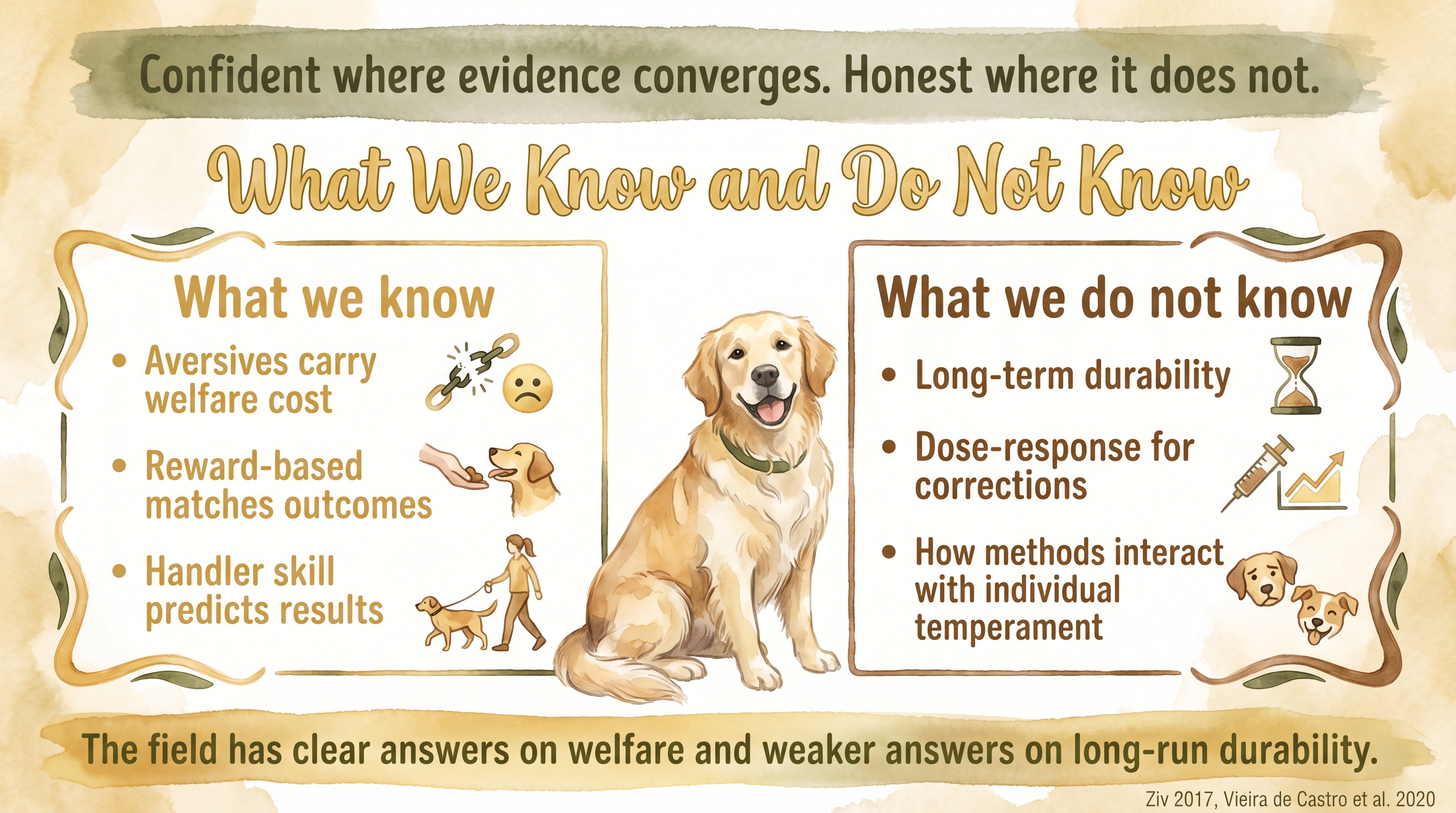
Clear answers on welfare - weaker answers on long-run durability.
Key Takeaways
- The field more clearly supports avoiding unnecessary welfare cost than it supports any universal claim that one method solves every dog problem.
- Reward-based work has the better published welfare profile, but that does not mean the literature has settled every long-term family-dog question.
- Handler skill, owner adherence, and upstream prevention are major variables that method debates often underplay.
- JB should present its own conclusions as evidence-consistent where appropriate, and explicitly heuristic where the field has not yet tested the deeper thesis.
The Evidence
This entry uses heuristic claim-level tags beyond the dedicated EvidenceBlocks below. These tags mark JB interpretive application rather than direct study findings.
- Ziv (2017)companion dogs
Review supports reward-based methods as first-line and links aversive approaches with stress, fear, and aggression risk. - Vieira de Castro et al. (2020)companion dogs
Behavioral, cortisol, and cognitive-bias measures converged in showing poorer welfare indicators in aversive-school dogs. - Powell et al. (2021) and Takeuchi et al. (2000)companion dogs
Show that handler variables and adherence materially shape outcome, limiting simplistic method-only conclusions. - companion dogs
Highlights unresolved confounds such as socialization-versus-training effects and the absence of decisive three-group comparisons.
- domestic dogs
No published long-term study directly compares what we do and do not know about training methods against structured relational raising and no-intervention controls across ordinary companion-dog homes.
SCR References
Sources
- Ziv, G. (2017). Journal of Veterinary Behavior.
- Vieira de Castro, A. C., et al. (2020). PLOS ONE.
- China, L., Mills, D. S., & de Souza Machado, D. (2020). Animals.
- Cooper, J. J., et al. (2014). PLOS ONE.
- Powell, L., Stefanovski, D., Siracusa, C., & Serpell, J. A. (2021). Frontiers in Veterinary Science, 7, 630931. https://doi.org/10.3389/fvets.2020.630931
- Takeuchi, Y., Houpt, K. A., & Scar