Evidence-Based vs Evidence-Informed Dog Training
Compound evidence detail1 SCR / 2 parts
- Documentedthe structural absence of an industry-wide standardized canine behavioral outcome measurement and reporting system, supported by Hsu and Serpell 2003 (C-BARQ instrument), Lamb 2018 (LAIR clinician-overestimate finding), Mills 2020 (LCAS validation), Wright 2012 (DIAS validation), Daniels 2022 (UK client-rated equivalence regardless of method), and the IAABC Foundation Journal 2023 review of informal-assessment dependence
- Heuristicthe JB framing comparing the dog-training industry's outcome-measurement vacuum to adjacent helping professions (veterinary medicine, human psychology, education) where outcome measurement is regulatorily mandated or conventionally standardized, with the qualifier that the structural claim concerns industry-scale practice and does not deny that individual trainers measure outcomes in their own work
In human medicine, "evidence-based" has a fairly demanding meaning. It implies that decisions are grounded in a substantial body of comparative research, that high-quality studies carry more weight than low-quality ones, and that professional judgment is being exercised inside a mature evidence hierarchy. Dog training often borrows the phrase while operating in a much thinner research environment. That does not make the phrase always false, but it does make it easy to overstate what is actually known. The more honest label for most of the field is evidence-informed. The field has real studies, real welfare findings, real survey data, and real behavior science concepts. It also has major gaps: short follow-up periods, small controlled samples, owner-report bias, unresolved socialization confounds, poor long-term comparative work, and almost no decisive tests of many practical claims families hear every week. Documented
The distinction between evidence-based and evidence-informed matters because it disciplines rhetoric. A person speaking evidence-based language in a thin field can accidentally imply that stronger closure exists than the literature can support. A person speaking evidence-informed language is admitting that evidence helps shape judgment, but judgment is still doing more work than the field sometimes likes to admit.
This is not a minor semantic preference. It changes how families evaluate confidence, how professionals talk about uncertainty, and how JB itself should present its own philosophy. If every claim is marketed as settled science, then honesty about confidence bands disappears. If evidence-informed practice is named clearly, then documented claims and interpretive claims can coexist without pretending to be the same kind of statement.
JB should be especially careful here because its framework is ambitious. Some JB claims are strongly supported. Others are consistent with evidence without being directly proven. The integrity of the whole project depends on keeping those categories separate.
What It Means
What "Evidence-Based" Would Require
To call a field fully evidence-based in the strict sense, one would want repeated strong studies on the main practical questions the field asks. Documented Which methods produce which long-term outcomes in which populations? How durable are gains after the intervention ends? What are the welfare costs across variants of technique? How much do owner variables alter results? How do prevention-oriented raising systems compare with problem-response training systems? Dog training does not yet have robust answers to most of those questions.
The field has some better-supported islands. Welfare concerns around aversive-heavy handling are supported by multiple lines of research. Documented Some comparative outcome findings recur across surveys and school comparisons. Yet the deeper the question becomes, the faster the evidence thins. By the time a family asks, "What will most likely produce a calm, mature adult dog in my house over years?" the field is already leaning heavily on inference.
Why "Evidence-Informed" Fits Better
Evidence-informed practice means available evidence is used seriously without pretending it closes every practical question. The clinician, trainer, breeder, or family reads the literature, respects study hierarchy, notices uncertainty, and then makes reasoned decisions using both evidence and context. That is not anti-scientific. It is an honest description of how practice works in a field whose evidence base is meaningful but incomplete.
The notebooks for this dispatch provide several reasons this label fits dog training well. Long-term outcomes are weakly measured. Socialization and owner-engagement confounds persist. Selection bias shapes method comparisons. Adherence changes results in ways the literature often undermeasures. Many questions families care most about, such as household calm or durable maturity, are not captured cleanly in published endpoints. Evidence therefore informs the judgment rather than replacing it.
How the Distinction Changes Trust
Trustworthy professionals usually become more trustworthy, not less, when they use the evidence-informed label carefully. A trainer who says, "Here is what the literature supports strongly, here is what it suggests, and here is where I am reasoning from experience and theory," is showing the family where confidence should be placed. A trainer who calls every claim evidence-based in a broad, undifferentiated way is asking for belief the field has not fully earned.
This is also where the Scientific Claims Register matters inside JB. Heuristic The SCR is an operational answer to the evidence-based versus evidence-informed problem. It forces claims to carry their confidence level. A documented claim can be spoken firmly. A heuristic claim must be hedged and presented as interpretation. That is exactly the discipline a thin field requires.
Signal Precision applies to knowledge claims too. If every statement is delivered with the same rhetorical force, the reader loses the ability to tell what is established, what is inferred, and what is still open.
Where Dog Training Overreaches
The overreach usually shows up in marketing language. "Science-based" gets used to bless broad programs built from a relatively small number of studies. "Evidence-based" is used as if it means the method has been proven superior across all important outcomes. Balanced and correction-oriented camps sometimes make a mirror-image overreach by using the field's incompleteness to imply that stronger welfare findings can be set aside. Both moves distort the field in opposite directions.
Calling the field evidence-informed does not weaken good science. It protects it from being converted into a brand slogan. It also protects families from the false choice between naive certainty and total skepticism. Evidence-informed practice says the evidence matters very much and still leaves room for uncertainty, context, and disciplined interpretation.
Why It Matters for Your Dog
Families usually encounter this distinction in disguised form. A website says its method is evidence-based. A trainer says the science is clear. Another professional says there is no evidence for the alternative. The words sound technical, but they are doing social work. They are telling the owner how much certainty to feel before looking under the hood.
For a Golden Retriever family, that matters because dog-raising decisions often happen quickly. A puppy class is being chosen this week. An adolescent problem is happening now. An expensive package is on the table. If the field is thinner than the language suggests, then the family needs a way to resist being pushed into false confidence. The evidence-based versus evidence-informed distinction gives them that tool.
Take a familiar situation. A family has a jumpy adolescent Golden who cannot settle after guests arrive. One professional says the problem is purely a training issue with an evidence-based protocol. Another says the answer is calmer household structure and prevention of rehearsal. A third says the dog needs stronger consequences. The literature is relevant here, but it does not settle the entire decision tree. Welfare evidence weighs against aversive-heavy handling as a first move. Adherence evidence says the plan must fit the household. Developmental reasoning says rehearsed overarousal matters. If one professional presents the whole package as already scientifically settled, the family is being sold more closure than the field can supply.
This is also helpful when families feel pressure to defend a philosophy as if it were a courtroom verdict. They do not need to prove that every JB claim has the same evidence weight. They need to know which JB claims are documented, which are observed, and which are heuristic. That is a stronger and more honest posture than borrowing the prestige of "evidence-based" and flattening the differences.
Dogs benefit from that honesty because it keeps decision-making flexible without becoming sloppy. The family can say, "We are choosing this because it has the better welfare profile and fits our home," which is a real evidence-informed statement. They do not need to say, "Science has already proven this will produce the best possible adult dog," which overreaches.
There is also a practical consumer-protection angle. When professionals distinguish documented findings from informed interpretation, owners can ask better follow-up questions. What specific studies support this? What part of your recommendation is based on judgment rather than direct trial evidence? What outcomes were measured? How long were dogs followed? Those questions tend to reveal very quickly whether the label is being used carefully or decoratively.
Goldens again make this especially important because their general social appeal can tempt families to overread early success. A method may look beautifully evidence-based because the dog is cooperative and kind, while the harder variables, such as long-term arousal baseline or household maturity, remain undermeasured. Evidence-informed thinking makes room for the breed's charm without letting charm masquerade as proof.
Families also gain emotional steadiness from this distinction. They no longer need to swing between zeal and disillusionment. If a plan helps but does not solve everything, that does not automatically mean the science failed. It may mean the family is using an evidence-informed framework in a field that has not yet measured every long-horizon outcome with the precision people wish it had.
That emotional steadiness has a practical downstream effect. Households that do not expect magical certainty are often better at course-correcting early. They can change trainers, simplify routines, or revise expectations without feeling that the whole worldview has collapsed. The dog then benefits from faster, calmer adaptation instead of from ideological whiplash.
This also improves consent. Families can choose an intervention more honestly when they know which parts are directly research-supported and which parts depend on professional judgment. Documented Honest consent is better for trust, better for follow-through, and better for evaluating the result later without confusion about what was actually promised.
It also lowers the social pressure to perform certainty in front of friends, trainers, or online communities. A family does not have to defend every choice as scientifically final. It can say, with enough backbone, that this is the most humane and evidence-consistent course available while still admitting the field has open questions.
That clarity becomes especially useful when a dog is improving unevenly. Owners can keep a good plan without pretending it was promised to solve everything, and they can modify the plan without feeling that modification itself is a betrayal of science. Evidence-informed language gives them more room to stay truthful while still staying committed.
What This Means for a JB Family
JB families should prefer professionals, programs, and written materials that differentiate their confidence levels openly. A trustworthy guide will usually sound precise about what is documented, modest about what remains uncertain, and clear about which judgments are interpretive. Heuristic
Apply that same expectation to JB. The project should not hide the fact that some of its strongest philosophical positions are still evidence-informed rather than fully evidence-based. That transparency is a strength, not a vulnerability. It means the framework knows where it is standing.
In practical terms, choose plans that are supported enough to be ethically and directionally sound, then evaluate them in your actual home with honesty. That is a better use of evidence than chasing the comfort of a label. The SCR exists so that families do not have to guess which kind of claim they are reading.
The healthiest conclusion is not that evidence-based language should disappear. It is that it should be used with discipline. In a thin field, evidence-informed is often the more accurate phrase, and accuracy builds better trust than inflated certainty ever can.
That accuracy also keeps the family's attention on what they can really observe: whether the dog is calmer, whether the plan is sustainable, whether the household is less conflict-ridden, and whether the claimed rationale matches the evidence weight behind it. Those are the questions that travel from theory into daily life.
In practice, that means a JB family can be both demanding and realistic. Demand honesty about the literature. Demand humane boundaries around what the dog is exposed to. Then stay realistic that some of the most important family-dog decisions still involve informed judgment because the field has not fully measured them yet. That combination is much sturdier than brand loyalty disguised as science.
Used that way, evidence-informed becomes a mature posture rather than a consolation prize. It tells the truth about the field and still gives families enough ground to act with confidence, which is exactly what most real homes need.
It also gives professionals a cleaner way to earn trust. A trainer who can say "this is the best-supported route, here is where judgment enters, and here is what we still need to watch in your actual dog" is often giving the family something more valuable than certainty: a framework sturdy enough to survive real life.
That sturdiness matters because family life is rarely tidy enough to reward brittle certainty. A language of disciplined confidence lets the household keep acting without pretending the field is more complete than it is.
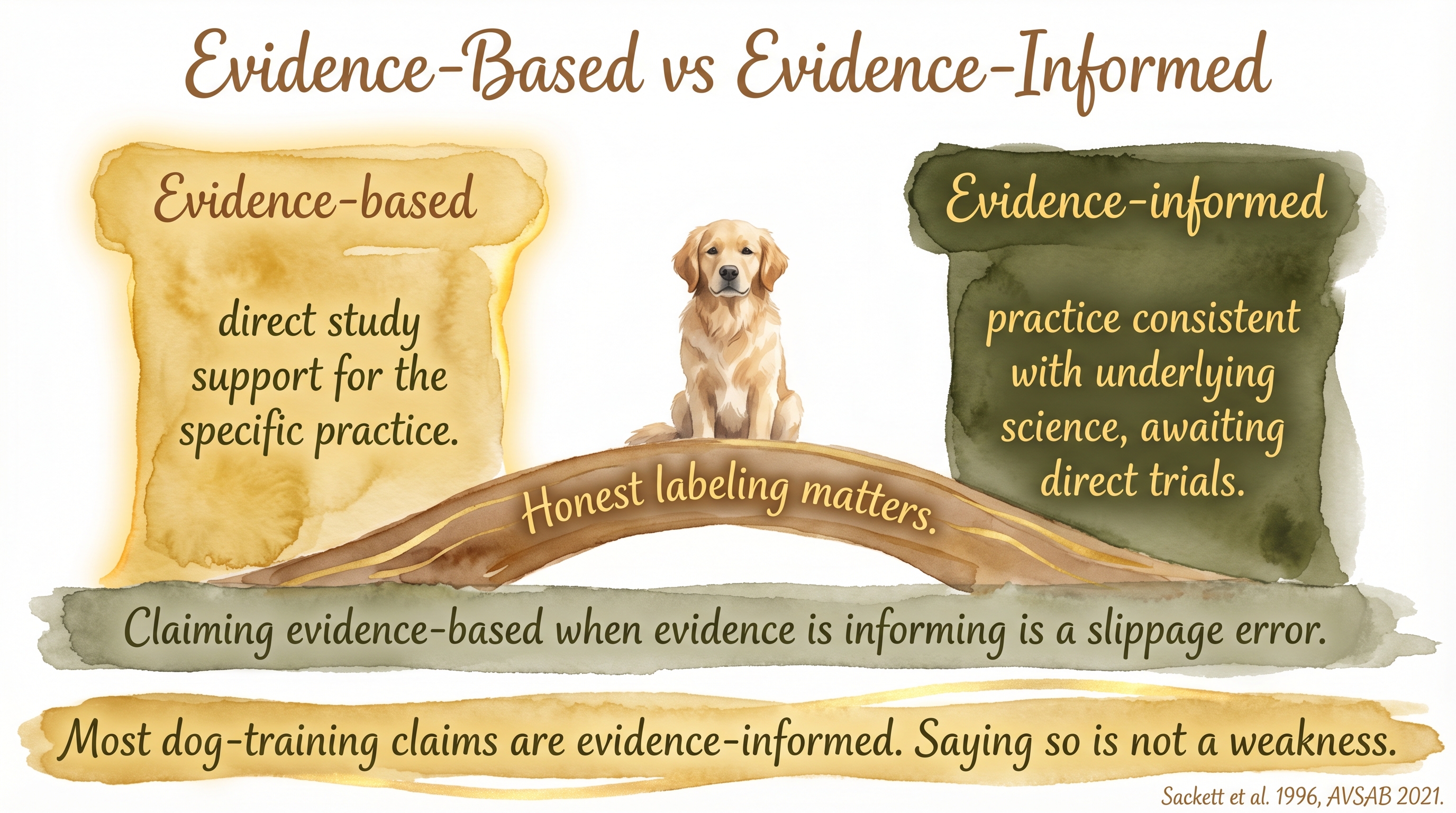
Most dog-training claims are evidence-informed - saying so is not a weakness.
Key Takeaways
- Dog training is better described overall as evidence-informed than as fully evidence-based across the entire range of family-dog questions.
- Some findings, especially around welfare costs and owner adherence, are strong enough to matter a great deal.
- The thinner the field becomes on long-term, real-world, or prevention-oriented questions, the more judgment must be named as judgment.
- JB's SCR is a structural way of keeping documented and heuristic claims from being rhetorically flattened into the same category.
The Evidence
This entry uses heuristic claim-level tags beyond the dedicated EvidenceBlocks below. These tags mark JB interpretive application rather than direct study findings.
- companion dogs
Documents adherence decay, owner effects, and weak long-term follow-up across many training and behavior-treatment questions. - companion dogs
Highlights unresolved confounds and the absence of clean comparative designs on several central practical questions. - Ziv (2017) and Vieira de Castro et al. (2020)companion dogs
Show that some welfare conclusions are genuinely supported even inside a thinner overall field. - human adherence research
Shows why practical effectiveness depends on the human implementation layer as much as on the nominal intervention.
- domestic dogs
No published study directly isolates the long-term dog-level and family-level effects of evidence-based vs evidence-informed dog training across ordinary companion-dog contexts.
SCR References
Sources
- Ziv, G. (2017). The effects of using aversive training methods in dogs - A review of the current evidence. Journal of Veterinary Behavior, 19, 50-60.
- Vieira de Castro, A. C., et al. (2020). Does training method matter? Evidence for the negative impact of aversive-based methods on companion dog welfare. PLOS One, 15(12), e0225023.
- Powell, L., et al. (2021). Improving dog training methods: Efficacy and efficiency of reward and mixed training methods. PLOS One, 16(4), e0247321.