The History of the Dog Training Industry: An Overview
Compound evidence detail2 SCRs / 4 parts
- Documentedthe documented historical sequence of systematic dog-training codification beginning with Konrad Most's 1910 manual Abrichtung des Hundes, Edwin Richardson's 1920 British War Dogs, the US War Department's 1943 Technical Manual TM 10-396 War Dogs, Blanche Saunders's 1954 obedience text, William Koehler's 1962 Method of Dog Training, and the historiographic continuation in Fisher 2017 Animal Studies Journal
- Heuristicthe JB framing of military-to-civilian methodological transfer through WWII-veteran handlers entering the 1950s-60s civilian pet industry, characterizing the influence as the primary historical pathway for systematic training's civilian propagation while acknowledging that the transfer was a diffuse, multi-channel cultural shift rather than a clean institutional pipeline
- Documentedthe documented absence of any RCT establishing single-method superiority across canine behavioral domains, paired with the on-record organizational position statements (AVSAB 2008 and 2021, APDT 2020 and 2023, CCPDT 2025, IACP 2025, plus Ziv 2017 and Todd 2018 reviews) which constitute institutional policy rather than scientific consensus
- Heuristicthe JB characterization of professional ideological fragmentation across force-free, balanced, and compulsion approaches, carrying the load-bearing firewall that absence of method-superiority RCT does not equalize methods on welfare grounds where SCR-026, SCR-028, and SCR-036 document harm from aversive methods independently of the outcome comparison gap
For most of the human-dog relationship, there was no separate profession called dog trainer. Dogs lived in camps, villages, hunting parties, farms, military units, and households for thousands of years before the modern industry took shape. The domestic dog predates agriculture, and the historical record shows long stretches of coexistence in which dogs were integrated into human life without a standardized civilian obedience profession. Documented
The industry that families recognize today is much newer. Konrad Most's 1910 manual brought written systematization to police and military dog work. B. F. Skinner's 1938 and 1953 publications gave later trainers a formal language for consequence based learning. Karen Pryor's 1984 book translated operant language for the public, and Ian Dunbar's SIRIUS puppy classes in 1982 pulled puppyhood itself into the center of the conversation. By the 1990s and 2000s, organizations such as the APDT, IAABC, and later the Pet Professional Guild were not just teaching skills. They were defining rival professional identities.
That sequence matters because it clarifies what the dog training industry actually is. It is not a timeless human inheritance finally polished into modern form. It is a recent mix of military history, laboratory theory, welfare reform, credentialing, media amplification, and consumer culture. Each era left behind language, tools, assumptions, and blind spots that still reach families today when they search for help with a puppy, a recall, a reactive dog, or a board-and-train program.
From the JB perspective, one further reading sits on top of the documented history. The rise of formal dog training appears to track the loss of older raising structures in which dogs learned through constant participation in everyday life. That stronger conclusion is interpretive, not settled science, and it must stay in that voice.
What It Means
The broad timeline has five major turns, and each one changed what people thought a dog needed from humans.
Before There Was an Industry
Before the twentieth century, dogs were generally managed inside work, family life, and local custom rather than handed over to a universal professional method. Xenophon's Cynegeticus, written around 370 BCE, gave guidance for hunting hounds, but it described a working partnership, not a free standing doctrine of obedience. Harding's 2023 analysis of the medieval Libellus de cura canum found the same pattern centuries later: practical care, embedded instruction, and no recognizable modern training school. General W. N. Hutchinson's Dog Breaking in 1848 moved closer to a codified method, yet even that text still belonged to a world of field craft and apprenticeship more than a generalized civilian industry.
The point is not that people did nothing with dogs before 1900. The point is that the modern assumption that every family dog requires method delivery from a specialist is historically recent. Dogs existed in human society long before that assumption existed.
Military Systematization
The first unmistakable break came with Konrad Most. In 1910 he published Abrichtung des Hundes, later translated as Training Dogs: A Manual, while working in the Prussian police system. Documented The source layer treats this as the first comprehensive written codification of systematic dog training. Most's world was police and military reliability. His methods emphasized compulsion, consequence timing, behavioral chaining, and authority under demanding conditions. The goal was not family harmony. The goal was dependable performance where failure carried serious consequences.
That matters because many later civilian practices did not emerge from living-room questions. They descended from institutions built for patrol, war, and command reliability. William Koehler extended that line into American civilian culture after World War II, especially through his 1962 book The Koehler Method of Dog Training. Even when later trainers rejected Koehler's harshness, they were often still arguing inside a framework he helped normalize: the dog as a subject of formal technique.
The Behaviorist Migration
The next turn came from laboratories. Pavlov's work with dogs established classical conditioning as a foundational idea. Thorndike's Law of Effect and Skinner's operant conditioning framework gave trainers a precise vocabulary for how consequences change behavior. Documented Skinner's own experiments were primarily on rats and pigeons in controlled environments, but the conceptual language migrated outward. The Brelands, through Animal Behavior Enterprises after 1947, turned operant methods into commercial animal training. Their 1961 paper, "The Misbehavior of Organisms," also showed that pure conditioning models hit species shaped limits, a warning that later dog culture often remembered too weakly.
Once operant language arrived in dog training, it reorganized the field. Questions about dogs increasingly became questions about reinforcement, punishment, schedules, markers, extinction, and criteria. That language was powerful and often useful. It also encouraged people to describe the dog primarily as a behavior-changing project.
The Positive Reinforcement Revolution
The late twentieth century did not abolish the training paradigm. It changed its moral center. Karen Pryor brought clicker language and marker precision into mainstream dog culture after her marine mammal work at Sea Life Park in Hawaii and her 1984 book Don't Shoot the Dog!. Ian Dunbar shifted attention to the socialization window and founded SIRIUS in 1982, arguing that waiting until six months missed the most formative part of puppyhood. He later founded the APDT in 1993, helping build a profession around preventive, reward-centered practice.
Jean Donaldson, Patricia McConnell, Karen Overall, and many others then helped define the new humane consensus. Hiby, Rooney, and Bradshaw in 2004, Rooney and Cowan in 2011, and Vieira de Castro and colleagues in 2020 all contributed to the welfare argument against aversive training. Documented By the time the Pet Professional Guild was founded in 2012, positive and force-free language had become more than a technique preference. It had become a moral identity within the field.
Fragmentation as the Modern Condition
The current industry is not unified. The source base describes a field split among force-free or R+ only trainers, LIMA institutions, balanced trainers, and ethological or relationship-oriented figures who think the method debate misses something larger. Certification bodies do not settle the dispute. There is no licensure floor in the United States, no single outcome standard, and no randomized trial proving one comprehensive method superior across all behavior domains.
That fragmented landscape is why families hear radically different advice from people who all sound confident. One trainer talks about marker timing, another about calm leadership, another about humane hierarchy, another about ecollar accountability, another about decompression, another about pattern games. Those differences are not random personality quirks. They are the living residue of a century of historical divergence.
JB reads this timeline as more than a sequence of methods. It is the story of a relationship gradually recoded into a technical problem. That reading is a philosophical interpretation built on the history, not a documented theorem.
Why It Matters for Your Dog
A Golden Retriever family does not usually encounter this history in chronological order. They encounter it in the form of contradiction. One puppy class tells them to carry food constantly. A television personality tells them calm authority solves most issues. A social media trainer says the problem is under-enrichment. Another says the problem is missing boundaries. Another says the dog is anxious because the family corrected it. Another says the dog is anxious because the family never corrected it.
The reason that advice feels incoherent is that families are hearing the aftershocks of different historical periods all at once. The old compulsion era still echoes in leash correction language. Behaviorism still echoes whenever every household problem gets translated into antecedents and consequences. The positive revolution still shapes what many people mean by humane training. The influencer era compresses all of that into short clips optimized for clarity, certainty, and speed.
If you do not know the history, it is easy to think the loudest speaker is also the most authoritative one. Families can mistake novelty for truth, slogans for evidence, and credentials for full competence. History slows that reflex down. It lets a family ask a better set of questions. Where did this advice come from? What kind of dog problem was this method built to solve? Does this language come from military reliability, laboratory learning theory, welfare reform, clinical behavior work, or media branding?
That change in question matters at the family level because most Golden Retriever households are not trying to prepare a patrol dog, a film dog, or a laboratory subject. They are trying to raise a socially fluent family dog who can settle in the kitchen, move through adolescence without chaos, greet guests without unraveling, and transition from breeder structure into ordinary home life without a crash. The history of the industry helps families see that not every tool in circulation was built for that assignment.
It also protects families from overreading the word training itself. A dog can learn real skills through formal training. That is not in dispute. What history complicates is the assumption that technique is the main engine of maturity. Many of the industry's most intense arguments live downstream from a prior assumption that the dog's development should be organized around discrete interventions delivered by a trainer or handler. Documented JB departs earlier than that. It starts with the puppy's developmental environment.
A practical example helps. Imagine a five month old Golden who jumps when guests arrive, gets mouthy at dusk, and struggles to settle after exciting outings. One historical tradition will read that dog as under-corrected. Another will read the same puppy as under-reinforced. Another will prescribe a class, a marker system, a place cot, and a structured protocol. Sometimes those tools help. But a family that has read the history is more likely to ask whether the deeper issue is arousal pattern, over-practice of excitement, lack of calm adult modeling, or a home rhythm that keeps the puppy hovering above threshold.
That is exactly why the history category belongs in a raising program. It does not exist so families can memorize names and dates. It exists so they can sort claims by lineage and choose help without surrendering judgment. A family that understands the genealogy of advice is harder to scare, easier to steady, and better able to tell the difference between a useful technique and a whole worldview.
Another reason the overview matters is that it helps families stop mixing historical leftovers as if they were one coherent system. A modern Golden family can receive compulsion language from one source, operant mechanics from another, welfare rhetoric from a third, and influencer certainty from a fourth, then unknowingly bring all of it into the same kitchen. The dog does not experience that as intellectual diversity. The dog experiences it as unstable human leadership. Seeing the arc as an arc helps the family notice which ideas were built for patrol reliability, which for laboratory prediction, which for humane reform, and which for media persuasion.
That historical awareness becomes especially useful during adolescence. When a Golden suddenly feels louder, stronger, more distractible, and harder to settle, the market rushes in with solutions. Some may help. History helps the family ask whether the deeper issue is not only missing technique but an environment that has been too stimulating, too permissive, or too inconsistent to support maturity. That question often moves the family closer to the real work faster than shopping for another slogan.
What This Means for a JB Family
The first takeaway for a JB family is simple: do not let the modern industry define the whole problem for you. If the industry begins by asking how to train the dog, JB begins by asking how the dog is being raised. That difference sounds semantic until you live inside it. Raising puts daily environment, emotional tempo, mentorship, boundaries, and rehearsal at the center. Training often begins later, at the level of technique.
The second takeaway is that history helps you keep what is true without inheriting what is misplaced. The military lineage was right that clarity matters. Behaviorism was right that consequences change behavior. Documented The positive revolution was right that welfare matters and that harsh compulsion carries real costs. The modern credentialing landscape is right that some standards are better than none. A JB family does not need to deny those truths. It needs to place them under a larger developmental frame.
The third takeaway is that the breeder to family transition should not feel like a change of species. If a puppy leaves a calm, structured breeder environment and enters a home that treats guidance as optional until a trainer intervenes, the puppy experiences a rupture in language. JB's soft landing idea exists to prevent that rupture. The home continues the work of steady rhythm, calm leadership, and careful non-initiation instead of outsourcing maturity to a later technique phase.
So the history of the dog training industry is not merely background reading. It is consumer protection for the family mind. It shows why the market sounds the way it does, why no single slogan resolves the whole field, and why JB insists on a category distinction between raising and training. Historical Divergence is not nostalgia. It is a practical lens for deciding what kind of help your dog actually needs.
It also protects the breeder-to-family transition. A puppy leaving a structured breeder environment does not benefit from entering a home that immediately starts trying on the industry's whole wardrobe of methods. The softer landing is usually the simpler one, a home that continues calm routines, clear boundaries, and low-drama guidance before layering in any extra technique. Read that way, history is not academic garnish. It is a stabilizer for the family's choices.
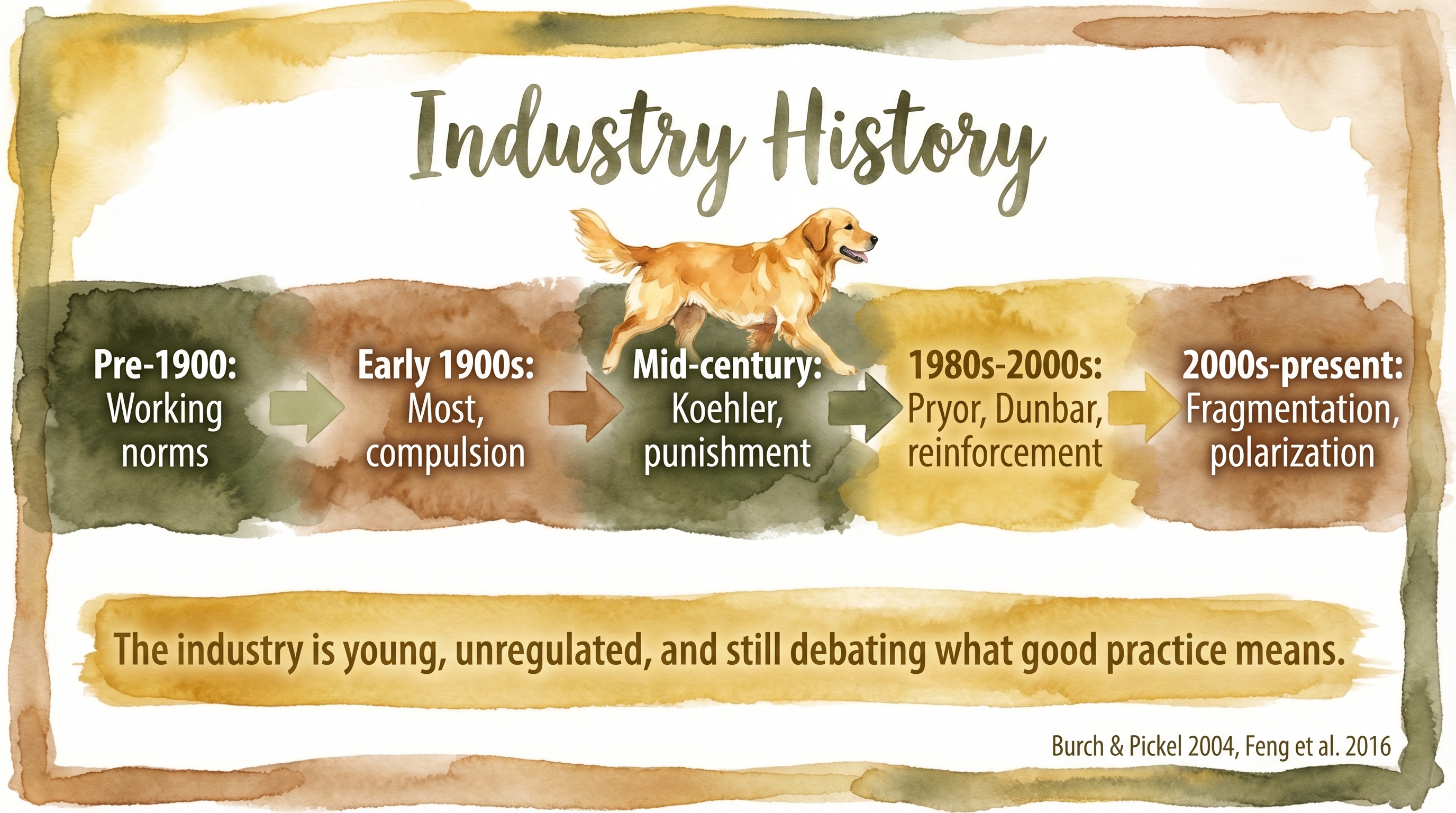
The industry is young, unregulated, and still debating what good practice means.
Key Takeaways
- The modern dog trainer is a recent professional role, not an ancient constant in human-dog life.
- Today's industry blends military history, laboratory learning theory, welfare reform, credentialing, and media culture.
- Families often hear contradictory advice because different eras left behind different assumptions about what dogs need.
- JB uses this history to separate raising from training and to keep developmental scaffolding at the center of family decisions.
The Evidence
- Most (1910) and Koehler (1962)domestic dogs
Document the military and postwar civilian codification of systematic dog training, including the movement from oral tradition toward written protocol and class format. - Skinner (1938, 1953) and Breland & Breland (1961)multiple species
Provide the behaviorist framework that later migrated into dog training, while also documenting species shaped limits through instinctive drift. - Pryor (1984), Dunbar (1982, 1993), Hiby et al. (2004), and Vieira de Castro et al. (2020)domestic dogs and multiple species
Mark the positive reinforcement era, the puppy prevention shift, and the welfare evidence that reshaped modern professional consensus. - Cavalli & Fenwick (2025) and industry policy documentsdomestic dog profession
Show a fragmented modern field with many credentials, divergent educational pathways, and no single consensus method across all cases.
- domestic dogs
No single dataset directly resolves the full population picture for the history of the dog training industry: an overview without the usual survey, sampling, and threshold limitations.
SCR References
Sources
- Cavalli/Fenwick and related policy documents support the fragmentation and voluntary-credentialing structure of the industry. They do not establish that certification predicts better dog outcomes.
- Most, K. (1910/1954). Training Dogs: A Manual; Koehler, W. R. (1962). The Koehler Method of Dog Training. Historical primary sources for systematic police, military, and civilian dog training methods.
- Pryor/Dunbar historical materials and Hiby/Vieira empirical studies support different parts of the positive-reinforcement transition. Keep historical influence, professional-movement history, and welfare-effect evidence separate.
- Skinner, B. F. (1938). The Behavior of Organisms.
- Skinner, B. F. (1953). Science and Human Behavior.
- Breland, K., & Breland, M. (1961). The misbehavior of organisms. American Psychologist, 16(11), 681-684.