Pre-Industrial Dog Keeping
Compound evidence detail1 SCR / 2 parts
- Documentedthe commensal pathway model of canine domestication established as the dominant framework in evolutionary biology, supported by Bergstrom 2020 genomics, Thalmann 2013 mtDNA, Larson and Bradley 2014, and Freedman 2014
- Heuristicthe JB interpretive bridge mapping the Five Pillars onto the selection pressures inferred to have operated during commensal domestication, a synthesis without direct genomic or archaeological support
Pre-industrial dog keeping refers to the long span of human-dog life before the rise of the specialized dog training profession. In that older world, dogs were not absent from instruction, boundaries, or work. They were simply developed inside everyday human settings rather than through a separate commercial method culture. Hunting, guarding, herding, scavenging, companionship, and camp life all taught dogs through repeated participation in a social environment that already had rules, rhythms, and consequences. Documented
The source layer gives several different windows into that world. Archaeology shows that dogs and humans were living together deep in prehistory. Ethnography shows dogs embedded in communities rather than managed as isolated consumer projects. Village dog and free-ranging dog studies show dogs organizing socially near humans without formal training schools. Early texts such as Xenophon's Cynegeticus and the medieval Libellus de cura canum show guidance and management, but not the later assumption that every dog needs a universal obedience technology.
That does not mean pre-industrial dogs were automatically easy or that all historical practices were gentle. It means the baseline arrangement was different. Dogs learned in the place where life happened. They were sorted by function, tolerated or culled based on usefulness, and shaped by constant participation in human activity, adult dog behavior, and environmental consequence rather than by a separate industry of sessions, classes, and credentials.
The JB claim that pre-industrial dogs were broadly raised rather than trained is well grounded as a historical reading. The stronger claim that they therefore functioned as modern family companions without formal intervention is partly interpretive and has to stay tagged that way because the ecological context was not the same as a contemporary suburban home.
What It Means
The clearest thing the early record shows is that dogs belonged inside human worlds long before a training profession existed.
Cohabitation Before Method
Ancient DNA and archaeological work place dog domestication deep in prehistory. Bergstrom and colleagues in 2022, Perri and colleagues in 2021, Frantz and colleagues in 2016, and Thalmann and colleagues in 2013 all support the basic point that dogs were already established as a human associated species thousands of years before modern obedience systems. Documented Bonn-Oberkassel, dated to roughly 14,000 years before present, shows not just coexistence but care. The puppy found there survived severe distemper episodes only because humans sustained it through illness. That is not evidence of formal training. It is evidence of relationship.
The dominant evolutionary model remains the commensal pathway. The JB-specific claim that the Five Pillars describe those ancient selection pressures is interpretive and must stay in that voice. But the more conservative historical point is secure: dogs entered human society long before a twentieth century profession told people how to relate to them.
Embedded Guidance, Not Detached Technique
The early written record is sparse, but what exists looks unlike the modern industry. Xenophon's hunting text describes working with hounds in the context of the hunt itself. Harding's analysis of Libellus de cura canum finds a medieval frame centered on care, utility, and embedded instruction. Hutchinson's nineteenth century Dog Breaking shows that humans certainly tried to shape dogs before 1900, yet even there the method belongs to sport specific practice, not to the later civilian assumption that every pet owner requires a trainer, a class, or a credentialed consultant. Documented
That distinction matters. Pre-industrial guidance was usually inseparable from place, work, family expectation, and repeated daily proximity. The dog learned the job where the job happened. The dog learned the household because it lived inside the household.
Selection and Social Context Did Heavy Work
Modern people often imagine the past as if every useful dog had to be individually taught from scratch. The record suggests a different balance. Working lines were selected over generations for traits that fit certain niches. Livestock guardian dogs, herding dogs, sled dogs, camp dogs, and hunting dogs entered developmental environments that continuously rewarded some responses and penalized others. Which dogs reproduced mattered. Which dogs remained in the camp or household mattered. Which dogs were trusted mattered.
That does not eliminate learning. It reframes it. Much of what later industry culture would describe as training was distributed across breeding, social setting, adult dog modeling, and routine human expectation.
Village Dogs and Free-Ranging Dogs as a Living Window
The strongest modern analog comes from free-ranging dog research. Documented Cafazzo and colleagues in 2010 documented linear social hierarchies in free-ranging dogs near Rome. Bonanni and colleagues in 2017 described older dogs holding higher rank and conflict being managed through ritualized submission more often than overt fighting. Pal, Ghosh, and Roy in 1998 documented maternal weaning by graduated withdrawal rather than punishment heavy confrontation. Bhattacharjee and colleagues in 2017 showed that puppy responsiveness to human cues changes with developmental experience. Sen Majumder and colleagues in 2016 found that free-ranging dogs preferentially den near humans.
Those studies do not prove that modern house dogs can simply be left to self organize. The SCR explicitly warns against that ecological leap. What they do show is that dogs can acquire social competence in human proximity without the scaffolding of formal classes, marker systems, or professional instructors. The animal itself is not born requiring a training industry.
Cross-Cultural Dog Keeping
Ethnographic work strengthens the picture. Chira and colleagues in 2023 found that human treatment of dogs across 144 cultures tracks function, subsistence, and personhood, not a single universal ownership model. Documented Indigenous and traditional communities described in the source layer often treat dogs as integrated beings shaped by kinship, camp order, and practical role. Serpell's earlier anthropological work also supports the wider claim that close animal companionship is not a modern Western novelty.
The important takeaway is not romance about the past. Pre-industrial dog life included risk, culling, hardship, and standards modern families would not accept. The useful takeaway is structural: dogs historically matured within ongoing social worlds, not primarily through episodic technical intervention.
The pre-industrial record does not give JB a perfect mirror image of modern family raising. What it does give is repeated evidence that dogs learned through immersion in older dogs, humans, work, and place before anyone built a market around formal technique.
Why It Matters for Your Dog
A Golden Retriever puppy born today is not living in a Natufian burial site, a medieval kennel, or a free-ranging village dog population. That obvious fact is exactly why this history is useful. It keeps families from making a bad inference in either direction.
The first bad inference is romantic nostalgia. A family should not read this history and conclude that no guidance is needed because dogs naturally raise themselves. That is not what the record says, and it is not what JB says. Historical dogs lived under stronger social consequence, clearer human expectation, more direct selection, and far less indulgent management than many modern companion dogs do.
The second bad inference is the industry's opposite mistake: because modern homes are artificial, the dog must therefore be managed primarily through formal training technology. The pre-industrial baseline weakens that assumption. It reminds families that dogs are built to learn from participation, proximity, repetition, and social structure. A puppy does not start as a blank household machine that only comes alive once a class begins.
That matters in daily Golden Retriever life. When a family asks whether the puppy is learning because of formal drills, the better question is broader. What is the puppy rehearsing from morning to night? What does it see adult humans doing around thresholds, food, excitement, greeting, settling, and movement through the house? Is there a calm adult dog to watch? Is the environment steady enough for observational learning to work, or is the puppy living in constant excitement and correction?
Families often miss how much of puppy development is happening outside the obvious training moments. A retriever that learns to rush doors, spin for attention, bark through meal preparation, and escalate every reunion is still learning all day. The pre-industrial record matters because it points attention back to the total environment. Historically, that total environment did much of the developmental work.
This is especially relevant for Goldens because they are cooperative, socially observant dogs. The breed is not indifferent to human behavior. It is highly tuned to it. A modern family can misuse that by creating a noisy, overexcited home and then trying to repair the result later with lessons. Or it can use that trait wisely by making ordinary household life into a steady curriculum of calmness, structure, and mentorship.
So this entry matters for your dog because it changes what counts as serious work. Serious work is not only what happens during a session. Serious work is the home rhythm the puppy is absorbing, the adult example the puppy is copying, and the behaviors that never get a chance to become habits.
The same history can be reassuring for modern families who feel that everything depends on finding the exact right method immediately. Pre-industrial dog keeping reminds them that dogs were not first made workable by a consumer menu. They were shaped by ordinary social life, by learning where they belonged, and by being pulled upward into a human community over time.
The pre-industrial record is also useful because it relieves some modern panic. Families are often made to feel as if failure is guaranteed unless they pick the right branded method immediately. Older dog-human arrangements suggest something steadier. Dogs learned a great deal by being folded into the life around them, watching capable adults, and living under expectations that were ordinary, consistent, and hard to escape. That does not eliminate the value of modern science. It simply reminds families that immersion itself is one of the oldest and strongest teachers in the story.
For Goldens, this can be comforting and demanding at once. Comforting, because the breed does not need a circus of techniques to begin becoming functional. Demanding, because the home really does have to become an environment worth learning from. If the adults are scattered, indulgent, and noisy, history will not save the dog. The lesson is not simplicity by magic. It is simplicity through lived structure.
For Goldens, the modern translation is not rustic nostalgia. It is the choice to let the puppy absorb household life through guided participation rather than treating family existence as filler between formal interventions. That is a very old lesson in a very current form.
That is one reason the entry stays so useful for families raising Goldens today. It reminds them that ordinary life is not a pause between lessons. Ordinary life is where most of the lesson happens.
That realization alone can steady a modern family considerably. That old truth is still available.
What This Means for a JB Family
For a JB family, pre-industrial dog keeping is not a call to recreate a vanished world. Heuristic It is a reminder about developmental logic. Dogs are social mammals that can learn a great deal from immersion in a functioning social order. If that is true, then the family home should be built as a functioning social order first and only secondarily as a place where techniques are applied.
That has a direct breeder to family implication. A JB puppy leaves a highly managed environment where daily life already carries structure. The family's task is not to replace that with improvisation until a trainer gets involved. The family's task is to continue the language of the environment: steady entry and exit routines, calm greeting patterns, supervised freedom, protected rest, measured exposure, and clear adult leadership.
It also reframes the meaning of mentorship. Mentorship is not endless verbal instruction. It is the puppy living near organized adults and absorbing how the day works. That can happen with human adults alone, with well chosen adult dogs, or with both. What matters is that the puppy has something worth copying.
The pre-industrial baseline also strengthens the JB Prevention pillar. If much of canine maturity historically emerged through lived structure rather than corrective repair, then a modern family should treat prevention as ordinary husbandry, not as a niche tactic. You do not wait for chaos and then ask which school of training can reverse it. You keep the early environment from teaching chaos in the first place.
That is why JB treats this entry as orientation rather than nostalgia. No family needs to recreate a medieval village or a pastoral camp. The point is simpler: the older baseline directs attention back toward immersion, mentorship, and daily life together. Those remain closer to the center of canine development than the modern market often admits.
For a JB family, the old baseline points in a practical direction. Let the puppy learn from how the household moves, pauses, greets, rests, waits, and transitions. Let the dog's education happen in the ordinary fabric of the day, not only in formal exercises. That is one of the clearest ways the pre-industrial record still reaches into modern family life.
That old pattern does not remove the need for modern knowledge. It simply reminds families that belonging, observation, and daily rhythm have always done more of the work than many modern owners realize.
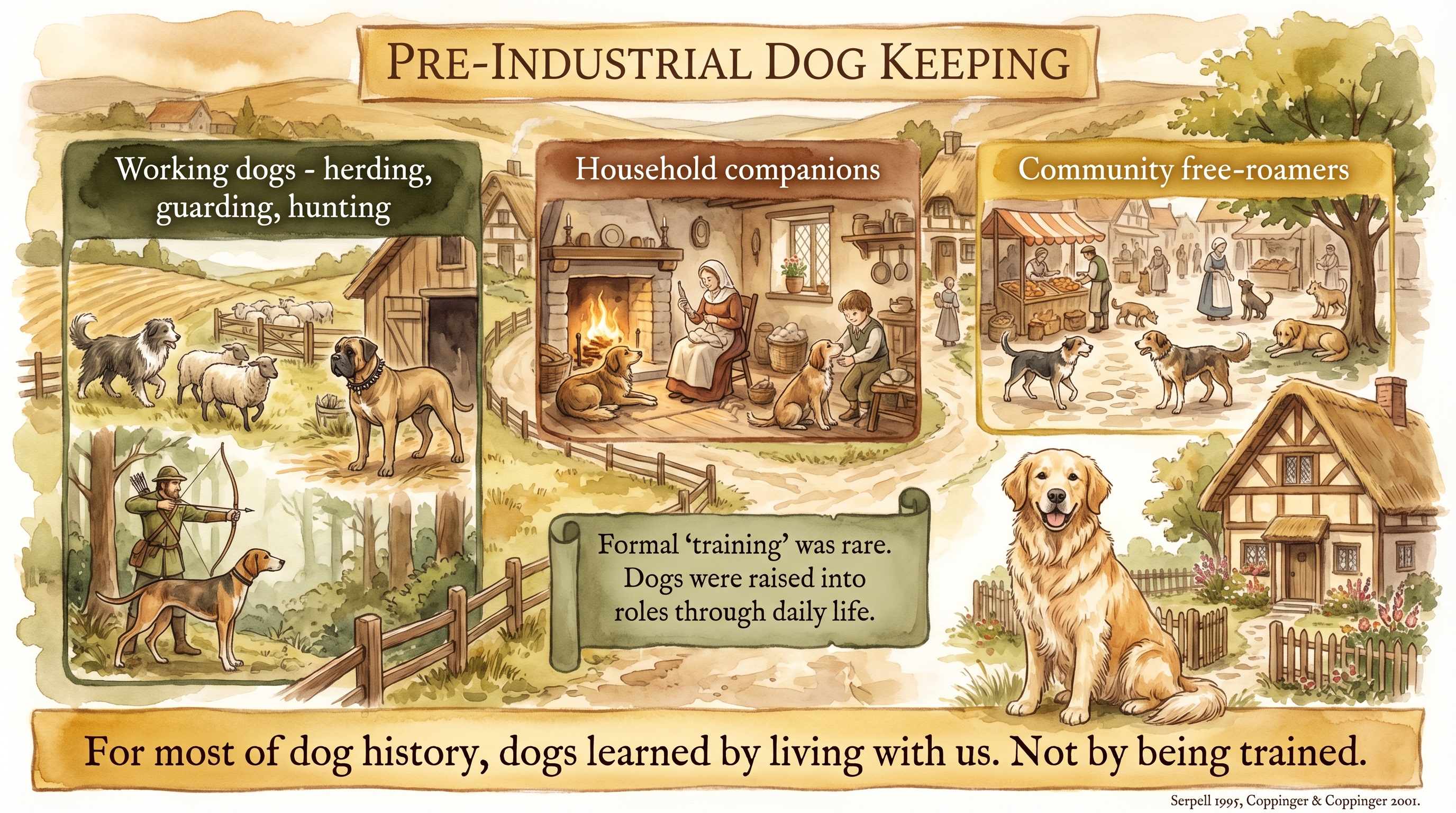
The historical record suggests that for most of pre-industrial dog-keeping, dogs learned primarily by living with humans rather than through formal training. This reconstruction is interpretive; the Just Behaving framing of this period as the ancestral baseline is held at the Mixed Evidence ceiling consistent with this entry's tag.
Key Takeaways
- Pre-industrial dogs were developed inside human communities long before a dog training profession existed.
- Historical guidance was usually embedded in work, family life, and local custom rather than detached from daily living.
- Free-ranging and cross-cultural evidence shows dogs acquiring social competence near humans without formal classes or credentialed instructors.
- JB uses this history to argue for building the home as a developmental environment, not merely as a site for later corrective technique.
The Evidence
This entry uses heuristic claim-level tags beyond the dedicated EvidenceBlocks below. These tags mark JB interpretive application rather than direct study findings.
- Bergstrom et al. (2022), Perri et al. (2021), and related domestication workancient dogs and wolves
Show that dogs were associated with human populations long before modern training institutions existed. - Janssens et al. (2018) and related archaeological findsancient dogs
Document close human care and attachment, including sustained puppy care at Bonn-Oberkassel, without any evidence of a formal training profession. - Cafazzo et al. (2010), Bonanni et al. (2017), Pal et al. (1998), Bhattacharjee et al. (2017), and Sen Majumder et al. (2016)free-ranging domestic dogs
Describe social hierarchy, maternal withdrawal, human proximity, and development in dog populations living near people without formal training systems. - Chira et al. (2023) and Serpell's anthropological workhuman-dog societies
Show that dog keeping varies across cultures and has long been embedded in human social life rather than organized around a single ownership and control model.
- domestic dogs
No published study directly isolates the long-term dog-level and family-level effects of pre-industrial dog keeping across ordinary companion-dog contexts.
SCR References
Sources
- Bergstrom et al. (2022) and Perri et al. (2021) domestication-history package. Supports pre-industrial and deep-history dog-human relationship context; not modern training-industry outcome evidence.
- Cafazzo/Bonanni plus Pal, Bhattacharjee, and Sen Majumder free-ranging-dog package. Supports free-ranging dog social-organization context; not direct evidence for modern commercial training outcomes.
- Chira 2023 and Serpell anthropological package. Supports anthropological context for dog-human coexistence; the contrast with modern training remains historical synthesis rather than direct outcome evidence.
- Janssens, L., Giemsch, L., Schmitz, R., Street, M., Van Dongen, S., & Crombe, P. (2018). A new look at an old dog: Bonn-Oberkassel reconsidered. Journal of Archaeological Science, 92, 126-138.