Konrad Most and the Origins of Military Dog Training
Compound evidence detail2 SCRs / 4 parts
- Documentedthe historical sequence of military-origin formalized training methodology, supported by Most 1910 (Abrichtung des Hundes) primary text, Richardson 1920, the War Department field manual TM 10-396 (1943), Saunders 1954, the Koehler 1962 primary text, and Fisher 2017 cultural-history analysis
- Heuristicthe JB application treating the military-to-civilian transfer as the primary driver of modern industry formation, an interpretive synthesis of a transfer that was diffuse and multi-channel rather than a clean pipeline
- Documentedthe wolf-side scientific record on the dominance model - Schenkel 1947 captive-pack methodology limitations, Mech 1999 wild-pack family-unit field data, and the AVSAB 2008 position statement against dominance-based training
- Heuristicthe JB application transferring the wolf family-unit framing to the dog-human relational architecture, an interpretive bridge that Mech's wolf data does not directly test in training contexts
Konrad Most sits at the point where old dog keeping becomes modern dog training. Before him, there were manuals, field traditions, and working dog customs. With him, there is something closer to a written operating system: a replicable method, an institutional setting, a theory of how dogs learn, and an explicit human role organized around command reliability. That is why his name matters so much in the history of the industry. Documented
Most published Abrichtung des Hundes in 1910, later known in English as Training Dogs: A Manual. He was working in the Prussian police system, later connected to state breeding and training establishments and military dog work. The source layer treats this book as the first comprehensive codification of systematic dog training. It did not emerge from a family dog marketplace. It emerged from a state need for dependable police and war dogs.
His methods are historically important and morally difficult at the same time. Most described physical compulsion, spiked collars, forced compliance, and strong authority as normal tools. He also described timing, chaining, and the use of secondary reinforcers in ways that later readers would recognize as anticipating operant ideas. The combination is why he is such a central figure. He was both a harsh practitioner by contemporary companion dog standards and a foundational system builder whose logic echoed through the next century.
For JB, Most matters because he marks a very specific divergence point. The dog is no longer primarily a young social mammal learning inside life. The dog becomes a subject of explicit technique deployed for institutional reliability. The historical facts are documented. The larger meaning of that shift is interpretive and has to remain in that voice.
What It Means
Konrad Most matters first as a biographical and institutional fact.
A Police and Military Figure
The source document places Most at the Royal Prussian Police Headquarters and later at the State Breeding and Training Establishment for police dogs in Berlin. Documented It also places him in military dog organization during World War I and later in armed forces dog work. That background explains both the tone and the aims of his system. He was not designing a humane family puppy curriculum for novice households. He was solving a state performance problem.
That setting shaped everything. Police and military dogs had to work under pressure, tolerate clear hierarchy, and perform specific tasks with limited ambiguity. A method built for that assignment naturally privileges reliability, control, and drill over developmental subtlety.
The 1910 Manual as a Historical Break
What makes Abrichtung des Hundes so consequential is not simply that it is old. It is that it converts what had often been oral, local, and apprentice based practice into a formal written protocol. The source layer calls it the first comprehensive systematic codification of dog training methodology. That phrasing matters. It signals a move from embedded craft to explicit transferable system.
Most described how to construct behaviors, how to sequence steps, how to apply consequence, how to create dependable responses, and how to establish human authority. He also distinguished primary and secondary reinforcers and described behavioral chaining in a way that later histories read as a practical anticipation of formal operant language. Even if one resists the phrase "ahead of Skinner," the historical fact remains that Most was already working with a clearly articulated consequence model in 1910.
Compulsion Was Not a Side Note
It is important not to sanitize him. The same manual that shows systematic intelligence also documents physical coercion. The source layer notes the switch, the spiked collar, and forced physical compliance. In Most's framework, compulsion was not an unfortunate exception. It was an ordinary tool within a broader architecture of control.
That combination explains why later traditions could inherit both his structure and his hardness. Once systematic training is defined as the engineering of behavior through ordered steps, many later disagreements become arguments about dosage and welfare rather than arguments about the legitimacy of the larger frame itself.
The Authority Model
Most also wrote from a worldview in which dogs must recognize human authority through a strongly hierarchical relationship. Later ethology would challenge the biological assumptions behind dominance language, especially when trainers imported captive wolf narratives into dog handling. But in Most's era, authority was not merely practical. It was philosophical. The dog's job was to submit to organized human purpose.
That is one place where contemporary readers have to be precise. Structured Leadership in JB is not a recycled dominance theory. It is parental guidance, secure base, safe haven, and calm boundary setting. Most's framework helps explain why modern families sometimes confuse those ideas. The historical line between authority and dominance was heavily blurred in the tradition he helped solidify.
Diffuse Influence on the Later Industry
The source base says Most's methods moved into later police, military, and civilian traditions, with William Koehler as the most obvious American downstream figure. The exact mechanism of transfer is partly heuristic because cultural transmission is diffuse. Still, the broad sequence is well supported: once a written training system exists for institutional dogs, pieces of it are available for later trainers to simplify, repackage, and civilianize.
That is why Most belongs in the opening chapters of this category. He is not one historical personality among many. He is a founder figure for the idea that dog behavior should be organized through a formal, trainer led system.
Most shows where the modern method story begins clearly enough to name. The dog's development is no longer read primarily through daily relationship. It is read through protocol, drill, and reliability under command.
Why It Matters for Your Dog
A Golden Retriever family may wonder why a Prussian police trainer from 1910 should matter in a modern home. Documented The answer is that many assumptions still circulating in civilian dog culture make more sense once you know where they came from.
When a family hears that a dog must comply because the human is the authority, that clarity should be established through discomfort if necessary, or that reliability matters more than emotional context, they are hearing echoes of a lineage that was built for working dogs under institutional pressure. Those assumptions did not float down from nature. They were constructed inside a very specific historical job description.
That matters because family dogs are often given advice that silently carries the priorities of other dog categories. A patrol dog, sentry dog, or police tracking dog may be evaluated first for obedience under challenge. A family Golden is being evaluated for something broader: can this dog live with children, settle near food and movement, handle guests, move from breeder to household with emotional stability, and mature without needless conflict? Those are overlapping questions, but they are not the same question.
Most also helps families sort truth from misplacement. There is a true element inside his legacy: clarity matters, rehearsal matters, and humans cannot lead with vagueness. What JB rejects is not clarity. It rejects the idea that compulsion centered protocol is the right developmental language for raising a companion puppy.
You can see the difference in ordinary household moments. Suppose a young Golden grabs a dish towel and starts a chase invitation. A Most style lens is naturally drawn toward control, interruption, and rapid suppression. A JB lens starts earlier and wider. Why was the towel available? What level of arousal is already in the room? How often has the puppy rehearsed stealing soft objects? Has the family been acting as mentors, or only as reactors? The second lens does not deny consequence. It changes the time horizon.
The entry matters because it warns families not to confuse the historical origin of the industry with the natural developmental needs of a puppy. A lot of later dog culture inherited military logic without noticing that the home is not a barracks, the puppy is not a state asset, and the actual goal is not command performance under battlefield conditions.
This is especially useful for Golden Retriever families because the emotional authority of military certainty can still sound persuasive. A socially rambunctious house dog can make adults yearn for the kind of sharp control language that working-dog traditions normalized. Documented History helps the family see that urge as inherited rather than inevitable. The goals are different, so the whole emotional logic can be different too.
The family-level risk is that Most's tone can still sound like truth because it sounds so certain. Adults living with a rambunctious retriever may hear the old command logic and feel relief. Finally, someone who sounds in charge. History helps the family see that certainty in context. It was built for wartime reliability where failure could carry serious operational cost. That is not the same assignment as helping a Golden mature inside a kitchen, a neighborhood, and a room full of children.
Once that distinction is clear, families can see a second point. The sharper the historical origin, the easier it becomes to stop romanticizing it. Most mattered because he codified training powerfully, not because his military aims automatically define what a family dog needs. The domestic question is different, so the human posture can be different too.
A Golden raised for family life needs seriousness without martial logic. That sentence captures much of why Most still matters. He helps families see what modern training inherited, and therefore what they are free to decline.
The family dog question is not whether the human can compel obedience under battlefield assumptions. It is whether the human can create enough order that the dog can mature without chronic conflict. Reading Most makes that contrast vivid.
That perspective is useful precisely because Most stands so close to the origin of systematized training. When families see how early the command-and-compulsion merger happened, they become less likely to mistake it for the natural language of all serious dog guidance.
Families are freer once they realize that not every serious voice in dog culture was built for family life in the first place.
For many families, that realization is surprisingly relieving. It means they can take structure seriously without borrowing a whole emotional style that was never designed for domestic life in the first place.
What This Means for a JB Family
For a JB family, Konrad Most is mainly a lesson in category control. He helps explain where much modern training language came from and why JB refuses to let that language define the whole field. If the origin point is police and military reliability, then the family has every right to ask whether that origin fits the task of raising a Golden Retriever for domestic life.
This does not require hostility toward history. Most should be read honestly. He systematized training with unusual clarity. He influenced later traditions. He belongs in the record. But the family should also feel free to say that a framework born for institutional control is not the same as a framework designed for developmental maturity in a social household. Heuristic
That distinction sharpens JB's understanding of Structured Leadership. Leadership is real. Direction is real. Boundaries are real. What changes is the relational meaning. JB leadership is not adversarial status management. It is calm parental authority that prevents confusion, lowers arousal, and keeps the puppy inside a coherent social world.
The practical implication is simple. When you meet advice that sounds hard, urgent, or control obsessed, ask what problem that advice was originally built to solve. If the answer sounds closer to patrol reliability than to family life, you are probably looking at a historical inheritance rather than a developmental necessity.
For a JB family, Most is therefore a boundary marker. He shows how modern dog training entered print culture with command, hierarchy, and compulsion fused tightly together. JB keeps the need for dependable adult guidance while refusing the assumption that family dogs require military-style proof of human authority. That distinction is one of the most practical uses of reading this history honestly.
For a JB family, this means reclaiming seriousness without importing battlefield psychology. You can be calm, firm, and unambiguous with a Golden while still treating the dog as a young social mammal being raised into family life rather than as a unit whose reliability must be extracted through compulsion. That is the practical line Most helps define.
The historical gift here is freedom through context. Once you know where the command-and-compulsion picture came from, it loses some of its inevitability. That makes room for a different kind of adult authority in the home.
That is why JB families can study Most without imitating him. Documented He clarifies the origin of a style that still speaks loudly in the culture, and clarity about origins is often the first step toward freedom from them.
Context loosens the hold of inherited certainty. That historical separation between origin and fit is one of the main reasons to keep reading him at all, because it makes better choices possible. History is most useful when it restores that kind of proportion. Seen that way, his historical importance becomes clarifying instead of prescriptive for family homes.
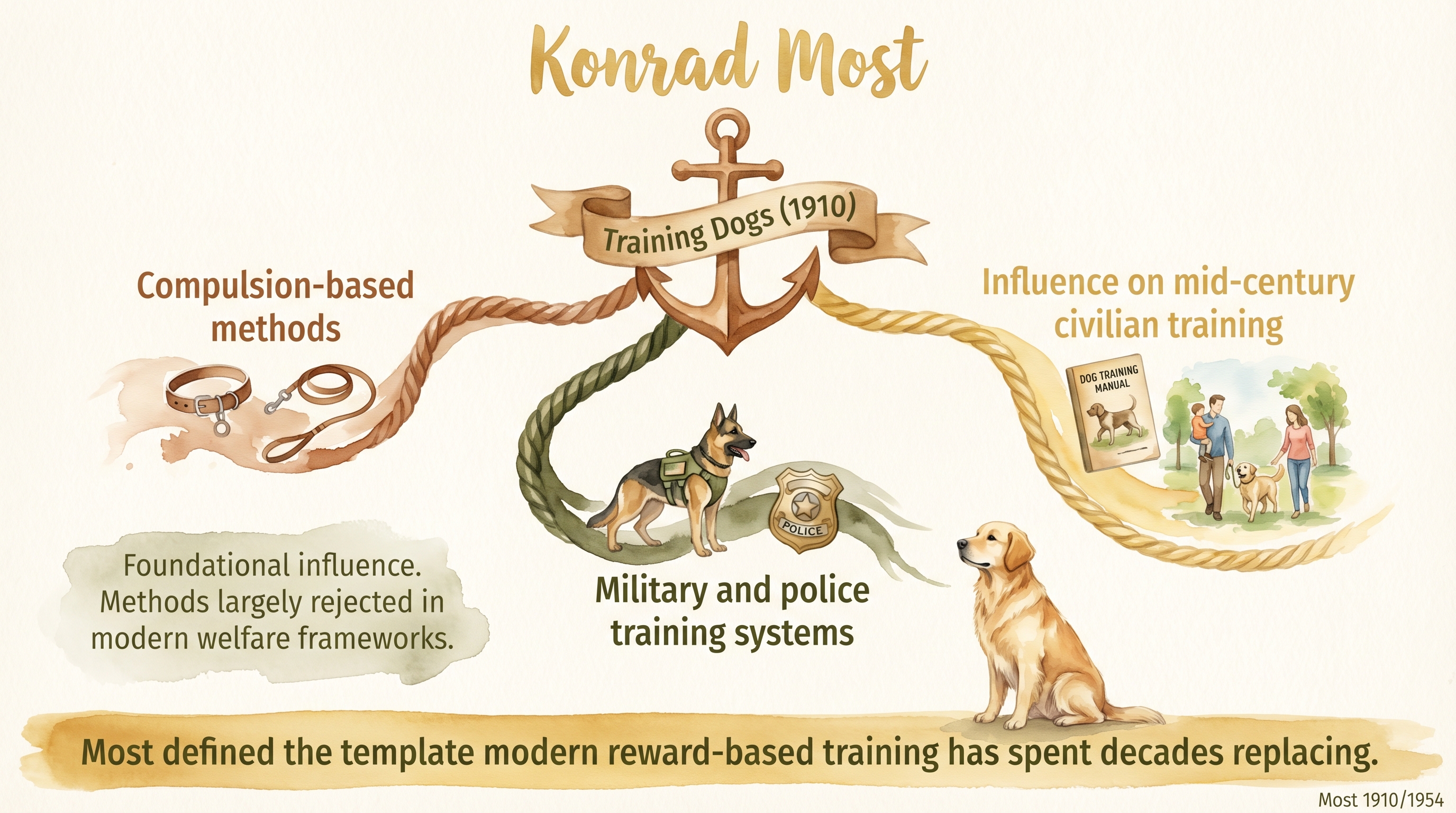
Most defined the template modern reward-based training has spent decades replacing.
Key Takeaways
- Konrad Most's 1910 manual is the clearest historical starting point for modern systematized dog training.
- His framework was built for police and military reliability, not for raising companion puppies in family homes.
- Most combined real systematic insight with methods that were harsh even before later welfare critiques.
- JB reads Most as a divergence point where the dog increasingly became a subject of protocol instead of a developing social partner inside daily life.
The Evidence
This entry uses heuristic claim-level tags beyond the dedicated EvidenceBlocks below. These tags mark JB interpretive application rather than direct study findings.
- Most (1910/1954)domestic dogs
Documents a comprehensive written training system for police and military dogs, including chaining, consequence timing, and explicit use of compulsion. - Source synthesis on Most's appointments and military roledomestic dogs
Places Most inside Prussian police training and later military dog organization, showing the institutional setting in which his manual was created. - SCR-155 and related historical analysisdomestic dogs
Supports the claim that systematic dog training became formalized in military and police contexts before diffusing into later civilian culture. - SCR-157 contextwolves and domestic dogs
Helps separate early authority and dominance assumptions from later scientific corrections about canid social structure.
- domestic dogs
No published long-term study directly compares konrad most and the origins of military dog training against structured relational raising and no-intervention controls across ordinary companion-dog homes.
SCR References
Sources
- Most, K. (1910/1954). Training Dogs: A Manual. Primary historical source for systematic police/military dog-training methods.
- Konrad Most's military appointments and police K-9 program leadership. Biographical attribution; not the primary methodological source. For Most's actual training methodology see Training Dogs: A Manual (1910/1954) cited separately on this entry.