Breeder Regulation: Federal and State
Compound evidence detail1 SCR / 2 parts
- Documentedthe USDA-APHIS Animal Welfare Act licensing structure with its standing direct-in-person-sale exemption alongside Massachusetts General Laws chapter 140 sections 136A and 137 kennel definitions, and the documented absence of developmental raising standards in either federal AWA regulations 9 CFR Part 3 or state kennel facility codes
- Heuristicthe JB interpretation that gaps in developmental oversight leave families without a reliable regulatory proxy for breeder quality, with the standing constraint that USDA licensure must not be treated as either a positive or negative quality signal because it only indicates scope of operation
Breeder regulation in the United States is one of the clearest places where families mistake legal status for quality. Many people assume that if a breeder is USDA licensed, the breeder must be good, and if a breeder is not USDA licensed, the breeder must be operating outside the law. Both assumptions are wrong often enough to mislead families badly. The real framework is narrower, more layered, and more jurisdiction-specific than that. Documented
At the federal level, the key law is the Animal Welfare Act, administered by USDA APHIS. That framework reaches certain commercial breeders and handlers, especially where wholesale sales or other covered business models are involved. APHIS's own licensing guide is especially important for family education because it states that a person who only sells domestic pets directly to pet owners in person, where seller, buyer, and animal are physically present, is exempt regardless of sales volume. That one fact explains a large portion of the confusion in breeder conversations. Documented
State law then adds a second layer. Some states have breeder-specific statutes or kennel categories that go beyond federal law. Massachusetts is directly relevant to JB because Chapter 140 section 136A defines categories such as commercial breeder kennel, commercial boarding or training kennel, and personal kennel. Documented State and local law therefore shape the operating framework even where federal licensure does not apply.
The practical takeaway is that regulation matters, but it is a floor. A breeder can meet the legal minimum and still fall short of what a family should want in health testing, social raising, transparency, and post-placement support. Families need that distinction early, because legal eligibility and ethical breeding quality travel on separate tracks for ordinary buyers.
What It Means
What the Federal System Actually Covers
The Animal Welfare Act does not regulate all dog breeding in the United States. Documented It regulates specific categories of covered activity. APHIS's licensing guide draws the line clearly around exemptions and covered dealer activity. One of the most important exemptions for family education is the direct-sale rule: if the seller only sells domestic pets directly to pet owners in person, with seller, buyer, and animal physically present, that seller is exempt from federal licensing regardless of volume. By contrast, wholesale sales and other covered business models can trigger federal licensure and inspection obligations.
That distinction is the heart of the federal picture. USDA licensure tells you something about business model and regulatory category. It does not automatically tell you that the breeder is better. Lack of USDA licensure can mean many different things, including simple lawful exemption under the direct-sale model.
Where State Law Adds More Structure
States vary widely. Some states create breeder-specific definitions, kennel categories, inspection frameworks, recordkeeping rules, or sales restrictions. Others rely more heavily on general cruelty law and local kennel control. The JB source layer summarizes the national picture conservatively, noting that a meaningful minority of states add breeder regulation while many others do not create a thick standalone breeder code.
Massachusetts matters especially because it provides a more concrete local framework for JB. Documented Chapter 140 section 136A defines several kennel categories, including commercial breeder kennel and commercial boarding or training kennel, and sets the local licensing structure in motion. That is not the same thing as saying Massachusetts guarantees breeder quality. It does mean there is a state statutory architecture families in this service area should understand.
Inspection status and legal paperwork can still be useful pieces of context when families read them correctly. They can reveal whether the breeder is operating openly, which regulatory bucket applies, and whether the breeder understands the obligations attached to that bucket. What they cannot do is answer the developmental questions families care about most. A clean paper trail is valuable. It is not a substitute for understanding how the puppies actually live.
Why Legal Status Is Not the Quality Question
Families often want the law to solve the breeder-evaluation problem for them. It cannot. Federal licensure can coexist with mediocre raising. Lawful exemption can coexist with excellent raising. State or local compliance can coexist with weak health testing, poor social environment, thin screening of homes, or no serious post-placement support.
This is why ethical breeding standards routinely exceed the legal floor. Health testing through OFA and CHIC frameworks, participation in breed-club codes of ethics, transparent discussion of pedigree and disease risk, developmental raising inside the home, and long-term family support all matter even when no statute commands them. Documented The law is mainly preventing the bottom from disappearing altogether. It is not defining the ideal.
The most important breeder decisions often happen well above the legal minimum. Law can prohibit obvious failure. It cannot create a deeply preventive raising program by itself.
Why This Matters So Much in Massachusetts
JB operates as a small family program in Massachusetts, so this topic is not abstract. The family should understand that a small direct-to-family Massachusetts breeder may be operating legally without federal USDA licensure and still be entirely legitimate. The questions that matter next are about health testing, raising environment, transparency, temperament stewardship, contract clarity, and breeder support after placement.
At the same time, Massachusetts law still matters because kennel categories, local licensing, and state expectations shape how dogs are housed, counted, and inspected. The safe summary is therefore dual: know the law, and then keep evaluating far beyond it.
Why It Matters for Your Dog
For a Golden Retriever family, breeder regulation matters because it influences the first environment the puppy will ever know. Yet the most useful legal lesson is not "only buy from a licensed breeder." It is "understand what the license, registration, or exemption actually means before you draw a conclusion."
Take a common misunderstanding. A family discovers that one breeder is USDA licensed and another is not. Without context, they assume the licensed breeder is safer. In reality, the licensed breeder may be operating a large wholesale or covered commercial model, while the unlicensed breeder may be a smaller direct-sale home breeder lawfully exempt under federal rules. The legal labels describe category first. They do not complete the quality judgment.
That distinction matters even more with Goldens because this breed attracts both highly conscientious family programs and high-volume commercial demand. Popular breeds create space for both excellence and scale-driven mediocrity. Families who do not understand the law often read the legal signal backwards.
The family-level questions are therefore better than the simplistic legal ones. Where are the puppies raised? What health testing has been done on the sire and dam? What does the breeder do for early development, calmness, handling, environmental exposure, and family matching? How clearly do they explain their contract? What happens if the family struggles six months later? Those are the questions most predictive of actual experience, even though they are not the questions the law can answer by itself.
A Massachusetts-specific example helps. A breeder can fit inside state kennel definitions and remain fully compliant while still running a program that is too large, too impersonal, or too thin in family support for what a JB-minded household wants. The inverse can also happen. A small breeder can be modest in legal footprint and very high in actual program quality. Once families understand that, their evaluation becomes much more intelligent.
There is another reason this entry matters. People under emotional pressure often use legality as a psychological shortcut. If the breeder is legal, the choice must be safe. If the breeder is exempt, the choice must be risky. Those shortcuts feel reassuring because they reduce ambiguity. They are still shortcuts. A Golden's future depends on much more than that.
The legal categories also say very little about how the breeder handles placement and transition. A breeder may be compliant on licensing questions and still send puppies home too early, match homes casually, provide weak contracts, or disappear after the sale. Another breeder may be legally straightforward and operationally excellent because the whole program is organized around developmental care, calmness, and sustained family support. Those differences matter more to the puppy than the family's initial fascination with federal terminology.
Travel and destination law add another layer for puppies leaving the breeder. If a puppy is crossing state lines, the receiving state's health-certificate or vaccination rules may matter. If a family is flying the puppy, airline and age requirements may matter. Breeder evaluation therefore includes asking whether the breeder understands not only their own status but also the compliance steps attached to the puppy's handoff. A breeder who is vague here may be vague in other important places too.
Families should also watch for the rhetorical misuse of legal labels. Some breeders market "USDA licensed" as if it were proof of excellence. Others market "not USDA because we are too small and personal" as if exemption itself were proof of virtue. Both moves can be manipulative. The right question is always what the status actually means and what the breeder does with the freedom or obligations that status creates.
That is where breeder transparency becomes inseparable from breeder quality. A serious breeder should be able to explain legal status, health-testing practices, litter-raising environment, puppy-matching process, and post-placement support in one coherent conversation. If the legal answer is crisp but everything about the puppies themselves becomes vague, the family has learned something important.
The same is true of scale. Numbers alone do not settle quality, but they do matter when they begin to outrun individual puppy attention, thoughtful matching, and calm developmental handling. Families should feel free to ask how many litters are on the ground, who is doing daily care, and how the breeder preserves consistency when several demands compete at once.
For JB families, this is where philosophical and legal thinking meet. The law can tell you some things about business structure and minimum standards. It cannot tell you whether the puppy grew up inside the kind of calm, structured, human-oriented developmental environment that supports the transition into family life.
That is why regulation should be treated as context, not as verdict. It is relevant information and never enough information.
What This Means for a JB Family
For a JB family, the best way to use breeder-regulation knowledge is to avoid drawing simplistic conclusions from federal labels. A USDA license is not a gold star. A lawful exemption is not a red flag by itself. Both are pieces of a larger puzzle.
That larger puzzle should still begin with legality. Families should want breeders who are operating openly within the law, who can explain their category clearly, and who are not vague about how their program is structured. After that, the evaluation should rise above the legal floor quickly and decisively.
JB's own operating standard is not driven by whatever the least demanding lawful practice happens to be. It is driven by the Five Pillars, Golden-specific stewardship, health testing, family matching, and the quality of the breeder-to-family handoff. In that sense, law is necessary but not defining.
Within the JB service area, that means families should be comfortable asking concrete questions without embarrassment. Are you federally licensed or exempt, and why? What Massachusetts or local kennel category applies to you? How are puppies raised day to day? What health testing has been completed? What support continues after placement? A transparent breeder should be able to answer those questions without marketing fog.
Those answers often reveal more than the labels themselves. A breeder who explains the legal category plainly and then immediately shifts to puppy development, home matching, health testing, and long-term support is usually telling the family where the real center of the program lies. That is the kind of orientation JB wants families to reward.
Good breeders also tend to volunteer the limits of the law rather than hiding behind it. They know a license, exemption, or kennel category does not answer the questions families care about most, so they move quickly to the program itself. That posture usually signals maturity. It says the breeder understands that the puppy's future depends more on stewardship than on paperwork alone.
That perspective helps families stay calm around legal vocabulary. Once the status is understood, the deeper question is whether the breeder's daily practice actually supports the kind of Golden the family hopes to bring home.
When families hold that line, breeder regulation becomes useful context instead of a misleading shortcut. The law still matters, but it no longer pretends to answer the whole puppy question by itself.
That is a healthier starting point for both legal literacy and puppy selection, and families who remember that usually ask better questions and get better answers.
So the practical family message is calm and disciplined. Learn what the breeder's legal status actually means. Then ask the much harder and much more important questions about how the puppies are being raised. That is where the real quality signal lives.
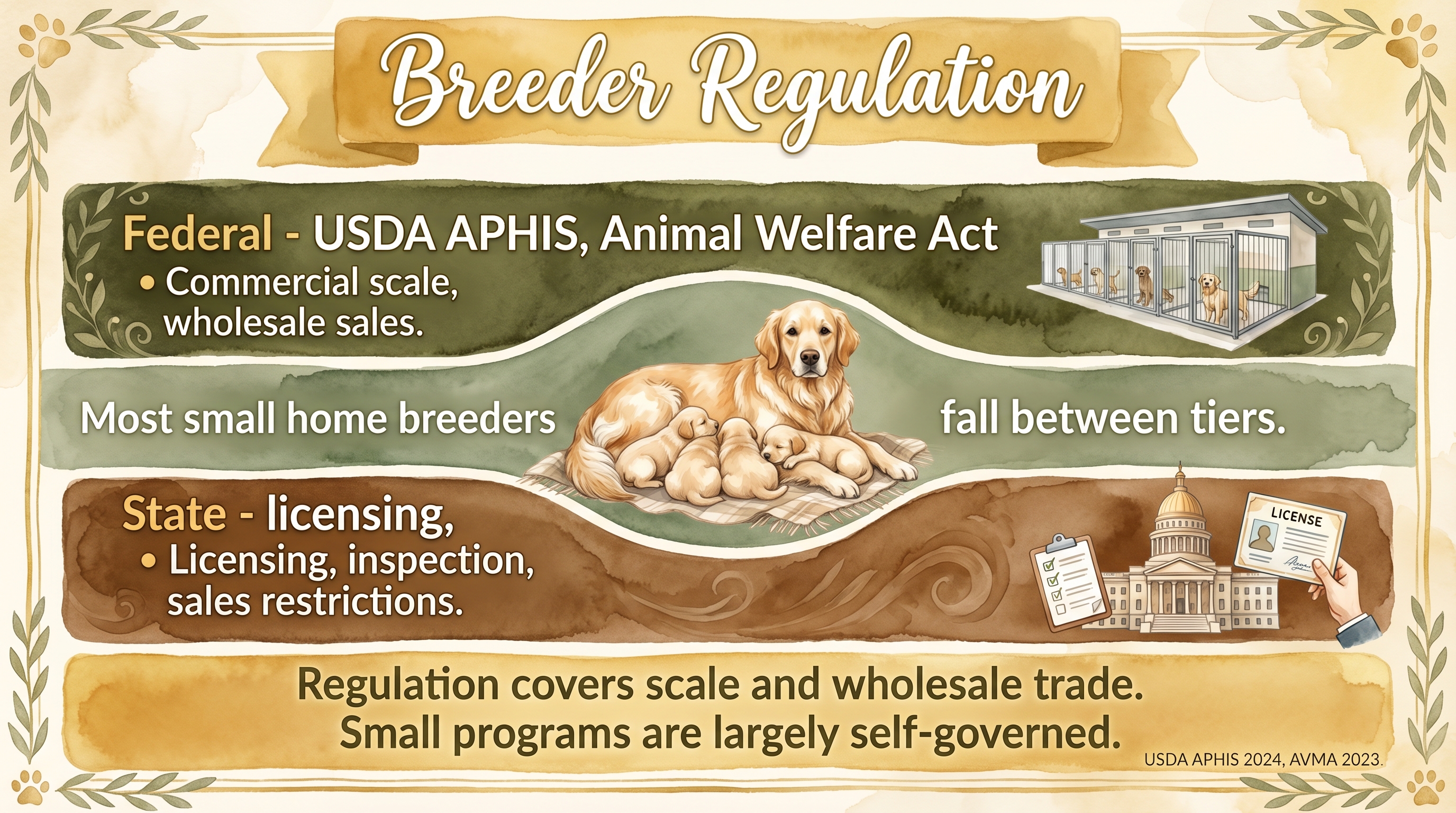
Regulation covers scale and wholesale trade - small programs are largely self-governed.
Key Takeaways
- Federal breeder regulation under the AWA is narrower than many families assume, and direct in-person pet sales are federally exempt.
- State law can add important breeder or kennel structure, but the details vary substantially by jurisdiction.
- Legal status tells families something about category and minimum compliance, not everything about actual breeder quality.
- For JB families, breeder evaluation should move quickly from legality to health testing, raising environment, transparency, and post-placement support.
The Evidence
- USDA APHIS licensing guidefederal breeder regulation
Documents the federal AWA licensing framework and the direct in-person sale exemption for domestic pets. - dog breeding and regulation
Supports the broader points that federal law leaves many small direct-sale breeders outside USDA licensing and that state regulation varies widely. - Massachusetts General Laws chapter 140 section 136Astate kennel regulation
Provides state definitions for commercial breeder kennel and related categories relevant to Massachusetts operators. - Voluntary health-testing and ethical-breeding frameworksbreed stewardship
Support the narrower point that meaningful breeder quality often depends on standards that exceed statutory minimums.
- domestic dogs
No published study directly measures how breeder regulation: federal and state changes long-term dog welfare, family outcomes, and retention across jurisdictions and enforcement contexts.
SCR References
Sources
- USDA APHIS. "Licensing and Registration Under the Animal Welfare Act."
- Massachusetts General Laws, Chapter 140, Section 136A.
- Orthopedic Foundation for Animals. "CHIC Program."