Dangerous Dog Statutes
Dangerous-dog statutes are the conduct-based alternative to breed-specific law. Instead of assuming risk from breed label, these laws usually respond to what an individual dog has done in a specific incident or documented pattern. A dog may be designated dangerous, potentially dangerous, nuisance, or vicious depending on the jurisdiction, and each designation can trigger new legal duties for the owner. Documented
The general structure is consistent even though details vary. A bite, attack, or serious threatening incident occurs. An official process follows, often through animal control or a hearing body. If the dog is designated under the statute, the owner may face requirements such as secure confinement, warning signs, muzzling in public, liability insurance, registration, spay or neuter requirements, or microchipping. In the most severe frameworks, repeat or extreme cases can end in mandated euthanasia.
The important feature is due process. Because the law is attaching serious consequences to one dog and one owner, many states require notice, a hearing, and some form of appeal or review. That distinguishes dangerous-dog law from casual neighborhood reputation. The designation is supposed to be legal, not merely social.
For families, this topic matters less because most owners will ever face it and more because it explains what happens when bite risk becomes a legal reality rather than just a training problem. That legal shift is what unnerves many families fastest.
It also matters because dangerous-dog law is what public responsibility looks like after prevention has already broken down. These statutes do not gradually coach families into better stewardship. They intervene when the stakes are already high, which is why the process often feels abrupt, emotionally overwhelming, and far less forgiving than the household expected.
What It Means
A Conduct-Based Legal Framework
Dangerous-dog law generally starts with conduct. That is the central contrast with BSL. The law asks what the dog did, under what conditions, and with what level of injury or provocation. A dog that seriously injures a person or domestic animal after an unprovoked attack is treated differently from a dog whose issue is mere neighborhood irritation.
That conduct focus is why many policymakers prefer this model. It is more individualized and usually easier to defend than breed-specific rules. It can still be strict. It is simply strict for a different reason.
Common Requirements After Designation
Once designated, the owner's obligations often increase sharply. Observed-JB Secure confinement is common. So are leash-and-muzzle rules in public, additional registration, warning signage, and proof of liability coverage in jurisdictions that require it. Some statutes differentiate between a lower dangerous tier and a higher vicious tier, with stronger restrictions at the higher level.
The point is not to punish the dog symbolically. The point is to reduce future risk through mandatory control measures. Whether those measures are wise in a given case is a separate question, but the legislative aim is usually forward-looking.
Hearings, Appeals, and Procedural Safeguards
Because the consequences can be substantial, statutes often require process before designation becomes final. Notice, hearing rights, evidence review, and appeal paths are common features. Massachusetts, for example, builds dangerous-dog procedure into Chapter 140 section 157. Other states use different terms and structures, but the underlying due-process logic is similar.
This procedural layer matters because families sometimes hear the phrase "dangerous dog" informally and assume the label has already become a legal fact. That is not always so. Neighborhood perception and legal designation are different things.
In dog law, informal reputation and formal designation are not the same category. A dangerous-dog statute usually requires a process, not just an accusation.
Why These Statutes Matter Even to Ordinary Owners
Most families will never go through a dangerous-dog hearing. The topic still matters because it is the legal downstream of serious bite or attack risk. Once a case enters this world, the conversation changes. The family is no longer only asking how to train better. They are also asking what public restrictions and liabilities now attach to the dog.
That shift is one reason early intervention matters so much. When dangerous-dog law arrives, the margin for casual error has usually already narrowed.
Definitions also vary more than many people realize. Some jurisdictions distinguish between potentially dangerous and dangerous dogs. Others use one category with escalating remedies based on injury severity, prior incident history, or level of provocation. A family reading internet summaries without the actual statute can easily misunderstand what counts, what triggers a hearing, and what evidence the decision-maker is allowed to weigh.
Documentation is part of the legal structure as well. Animal-control reports, witness statements, veterinary records, photographs, prior complaints, vaccination records, and proof of confinement can all become relevant once a case is formally reviewed. Documented Families who understand that early are better positioned to respond honestly and coherently rather than discovering too late that a casual incident history has become the backbone of a legal file.
Owner duties can also continue long after the hearing itself. Registration renewals, fencing expectations, muzzle rules, liability coverage, signage, and reporting obligations may become part of ordinary life if the dog remains in the home. A dangerous-dog statute is therefore not only a moment of judgment. It can become an ongoing framework that reshapes how the household manages the dog every day.
Why It Matters for Your Dog
Golden Retrievers are not the breed people usually imagine when they hear "dangerous dog statute," and that can make the topic feel remote. It is not fully remote. Any dog can enter legal risk if behavior escalates far enough.
The more practical lesson is that legal seriousness often arrives later than warning signs. Families may live for months with resource guarding, fear-barking, bite inhibition failures, fence charging, or repeated off-leash rushing while still thinking in purely training terms. If a severe incident finally occurs, the legal system may enter abruptly and with very different priorities than the family had before.
A common scenario makes this clearer. A family has a Golden that is increasingly reactive on leash and has already snapped once in a crowded space. They keep hoping better obedience will solve it. Then the dog bites another dog or a person in a public incident. At that point, the legal question is no longer theoretical. Depending on jurisdiction, a formal complaint or dangerous-dog process may begin, and the family's choices become constrained by law.
This is why leash-law compliance and early professional help matter more than people sometimes think. They are not only about good manners. They can affect whether a manageable problem becomes a legally structured one.
Families should also understand that dangerous-dog law does not tell the whole story about why the dog behaved as it did. Pain, fear, management failure, and human error may all have played roles. The statute is dealing with public risk. It is not necessarily delivering a full behavioral diagnosis. That distinction matters for humane handling after the incident.
A Golden's friendliness can be a mixed blessing here. It may delay adult seriousness because the dog is sweet in most contexts. Then one high-risk context arrives and surprises everyone. A conduct-based statute is built for the incident, not for the dog's usual reputation.
The best family takeaway is therefore preventive. If a pattern looks like it could someday create a serious incident, act before the law becomes the teacher. Once the case is inside formal designation territory, options are narrower, stress is higher, and the dog's future can change quickly.
Immediate adult behavior after an incident matters more than many families realize. Documented Secure the dog, separate all parties safely, get medical or veterinary care where needed, exchange information honestly, and follow reporting requirements. Defensiveness in the first hour often makes everything worse later. Calm containment and accurate documentation help both public safety and the dog's legal position.
Households with children, frequent visitors, or dense neighborhood contact should take lower-level warning signs seriously for the same reason. Repeated rushing at the door, escalating handling conflict, leash reactivity near sidewalks, or a pattern of near misses can all be socially normalized until one incident finally crosses the legal threshold. Families do not need to panic over every growl. They do need to stop treating repeated warning signals as harmless personality.
Management changes become mandatory long before a court or hearing officer orders them. If the dog has bitten, snapped in close quarters, or shown a serious escalation pattern, the family may need barriers, leashes, safer guest procedures, muzzle conditioning, structured separation from triggers, or child-free routines immediately. Documented Those are not admissions of defeat. They are part of acting like adults before another incident reduces the dog's options further.
Professional help after a serious incident should also become more selective. This is not the moment for random trainer shopping or for a charismatic online personality who promises fast control. The family may need a veterinarian, a veterinary behaviorist, a qualified behavior consultant, or legal advice depending on the case. Dangerous-dog law does not answer the behavior diagnosis, but it does make the cost of getting that diagnosis wrong much higher.
Social honesty matters here too. Families sometimes minimize the story when speaking to relatives, neighbors, or future professionals because they fear judgment or loss. That instinct is understandable and dangerous. A dog cannot be managed well if each new helper receives a softened version of what happened. Clear reporting protects the public, but it also gives the dog the best chance of landing inside a plan built for reality rather than for wishful editing.
There is a household lesson underneath that honesty. Once a serious incident has happened, the case usually stops being about whether the dog is lovable, whether the bite was out of character, or whether the family meant well. It becomes about whether the adults can create a stable management system that protects others consistently. Families who can make that shift early are often the ones most capable of preserving whatever humane options still remain.
What This Means for a JB Family
For a JB family, dangerous-dog law is a reminder that raising and public responsibility cannot be separated. A dog can be beloved at home and still create legal risk in public if warning signs are minimized too long.
JB therefore treats early intervention as a form of protection for both dog and family. Heuristic Calmness, prevention, supervision, environmental management, and referral when needed all matter partly because they reduce the chance that the law will have to step in after a severe incident.
If a family ever does face this framework, precision matters. Learn the exact statute, comply with process, involve the right professionals, and separate the legal designation from the broader behavioral question of what the dog needs next. Public safety and humane treatment do not have to be enemies, but they do require adults who can think clearly under pressure.
The best time to learn about dangerous-dog law is before you need it. That alone makes the topic worth reading.
That precision includes emotional discipline. Families often lurch between denial and despair after a serious incident, but neither response helps the dog. The steadier path is to gather facts, reduce immediate risk, comply with the process, and ask what the household must change regardless of the formal outcome. A hearing may decide the legal label. It does not remove the family's duty to become safer and clearer at home.
JB can hold that line without becoming punitive. Prevention after an incident means no more casual exposure, no more optimistic guessing, and no more treating affection in easy contexts as proof that the risk has passed. Humane stewardship sometimes looks strict precisely because the stakes have become real.
Some families will conclude that the restrictions, risk, or prognosis are more than they can responsibly carry. That decision is painful, and it still belongs inside adult seriousness rather than shame or fantasy. Dangerous-dog law forces hard questions. JB's contribution is to insist that those questions be answered with precision, honesty, and as much dignity for the dog as the situation allows. That is hard and still better than letting denial become the last teacher.
Even when a formal designation is reduced, dismissed, or never entered, the household should treat the incident as a real turning point. Escaping the harshest legal outcome is not proof that the dog can return to the old pattern of exposure. The wiser reading is usually that the family has been warned while there is still room to change course deliberately. Families who can accept that warning tend to make the next chapter safer for everyone involved, which is one reason ordinary warning signs deserve adult attention long before the law assigns them a name in everyday life, especially in homes still tempted to minimize near misses. Especially in ordinary neighborhood life, those warning signs usually appear well before any hearing or official designation begins.
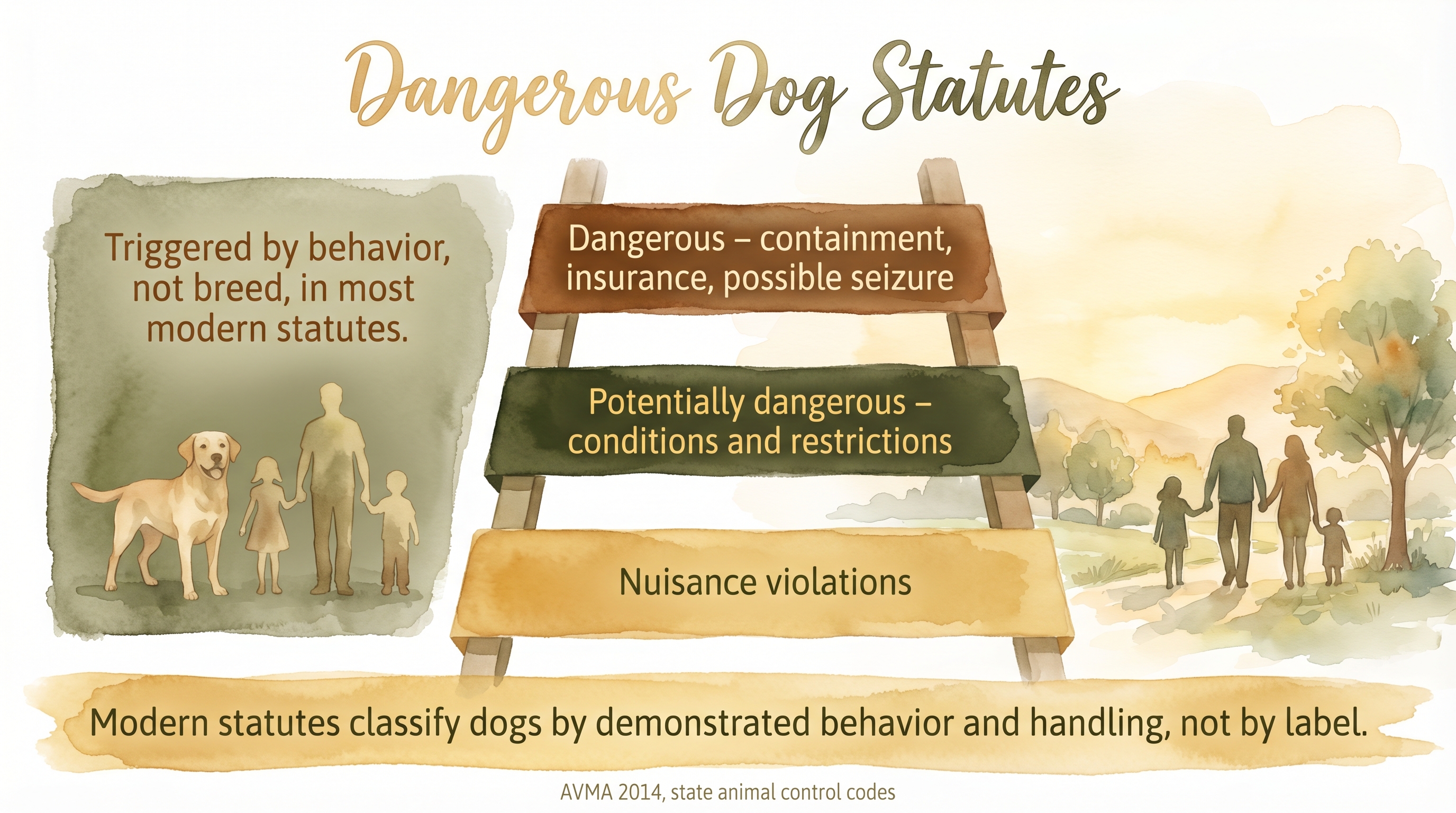
Modern statutes classify dogs by demonstrated behavior and handling, not by label.
Key Takeaways
- Dangerous-dog statutes focus on what an individual dog has done rather than on breed label alone.
- Once a dog is designated, owners may face confinement, muzzle, registration, insurance, and other control requirements depending on the jurisdiction.
- Many statutes include notice, hearing, and appeal rights because the consequences are substantial.
- For JB families, the most useful lesson is preventive: act on serious patterns early so the legal system does not become the first clear boundary.
The Evidence
This entry uses observed claim-level tags beyond the dedicated EvidenceBlocks below. These tags mark JB program observation or practice-derived claims that need dedicated EvidenceBlock coverage in a later content pass.
This entry uses heuristic claim-level tags beyond the dedicated EvidenceBlocks below. These tags mark JB interpretive application rather than direct study findings.
- State dangerous-dog statutes such as Massachusetts chapter 140 section 157state dog law
Document hearing-based designation, control measures, and jurisdiction-specific procedures after serious incidents. - AVMA model dangerous-dog legislation materialsdog policy
Support the broader preference for behavior-based regulation over breed-based shortcuts. - dog regulation
Supports the broader claim that dog law varies by jurisdiction and that conduct-based frameworks are central to state-level regulation. - Public dangerous-dog frameworks across stateslegal procedure
Support the claim that notice, hearing, and escalating restriction are common structural features.
- domestic dogs
No published study directly measures how dangerous dog statutes changes long-term dog welfare, family outcomes, and retention across jurisdictions and enforcement contexts.
SCR References
Sources
- Massachusetts General Laws, Chapter 140, Section 157.
- American Veterinary Medical Association. Model dangerous-dog and bite-prevention materials.
- AVMA model/dangerous-dog materials support the public-policy framing of dangerous-dog governance. They are legal or policy sources, not behavioral efficacy studies.
- Public dangerous-dog frameworks support jurisdictional variation and policy structure. They do not establish causal claims about training methods or breed behavior.
- Massachusetts General Laws, Chapter 140, Section 157. Nuisance or dangerous dogs; orders for remedial action; appeal; violation of order.