Breed-Specific Legislation
Compound evidence detail1 SCR / 2 parts
- Documentedthe breed-specific-legislation policy landscape including the AVMA literature review against BSL, Patronek 2013 dog-bite-fatality co-occurrence findings, the United Kingdom Dangerous Dogs Act 1991 and subsequent reviews, the Ontario pit bull legislative history, and the CDC's explicit decision not to maintain breed-specific bite statistics as a valid surveillance metric
- Ambiguousthe unsettled population-scale question of whether breed-targeted laws reduce bite risk, given inconsistent peer-reviewed findings and the challenge of separating statute effects from broader bite-incidence patterns; downstream documents must avoid treating BSL as categorically proven either ineffective or effective
Breed-specific legislation, often shortened to BSL, refers to laws that restrict or regulate dogs based on breed or perceived breed rather than on the conduct of an individual dog. In public argument, the term usually points to pit bull restrictions, but the larger legal idea has also reached breeds such as Rottweilers, Doberman Pinschers, and others in some jurisdictions. The underlying premise is straightforward: if a breed is thought to be unusually dangerous, lawmakers can reduce harm by regulating the breed category itself. Documented
That premise proved politically durable in the United States beginning in the 1980s and still survives in some places. Yet the policy record became more contested over time. Veterinary and public-health critics argued that breed is an unstable proxy for risk, that visual identification is unreliable, and that bite severity depends on multiple factors beyond label alone. Many jurisdictions later shifted toward breed-neutral dangerous-dog frameworks focused on individual behavior.
The law remains mixed. Some municipalities still enforce breed restrictions. Many states now preempt local breed-specific rules or prefer behavior-based dangerous-dog systems. Internationally, the United Kingdom's Dangerous Dogs Act 1991 and Ontario's pit bull restrictions are well-known examples of breed-targeted regulation in public debate. Ambiguous
For a Golden Retriever family, this topic is rarely urgent in the immediate sense because Goldens are not typical BSL targets. It still matters because it shows how dog law can drift toward category thinking when fear runs ahead of precision.
It also matters as a policy lesson. BSL shows how quickly lawmakers can trade a complicated prevention problem for a simpler-looking legal category. Once that happens, questions about handling, ownership, environment, reporting, and repeat behavior can get pushed into the background even though they may matter more to actual public safety.
What It Means
How Breed-Specific Laws Took Hold
BSL expanded most visibly during public anxiety about severe dog-bite incidents. Policymakers, facing pressure to act quickly, often reached for breed labels as a simple legal handle. A breed list is administratively easier to write than a nuanced behavior system, even if it is much harder to justify scientifically.
That legislative impulse explains why the laws varied so widely. One place targeted pit bull type dogs. Another added Rottweilers or Dobermans. Another created insurance or muzzling rules around named breeds. The category itself was never especially stable across jurisdictions, which is already a clue that the law was often responding to local perception as much as to hard comparative evidence.
Why the Evidence Became Contested
Veterinary and public-health criticism of BSL grew for several reasons. AVMA's dog-bite-prevention materials and related policy work argue that breed alone is a poor stand-in for individual dangerousness and that community bite prevention is better served by broader, behavior-based approaches. Documented CDC commentary in earlier years similarly highlighted the difficulty of drawing strong prevention conclusions from breed labels alone.
A second problem is identification. Many dogs targeted by breed laws are mixed or identified visually rather than through pedigree certainty. Once a law turns on category, enforcement pressure falls heavily on how confidently officials think they recognize the breed, not just on what the dog has done.
What Replaced BSL in Many Jurisdictions
The alternative has usually been breed-neutral dangerous-dog law. Instead of asking what the dog is, these laws ask what the dog has done. That can still produce strict regulation, including confinement, muzzling, insurance, registration, or euthanasia in severe cases. The difference is that the law is tied to conduct or incident history rather than to breed identity alone.
This shift did not happen everywhere at once, and it did not erase all local breed bans. It did reflect a broader policy judgment that behavior-specific law is easier to defend than broad assumptions about breed essence. Documented
BSL is what happens when law tries to use breed as a shortcut for risk. The strongest criticism is not only moral. It is also about precision and administrative reliability.
The International Examples Still Matter
The United Kingdom's Dangerous Dogs Act 1991 remains one of the best-known breed-targeted laws internationally because it banned or heavily restricted several named types. Documented Ontario's Dog Owners' Liability Act amendments similarly became part of North American discussion because of their pit bull focus. These laws remain reference points whenever U.S. jurisdictions revisit breed-targeted policy.
They matter not because every American city copies them directly, but because they show the recurring policy pattern: visible attacks produce political demand for category bans, then evidence and enforcement problems complicate the promise of simple prevention.
State preemption added another layer to the American story. In many states, legislatures later restricted or prohibited local governments from adopting new breed-specific ordinances. That did not end disagreement about dangerous dogs. It did show that once breed-based enforcement was tested in practice, lawmakers increasingly questioned whether municipal breed bans were a sound or administratively stable way to govern risk.
Insurance and housing policy kept the issue alive in a different form. Even where public ordinances weakened, some landlords and insurers continued using breed lists in their own risk screens. Families therefore still encounter breed-based decision making even outside criminal or municipal code enforcement, which is part of why the topic remains socially and legally relevant.
Why It Matters for Your Dog
A Golden Retriever family may be tempted to dismiss this entry because the breed is not on the usual BSL list. That would miss the practical value. BSL shows what happens when dog law is written at the wrong level of generality.
If law begins with labels instead of conduct, families can become careless about the dogs who are not labeled. A friendly Golden still needs leash compliance, bite prevention, supervision around children, and thoughtful raising. Breed reputation does not create immunity from consequences.
The topic also matters because many families will someday live near, rent near, insure near, or socialize near breeds that are affected by local restriction. Understanding the logic and critique of BSL helps families navigate those conversations more intelligently and less emotionally.
A practical example shows why precision matters. Suppose two dogs create identical public problems: repeated off-leash rushing, one serious bite incident, and multiple complaints. Under a breed-neutral system, the law can treat the incidents as the basis for intervention. Under a breed-targeted system, one dog may begin with a presumption problem before any incident and the other may benefit from a socially positive breed reputation. That mismatch is part of what critics mean when they say BSL is a weak fit for individual-risk management.
Goldens themselves also show the limits of breed shorthand. Their broad family-dog reputation is deserved often enough to be meaningful, but it can still hide immature, under-managed, or overstimulated behavior if adults rely on stereotype instead of observing the dog in front of them. BSL is one extreme version of the same error in policy form.
The family-level lesson is therefore broader than politics. When adults learn to ask what the dog is doing, under what conditions, with what pattern, and with what level of management, they become less vulnerable to both fear-based exaggeration and breed-based complacency.
This matters in public conversation too. Dog-law arguments become far less overheated when families recognize that policy can be strict without being breed-based. Dangerous-dog statutes, leash laws, and liability rules can all be serious while still focusing on conduct.
Housing and insurance disputes make that distinction practical rather than abstract. A family may never live under a citywide breed ban and still run into breed screens when renting, shopping for homeowners coverage, or joining a condo association. Those private restrictions are not identical to municipal BSL, but they draw on the same idea that breed label can stand in for individual risk. Knowing that helps families keep the policy conversation precise.
Mixed-breed identification problems matter in daily life too. Many dogs caught in breed-targeted systems are not papered purebreds but visually identified "types." That means neighbors, landlords, officers, or shelter staff may be making consequential decisions from appearance rather than from pedigree certainty. The administrative burden shifts away from proving behavior and toward arguing about what kind of dog this is, which is one reason critics view the system as unstable.
Goldens offer a useful mirror image. Positive breed reputation can soften adult seriousness just as negative breed reputation can harden policy. A friendly Golden off leash, rushing children, or rehearsing rude greetings may be excused because the breed reads as safe. That is not the same legal problem as BSL, but it comes from the same cognitive shortcut of letting breed image do work that observation should be doing.
There is also a civics lesson here for ordinary families. Conduct-based regulation asks adults to care about what their dog actually does in shared space. That framework puts more responsibility on handling, management, and prevention. Families who accept that standard usually contribute to calmer public debate because they are not defending dogs by stereotype. Observed-JB They are defending dogs by insisting on context, evidence, and individual pattern.
Private rule systems reveal the same tension from another angle. Landlords, insurers, condo associations, and even some shelters may rely on breed labels because they look efficient, yet the practical result can be the same mismatch critics see in public BSL: a labeled dog with no incident history is screened out while an unmanaged dog of a favored breed receives leniency until conduct finally forces the issue. Mixed-breed dogs make the problem sharper because visual identification becomes the stand-in for proof. Families who understand that pattern are better positioned to argue for behavior-focused standards without pretending that risk management itself is unnecessary.
Historical memory is part of the reason this debate keeps returning. High-profile attacks create pressure for immediate, visible action, and breed labels offer that visibility fast. The slower work of enforcing leash rules, improving dangerous-dog process, educating owners, supporting bite-prevention policy, and reading individual case history is harder to summarize in a headline. Families who understand that political rhythm are less likely to be pulled into false choices between panic and denial. There are more precise ways to take risk seriously than pretending a breed name finishes the analysis.
What This Means for a JB Family
For a JB family, the most useful takeaway is that breed reputation should not do the work of observation. Goldens benefit from positive public assumptions, but families should not let that soften their responsibility for actual behavior.
JB also reads BSL as a warning about legal overreach through simplification. When law moves too quickly from fear to category, it can lose precision. That same risk appears in everyday family life whenever adults explain behavior through stereotype rather than through context. Documented
Practically, the family should know its local rules, keep the dog inside solid public manners, and remember that the most durable public legitimacy comes from responsible handling, not from breed image. A calm, well-managed dog is easier for any legal framework to live with.
The larger point is modest but useful. BSL may not target Goldens, but the reasoning habits behind it still matter. Precision protects dogs better than panic does.
JB also reads the topic as a warning against borrowing any shortcut that collapses dog behavior into identity. Families do this casually when they say a breed is naturally easy, naturally safe, naturally impossible, or naturally suspect. Good raising pushes the adults back toward specifics: what happened, how often, under what conditions, with which people, and with what level of supervision.
That is why even a Golden home should care about BSL. The legal target may be elsewhere, but the discipline it invites is universal. Responsible public life with dogs depends on resisting both stigma and complacency, then building judgments from observed conduct instead.
For JB, that means keeping the family's own dog legible through behavior rather than reputation. Good public manners, leash compliance, calm greetings, and honest management reduce the need to hide behind breed image in the first place. A Golden should not be defended by saying, in effect, "our breed would never." The stronger defense is that this individual dog is being raised and handled responsibly.
It also means speaking carefully when other breeds become the subject of neighborhood fear. Families do not need to deny that some dogs create real public risk. They do need to resist the slide from incident to essence. Once that slide happens, law and culture both start rewarding oversimplification. JB's bias remains the same: read the actual dog, the actual pattern, the actual environment, and the actual management history before pretending a label has settled the question. That is a steadier standard for families and a fairer one for dogs, and families who learn that habit at the policy level usually bring it home to daily life as well.
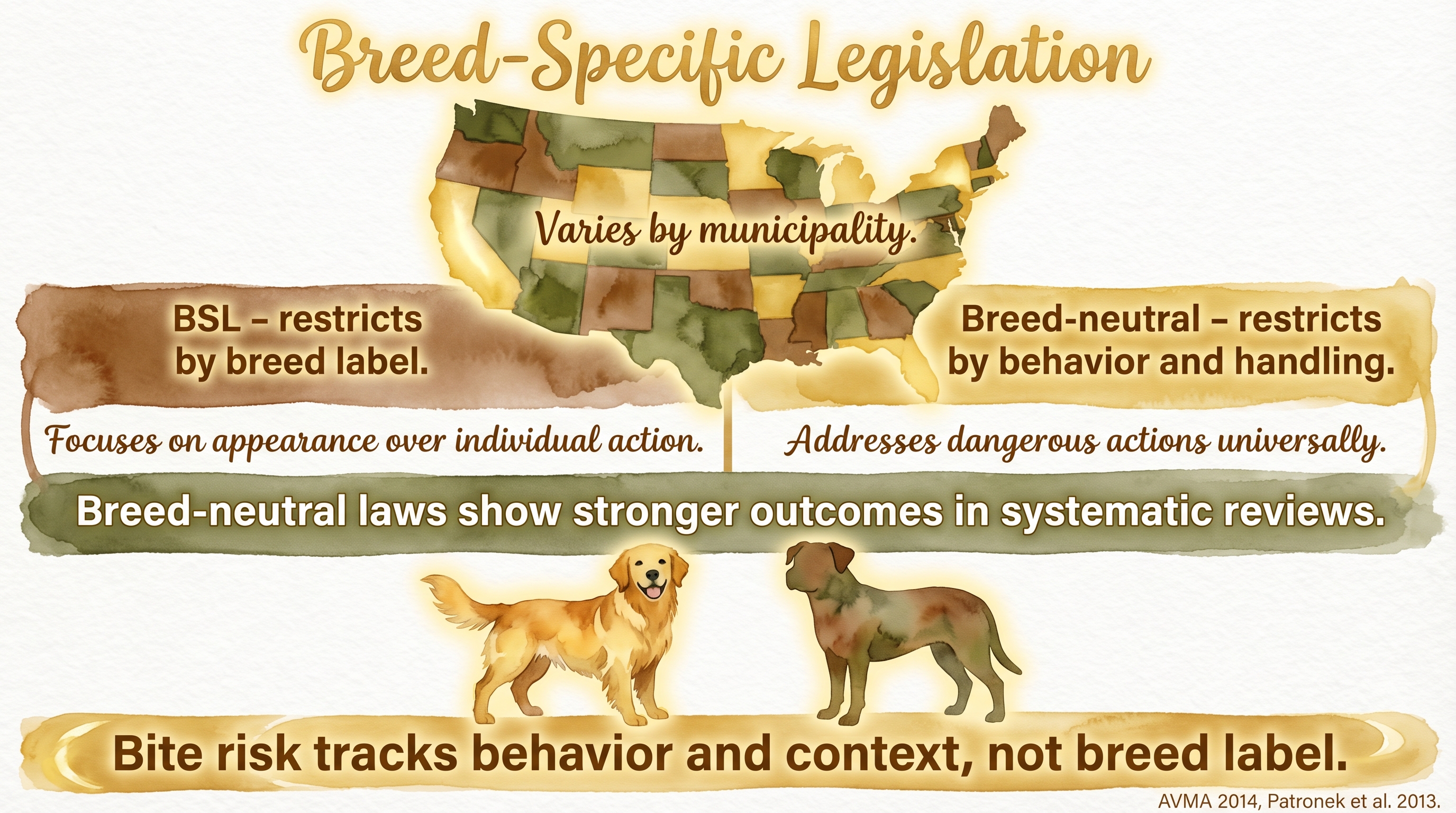
Bite risk tracks behavior and context, not breed label.
Key Takeaways
- BSL regulates or restricts dogs by breed or perceived breed rather than by individual conduct.
- The policy spread because breed labels offered lawmakers a simple response to fear after serious attacks.
- Critics argue that breed is a weak and administratively unstable proxy for actual risk, which is why many jurisdictions moved toward behavior-based dangerous-dog law.
- For JB families, the deeper lesson is to evaluate dogs by pattern and context rather than by breed stereotype alone.
The Evidence
This entry uses observed claim-level tags beyond the dedicated EvidenceBlocks below. These tags mark JB program observation or practice-derived claims that need dedicated EvidenceBlock coverage in a later content pass.
This entry uses ambiguous claim-level tags beyond the dedicated EvidenceBlocks below. These tags mark claims where the literature remains unsettled or multiple interpretations coexist.
- AVMA dog-bite-prevention materialsdog policy
Support the critique that breed alone is a weak proxy for dangerousness and that behavior-based law is generally more defensible. - CDC and public-health commentarydog-bite policy
Support the narrower claim that population-level bite prevention cannot be cleanly solved through breed labels alone. - Dangerous Dogs Act 1991 and Ontario pit-bull legislationbreed-specific law
Document well-known international examples of breed-targeted regulation. - regulatory comparison
Supports the broader point that dog law varies significantly across jurisdictions and legal philosophies.
- domestic dogs
No published study directly measures how breed-specific legislation changes long-term dog welfare, family outcomes, and retention across jurisdictions and enforcement contexts.
SCR References
Sources
- American Veterinary Medical Association. Dog-bite-prevention materials.
- United Kingdom. Dangerous Dogs Act 1991.
- Ontario. Dog Owners' Liability Act.