Calm Vocal Markers
Compound evidence detail1 SCR / 2 parts
- Observed-JBthe ethological evidence that adult dogs deploy specific social signals with situational selectivity and brief contextual deployment (Abrantes, Bekoff, Mech) together with the Bray, MacLean et al. 2021 retriever puppy demonstration that canine attention to human gestural cues is biologically pre-loaded
- Heuristicthe JB application generalizing the dog signal-precision pattern into a universal social-signaling principle and the corollary claim that high-frequency human verbal praise categorically degrades communicative information in household contexts
Calm Vocal Markers are brief, flat signals such as "ah-ah" or "no" delivered at the moment of behavior. In JB they are not commands, not lectures, and not emotional release. They are informational punctuation. The practice itself is observed JB technique. The supporting logic comes from Signal Precision and from the caution that engineered human marker systems should not be confused with documented natural canine analogs. Observed-JB
What It Means
A calm vocal marker is:
- short
- flat
- precisely timed
- emotionally neutral
- immediately over
What it is not:
- yelling
- nagging
- repeating "no" five times
- adding a frustrated speech after the moment has passed
The marker matters because of contrast. If the human is always talking, always praising, always warning, or always correcting verbally, the channel carries very little information. JB argues that a rare, well-timed signal can land cleanly precisely because it is uncommon. Heuristic
The wiki also has to stay careful here. JB is not entitled to claim that a human verbal marker is simply a natural canine signal in spoken form. That would overshoot the evidence. SCR-004 draws a line between natural canine communication and engineered human protocols. Heuristic The safer claim is narrower: calm, sparse, well-timed human vocal input is likely more legible than constant emotional noise.
Why It Matters for Your Dog
Many family homes do not need louder communication. They need less contaminated communication.
The vocal marker should feel like punctuation, not a paragraph.
Used properly, the marker helps interrupt a moment without blowing the whole interaction out of proportion. Used improperly, it becomes a socially acceptable form of yelling. Observed-JB
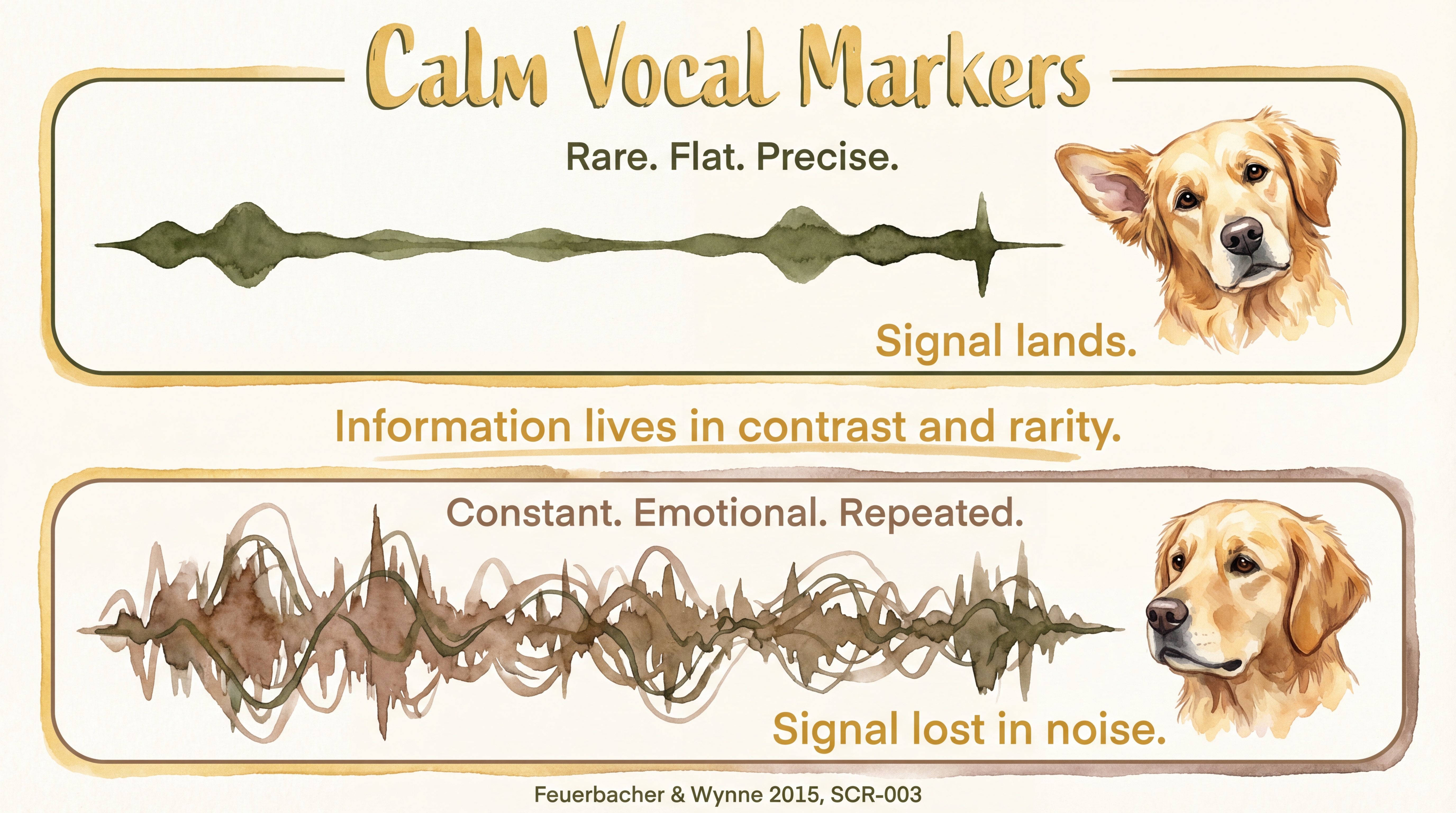
A rare, flat signal in a calm environment stands out. A loud signal in a loud environment is just more noise.
Key Takeaways
- A calm vocal marker is brief, flat, and precisely timed - it is punctuation, not a paragraph.
- The marker carries information because it is rare and contextual, not because it is loud.
- Human vocal markers are not the same as natural canine signals - that distinction matters for evidence honesty.
- If you are saying 'no' constantly, the signal has already lost its value.
The Evidence
- SCR-003 synthesisdomestic dogs and JB observation
JB's signal-precision framework supports the idea that sparse, contextual, well-timed signals carry more information than constant channel-flooding. - SCR-004 synthesisdomestic dogs and ethological reasoning
The page must not claim that engineered human marker systems are documented natural canine analogs. The stronger claim remains heuristic.
- Golden Retrievers in program practice
The specific use of flat vocal markers as part of the JB correction toolkit is observed practice grounded in signal-precision reasoning, not a directly studied canine communication protocol.
No published study directly tests the specific claims or protocols described in this entry within a controlled canine trial.
SCR References
Sources
- Feuerbacher, E. N., & Wynne, C. D. L. (2015). Shut up and pet me. Journal of the Experimental Analysis of Behavior, 103(1), 181-193.
- Rooney, N. J., & Bradshaw, J. W. S. (2002). An experimental study of the effects of play upon the dog-human relationship. Applied Animal Behaviour Science, 75(2), 161-176.
- SCR-003 synthesis. Supports observed canine signal precision and natural-analog principles as ethological background. The calm-vocal-marker technique-level claim remains [Observed/Heuristic] (anchor: SCR-003, SCR-004).
- SCR-004 synthesis. Supports observed canine signal precision and natural-analog principles as ethological background. The calm-vocal-marker technique-level claim remains [Observed/Heuristic] (anchor: SCR-003, SCR-004).