C-BARQ and Standardized Dog Behavior Assessment
The Canine Behavioral Assessment and Research Questionnaire, usually shortened to C-BARQ, is one of the most widely used standardized owner-report tools in canine behavioral research. It was originally developed and validated at the University of Pennsylvania by James Serpell and Yuying Hsu in 2003, and it has since become a major instrument for breed comparisons, epidemiologic surveys, longitudinal projects, and studies of everyday companion-dog behavior. Its appeal is straightforward. Most canine behavior unfolds in homes, on sidewalks, around guests, at doors, or when the dog is left alone. Owners are the people who witness those moments repeatedly. A well-designed owner questionnaire can therefore capture aspects of daily life that a clinic visit or brief behavioral test might miss. Documented
The same feature that makes C-BARQ valuable also creates its main limitation. It is a standardized owner impression, not a direct diagnosis. The questionnaire organizes perception. It does not abolish bias. Owners differ in how carefully they observe, how much behavior they normalize, how comfortable they are reporting aggressive behavior, and how severe something has to feel before they call it a problem. Blackwell, Bradshaw, and Casey 2013 showed how much fear behavior can be underrecognized when owners are simply asked whether their dog is fearful. Standardized tools help by giving people common prompts, but they still depend on what humans notice and admit.
That is why C-BARQ matters so much in behavioral epidemiology. It is not magic. It is a disciplined way of asking similar questions at scale so that patterns can be compared across breeds, ages, contexts, and studies. Documented When used well, it gives the field something much better than anecdote without pretending to be the final word on any one dog.
For JB, the tool is useful precisely because it sits in the middle altitude between the clinic and the crowd. It does not tell you what philosophy to adopt. It does help make behavior more describable, which is often the first step toward reading a dog honestly.
What It Means
What the Tool Actually Is
C-BARQ is a structured owner questionnaire that asks about the dog's responses in common everyday situations and then summarizes those responses into fourteen behavior categories. The Morris Animal Foundation's behavior-data documentation notes that the questionnaire includes about 100 questions and that those questions can be summarized into fourteen categories. The major domains include trainability; several forms of aggression, such as stranger-directed, owner-directed, dog-directed, and familiar-dog aggression; several forms of fear, such as stranger-directed fear, dog-directed fear, and nonsocial fear; as well as attachment and attention-seeking, excitability, and related behavior dimensions. That structure is one reason the tool travels so well across studies. It is broad enough to capture real-world behavior, but standardized enough to compare across thousands of dogs.
The original Serpell and Hsu development work gave the field a common language for owner-reported canine behavior. Documented Later studies, including Duffy, Hsu, and Serpell 2008 on breed differences in canine aggression, helped establish the questionnaire as a practical research instrument rather than a one-off survey.
Why Researchers Use It So Often
Researchers use C-BARQ because it scales. A clinician can assess one dog deeply. A standardized questionnaire can assess thousands of dogs in parallel. That is how large projects can ask breed-level questions, age-related questions, and longitudinal questions that would otherwise be far too costly. The Morris Animal Foundation data commons describes yearly C-BARQ collection in its canine lifetime project, and the Dog Aging Project has used similar large-scale owner-report logic to study behavior in huge populations. Documented
The tool is also useful because it separates behavior domains that owners often blur together. "My dog is aggressive" is not a tidy epidemiologic category. Aggression toward unfamiliar dogs is not the same as aggression toward household members. Fear of strangers is not the same as generalized anxiety. Excitability is not the same as trainability. A questionnaire that disaggregates those categories lets the field say more than "this dog is good" or "this dog is difficult."
What C-BARQ Has Helped Show
C-BARQ-based work has been used to map breed-average patterns, to track behavior across time, to support genetic and genomics research, and to compare behavior profiles across populations. Documented Duffy, Hsu, and Serpell 2008 used it to study breed differences in aggression and reported that Golden Retrievers were among the least aggressive breeds toward both humans and dogs in that dataset. The Morris Animal Foundation's behavior-data page explicitly notes that C-BARQ can reveal clear breed-consistent patterns in many categories while still showing the effects of sex and age. The 2022 Science paper by Morrill and colleagues pushed this conversation further by suggesting that breed explains only about 9 percent of behavioral variation in individual dogs, which means C-BARQ-derived breed patterns are real but far from destiny.
This combination is exactly why the tool is so useful. It can identify population tendencies without collapsing individual dogs into stereotypes. That makes it valuable both for science and for consumer education.
A good behavior tool does not replace judgment. It improves description. Precision in description is often the first protection against both underreaction and overreaction in a family dog.
What the Tool Cannot Do
C-BARQ does not substitute for a clinical behavior workup. It cannot examine medical pain. It cannot observe body language directly. It cannot tell whether owner interpretation is accurate in every case. It cannot fully correct for the fact that one owner's "mild barking concern" is another owner's "serious behavior problem." It is also vulnerable to context blindness. A dog may score high on certain items because the household is chaotic, because the dog is adolescent, because the owner is inexperienced, or because a true clinical problem exists. Documented The questionnaire does not resolve those causes by itself.
That limit is important for families. A standardized score can help frame a problem and identify patterns, but it should not be mistaken for a complete explanation of the dog.
Why It Matters for Your Dog
For an individual family, the practical value of C-BARQ is not that it produces a magical number. It is that it encourages structured noticing. Many owners first describe their dog in mood words: stubborn, sweet, anxious, crazy, needy, reactive. Those words are understandable, but they are vague. A structured questionnaire asks instead: with whom, in what context, how often, and how intensely? Does the dog react more to strangers or to familiar visitors? Is the problem about separation, touch, noise, novelty, or restraint? Is the dog overexcited, fearful, aggressive, or some combination of those states? Those are better questions.
That improved description matters because many treatment mistakes begin with category mistakes. A family may call a dog disobedient when the more accurate pattern is anxiety. Another may call a dog dominant when the consistent issue is fear of unfamiliar people. A third may say the dog is "fine except for barking" without noticing that the barking clusters with nonsocial fear, startle, and poor recovery. A tool like C-BARQ does not solve the problem on its own, but it can stop the family from talking about five different phenomena as if they were one.
This is particularly useful for Goldens because the breed's public image can flatten real differences between individuals. Many Golden families expect sociability, softness, and trainability, and those expectations can make them dismiss warning signs that do not fit the stereotype. A standardized assessment frame pushes back on that by asking the owner to observe the dog actually in front of them. A Golden with stranger fear, high excitability, separation distress, or touch sensitivity is still a Golden. Breed reputation should not block clear observation.
The questionnaire format can also help families notice what is absent. A dog may look "good overall" until the owner is asked specific questions about response to fireworks, veterinary handling, unfamiliar men, sudden noises, or being left alone. Estimated Once those questions are asked clearly, the behavioral picture can become more detailed very quickly.
Another benefit is longitudinal honesty. Owners often adapt to the dog's current baseline and forget what has changed. Repeating a structured tool over time can reveal whether the dog is becoming more settled, more fearful, more dog-selective, or more excitable in ways that casual memory would blur. That can be especially valuable during adolescence, after major household change, or while a treatment plan is underway.
The limits of the tool are just as important. Families should not treat a high score on a category as a diagnosis or a low score as permission to ignore what they see in life. If a dog is frightening guests, freezing at children, or panicking when left alone, the household should respond to reality, not to questionnaire comfort. A structured survey is best used as a support for attention, not a replacement for it.
There is also a subtle emotional benefit. When behavior is described more precisely, adults often feel less ashamed and less melodramatic at the same time. The conversation shifts from "our dog is broken" to "our dog scores and behaves in ways consistent with fear of strangers and high excitability." That wording does not remove the problem, but it makes the problem more workable.
JB families may find this especially compatible with their broader philosophy. Precise observation is part of good raising. You cannot mentor what you are too vague to see. A tool that sharpens description can therefore be useful even for people who do not want to outsource judgment to a score sheet.
Families can also use the tool to separate transient developmental turbulence from more stable patterns. A puppy may be briefly noise-sensitive after one bad event, whereas a broader pattern of startle, avoidance, and poor recovery across multiple contexts suggests a more meaningful fear picture. A structured questionnaire is not perfect at making that distinction, but it does slow the family's tendency to rely on one dramatic memory or one flattering assumption.
This matters in family conversations as well. When adults disagree about the dog, a structured assessment can lower the temperature by giving them shared prompts. Instead of arguing about whether the dog is "just dramatic" or "actually anxious," they can compare concrete situations and frequencies. Better description often makes better collaboration possible.
Structured assessment is also useful when progress is partial. A family might feel, vaguely, that the dog is better or worse after a season of work, adolescence, travel, or medication support. A tool like C-BARQ can break that vague impression into domains. Maybe stranger fear is lower but excitability is unchanged. Maybe attention-seeking is lower while separation concerns remain. That kind of pattern does not solve the problem, but it tells the family where effort is paying off and where it is not.
What This Means for a JB Family
JB families can use a tool like C-BARQ as a descriptive aid. It may help organize what the dog is showing, identify which contexts are hardest, and separate fear, aggression, excitability, and attachment-related behavior more cleanly.
Use it for pattern recognition, not for philosophy. A questionnaire can tell you that certain problems cluster. It cannot tell you by itself what relational stance the family should take or what the deepest cause is.
For that reason, the best use of C-BARQ in a JB home is often before or alongside real observation. Fill it out carefully, then compare it with what the family sees in greetings, walks, recovery, rest, and handling. The value is in sharpening attention.
That fits JB well. The philosophy does not ask families to ignore behavioral tools. It asks them not to confuse the tool with the dog. A structured questionnaire can improve vision. It should not become a substitute for raising.
If the tool reveals a pattern the family had minimized, that is helpful. Better to see a problem clearly while it is still manageable than to protect a flattering story about the dog until the problem becomes expensive.
In practical terms, that means a JB family can use a questionnaire as a checkpoint. Fill it out honestly, compare it against lived observation, and then ask what household changes would actually reduce the pattern being seen. The score is not the intervention. The score is a prompt to become a more accurate adult for the dog.
That is probably the healthiest relationship any family can have with a standardized tool. Respect its ability to organize data. Refuse to surrender judgment to it. Then use the clearer picture to guide better everyday raising.
Used this way, a behavioral questionnaire becomes a servant of the relationship rather than a rival to it. The family sees better, argues less vaguely, and then returns to the real work of shaping daily life around what the dog actually needs.
That is enough to make the tool valuable without pretending it is more than it is.
That restraint matters.
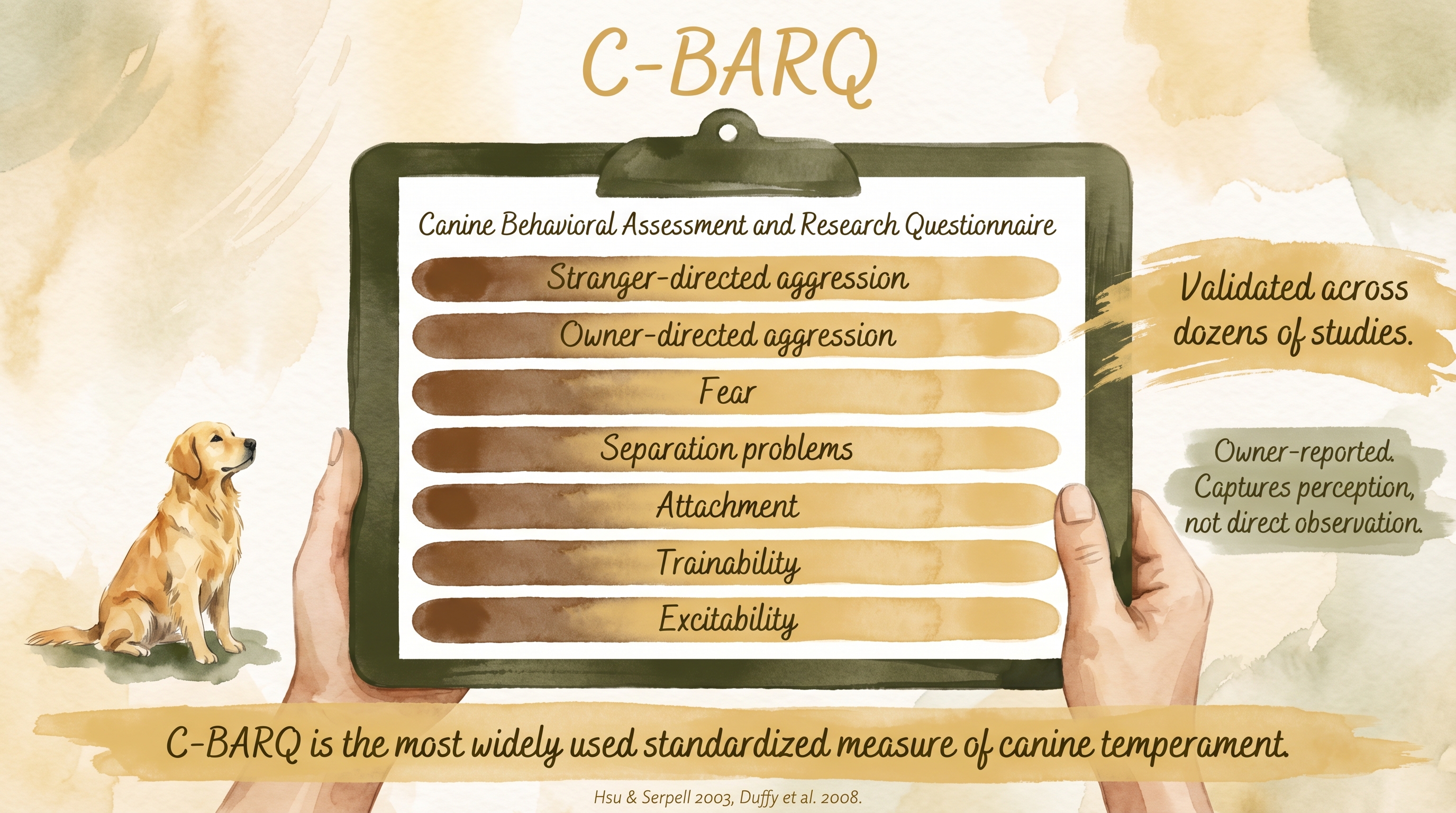
C-BARQ is the most widely used standardized measure of canine temperament.
Key Takeaways
- C-BARQ gives researchers and families a more standardized way to describe everyday canine behavior across common contexts.
- Its great strength is scale and structured description, not diagnostic certainty.
- Breed-average patterns derived from C-BARQ are informative without being destiny for any individual dog.
- For JB families, the questionnaire is most useful when it sharpens observation rather than replacing it.
The Evidence
This entry uses estimated claim-level tags beyond the dedicated EvidenceBlocks below. These tags mark approximate ranges or timing claims that should remain bounded by the cited sources.
- Serpell and Hsu (2003)companion dogs
Developed and validated the C-BARQ as a standardized owner-report questionnaire for canine behavior. - Morris Animal Foundation behavior-data documentationcompanion dogs
Describes the questionnaire as approximately 100 items summarized into fourteen behavior categories and linked to the larger University of Pennsylvania database. - Duffy, Hsu, and Serpell (2008)companion dogs
Used C-BARQ to identify breed-level differences in aggression profiles across multiple breeds. - companion dogs
Notes the instrument's place in canine behavioral epidemiology while leaving owner-report bias fully in view.
- domestic dogs
No published study directly isolates the long-term dog-level and family-level effects of c-barq and standardized dog behavior assessment across ordinary companion-dog contexts.
SCR References
Sources
- Serpell, J. A., & Hsu, Y. (2003). Applied Animal Behaviour Science.
- Duffy, D. L., Hsu, Y., & Serpell, J. A. (2008). Breed differences in canine aggression. Applied Animal Behaviour Science, 114(3-4), 441-460.
- Morris Animal Foundation/C-BARQ documentation supports C-BARQ as a standardized behavior-measurement tool. It does not show that commercial dog trainers generally use longitudinal outcome measurement.
- Hsu, Y., & Serpell, J. A. (2003). Development and validation of a questionnaire for measuring behavior and temperament traits in pet dogs. Journal of the American Veterinary Medical Association, 223(9), 1293-1300.