Breed and Behavior Associations
Breed influences behavior, but not in the cartoon way popular culture often imagines. Population-level studies repeatedly find measurable breed differences in traits such as trainability, sociability, excitability, energy, dog-directed behavior, and some forms of fear or aggression. C-BARQ research by Duffy, Hsu, and Serpell 2008 showed clear breed-level patterns in aggression-related scores, and the Morris Animal Foundation's use of C-BARQ has continued to show breed-consistent tendencies across behavior categories. Golden Retrievers, on average, tend to score as highly trainable, strongly attached to people, and relatively low in stranger- and owner-directed aggression compared with many other breeds. Those are real population tendencies. They are useful information for families deciding what kind of dog may fit their home. Documented
At the same time, breed is not destiny. The 2022 Science paper by Morrill and colleagues, working from large genomic and owner-report datasets, argued that breed explains only about 9 percent of behavioral variation in individual dogs. That is a consequential result because it challenges the folk belief that knowing a breed tells you most of what you need to know about the dog in front of you. Breed still matters. It simply matters at the level of probability and starting point rather than as a script the dog must act out.
This is why discussions of breed and behavior so often become intellectually sloppy. One side treats breed as nearly everything. Another side reacts by talking as if breed means almost nothing. The research supports neither extreme. Documented Breed contributes real average tendencies, but within-breed variation is wide and individual development matters enormously.
JB reads this in a layered way. Genetics sets a starting profile. Raising either protects, amplifies, or distorts that starting profile over time. A good Golden Retriever begins with a favorable family-dog template. Good raising does not replace that template. It gives it the best odds of maturing intact.
What It Means
Breed Averages Are Real
Behavioral epidemiology would be much poorer without breed-level work. C-BARQ studies helped show that average behavior profiles are not randomly distributed across breeds. Documented Duffy, Hsu, and Serpell 2008 found meaningful breed differences in multiple aggression categories, and Golden Retrievers ranked among the breeds with comparatively low aggression scores. Other population work has repeatedly shown breed-linked differences in trainability, excitability, energy, sociability, and fearfulness. These findings are not mystical. They are what one would expect in a species shaped by intense artificial selection for work, social style, motor pattern, and human partnership.
Breed-level data therefore gives families legitimate prior information. If a breed was historically selected for cooperative retrieval, biddability, and human partnership, it is unsurprising that average trainability and social attachment would differ from those of breeds selected for independence, guarding, or high predatory persistence. Epidemiology is not creating these tendencies. It is describing them.
Individual Variation Remains Larger Than Most People Think
The newer genetics work helps discipline breed talk. Morrill et al. 2022, using large genomic and behavioral datasets, concluded that breed accounted for only about 9 percent of variation in individual behavior. Estimated That finding does not erase breed effects. It re-scales them. Breed can shift the baseline probability of certain traits without tightly determining the individual outcome. A family that knows only "Golden Retriever" still knows far less than it may think about a specific puppy's future fear profile, recovery, sociability, reactivity, or adolescent resilience.
This is one reason breed stereotypes can become dangerous. Positive stereotypes create complacency, while negative stereotypes create premature suspicion. Both obscure the actual dog.
The Golden Retriever Profile, Read Honestly
Golden Retrievers are often favored for family life because their average profile is genuinely attractive. They tend to score high in trainability, strong in social attachment, and low in stranger-directed and owner-directed aggression compared with many breeds. Documented They are also active, socially rewarding, and often highly reinforcement-sensitive, which can make them easier for ordinary families to teach. Those are not fantasies. They are part of why the breed became such a major family companion in the first place.
Yet the average Golden profile still carries vulnerabilities. High sociability can drift into overexcitement if not channeled. Strong social attachment can become separation-related difficulty in unstable homes. A soft, affiliative dog can still become noise-sensitive, socially hesitant, or adolescently dysregulated. A low average aggression breed can still contain individual dogs whose fear or conflict behavior becomes serious. A favorable breed average therefore reduces risk; it does not erase the need for good raising.
That is one reason breed research should never be used lazily. The better the average profile sounds, the easier it becomes for families to assume development will take care of itself. In reality, the breed gift is something like a head start. Head starts can be wasted when adults confuse promise with completion.
Mentorship does not replace genetics. It gives favorable traits somewhere to mature. A good starting dog still needs adults who pull that dog upward toward composure instead of letting immature tendencies become the main organizing pattern.
Breed Should Inform Expectations, Not Freeze Them
The best use of breed information is as expectation guidance. It can help a family choose an appropriate dog, prepare for likely energy and social patterns, and understand some broad predispositions. The worst use is to treat the breed label as a complete explanation after the dog is already in the home. Once the individual dog exists, behavior has to be read at the level of the actual animal, not at the level of the breed's public mythology.
That point matters for both science and everyday life. Epidemiology works with averages. Good raising works with particulars.
Why It Matters for Your Dog
For a family raising a Golden Retriever, breed-behavior research can be both comforting and misleading if read carelessly. Documented It is comforting because the breed's average profile is genuinely favorable for family life. Families are not imagining that Goldens often start from a socially cooperative place. It is misleading when that same average profile gets turned into a guarantee.
A Golden puppy may come into the home with ease around people, quick social recovery, and a natural tendency to orient toward humans. Those are lovely traits, and they matter. They also create a temptation to assume that whatever the family does will probably be fine because the dog is a Golden. That is the dangerous turn. Friendly breeds can absorb sloppy raising for a while and still look charming. Later, the cost appears as chronic overexcitement, poor settling, rough social style, leash intensity, adolescent impulsivity, or poor frustration tolerance.
Breed-level knowledge should therefore sharpen the family's stewardship rather than soften it. If Goldens are generally cooperative and attached, then the raising plan should protect those qualities. If they are active and socially enthusiastic, then the household should be especially careful not to reward frantic greeting patterns or treat hyperarousal as cute personality. If they are often responsive to people, then adult emotional steadiness matters even more because the dog is likely to read it closely.
This is also where the Morrill 2022 result becomes practically useful. Breed explains only a portion of variation, which means families should not dismiss real concerns because "Goldens are not like that." A Golden with stranger worry, noise sensitivity, escalating dog-directed tension, or poor handling tolerance should be read as the individual dog he is. Breed optimism should not muffle data from the actual home.
At the same time, families do benefit from honoring the breed's strengths. A good Golden often gives adults a lot to work with. Their sociability, reinforcement sensitivity, and desire for connection can make calm guidance, routine, and mentorship especially powerful. That is one reason the breed fits JB's philosophy so naturally. The dog often arrives inclined toward relationship. The raising system then decides whether that inclination matures well or becomes diffuse, overexcited, and immature.
Another way breed research helps is by lowering unfair self-blame. If a family chooses a breed with high energy, independence, or predatory drive, certain household challenges are not random bad luck. They are partly predictable consequences of starting material. The same is true in a more positive direction with Goldens. Choosing a breed with family-compatible averages is a meaningful protective decision. It just is not the final decision.
This matters when comparing dogs across homes too. One family's "easy" Golden and another family's "difficult" Golden may have started from genuinely different individual baselines even within the same breed. Breed-level data should make families more realistic, not more judgmental. Genetics gives a range. Raising helps determine where within that range the dog lands.
Families should also remember that breed averages were not constructed for suburban modernity alone. Retrieval heritage, social cooperation, and human attentiveness are assets in a family home, but they can still express awkwardly if the dog is chronically overstimulated, under-rested, or raised without much adult structure. Good breed material can be squandered. That is one of the quiet lessons of the modern behavior problem landscape.
Breed knowledge can therefore function as stewardship guidance. If a family knows Goldens often begin with social enthusiasm and biddability, the household should be careful not to turn those strengths into liabilities by rewarding frantic greetings, constant dependence, or immature social style. The better the raw material, the more tragic it is when poor raising disperses it into avoidable chaos.
Breed also helps explain why one intervention seems easy in one home and strangely hard in another. Different dogs are not starting from the same baseline, even inside the same family-dog category. Good science should make families more respectful of those starting differences rather than more confident in simplistic one-size-fits-all claims.
That respect also helps families respond more wisely when a dog diverges from expectation. If a Golden is more socially hesitant or more intense than the breed stereotype suggested, the right move is not disappointment. The right move is to adjust the raising plan to the actual dog while still benefiting from what the breed average tells you about likely strengths and vulnerabilities.
In that way, breed science can actually make a family more flexible. It gives them a sensible prior without forcing them to remain loyal to that prior when the dog in front of them is telling a more specific story. Good families update.
What This Means for a JB Family
JB families should use breed information as starting information. A Golden Retriever is a favorable raw material for family life, and that is worth saying plainly. It is one reason Dan chose the breed.
Then the family should immediately move from breed average to individual observation. How does this puppy recover? How intense is social excitement? How easily does frustration spill over? How much support does calmness need? Those questions respect both genetics and reality.
The deeper JB position is simple: good genes deserve good raising. The Five Pillars are not an argument against breed. They are an argument that the breed's best tendencies should be protected, matured, and not taken for granted.
That is especially important with an easy-to-love breed. Adults can mistake warmth for maturity and friendliness for regulation. A JB family should not make that mistake. It should use the Golden's strong starting point as an invitation to become even more deliberate.
When breed and raising work together, families get the dog they hoped the breed name suggested. When they do not, the breed label by itself will not save the outcome.
That is also why JB keeps both humility and confidence in view. Confidence, because choosing a breed with a favorable family profile matters. Humility, because every individual dog still has to be read and raised as himself rather than as a reputation wearing fur.
Seen that way, breed knowledge becomes a responsibility rather than a boast. The family has chosen a strong starting point. Now it has to build a life worthy of that starting point.
That responsibility is actually good news. It means the family is not trapped between breed determinism and blank-slate fantasy. It can honor the dog's starting architecture and still believe daily life will decide a great deal about how that architecture matures.
That is the JB use of breed science in one sentence: choose wisely, observe honestly, and raise deliberately. Breed gives the house an opening. The house still has to turn that opening into a life.
That is a serious and hopeful way to read the research. Documented
It also keeps families from using the breed label as either excuse or vanity. The point of choosing a Golden is not to coast on the name. It is to protect and mature what the breed tends to offer.
That is good stewardship.
And worth honoring.
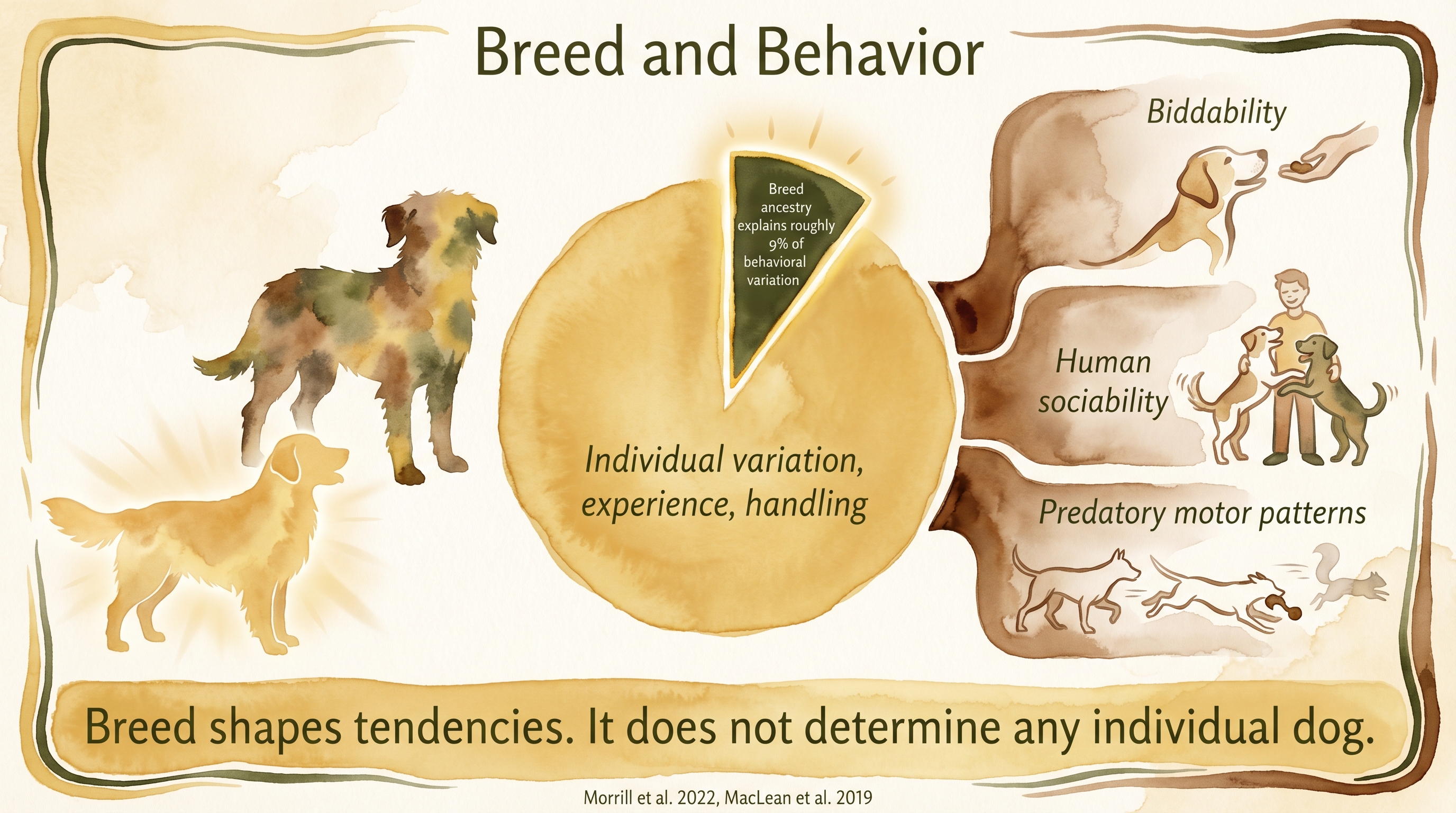
Breed shapes tendencies - it does not determine any individual dog.
Key Takeaways
- Breed averages are real and useful, especially for broad traits such as trainability, sociability, and some risk profiles.
- Those averages do not tightly determine the behavior of an individual dog.
- Goldens begin with a favorable family-dog profile, but that profile still requires protection and maturation through raising.
- JB treats genetics as starting architecture and raising as the process that helps that architecture hold together.
The Evidence
This entry uses estimated claim-level tags beyond the dedicated EvidenceBlocks below. These tags mark approximate ranges or timing claims that should remain bounded by the cited sources.
- Duffy, Hsu, and Serpell (2008)companion dogs
Found breed-level differences in aggression profiles using C-BARQ data, with Golden Retrievers among lower-scoring breeds in several aggression categories. - Morris Animal Foundation C-BARQ documentationcompanion dogs
Describes consistent breed-associated patterns across multiple behavior dimensions while also noting the influence of age and sex. - Morrill et al. (2022)companion dogs
Estimated that breed explains only about 9 percent of behavioral variation in individuals, challenging simplistic breed determinism. - companion dogs
Supports the broader epidemiologic reading that average tendencies and individual outcomes must be kept distinct.
- domestic dogs
No single dataset directly resolves the full population picture for breed and behavior associations without the usual survey, sampling, and threshold limitations.
SCR References
Sources
- Duffy, D. L., Hsu, Y., & Serpell, J. A. (2008). Applied Animal Behaviour Science.
- Morrill, K., et al. (2022). Science.
- Morris Animal Foundation Behavior Data overview.