The Casey 2014 Owner Survey on Training Methods
Rachel Casey and colleagues published a large owner-survey paper in 2014 that remains influential because it tied training style to a family outcome people care about deeply: human-directed aggression. The paper, "Human directed aggression in domestic dogs (Canis familiaris): Occurrence in different contexts and risk factors," appeared in Applied Animal Behaviour Science and analyzed owner-reported patterns across roughly four thousand dogs in the United Kingdom. Large samples do not solve every research problem, but in a field crowded with small studies they matter. Documented
The finding most relevant to training debates was that positive-punishment use was associated with increased owner-reported aggression directed at family members and strangers. The paper also suggested a dose-response pattern, meaning the more punishment owners reported using, the more likely aggression problems were reported. This is one reason the study shows up so often in discussions of aversive methods. It links training style not just to obedience or stress signals, but to one of the most serious forms of behavior fallout a household can face.
At the same time, the study is a survey, which means it carries the usual interpretive traps. Heuristic Owners with already aggressive dogs may have become more punitive because the case was difficult. Owners may misremember, misclassify, or underreport their own methods. Aggression was owner-reported rather than directly observed by blinded assessors. These are not reasons to dismiss the paper. They are reasons to read it correctly.
JB uses Casey 2014 as a weighty association study, not as a perfect causal proof. The paper adds real evidence against routine punishment and against the casual assumption that harsher handling simply creates safer dogs. It also fits JB's broader prevention logic, because the survey is fundamentally describing problems that families would prefer never to build in the first place.
What It Means
Why This Survey Still Matters
In dog-behavior research, very large experimental datasets are rare. Documented Casey 2014 matters partly because scale gives it a different kind of power. Where a small observational study may suggest a pattern, a large owner survey can show whether that pattern is common enough to care about at the population level. This paper did that for aggression risk factors, including training method.
The training result mattered because it was not isolated to one narrow scenario. Positive-punishment use was associated with higher aggression reported toward family members and toward unfamiliar people. That is the kind of signal that changes how a literature is read. It suggests the costs of punitive handling may extend into the everyday safety of the home.
What the Paper Actually Found
The paper examined human-directed aggression across different contexts and looked at a range of possible risk factors. Among those factors, the use of punishment stood out. Owners who reported more positive-punishment methods also reported higher aggression rates. Documented The notebook synthesis for this dispatch emphasizes a dose-response interpretation: more punitive handling tracked with more reported aggression rather than less.
That matters because a common folk argument about punishment is that it brings respect, control, or inhibition. Casey's survey points the other way. It suggests that punitive methods correlate with more aggressive outcomes, not safer ones. As an association, that is already an important warning even before causation is established.
What the Study Cannot Decide
The biggest limitation is reverse causation. Did punishment contribute to aggression, or did aggression lead owners to try more punishment? The survey cannot fully untangle that. It also cannot tell us exactly what owners meant by "punishment" in every household. Some may have meant stern verbal reprimands. Others may have meant leash corrections, alpha rolls, or more physical interventions. Self-report compresses unlike events into broad categories.
Measurement quality is another limit. Owner-reported aggression is still owner-reported aggression. Documented One owner calls a stiff growl aggression. Another overlooks a snap. A third underreports because they feel ashamed. None of that makes the dataset useless, but it does mean the paper is stronger as a risk signal than as a precise behavioral map.
Casey matters to JB because the paper points to a grim downstream reality. Once households are in the territory of aggression and punishment, the family is already working on ground where prevention would have been far cheaper and kinder.
Why the Survey Still Carries Weight Despite the Limits
A large survey does not become irrelevant because it is not experimental. In a field where randomized aggression studies are ethically and practically constrained, strong association data still matters. Documented Casey 2014 carries even more weight because it sits alongside Herron et al. 2009, Hiby 2004, Arhant 2010, and later aversive-welfare work rather than standing alone. The broader literature repeatedly points in the same direction: punishment-heavy handling is linked with worse behavioral and welfare outcomes.
That is the right level at which to use the paper. It is one important piece in a converging picture. It is not a magic wand that dissolves every causal question, but it is strong enough to challenge any trainer who speaks as if harsher methods are obviously the road to safety.
Population-level association matters here because aggression is too serious a topic for casual intuition. Families often rely on folklore about firmness, respect, or accountability when the dog has begun to guard or snap. Casey 2014 does not bless a simple opposite folklore. It gives a larger empirical warning sign that should make all confident pro-punishment advice sound much less casual than the market often makes it.
Why It Matters for Your Dog
For a Golden Retriever family, Casey 2014 matters because punishment often enters the picture precisely when families are frightened and overwhelmed. Observed-JB A dog growls over a resource, snaps in frustration, stiffens around children, or begins redirecting during arousal. Someone then says the dog needs firmer correction before it gets worse. The Casey survey should make families slow down before accepting that instinctive logic.
The paper's core warning is practical. More punishment does not obviously map onto more safety. In the survey, it mapped onto more owner-reported aggression. Even if some of that pattern reflects owners escalating punishment after aggression appeared, that still matters. It means punitive handling is showing up inside difficult cases often enough that we should be cautious about recommending it casually.
A Golden-specific example shows the point. Imagine a young retriever who begins guarding socks, tissues, or stolen kitchen items. A frustrated adult grabs for the object, uses a stern verbal correction, corners the dog when it runs, and escalates if the dog growls. From the adult's perspective this feels like necessary seriousness. Casey 2014 is one reason to worry that this pattern may be increasing conflict rather than solving it. The family may be teaching the dog that human approach around valued items predicts escalating social pressure.
This matters because Goldens are often assumed to be inherently safe and forgiving. That assumption can make families slower to notice early aggression risk and faster to use correction when they finally do notice it, because the behavior feels like a shocking betrayal of breed expectations. A study like Casey helps puncture that emotional reaction. The right question is not whether the dog's behavior feels inappropriate for a Golden. The right question is what handling pattern is most likely to lower risk without feeding the conflict cycle.
The survey also has a broader consumer-protection value. Many correction-oriented trainers present punishment as maturity, clarity, or accountability. Casey 2014 does not prove every correction increases aggression. It does provide a strong reason to reject the easy confidence of that sales language. Families should expect a much more careful justification from anyone recommending punitive handling around aggression-related problems.
Goldens make the prevention lesson vivid too. Much of the aggression literature concerns cases that have already moved into guarding, fear, frustration, or conflict. JB reads that as a reminder that calm raising, clean resource patterns, socially secure adults, and early non-initiation of chaos are not sentimental extras. They are upstream risk management. The survey is measuring what happens after that upstream work has gone badly or never been done.
The paper also helps families resist a false binary. The alternative to punishment is not permissive chaos. It can be management, desensitization, structured access, prevention, and clear but non-punitive interruption. A family that only sees "punish or be unsafe" is already thinking inside a narrowed and dangerous frame.
Notice what this does to timing inside a real home. If a family waits until emotions are high and then treats punishment as the first serious intervention, they are often choosing under the worst possible conditions: fear, urgency, embarrassment, and incomplete understanding of the triggers. Casey 2014 does not tell them exactly how to treat every guarding or conflict case, but it does say that adding punitive pressure to that emotional mix should not be considered the obvious grown-up response.
Seen from another angle, the survey also changes how families should evaluate so-called balanced advice. If a trainer says rewards build behavior but punishment keeps everyone safe, Casey gives good reason to ask what evidence shows that safety benefit in ordinary homes. The survey's direction of association points the other way. Even with reverse-causation caution, the literature is not giving families a clean empirical basis for assuming that punitive handling is the missing ingredient in conflict-prone cases.
Children make the lesson even more concrete. In many homes, the flashpoint for punishment is not only the dog's behavior but the adults' fear about what might happen around kids, visitors, or vulnerable family members. That fear is understandable. Casey matters because it says fear should not be allowed to masquerade as evidence. A frightened household may still need fast management and professional help, but it should not leap from urgency to the assumption that more punitive handling is what creates genuine safety.
Placed in that family context, the survey becomes less an abstract warning and more a decision-making tool. It reminds adults to distinguish acting quickly from acting punitively. Gates, leashes, supervised access, cleaner routines, and better trigger awareness can all be immediate responses. Casey helps families remember that urgency does not remove the need for judgment about method.
What This Means for a JB Family
The first JB takeaway is to treat aggression-adjacent cases as the worst place to reach casually for punishment. Casey 2014 is one of the clearest signals in the literature that punitive handling and aggression risk are not a safe combination to romanticize.
The second takeaway is to read association carefully without weakening the practical lesson. Even if some owners punished because the dog was already difficult, the paper still shows that punishment belongs to a high-risk picture rather than to a clean safety solution. Documented That alone should lower confidence in correction-heavy advice around guarding, snapping, or family conflict.
Third, pull the whole conversation upstream whenever possible. Guarding, resource conflict, adolescent frustration, and arousal spillover do not come out of nowhere. Prevention, calmer handling, cleaner resource exchanges, and more thoughtful household structure reduce the odds that families ever need to make hard decisions in this territory.
Finally, use Casey to upgrade your questions when talking to trainers. Ask how they distinguish suppression from reduced aggression risk. Ask how they monitor fallout. Ask what they do if punitive handling increases tension. If the answers are casual or theatrical, the family has learned what it needs to know.
One more practical rule follows from the paper: when aggression or guarding enters the picture, slow the adults down before they speed the dog up. Separate people and resources, reduce rehearsal, tighten management, and get clearer about triggers before anyone starts experimenting with stronger corrections. That sequence is not softness. It is a more responsible response to a body of literature that does not show punishment delivering the safety certainty people often imagine.
Equally important, keep the survey's humility intact. Casey is not a command to excuse threatening behavior or to avoid structure. It is a reminder that fear, conflict, and punishment can interact in the wrong direction. A JB family should hear that as a call for cleaner management, calmer adults, and more thoughtful professional help, not as permission to let problems drift.
That is why this paper fits so naturally with JB's prevention lens. The best aggression plan is still the one the family never has to improvise under panic. When warning signs appear, Casey supports a slower, more surgical response than the culture of firmness often recommends.
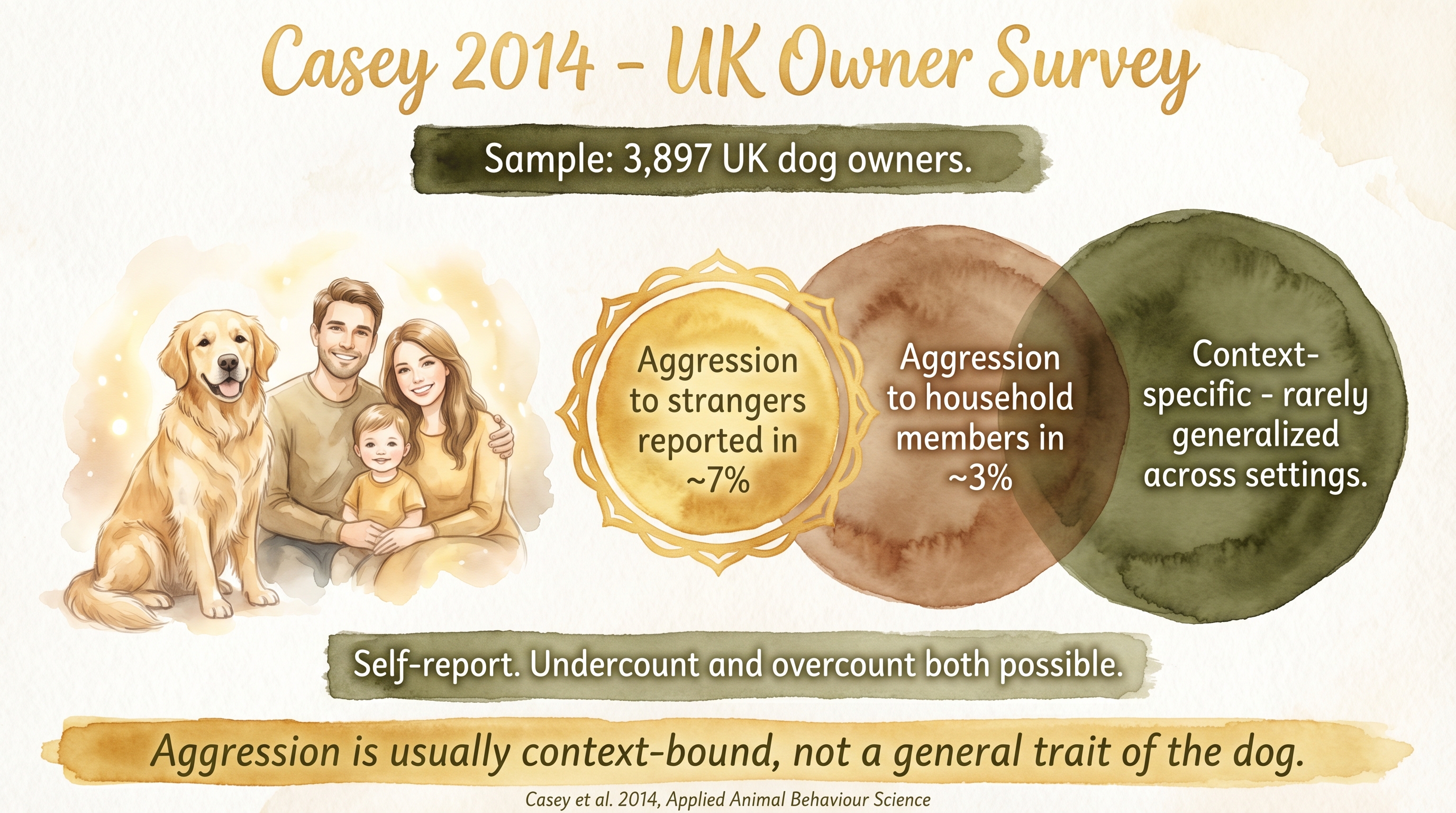
Aggression is usually context-bound, not a general trait of the dog.
Key Takeaways
- Casey 2014 matters because it brings a large sample to one of the most serious questions in training, namely aggression risk.
- Its finding is associative, not perfectly causal, but the direction is clear enough to challenge casual pro-punishment advice.
- Families should not read punitive handling as an obviously safe response to guarding, snapping, or conflict behaviors.
- For JB, the paper reinforces the value of prevention and calm upstream handling long before the home becomes an aggression case.
The Evidence
This entry uses observed claim-level tags beyond the dedicated EvidenceBlocks below. These tags mark JB program observation or practice-derived claims that need dedicated EvidenceBlock coverage in a later content pass.
This entry uses heuristic claim-level tags beyond the dedicated EvidenceBlocks below. These tags mark JB interpretive application rather than direct study findings.
- Casey et al. (2014)companion dogs
Large UK owner survey linked positive-punishment use with higher owner-reported aggression toward family members and strangers. - companion dogs
Places the paper in the broader pattern of punishment-linked behavior concerns while emphasizing reverse-causation limits. - Herron, Shofer, & Reisner (2009)companion dogs
Provides complementary survey evidence that confrontational methods can provoke aggressive responses. - Arhant et al. (2010)companion dogs
Supports the broader association between frequent punishment and owner-reported aggression or avoidance.
- domestic dogs
No published follow-up study directly tests how the findings summarized under the casey 2014 owner survey on training methods generalize across breeds, households, and long-term outcomes.
SCR References
Sources
- Casey, R. A., Loftus, B., Bolster, C., Richards, G. J., & Blackwell, E. J. (2014). Applied Animal Behaviour Science.
- Herron, M. E., Shofer, F. S., & Reisner, I. R. (2009). Applied Animal Behaviour Science.
- Arhant, C., Bubna-Littitz, H., Bartels, A., Destrez, A., & Baumgartner, J. (2010). Behaviour of smaller and larger dogs: Effects of training methods, inconsistency of owner behaviour and level of engagement in activities with the dog. Applied Animal Behaviour Science, 123(3-4), 131-142.
- Casey, R. A., Loftus, B., Bolster, C., Richards, G. J., & Blackwell, E. J. (2014). Human directed aggression in domestic dogs: Occurrence in different contexts and risk factors. Applied Animal Behaviour Science, 152, 52-63.