The Treatment Prediction
Compound evidence detail1 SCR / 2 parts
- Documentedcanine welfare evidence on aversive training methods (Vieira de Castro 2020, Ziv 2017, Hiby 2004) and attachment-mediated stress modulation evidence (Schoberl 2015, Asher 2020, Brubaker and Udell 2023)
- HeuristicJB claim that secure attachment context measurably alters how dogs experience mechanically operant-identical correction procedures, RF-flagged in the SCR and formally untested in controlled canine studies
The treatment prediction is one of the most important findings in the whole human-variable layer: owner attachment style and personality predict canine behavior-treatment outcomes independently of the protocol itself. That does not make method irrelevant. It makes relationship context impossible to ignore. Documented
What It Means
Most behavior-change discussions in the dog world assume the protocol is the main event. Documented A clinician or trainer selects a plan, the family applies it, and the outcome is read as a verdict on the method. Powell and colleagues complicated that story in a way that matters deeply for JB.
Their study followed 131 dog-owner dyads who attended a veterinary behavior service. Documented Owners completed C-BARQ at baseline, three months, and six months, along with owner-personality and owner-attachment measures at baseline. The consultations could include behavior modification, environmental change, safety rules, and psychopharmacological support. The important result was not that method ceased to matter. It was that owner attachment style predicted outcomes independently of the specific behavioral protocol used. In plain language, who the family was in the relationship helped determine how well the treatment landed.
The paper is also worth reading accurately rather than mythically. Baseline canine behavior was still the most consistent predictor of change. Documented Some outcomes improved overall, including increased trainability and reductions in chasing, separation-related behavior, and energy level over six months. That means Powell is not a "relationship explains everything" paper. It is a "relationship remains significant even after method and case severity are already in the room" paper, which is arguably more useful.
That is a much more serious finding than it may sound at first pass. If two families receive comparable guidance and one improves more than the other for reasons tied to attachment style, then the protocol is not entering empty space. It is entering a relational system that either supports or distorts what the protocol is trying to do.
This is exactly why Category 12 treats the relationship as the delivery mechanism. The dog does not experience formal treatment only during planned sessions. The dog experiences the caregiver's tone, timing, emotional regulation, consistency, and relational history across every ordinary hour between those sessions. A technically good plan can therefore be diluted, sharpened, or destabilized by the family climate it is embedded in.
Dodman's large owner-personality study strengthens the same picture from another angle. Documented There, training method mediated only a small portion of the link between owner personality and dog behavior problems. The larger influence appeared to operate through daily life itself, the thousands of micro-interactions that formal protocols cannot fully control. Powell's treatment result sits naturally beside that. Interventions are not floating above the relationship. They are being delivered through it.
Powell also helps guard against over-simplification in a second way. The owner effects were not a single universal personality recipe that improved every problem equally. Associations varied by subscale and timepoint. Owner conscientiousness, extraversion, openness, and owner-dog attachment each showed different relationships with different outcomes. That matters because it means we are dealing with a complex delivery system, not a one-number score for "good families." JB's use of the finding should therefore stay relational and directional, not personality-typing for its own sake.
The attachment literature makes the idea even more plausible. Schoberl showed that secure attachment changes cortisol buffering. Brubaker showed that caregiving style covaries with attachment and task persistence. Put together, these lines suggest that treatment success will partly depend on whether the adult is physiologically usable, behaviorally coherent, and relationally organized enough for the dog to process the intervention well.
This is where the entry connects to SCR-005 without outrunning the science. Powell did not directly test calm correction inside secure versus insecure attachment relationships. The paper is not a completed JB trial. What it does provide is documented evidence that relationship variables predict behavior-change outcome independently of method. That is a powerful support beam under the broader relational-modulation hypothesis.
It also helps explain why owner compliance is such a stubborn issue in canine behavior medicine. A demanding plan is not being delivered by a neutral machine. It is being delivered by a human with a particular attachment style, tolerance for frustration, relationship history with the dog, and capacity for consistency. When a plan fails, part of what may be failing is not only knowledge of the plan, but the human system that has to enact it over weeks and months.
The practical implication is that methods cannot be evaluated as if all handlers were interchangeable delivery devices. Two adults can perform mechanically similar steps while producing different outcomes because the dog is not only reading the mechanical steps. The dog is reading the relationship those steps arrive through.
That is a disciplined reason to stop asking only, "Which method works?" and start asking, "For whom, in what relationship, under what caregiver state, and inside what daily pattern?" The method question is not wrong. It is incomplete.
Why It Matters for Your Dog
For families, this entry is both demanding and reassuring. Demanding, because it means the adult cannot hide behind technique alone. Reassuring, because it explains why some families feel stuck even after receiving solid advice. The missing variable may not be one more method change. It may be the relationship carrying the method.
The treatment-prediction finding does not prove every JB correction claim, but it strongly supports the broader idea that mechanically similar interventions can land differently depending on the relationship they are delivered through.
This is one reason JB keeps treating adult calmness, relational steadiness, and structured leadership as primary work rather than as side issues. They are not cosmetic extras around the method. They are part of what determines whether the method becomes information, noise, or threat to the dog.
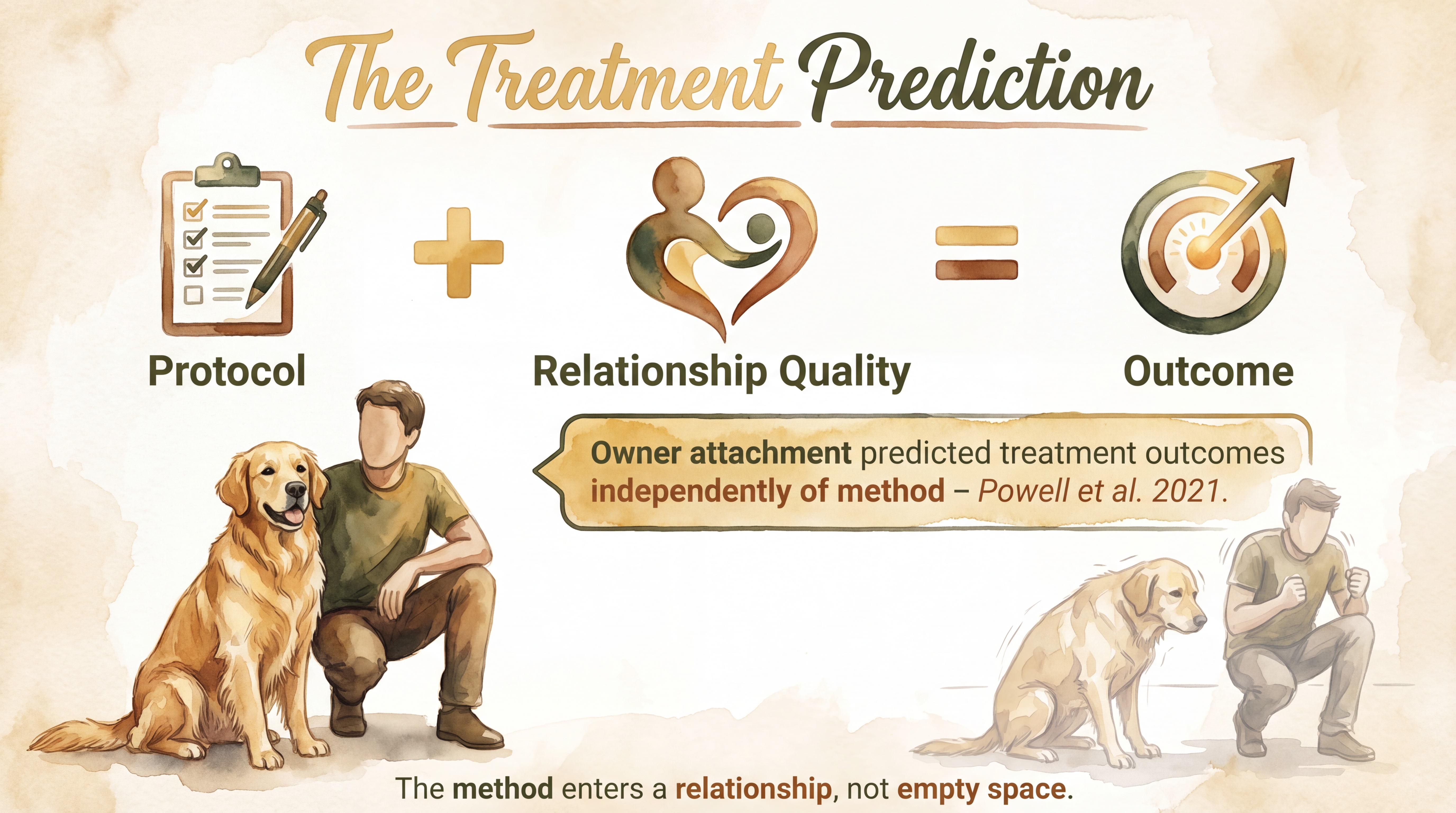
Owner behavior often predicts treatment outcomes more reliably than the dog's diagnosis, making the human variable a clinical priority.
Key Takeaways
- Owner attachment style and personality predict canine treatment outcomes independently of the behavioral protocol alone.
- This means method does not operate in a vacuum. It is delivered through a relationship with its own strengths and weaknesses.
- The finding strongly supports taking caregiver state and bond quality seriously when evaluating why behavior plans succeed or fail.
- It supports the broader JB thesis about relational modulation without by itself constituting a direct JB intervention trial.
The Evidence
- Powell, L. et al. (2021)domestic dogs and humans
Found that owner attachment style predicted canine behavioral treatment outcomes independently of the specific protocol used over three- and six-month follow-up intervals. - Dodman, N. H. et al. (2018)domestic dogs and humans
Showed that training method accounted for only a small portion of the link between owner personality and dog behavior problems, strengthening the case that daily relationship variables matter.
- Schoberl, I. et al. (2016)domestic dogs and humans
Showed that secure attachment changes cortisol reactivity during challenge, supporting the idea that relationship quality changes how interventions are experienced. - Brubaker, L., and Udell, M. A. R. (2023)domestic dogs
Found that caregiving style predicts attachment security and persistence, reinforcing that caregiver variables alter how dogs organize under challenge.
- SCR-005 boundarydomestic dogs
The Powell result documents method-independent relationship effects on treatment outcome, but it does not directly test identical corrective procedures across secure and insecure attachment relationships.
No published trial has directly compared the same canine behavior protocol delivered inside secure versus insecure caregiver relationships while holding protocol mechanics constant.
SCR References
Sources
- Brubaker, L., & Udell, M. A. R. (2023). Does pet parenting style predict the social and problem-solving behavior of pet dogs? Animal Cognition, 26(1), 345-356. https://doi.org/10.1007/s10071-022-01694-6
- Dodman, N. H., Brown, D. C., & Serpell, J. A. (2018). Associations between owner personality and psychological status and the prevalence of canine behavior problems. PLOS ONE, 13(2), e0192846. https://doi.org/10.1371/journal.pone.0192846
- Powell, L., Stefanovski, D., Siracusa, C., & Serpell, J. (2021). Owner personality, owner-dog attachment, and canine demographics influence treatment outcomes in canine behavioral medicine cases. Frontiers in Veterinary Science, 7, 630931. https://doi.org/10.3389/fvets.2020.630931
- Schoberl, I., Beetz, A., Solomon, J., Gee, N., Kotrschal, K., & Wedl, M. (2016). Social factors influencing cortisol modulation in dogs during a strange situation procedure. Journal of Veterinary Behavior, 11, 77-85. https://doi.org/10.1016/j.jveb.2015.09.007