Caregiving Style and Canine Outcomes
Compound evidence detail1 SCR / 3 parts
- Documentedthe Baumrind authoritative-parenting literature in human child development
- Documentedthe canine correlational evidence linking dog-directed caregiving styles to attachment, attention, sociability, and problem-solving outcomes (van Herwijnen 2018/2020, Brubaker and Udell 2023)
- Heuristicthe JB inference that one specific caregiving style experimentally produces the best long-term developmental outcomes in dogs
Caregiving style is no longer a soft metaphor borrowed from parenting books. In dogs, it is now a measurable research variable that predicts attachment quality, sociability, persistence on tasks, and several classes of behavior problems. The strongest scientific summary is two-part: the association signal is real and convergent, while the full causal mechanism is still not experimentally closed. Mixed Evidence
What It Means
The core idea is simple. Dogs do not only live inside a technique set. They live inside a caregiver. How that caregiver responds across days and months, warm or cold, structured or loose, calm or reactive, becomes part of the developmental environment. Caregiving style is the broader pattern underneath the individual moment.
Human developmental psychology gives the starting framework. Baumrind's parenting model distinguishes authoritative caregiving, high warmth plus high structure, from authoritarian, permissive, and uninvolved forms. In children, the authoritative quadrant is the best-supported overall pattern for healthy developmental outcomes. Dog science is not allowed to copy that conclusion automatically, but it is allowed to ask whether analogous style differences can be measured in human-dog relationships.
That question now has a meaningful answer. van Herwijnen and colleagues adapted the Parenting Styles and Dimensions Questionnaire for dog-directed contexts and surveyed 518 Dutch caregivers. Their analysis recovered recognizable style clusters rather than random noise. The strongest dimensions included an authoritarian-correction pattern and two authoritative patterns, one more intrinsic-value oriented and one more training-oriented. That matters because it shows dog-directed caregiving style is not just philosophical vocabulary. It can be operationalized.
That first study also clarified an important limitation in the canine literature. Documented A clearly permissive or uninvolved quadrant did not surface cleanly in the sample, and the authors pointed to the likely reason: the participants were highly engaged caregivers, not a representative sweep of every kind of household. That is both a weakness and a useful clue. It means the field may still be undersampling the least structured households, but it also means that even inside a relatively invested sample, warm-and-structured versus correction-heavy differences were still strong enough to detect.
The follow-up observational study made the construct more concrete. Documented In 40 owner-dog dyads moving through a distraction course, parenting-style scores predicted visible behavior in the room. More authoritative caregivers used more praise and less correction, while authoritarian-correction was linked to more verbal correction and more leash tension. Parenting style explained roughly 30 percent of the variance in what the dyads actually did. The dog looking back toward the caregiver, one of the most practically meaningful behaviors in the JB world, was more likely in the authoritative direction and less likely in the authoritarian-correction direction.
That study matters methodologically because it moved the conversation beyond self-description. Documented The researchers were no longer asking only what families believed about their style. They were observing what happened when the dyad had to navigate a more demanding course and a calmer break-time setting. In other words, the style signal survived contact with real interaction. The observed differences were still proximal rather than full-life developmental outcomes, but they showed that caregiving style is visible in timing, pressure, praise, and attention allocation, not only in survey language.
Brubaker and Udell then asked the harder outcome question. In 48 dyads classified into authoritative, authoritarian, and permissive styles, dogs of authoritative caregivers showed the highest secure-attachment rates, the best sociability, and the strongest persistence on a solvable problem. That is an important step forward because it moves the literature from interaction style alone into attachment and competence. The style difference was not only cosmetic. It was associated with what the dog became under mild challenge.
That is one reason the Brubaker study carries so much weight in this subcategory. It did not stop at a single attachment label or a single obedience score. It linked caregiving style to secure attachment, social sensitivity, and persistence on a task the dog could in fact solve. Persistence matters because it is one of the cleanest everyday windows into whether the dog stays behaviorally organized when effort is required. A dog who remains engaged, keeps trying, and uses the caregiver or context effectively is telling us something deeper than whether a cue was obeyed once.
de Assis and colleagues pushed the field further by building the Lincoln Owner Caregiving Questionnaire, or LOCQ. Instead of only importing human quadrants, they used factor analysis to identify insecure caregiving dimensions directly in dog-owner relationships. The resulting dimensions were disorganised, avoidant, and ambivalent. High disorganised scores predicted separation-related problems and multiple concurrent problems. High avoidant scores predicted fearfulness. High disorganised plus high avoidant predicted aggression. The dogs whose families reported no behavior problems showed the lowest medians across all three insecure dimensions, a profile the authors interpreted as consistent with secure caregiving marked by sensitivity, reliability, availability, and structure.
That change in instrument design matters. LOCQ did not merely ask whether dog families resemble Baumrind's original quadrants. It asked which insecure patterns emerge when dog-directed caregiving is measured on its own terms. That makes the resulting disorganised and avoidant signals especially valuable. They are not a loose human analogy pasted onto dogs after the fact. They are canine relationship measures that still converge with the broader attachment logic.
Bouma and colleagues broadened the picture further. Their work linked parenting-style transmission and dog outcomes, finding that authoritative caregiving aligned with secure attachment, sociability, and problem-solving success, while permissive caregiving aligned with dogs who followed stranger cues more readily than their own caregiver's cues. They also reported a link between permissive style and higher canine obesity. That is an especially useful result because it shows caregiving style does not stay trapped in one behavioral silo. It reaches social orientation, cognition, and physical management.
Bouma's mixed-method design also helps explain why these styles persist. In that study, intergenerational transmission effects were detected in human-dog relationships, and orientation toward dogs mattered. Documented A protectionistic orientation, one that respects species-specific canine needs, reduced the likelihood of reproducing more authoritarian patterns, while humanistic and protectionistic orientations both contributed to some compensatory permissive behaviors. That combination is important. It suggests the path to better caregiving is not colder feeling. It is warmer care that is also dog-realistic rather than purely anthropomorphic.
Taken together, these studies now form a true convergence pattern. Documented Different research groups, different measures, different countries, and different outcome variables keep finding that the warm-and-structured side of caregiving is associated with the strongest results, while reactive, distant, disorganized, or permissive styles are associated with weaker ones. That level of recurrence matters. It means the signal is not resting on one charismatic paper.
At the same time, this is not finished causal science. Most of the literature is cross-sectional, observational, or correlational. It shows that style and outcome travel together. It does not yet isolate the active ingredient the way a tightly controlled developmental experiment would. That is why the careful sentence is stronger than either extreme. We can say the association between caregiving style and canine outcomes is documented. We cannot yet say the full warmth-plus-structure mechanism has been experimentally proven in dogs the way it is discussed in some human developmental contexts.
This is where the bond category changes the emphasis. Category 12 is not asking only whether dogs learn from consequences. It is asking what kind of relationship those consequences are delivered through. The caregiving-style literature answers that directly. The relationship is not a backdrop. It is part of the mechanism.
Why It Matters for Your Dog
For families, this entry changes the diagnostic question. Instead of asking only, "What training method are we using?" it invites the more consequential question, "What kind of caregiver are we being?" That does not erase technique. It puts technique back inside the relational environment that gives it meaning.
The caregiving-style literature is one of the clearest scientific supports for JB claim that the adult should function as a calm, warm, structured parent rather than as either a permissive peer or a reactive controller.
It also protects against overclaiming. JB can responsibly say that authoritative-like caregiving patterns are associated with the best documented canine outcomes currently measured. Documented JB should not say that every outcome difference has already been reduced to one experimentally isolated cause. The relationship claim is strong enough without pretending the last methodological step has already happened.
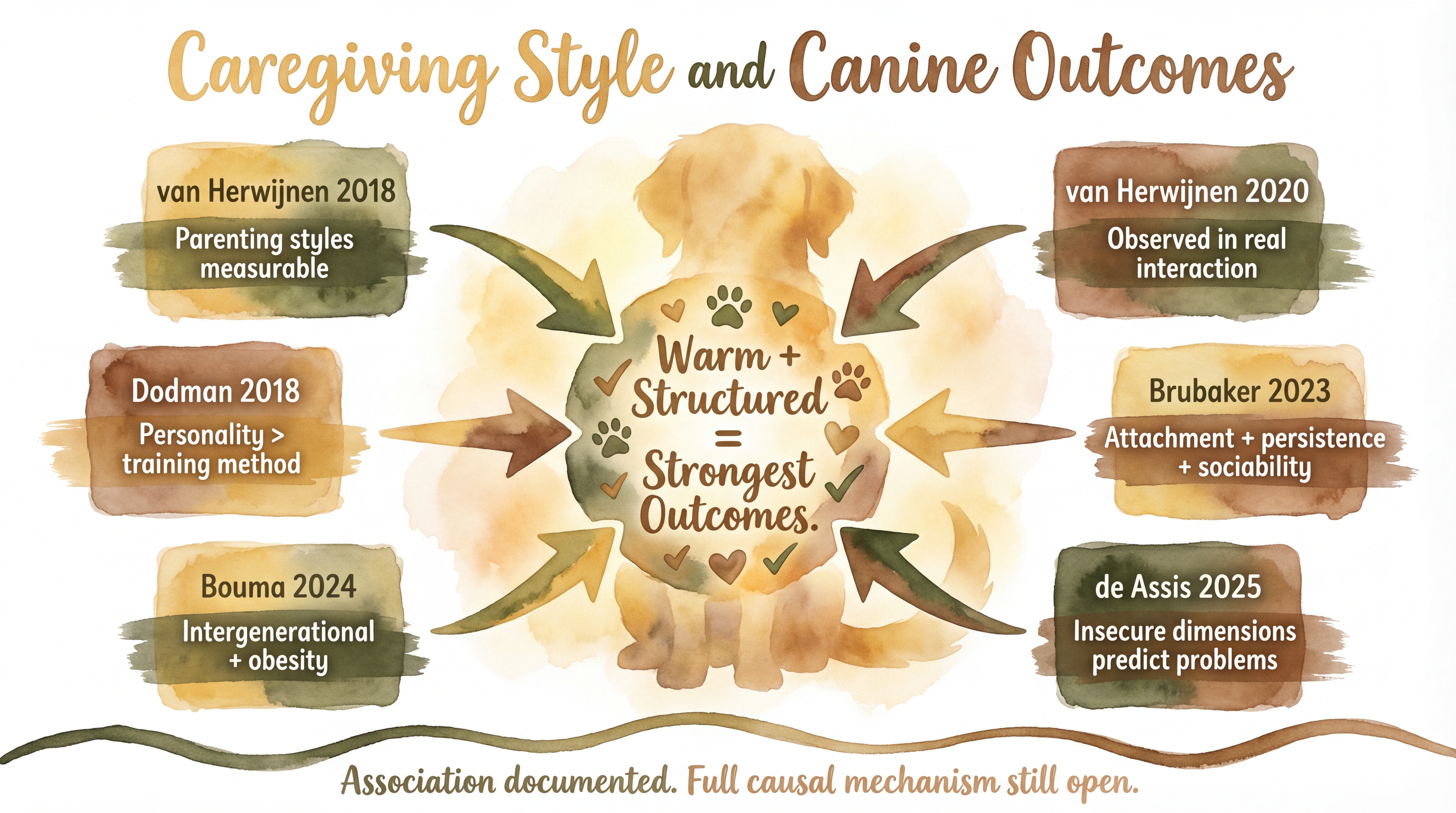
How an owner raises a dog measurably shapes behavioral outcomes, making caregiving style a variable that matters as much as breed or genetics.
Key Takeaways
- Caregiving style is now a measurable canine research variable, not just a borrowed metaphor from human parenting.
- Across multiple studies, warm and structured caregiving is associated with stronger attachment, better sociability, and better problem-solving outcomes in dogs.
- Disorganised, avoidant, reactive, and permissive caregiving patterns are associated with weaker behavioral and relational outcomes.
- The association signal is documented. The full causal mechanism remains more bounded than the strongest human parenting literature.
The Evidence
This entry uses mixed-evidence claim-level tags beyond the dedicated EvidenceBlocks below. These tags mark claims that combine documented findings with observed practice, heuristic application, or unresolved gaps.
- van Herwijnen, I. R. et al. (2018)domestic dogs
Recovered dog-directed parenting-style dimensions from 518 caregiver surveys, showing that caregiving patterns are measurable rather than anecdotal. - van Herwijnen, I. R. et al. (2020)domestic dogs
Found that parenting-style scores predicted praise, correction, leash tension, and dog orientation back toward the caregiver in observed distraction-course interactions. - Brubaker, L., and Udell, M. A. R. (2023)domestic dogs
Reported that authoritative caregivers had dogs with the strongest secure-attachment, sociability, and solvable-task persistence outcomes. - de Assis, L. S. et al. (2025)domestic dogs
Used the LOCQ to show that disorganised, avoidant, and ambivalent caregiving dimensions predict separation problems, fearfulness, and aggression. - Bouma, E. M. C. et al. (2024)domestic dogs
Linked caregiving style to attachment, sociability, problem-solving, stranger-following, and obesity-related household patterns.
- Baumrind, D. (1966, 1991)humans
Established the authoritative, authoritarian, permissive, and uninvolved parenting framework and showed that warmth plus structure produces the strongest overall developmental outcomes in children.
- SCR-019 boundarydomestic dogs and humans
The association between warm structured caregiving and stronger outcomes is documented in dogs, but the full causal warmth-plus-structure mechanism remains more bounded than in the human literature.
No published breeder-to-family or household intervention trial has directly assigned caregiving styles and then measured downstream attachment and behavior outcomes as formal primary endpoints.
SCR References
Sources
- Baumrind, D. (1966). Effects of authoritative parental control on child behavior. Child Development, 37(4), 887-907.
- Baumrind, D. (1991). The influence of parenting style on adolescent competence and substance use. Journal of Early Adolescence, 11(1), 56-95.
- Bouma, E. M. C., Vingerhoets, A. J. J. M., & van der Veld, W. M. (2024). Parenting styles and intergenerational transmission in human-dog relationships. Animals, 14(7), 1038. https://doi.org/10.3390/ani14071038
- Brubaker, L., & Udell, M. A. R. (2023). Does pet parenting style predict the social and problem-solving behavior of pet dogs? Animal Cognition, 26(1), 345-356. https://doi.org/10.1007/s10071-022-01694-6
- de Assis, L. S., Georgetti, B., Burman, O. H. P., Pike, T. W., & Mills, D. S. (2025). Development of a dog owner caregiving style scale (Lincoln Owner Caregiving Questionnaire, LOCQ) and its relationship with behaviour problems in dogs. Applied Animal Behaviour Science, 287, 106628. https://doi.org/10.1016/j.applanim.2025.106628
- van Herwijnen, I. R., van der Borg, J. A. M., Naguib, M., & Beerda, B. (2018). The existence of parenting styles in the owner-dog relationship. PLOS ONE, 13(2), e0193471. https://doi.org/10.1371/journal.pone.0193471
- van Herwijnen, I. R., van der Borg, J. A. M., Naguib, M., & Beerda, B. (2020). Dog-directed parenting styles predict verbal and leash guidance in dog owners and owner-directed attention in dogs. Applied Animal Behaviour Science, 232, 105131. https://doi.org/10.1016/j.applanim.2020.105131