Attachment and Cortisol Buffering
Attachment changes more than behavior. In dogs, attachment quality also changes stress physiology. Securely attached dogs show lower cortisol reactivity in standardized social challenge procedures, and owner psychological variables shape how flexibly the canine stress system responds. Documented
What It Means
The key idea is social buffering. A trusted attachment figure does not have to erase a stressor to matter. Documented The figure changes how the stressor is processed. In attachment science, that is one of the main ways the bond proves it is biologically real rather than merely emotionally pleasant.
To see why that matters, it helps to name the system involved. Cortisol is one of the main hormonal outputs of the HPA axis, the hypothalamic-pituitary-adrenal stress system. When challenge rises, cortisol helps mobilize energy and attention. That is not inherently bad. The problem begins when the response is too large, too rigid, badly timed, or slow to recover. Stress physiology is therefore not a morality tale in which low cortisol always equals good and high cortisol always equals bad. The real question is whether the system is being regulated efficiently for the context the dog is in.
In dogs, Schoberl and colleagues provide the clearest direct evidence. Their 2016 study combined a canine Strange Situation classification with salivary cortisol sampling during several standardized social challenges: the attachment procedure itself, play with the caregiver, and two mild threat situations, one with the caregiver present and one without. "Securely attached" in that paper did not mean merely affectionate or eager to greet. It meant the dog's separation, reunion, contact-seeking, and exploration patterns fit the more organized side of the Ainsworth-style classification rather than the insecure side. Those dogs secreted significantly less cortisol during the attachment and play contexts, with the clearest reported signal at p = 0.008.
The design matters because it tested more than whether any friendly human can soothe a dog. Documented Cortisol was sampled across situations that loaded the social system differently, and the buffering advantage depended on relationship quality. The caregiver was not functioning as a generic warm body. The specific attachment relationship predicted whether presence translated into physiological regulation. That is why the finding is stronger than a casual claim that company reduces stress.
That is why attachment-and-cortisol work belongs in Category 12 rather than only in a general attachment-science bucket. It shows the bond acting as a biological system. The dog and human are not joined by metaphor alone. Relationship quality alters physiological cost.
The evidence also became more specific over time. In their later laboratory study of 132 caregivers and dogs, Schoberl and colleagues shifted from asking only how much cortisol a dog produced to asking how flexibly the system moved across different challenges. Their metric was iCV, the individual coefficient of variation of cortisol. In plain language, iCV asks how much room the dog's stress system has to move. A healthy flexible system rises when something genuinely demanding happens and then comes back down. A rigid system stays too flat or too chronically elevated. Both are bad because they mean the HPA axis is not matching the situation well.
That is why flexibility is often the more useful concept than simply low cortisol. A dog with uniformly low cortisol is not automatically well regulated. The stronger picture is a dog whose physiology fits the context and then recovers. Schoberl's 2017 results linked higher caregiver Agreeableness with higher dog iCV and linked caregiver Neuroticism and insecure attachment variables with lower dog iCV. The implication is not that good relationships eliminate stress. It is that they appear to support a more adaptable stress system.
This also explains why one-off snapshots can mislead families. A dog can look calm in a room and still be carrying a physiologically rigid system. Another dog can show an appropriate stress rise in novelty and then recover cleanly once the challenge resolves. The second profile is often healthier, even though it may look less superficially serene in the moment. The buffering literature is therefore about regulation quality, not about creating a dog who never registers difficulty.
Coppola and related social-support work help frame the larger point. Human contact alone can reduce canine stress responding under challenge, which means social contact has real value in its own right. Documented But that is not the same claim as attachment buffering. The stronger Schoberl result is relationship-specific: the caregiver buffers well when the bond is secure, and simple proximity is not enough when the bond is insecure or the caregiver relationship is poorly organized. This is not "love reduces stress" in a vague universal sense. It is the narrower and more useful claim that a specific attachment relationship changes how the dog's body processes stress.
That distinction matters for JB because a household can be affectionate without being physiologically organizing. A dog may receive plenty of attention and still lack a caregiver who is readable enough to buffer stress efficiently. The bond that protects physiology is not just closeness. It is closeness that organizes.
Seen that way, cortisol buffering is one of the clearest places where the bond stops being a metaphor. The relationship is not only changing visible behavior in the room. It is changing the biological price the dog pays for moving through that room.
It is also one of the clearest places where the human variable becomes scientifically unavoidable. A family does not have to like that conclusion for it to remain true. The adult's style, readability, and baseline psychological organization enter the dog's physiology whether or not the family intends them to. That is exactly why JB treats adult calm as a developmental responsibility rather than as a personality preference.
It also explains why stress support and stress prevention are not competing ideas. Documented A secure attachment figure can buffer a dog during challenge, but the strongest developmental picture is still a life in which needless arousal is reduced before buffering becomes necessary. In JB terms, calmness and attachment are allies. One lowers the load going in, and the other helps the dog process what remains.
This is also where the scientific boundary matters. The documented claim is that attachment quality and owner psychological variables are associated with measurable cortisol differences in dogs. The stronger intervention claim is not yet documented. No trial has shown that therapeutically changing the human immediately remakes the dog stress system in a clean causal line. The association is real. The intervention shortcut remains untested.
Why It Matters for Your Dog
For families, the practical message is both reassuring and demanding. Reassuring, because the bond can genuinely help the dog handle stress better. Demanding, because the adult state is part of that equation. A caregiver who is steady, legible, and regulating is not only creating a nicer atmosphere. That caregiver is changing what the dog body has to manage.
Attachment and cortisol buffering help explain why calmness in JB is a biological baseline rather than a cosmetic preference. The adult state and the bond quality both enter the dog stress system.
This also helps families avoid two common mistakes. The first is overclaiming, as if love alone protects the dog from stress. The second is underclaiming, as if the relationship does not matter and only exposures, repetitions, or technique do the work. The science supports a middle position that is stronger than either extreme: the bond measurably changes the dog physiology, but it does not excuse careful environmental management or guarantee a uniform outcome in every context.
It also helps avoid blame-thinking. The takeaway is not that a family must become physiologically perfect before a dog can do well. The takeaway is that the adult's state is part of the dog's environment, which means it can be made calmer, clearer, and more consistent over time. That is a demanding message, but it is also hopeful because it identifies a lever families can actually work on.
It also keeps the goal realistic. Good buffering does not remove challenge from life. It helps the dog meet challenge at a lower biological cost.
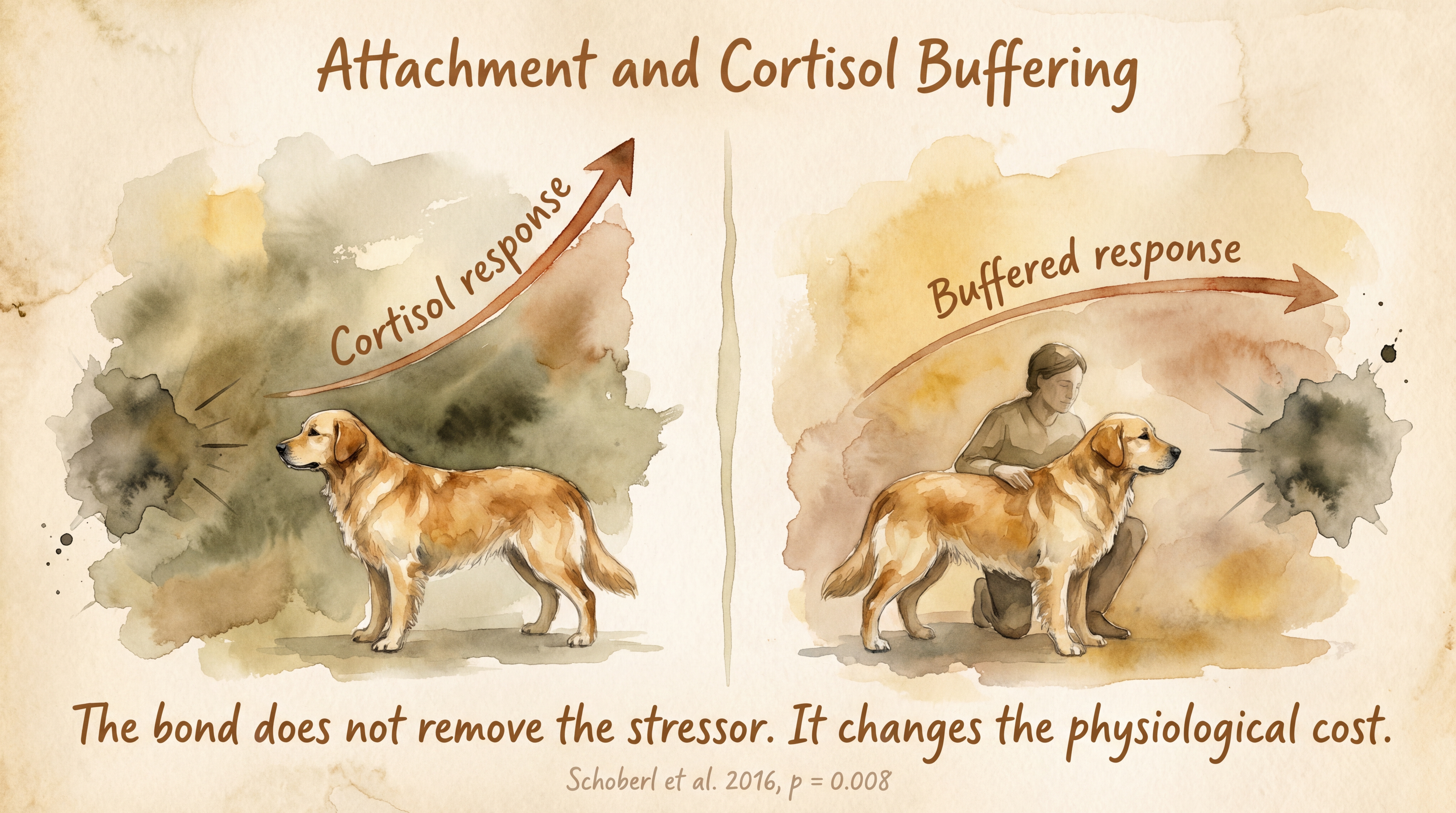
A bonded owner's presence measurably reduces a dog's cortisol response to stressors, acting as a biological buffer against overwhelm.
Key Takeaways
- Secure attachment in dogs is associated with lower cortisol reactivity during standardized social stress.
- Owner psychological profile also affects how flexibly the canine stress system responds, which makes the human variable part of the biology of the bond.
- The caregiver is better understood as a dimmer switch for stress load than as an off switch that removes all challenge.
- The documented claim is association and buffering, not a fully tested intervention model in which changing the human automatically fixes the dog.
The Evidence
- Schoberl, I. et al. (2016)domestic dogs and humans
Securely attached dogs secreted significantly less cortisol during standardized social challenge procedures. - Schoberl, I. et al. (2017)domestic dogs and humans
Owner psychological profile and attachment variables predicted lower canine HPA-axis flexibility more strongly than dog personality traits did. - Coppola, C. L. et al. (2006)domestic dogs
Human social support altered canine responses under challenge, supporting a caregiver-buffering interpretation.
- Hostinar, C. E., Sullivan, R. M., and Gunnar, M. R. (2014)humans and other mammals
Reviewed how caregiver presence alters stress-system activation across development, providing the comparative foundation for social buffering claims. - Hennessy, M. B., Kaiser, S., and Sachser, N. (2009)multiple mammals
Documented social buffering across species while leaving species-specific mechanisms to be tested directly.
- SCR-059 boundarydomestic dogs and humans
The association between owner psychology and dog cortisol flexibility is documented, but direct therapeutic intervention on the human as a tested route to canine physiological change remains unproven.
No published household trial has directly compared different family transition or caregiving protocols and then measured canine cortisol outcomes as the primary endpoint.
SCR References
Sources
- Coppola, C. L., Grandin, T., and Enns, R. M. (2006). Human interaction and cortisol: Can human contact reduce stress for shelter dogs? Physiology and Behavior, 87(3), 537-541. https://doi.org/10.1016/j.physbeh.2005.12.001
- Hennessy, M. B., Kaiser, S., and Sachser, N. (2009). Social buffering of the stress response: Diversity, mechanisms, and functions. Frontiers in Neuroendocrinology, 30(4), 470-482. https://doi.org/10.1016/j.yfrne.2009.06.001
- Hostinar, C. E., Sullivan, R. M., and Gunnar, M. R. (2014). Psychobiological mechanisms underlying social buffering of the hypothalamic-pituitary-adrenocortical axis. Development and Psychopathology, 26(3), 1049-1066. https://doi.org/10.1017/S0954579414000501
- Schoberl, I., Beetz, A., Solomon, J., Gee, N., Kotrschal, K., and Wedl, M. (2016). Social factors influencing cortisol modulation in dogs during a strange situation procedure. Journal of Veterinary Behavior, 11, 77-85. https://doi.org/10.1016/j.jveb.2015.09.007
- Schoberl, I., Wedl, M., Bauer, B., Day, J., Mostl, E., and Kotrschal, K. (2017). Effects of owner-dog relationship and owner personality on canine cortisol modulation. PLoS ONE, 12(2), e0170707. https://doi.org/10.1371/journal.pone.0170707