The Causal Gap
Compound evidence detail1 SCR / 3 parts
- Documentedthe Baumrind authoritative-parenting literature in human child development
- Documentedthe canine correlational evidence linking dog-directed caregiving styles to attachment, attention, sociability, and problem-solving outcomes (van Herwijnen 2018/2020, Brubaker and Udell 2023)
- Heuristicthe JB inference that one specific caregiving style experimentally produces the best long-term developmental outcomes in dogs
The caregiving-style literature in dogs is strong enough to take seriously and incomplete enough to require restraint. Multiple studies now converge on the same broad pattern, but the field has not yet isolated the full causal mechanism with the kind of experimental confidence that would justify finished-science rhetoric. Ambiguous
What It Means
The first thing to say is that there really is a pattern. van Herwijnen, Brubaker, de Assis, Bouma, Dodman, and related studies do not scatter randomly. Warm-and-structured caregiving keeps aligning with stronger outcomes, while reactive, permissive, disorganised, or distant patterns keep aligning with weaker ones. That kind of recurrence matters. A causal gap is not the same thing as a weak signal.
The recurrence is especially meaningful because it appears across different research designs. Documented Some studies are survey based. Some include direct observation. Some look at attachment classification, some at problem solving, some at behavior-problem prevalence, some at treatment response, and some at long-term household factors. When different methods keep pointing in the same broad direction, confidence in the directional signal rises even when mechanism is not yet closed.
The second thing to say is that recurrence does not automatically solve mechanism. Most of the caregiving-style literature is cross-sectional, correlational, or observational. It shows that caregiver style and dog outcome move together. It does not yet fully prove what produces what, or exactly which ingredient is doing the heaviest causal work.
Directionality is one major problem. It is very plausible that reactive or permissive caregiving helps produce difficult outcomes in dogs. It is also plausible that difficult dogs pull families toward more reactive, more inconsistent, or more indulgent patterns over time. Real life probably contains both directions at once. A frightened dog can make a family more compensatory. A chaotic puppy can make a family more irritable. A vague caregiving style can make the dog more difficult. The relationship can become a feedback loop.
The literature has some tools for pushing back on that problem, but not enough to close it. Dale's longitudinal work on separation-related behavior partially addresses temporal ordering by measuring early caregiver behavior and later dog outcomes. Smith's Golden Retriever Lifetime Study does something similar by tracking household variables over time. Those designs help. They do not remove all possible bidirectional influence.
Measurement heterogeneity is another issue. van Herwijnen used a dog-adapted parenting questionnaire, then an observational distraction-course study. Documented Brubaker used style classification paired with secure-base and problem-solving outcomes. de Assis used a new questionnaire that identified insecure dimensions such as disorganised and avoidant caregiving. Bouma tied style transmission to broader dog outcomes. This heterogeneity is a strength for convergence because the signal appears across methods. It is also a weakness for causal precision because the field is not yet using one unified instrument with one unified outcome map.
The missing quadrants matter too. The uninvolved style, low warmth and low structure, has not been cleanly tested with strong canine outcome data. van Herwijnen did not recover a statistically significant permissive or uninvolved style in the 2018 survey, likely because the sample consisted of highly devoted caregivers. Documented Brubaker's strongest direct comparison used authoritative, authoritarian, and permissive, but not uninvolved. That means one full corner of the Baumrind grid remains underdeveloped in dog research.
That sample-bias issue is not a trivial footnote. If dog-caregiving studies keep attracting highly engaged, highly educated, and disproportionately female respondents, the literature may under-represent the households where low structure, low warmth, or chronically inconsistent care are most pronounced. Documented In other words, the field may already be observing the signal while still missing some of the strongest real-world versions of the problem. That possibility makes humility necessary, but it also argues against dismissing the current evidence as weak.
Even the strongest new measures carry boundaries. In the LOCQ work, the secure side is partly inferred from low insecure scores rather than built as a fully independent experimentally validated positive construct. That does not undo the findings. It does mean the language around secure caregiving should stay more careful than the language around the documented human model it is borrowing from.
This is why Category 12 has to hold two truths at once. The caregiving-style evidence is not weak, and it should not be written as if it were speculative fluff. At the same time, the statement "warmth plus structure causes the best outcomes in dogs" still needs a ceiling. It is the best-supported interpretation of the available evidence, not the final experimentally isolated answer.
It is also worth noticing why the last methodological step is hard to obtain. A perfectly clean canine parenting-style trial would require assigning families to relationship styles over long periods, measuring compliance, and holding breed, age, baseline temperament, household stress, and training history constant. That is difficult practically and ethically. So the likely path forward is not one magical experiment. It is stronger longitudinal designs, better instruments, and continued convergence across attachment, behavior, and physiology.
The right mental model is not "nothing is proven." The right model is "the causal map is incomplete, but the compass direction is already meaningful." That is more than enough to guide practice honestly. It is not enough to erase every boundary note.
Why It Matters for Your Dog
For families, this entry matters because it protects both trust and usefulness. If the wiki pretends the causal story is more finished than it is, credibility erodes later. If the wiki hides behind endless caution and refuses to say anything actionable, the science becomes useless. The honest middle is stronger than both errors.
JB can responsibly treat warm structured caregiving as the best-supported direction while still acknowledging that the full canine causal chain remains less experimentally closed than the human developmental model it resembles.
This also protects families from false certainty. A good result does not prove every element of the family's approach was the active ingredient. A difficult result does not prove the family lacked love. The literature is strong enough to orient practice, but not so simple that it can turn every household outcome into a one-variable morality tale.
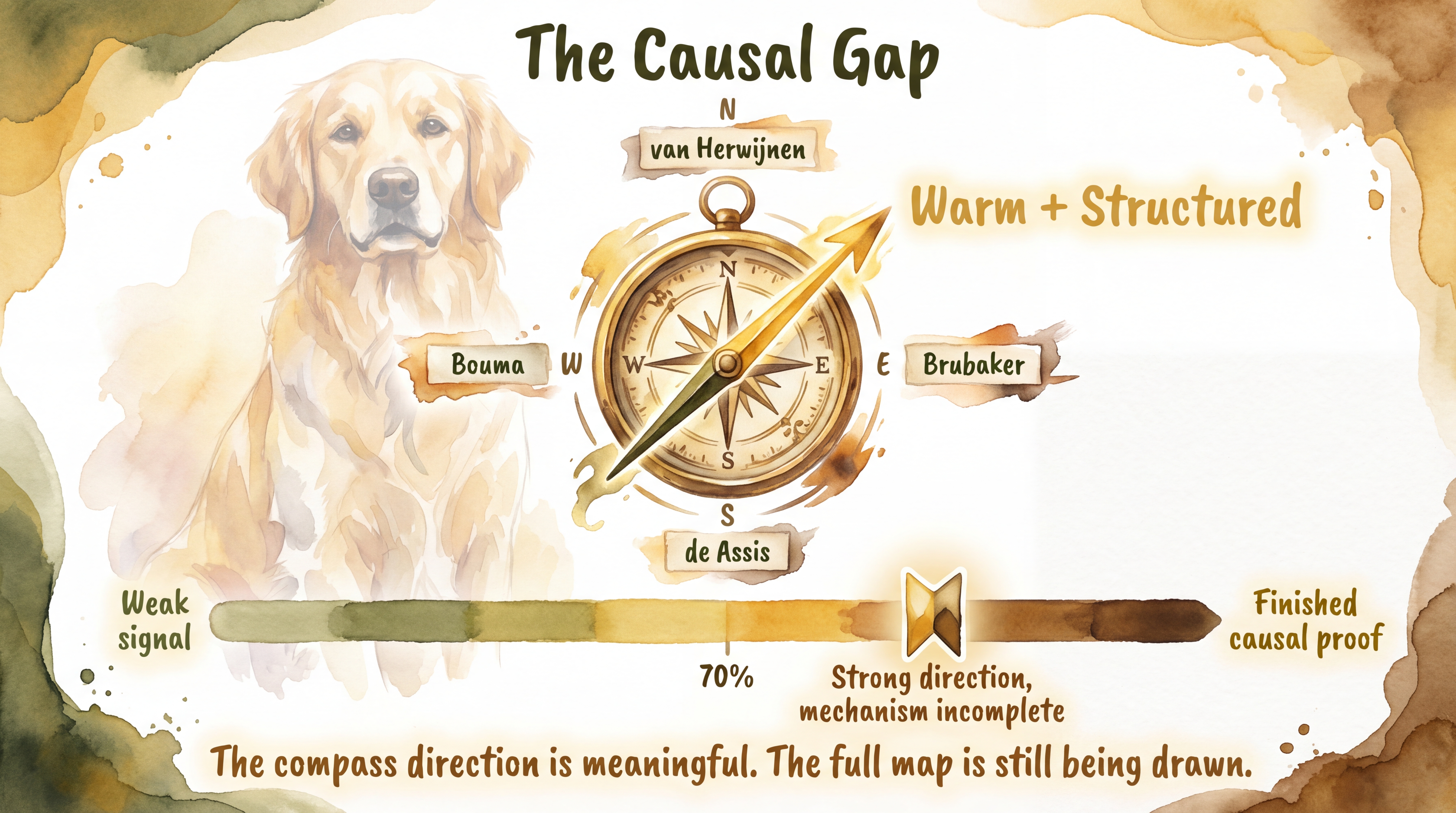
Most caregiving-outcome research is correlational, meaning it identifies patterns but cannot prove that one specific owner behavior caused one specific dog result.
Key Takeaways
- The caregiving-style pattern in dogs is convergent and meaningful, but most of the literature is still correlational or observational rather than fully experimental.
- Directionality remains a real issue because difficult dogs can also shape family behavior over time.
- The uninvolved quadrant and a fully unified canine caregiving measure remain underdeveloped in the current literature.
- The strongest honest conclusion is that warm structured caregiving is the best-supported direction, not that the entire causal mechanism is already finished science.
The Evidence
This entry uses ambiguous claim-level tags beyond the dedicated EvidenceBlocks below. These tags mark claims where the literature remains unsettled or multiple interpretations coexist.
- van Herwijnen, I. R. et al. (2018, 2020)domestic dogs
Showed that caregiving styles can be measured and that those styles predict observed handling and orientation behavior. - Brubaker, L., and Udell, M. A. R. (2023)domestic dogs
Found that authoritative caregiving aligned with stronger attachment, sociability, and persistence outcomes than comparison styles. - de Assis, L. S. et al. (2025)domestic dogs
Reported that insecure caregiving dimensions predicted clinically meaningful separation, fear, and aggression outcomes. - Bouma, E. M. C. et al. (2024)domestic dogs
Extended the literature into intergenerational transmission, permissive outcomes, and broader social-behavior patterns.
- Dale, F. C. et al. (2024)domestic dogs
Measured early-life caregiver variables before later separation-related outcomes, partially addressing temporal ordering. - Smith, N., Luethcke, K. R., and Craun, K. (2025)Golden Retrievers
Tracked household variables over time in a large cohort, strengthening owner-to-dog directional inference without eliminating all bidirectional explanations.
- SCR-019 boundarydomestic dogs and humans
The association between authoritative-like caregiving and stronger canine outcomes is documented, but the active causal mechanism remains incompletely isolated in dog research.
No published canine study has experimentally assigned families to authoritative, permissive, authoritarian, and uninvolved caregiving conditions and then tracked standardized developmental outcomes over time.
SCR References
Sources
- Bouma, E. M. C., Vingerhoets, A. J. J. M., & van der Veld, W. M. (2024). Parenting styles and intergenerational transmission in human-dog relationships. Animals, 14(7), 1038. https://doi.org/10.3390/ani14071038
- Brubaker, L., & Udell, M. A. R. (2023). Does pet parenting style predict the social and problem-solving behavior of pet dogs? Animal Cognition, 26(1), 345-356. https://doi.org/10.1007/s10071-022-01694-6
- Dale, F. C., Burn, C. C., Murray, J., & Casey, R. (2024). Canine separation-related behaviour at six months of age: Dog, owner and early-life risk factors identified using the Generation Pup longitudinal study. Animal Welfare, 33, e60. https://doi.org/10.1017/awf.2024.56
- de Assis, L. S., Georgetti, B., Burman, O. H. P., Pike, T. W., & Mills, D. S. (2025). Development of a dog owner caregiving style scale (Lincoln Owner Caregiving Questionnaire, LOCQ) and its relationship with behaviour problems in dogs. Applied Animal Behaviour Science, 287, 106628. https://doi.org/10.1016/j.applanim.2025.106628
- Smith, N., Luethcke, K. R., & Craun, K. (2025). The impacts of household factors and proxies of human social determinants of health on dog behavior (Golden Retriever Lifetime Study). Preventive Veterinary Medicine, 239, 106520.
- van Herwijnen, I. R., van der Borg, J. A. M., Naguib, M., & Beerda, B. (2018). The existence of parenting styles in the owner-dog relationship. PLOS ONE, 13(2), e0193471. https://doi.org/10.1371/journal.pone.0193471
- van Herwijnen, I. R., van der Borg, J. A. M., Naguib, M., & Beerda, B. (2020). Dog-directed parenting styles predict verbal and leash guidance in dog owners and owner-directed attention in dogs. Applied Animal Behaviour Science, 232, 105131. https://doi.org/10.1016/j.applanim.2020.105131