Attachment Theory Applied to Dogs
Compound evidence detail1 SCR / 2 parts
- Documentedthe human attachment evidence base together with the canine-direct secure-base findings (Topal 1998, Horn 2013) and Schoberl-documented physiological effects of secure caregiving in dogs
- Heuristicthe full attachment-theory apparatus transfer to canine relationships, including internal working models and attachment-classification systems
Attachment theory is one of the strongest scientific bridges available for understanding the dog-human bond. Dogs do form documented attachment bonds with human caregivers, but the full human attachment framework does not transfer into dogs without limits. Documented
What It Means
Attachment theory began in human developmental psychology, but its logic was always broader than human family life. Documented Bowlby argued that young social mammals survive by staying organized around a dependable caregiver. When stress rises, the young organism seeks proximity. When the caregiver is available and usable, the world becomes exploreable again.
That basic architecture travels well to dogs. Topal and later attachment researchers showed that dogs do not treat their caregivers as merely familiar people. In unfamiliar situations, caregivers change what dogs do. Dogs seek them, regulate around them, and use them as a secure base for outward movement. That part of the story is now on strong ground.
The Topal adaptation makes that point more concretely than a simple preference test. Dogs and caregivers moved through an unfamiliar-room procedure built around short episodes of togetherness, stranger presence, separation, and reunion, while researchers coded exploration, following, greeting, contact seeking, and distress-related behavior. Documented That matters because a familiarity test only asks which person the dog prefers. The Strange Situation asks a harder question: who organizes the dog when novelty and separation load the system. Topal's dogs differentiated the caregiver most clearly under those pressure points, especially around reunion and renewed exploration, which is why the study became foundational for attachment rather than mere recognition.
One reason attachment theory has held up so well is that it gives a disciplined checklist rather than a vague feeling-state. In Bowlby and Ainsworth's framework, attachment is recognized through recurring functional hallmarks: proximity seeking, separation distress, safe-haven use under stress, and secure-base use for exploration. Documented The canine literature now has evidence that maps onto each of those functions at the behavioral level. That is why the transfer is scientifically serious. Dogs are not being called "attached" simply because they are affectionate, social, or human-oriented. They are being called attached because their behavior changes in the specific ways attachment theory predicts.
What matters for scientific discipline is separating the layers of the theory. The first layer is documented: dogs form attachment bonds functionally analogous to infant-caregiver bonds, and secure-base effects are real in dog-human dyads. The second layer is partly documented and partly bounded: it includes the caregiving-quality literature showing that relationship style covaries with how dogs use the adult. van Herwijnen's survey work recovered recognizable dog-directed parenting styles in hundreds of families, and the observational follow-up found that more authoritative families used more praise and less correction while their dogs showed less leash tension and more looking back toward the adult. Schoberl's cortisol work then linked secure attachment and caregiver psychology to how efficiently the dog's stress system is buffered. That is meaningful middle-layer evidence, but it is still mostly associational rather than a completed causal map. The third layer is the honest gap: detailed human-style classifications, internal working models, and full developmental transfer remain more interpretive in dogs.
That middle layer matters because it is where the bond starts to look developmentally consequential rather than merely affectionate. If the adult's style predicts whether the dog looks back, stays organized, or shows lower physiological stress cost, then attachment is not just a label for closeness. It is part of the mechanism by which the relationship becomes usable. JB's claim that calm, readable adults matter fits comfortably inside that layer. The stronger claim that a specific raising system has already been experimentally proven to produce superior canine attachment security does not.
That is also why attachment theory gives JB something firmer than a vocabulary upgrade. It gives a way to distinguish a relationship that merely feels warm from a relationship that actually helps the young dog organize behavior under stress. The difference between those two states is exactly where good dog-raising lives.
That boundary matters because attachment language is easy to overuse. It is tempting to treat every close dog-human relationship as if the entire human attachment literature now applies sentence for sentence. The dog evidence does not justify that. A better way to understand the science is to think of attachment theory as a map with one region drawn sharply and another still fading into sketch lines. The sharp region is the bond itself. The sketch region is the deeper theoretical machinery behind that bond.
It also matters because not every pleasant human-dog relationship automatically functions as attachment in the strong sense. A dog can enjoy a person, solicit interaction, and even prefer that person without using them as a true secure base under uncertainty. Attachment is therefore a narrower and more useful concept than "they really love each other." It asks whether the adult becomes usable when the young dog is stressed, disorganized, or unsure. That narrower definition is what gives the theory explanatory power.
For families, the most important practical insight is that the relationship is not background scenery. The dog is not only learning from commands, rewards, and corrections. The dog is also learning whether the adult is stable enough to serve as an anchor. That is why JB keeps returning to calmness, predictability, and parental steadiness. In attachment terms, the adult is not just delivering technique. The adult is becoming part of the puppy's regulation system.
That does not mean the adult must become constantly available or emotionally demonstrative. In attachment science, the caregiver's job is not to flood the channel with involvement. It is to be dependable enough that the young organism can organize around their presence and recover when things become difficult. That is one reason JB emphasis on calmness fits so naturally here. Calmness does not make the relationship cold. It makes the relationship usable.
This also clarifies why transition periods matter so much. When a puppy moves from breeder to family, the question is not only whether the new home is loving. The deeper question is whether the new adults become predictable quickly enough to be used as attachment figures under stress. Attachment theory therefore gives scientific language to JB concern about soft landings, continuity, and low-drama beginnings. The puppy is not just learning a house. The puppy is learning who the new organizing adults are.
That is one reason attachment is a stronger concept than companionship alone. A playmate may be enjoyable. An attachment figure is usable when the nervous system is under load.
That difference is exactly where relationship quality stops being sentimental and becomes developmental.
It is also where JB's language of mentorship begins to make scientific sense.
One everyday analogy helps here. A secure caregiver functions more like a dock than a magnet. The point is not that the dog must stay pressed against the dock at all times. The point is that the dog can move outward because the return point is steady. That is what secure-base language is trying to capture.
Why It Matters for Your Dog
When attachment theory is applied carefully, it clarifies why the JB relationship claim is not sentimental. Heuristic The bond is one of the mechanisms through which developmental outcomes are produced. A puppy raised around adults who are calm, legible, and dependable is not only having pleasant experiences. The puppy is learning who to use when novelty, stress, and uncertainty arrive.
Attachment theory supports the idea that the adult should function as a secure base and safe haven. JB extends that into a parental model of leadership rather than a peer or rivalry model.
This is also where restraint protects credibility. The science supports saying that dogs form attachment bonds and that those bonds matter. It does not support announcing that every element of human attachment theory has already been proven in dogs or that any single raising system has been experimentally validated as an attachment intervention. The practical guidance can stay firm while the mechanism stays honestly bounded.
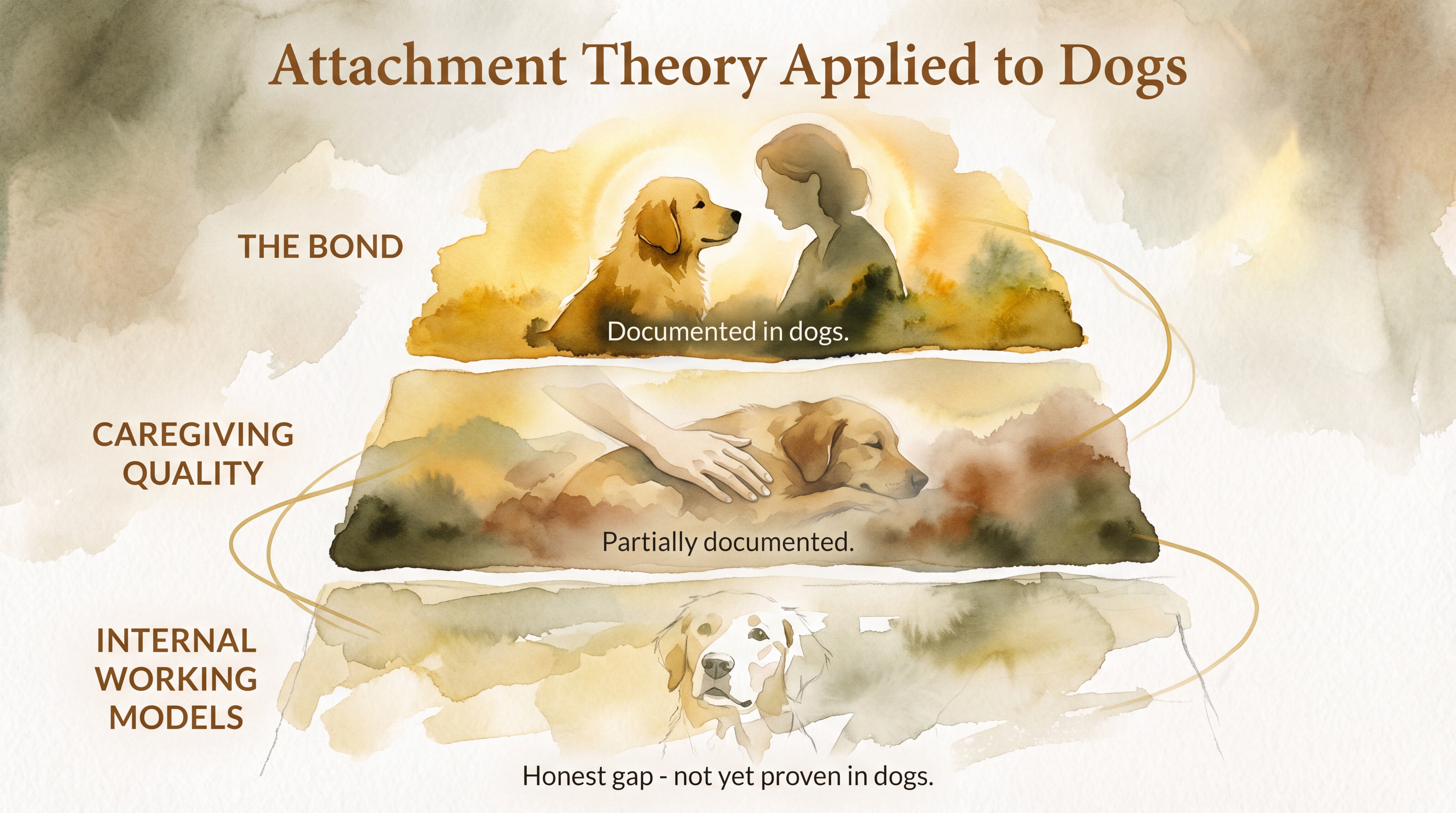
Attachment theory provides the scientific framework for understanding why dogs seek proximity and use their owners as a secure base for exploration.
Key Takeaways
- Dogs form real attachment bonds with human caregivers, and those bonds change exploration, reunion behavior, and stress regulation.
- The strongest documented layer is the bond itself and the secure-base effect, not the full transfer of every human attachment concept into dogs.
- Your relationship with your dog is part of the developmental mechanism, not just the delivery route for training technique.
- The safest scientific framing is confident about the bond and careful about the deeper theoretical machinery behind it.
The Evidence
- Topal, J. et al. (1998)domestic dogs
Adapted the Strange Situation to dogs and documented caregiver-specific attachment behavior rather than undifferentiated familiarity. - Horn, L., Huber, L., and Range, F. (2013)domestic dogs
Confirmed that caregiver presence functions as a secure base by changing exploration and task engagement in a novel context. - Solomon, J. et al. (2019)domestic dogs
Adapted attachment classification procedures to dogs and found substantial coding agreement plus meaningful caregiver-sensitivity links.
- Bowlby, J. (1969/1982)humans
Defined attachment as a biologically organized relationship in which the caregiver structures protection, proximity, and exploration. - Ainsworth, M. D. S. et al. (1978)humans
Operationalized attachment quality through separation, reunion, proximity seeking, and secure-base exploration in the Strange Situation.
- Savalli, C., and Mariti, C. (2020)domestic dogs
Argued that Bowlby's framework can be applied to dogs while acknowledging that deeper constructs such as internal working models remain inferential rather than directly demonstrated. - SCR-017 boundarydomestic dogs and humans
Secure attachment from responsive caregiving is documented, but the full human attachment apparatus transfers to dogs only in a bounded and partly heuristic way.
No published trial has directly compared breeder or family raising approaches and then measured downstream attachment security in puppies as a formal primary outcome.
SCR References
Sources
- Ainsworth, M. D. S., Blehar, M. C., Waters, E., and Wall, S. (1978). Patterns of Attachment: A Psychological Study of the Strange Situation. Erlbaum.
- Bowlby, J. (1969/1982). Attachment and Loss, Volume 1: Attachment. Basic Books.
- Horn, L., Huber, L., and Range, F. (2013). The importance of the secure base effect for domestic dogs. PLoS ONE, 8(1), e65296. https://doi.org/10.1371/journal.pone.0065296
- Savalli, C., and Mariti, C. (2020). Would attachment theory help improve the welfare of domestic dogs? Relevance of a theoretical framework from human psychology. Animals, 10(7), 1244. https://doi.org/10.3390/ani10071244
- Solomon, J., Beetz, A., Schoberl, I., Gee, N., and Kotrschal, K. (2019). Attachment security in companion dogs: Adaptation of Ainsworth classification procedures to dogs and their human caregivers. Attachment and Human Development, 21(4), 389-417. https://doi.org/10.1080/14616734.2018.1517813
- Topal, J., Miklosi, A., Csanyi, V., and Doka, A. (1998). Attachment behavior in dogs: A new application of Ainsworth's Strange Situation Test. Journal of Comparative Psychology, 112(3), 219-229. https://doi.org/10.1037/0735-7036.112.3.219