The Permissive Trap
Compound evidence detail1 SCR / 3 parts
- Documentedthe Baumrind authoritative-parenting literature in human child development
- Documentedthe canine correlational evidence linking dog-directed caregiving styles to attachment, attention, sociability, and problem-solving outcomes (van Herwijnen 2018/2020, Brubaker and Udell 2023)
- Heuristicthe JB inference that one specific caregiving style experimentally produces the best long-term developmental outcomes in dogs
The permissive trap is the mistake of equating love with low demand. In the caregiving-style literature, permissive patterns are associated with weaker owner anchoring, lower secure attachment, poorer persistence, and even obesity-related household effects. The problem is not too much warmth. The problem is warmth that never becomes structure. Documented
What It Means
Permissive caregiving feels attractive because it does not usually feel cruel. It often feels affectionate, emotionally generous, and deeply bonded. The family gives comfort quickly, resists frustration for the puppy, relaxes boundaries when enforcement feels mean, and interprets closeness as the main proof of a good relationship. That emotional logic is understandable. The research question is whether it produces the outcomes families think it does.
In the parenting framework, permissiveness is not simply kindness. It is high responsiveness combined with too little demandingness. That distinction matters because many families hear criticism of permissiveness as criticism of warmth itself. The literature points in a different direction. The problem is not warmth. The problem is warmth that never fully becomes guidance, boundary, or developmental expectation.
Brubaker and Udell suggest caution. In their 48-dyad study, dogs of permissive caregivers did not match the authoritative group in attachment security, sociability, or persistence on a solvable task. Documented That matters because permissiveness is often sold implicitly as a warmer and more humane form of care. The evidence does not support the idea that warmth without structure is the strongest developmental package.
The problem-solving result is especially revealing. Persistence on a solvable task is one of the clearest low-drama ways to see whether the dog stays engaged under mild challenge. Dogs of permissive caregivers were not merely less obedient in a narrow sense. They were less well organized when effort and frustration tolerance were required. That is exactly the kind of hidden cost permissiveness tends to disguise.
Bouma's 2024 work sharpened the picture further. Permissive caregiving was associated with dogs who followed strangers' cues more readily than their own caregiver's cues. Documented That is one of the most revealing findings in the whole caregiving-style cluster because it shows what permissiveness can cost relationally. The family may feel extremely close to the dog, but the dog is not necessarily using the family as the most salient guide under social pressure.
That pattern should not be mistaken for openness or friendliness alone. A dog who defaults to stranger guidance over caregiver guidance is showing a weaker organizing bond than families often assume. The adult may be loved, but not fully established as the usable center of direction. In JB language, the puppy has been kept socially soft rather than pulled upward into mature relational focus.
Bouma's broader findings reinforce that this is a whole-household pattern rather than a one-symptom problem. Permissive caregiving also aligned with higher canine obesity. That is important because it shows the same low-structure style shaping food management, routine, and impulse organization, not only social attention. A weak structure signal tends to spread.
The Golden-specific literature makes the same story feel less abstract. In the Golden Retriever Lifetime Study analysis, bed-sharing was associated with increased stranger aggression and a significant reduction in trainability over time, while single-dog homes showed greater dog-directed fear and poorer trainability than multi-dog homes. Those findings do not prove that one sleeping arrangement or one household type causes the outcome by itself. They do show that highly intimate, highly human-centered, or less socially structured arrangements are not neutral. Even within a famously family-oriented breed, the household pattern matters.
Those Golden findings should be handled carefully because they are not formal permissiveness measures. Bed-sharing or single-dog status is not the same thing as a validated parenting-style score. But they are still useful here because they point to the same larger question: what kind of social and structural environment is the dog growing up inside? When intimate or convenience-based arrangements repeatedly align with weaker trainability or fear-related outcomes, they become worth reading alongside the permissive-caregiving literature rather than in isolation.
This is why JB talks about the "social puppy in an adult body." That phrase is an interpretive synthesis, not a formal study label, but it captures a real documented pattern. Heuristic A dog can remain highly affiliative while still failing to mature into stable social focus, frustration tolerance, or owner-directed organization. Permissiveness often preserves babyish closeness while underbuilding adulthood.
It is important not to caricature the permissive family here. These are usually people who care a great deal. The trap exists precisely because the emotional motive is loving. But development does not respond only to motive. It responds to pattern. A puppy can be deeply loved and still be raised in a way that leaves it socially vague, structurally under-supported, and harder to guide.
The scientific boundary is narrower than the practical lesson. The research does not say every act of indulgence is damaging, every affectionate family is permissive, or every dog who sleeps on a bed is set up to fail. Documented What it says is that the low-structure pattern keeps recurring in studies as the weaker developmental direction. That is enough to take seriously.
Why It Matters for Your Dog
For families, the permissive trap is important because it helps explain why some relationships feel warm but function poorly. The dog may be attached, eager for closeness, and emotionally expressive, yet still hard to direct, easy to overarouse, and more tuned to strangers or impulses than to the family's guidance. That is not proof of insufficient love. It is often proof that love was not organized.
Structured Leadership protects families from permissiveness by keeping warmth and direction together. The adult does not become colder. The adult becomes more usable.
This is also where JB's rhetoric about maturity matters. The goal is not to harden the dog. It is to help the dog grow up. Warmth remains essential, but warmth that never asks for orientation, regulation, or structure leaves the puppy socially younger than the family expects.
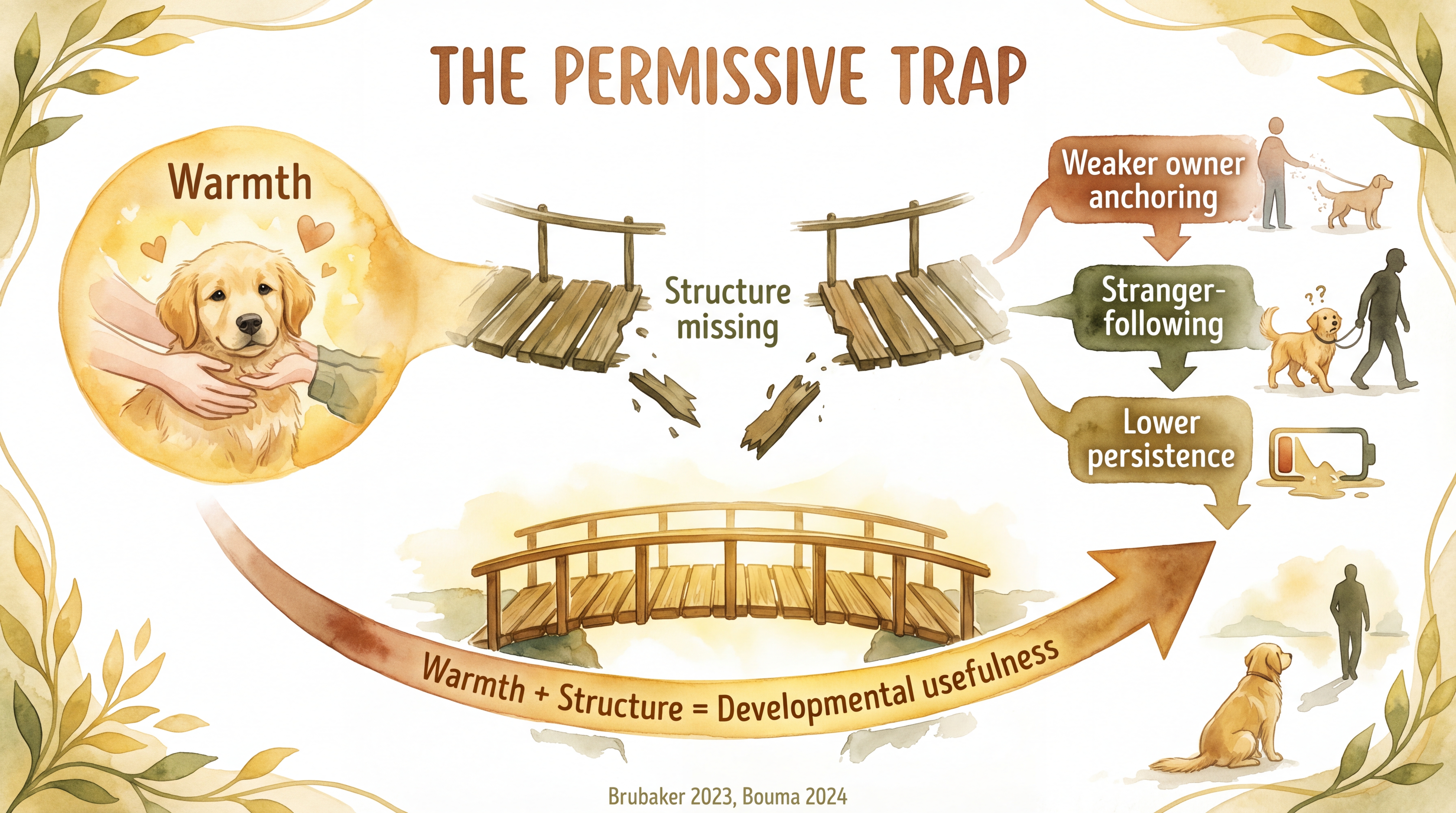
High affection without structure does not produce confident dogs. It produces anxious ones who have warmth but no reliable framework to organize behavior around.
Key Takeaways
- Permissive caregiving means warmth without enough consistent structure, not simple kindness or affection.
- Studies link permissive patterns to weaker owner anchoring, lower secure attachment, poorer persistence, and obesity-related household effects.
- A dog can feel very loved while still being under-structured and developmentally vague.
- The antidote is not less warmth. It is warmth that also provides direction, boundaries, and a center worth following.
The Evidence
- Brubaker, L., and Udell, M. A. R. (2023)domestic dogs
Found that dogs of permissive caregivers showed weaker attachment-related and problem-solving outcomes than dogs of authoritative caregivers. - Bouma, E. M. C. et al. (2024)domestic dogs
Reported that permissive caregiving aligned with stranger-following, weaker owner anchoring, and higher rates of canine obesity. - Smith, N., Luethcke, K. R., and Craun, K. (2025)Golden Retrievers
Found that household variables including bed-sharing and single-dog home status predicted trainability and fear-related outcomes within a Golden Retriever cohort.
- Baumrind, D. (1966, 1991)humans
Defined permissive parenting as high warmth with insufficient structure and showed that it underperforms authoritative parenting across important developmental domains.
- SCR-019 boundarydomestic dogs and humans
Permissive caregiving is documented as a weaker direction in the available dog literature, but broader phrases such as social juvenility remain interpretive syntheses layered on top of the measured outcomes.
No published trial has directly followed puppies from placement into explicitly permissive versus warm-structured households while measuring long-term maturity, owner focus, and regulation as primary outcomes.
SCR References
Sources
- Baumrind, D. (1966). Effects of authoritative parental control on child behavior. Child Development, 37(4), 887-907.
- Baumrind, D. (1991). The influence of parenting style on adolescent competence and substance use. Journal of Early Adolescence, 11(1), 56-95.
- Bouma, E. M. C., Vingerhoets, A. J. J. M., & van der Veld, W. M. (2024). Parenting styles and intergenerational transmission in human-dog relationships. Animals, 14(7), 1038. https://doi.org/10.3390/ani14071038
- Brubaker, L., & Udell, M. A. R. (2023). Does pet parenting style predict the social and problem-solving behavior of pet dogs? Animal Cognition, 26(1), 345-356. https://doi.org/10.1007/s10071-022-01694-6
- Smith, N., Luethcke, K. R., & Craun, K. (2025). The impacts of household factors and proxies of human social determinants of health on dog behavior (Golden Retriever Lifetime Study). Preventive Veterinary Medicine, 239, 106520.