Intergenerational Transmission of Caregiving
Compound evidence detail1 SCR / 3 parts
- Documentedthe Baumrind authoritative-parenting literature in human child development
- Documentedthe canine correlational evidence linking dog-directed caregiving styles to attachment, attention, sociability, and problem-solving outcomes (van Herwijnen 2018/2020, Brubaker and Udell 2023)
- Heuristicthe JB inference that one specific caregiving style experimentally produces the best long-term developmental outcomes in dogs
Families do not start from zero when a puppy comes home. They bring a caregiving history with them. In the emerging human-dog relationship literature, one of the most important findings is that people often reproduce broad parenting-style patterns with their dogs, which means the adult's own developmental past becomes part of the puppy's present environment. Documented
What It Means
The first important clarification is that intergenerational transmission does not mean destiny. It means default. Adults often act from patterns that feel natural long before those patterns are examined. Observed-JB If a family grew up around high warmth and low structure, they may experience permissiveness as kindness and boundary-setting as emotional harshness. If they grew up around warmth plus structure, calm leadership may feel more intuitive.
Bouma and colleagues pushed this issue into the dog world directly. Using a mixed-method design with 391 dog caregivers and 10 interviews, they reported intergenerational effects in human-dog caregiving, with permissive parenting showing a particularly clear carryover pattern. Ambiguous That matters because it means puppy raising is not only about what advice a family receives. It is also about what relational template that advice lands on.
That study also adds something more specific than the broad phrase "people repeat what they know." Documented Orientation toward dogs mattered. A protectionistic orientation, which treats dogs as companions with real species-specific needs, reduced the likelihood of reproducing more authoritarian caregiving. Humanistic and protectionistic orientations also increased some compensatory permissive behaviors. In plain language, the family is not only carrying a parenting history forward. It is interpreting the dog through a particular moral lens while doing so.
This helps explain a common puzzle in the dog world. Two families can receive nearly identical guidance and emotionally hear it very differently. One family hears structure as clarity. Another hears the same structure as withdrawal of affection. One family hears prevention as calm foresight. Another hears it as withholding freedom. The difference is not always information. Sometimes it is inheritance of style.
This is where the orientation piece adds real value. A more humanistic lens can make the dog feel psychologically child-like in the wrong way, so that boundaries feel like personal rejection rather than species-appropriate guidance. A more protectionistic lens can move families in a healthier direction because it keeps warmth while preserving respect for canine developmental needs. That difference helps explain why some families become permissive through sentiment and others become more organized through the same underlying affection.
The dog-human bond category matters here because the transmitted pattern does not stay inside the adult's mind. It becomes an interaction style the puppy must live inside. If the inherited pattern trends permissive, the puppy may receive abundant affection but insufficient upward pull toward maturity. If the inherited pattern trends reactive or overly corrective, the puppy may experience direction without enough usable warmth. Either way, the adult's unseen history becomes the puppy's developmental climate.
This is one reason Bouma's intergenerational work fits so naturally beside Brubaker and the van Herwijnen studies. Documented The latter show that caregiving style predicts attachment, sociability, and problem-solving outcomes. Bouma helps explain why those styles may feel emotionally obvious to families in the first place. The style is often older than the puppy.
The practical significance is especially strong in families who want to do well and still feel internally split. They may admire calm leadership in theory and recoil from it in practice. They may know that the puppy needs boundaries and still feel guilty every time they provide one. Intergenerational transmission gives that conflict a shape that is more compassionate and more usable than simply calling the family inconsistent.
The interviews matter for that reason as much as the regression models do. Numbers can show that styles repeat. Interviews help explain how repetition feels from inside the family. People describe themselves as slipping into roles, compensating for what they did or did not receive growing up, or treating the dog as the site of repair. That is exactly the kind of emotional mechanism that makes perfectly good puppy guidance hard to carry out when the puppy arrives.
This also helps explain why permissiveness can feel morally righteous. If a family inherited a model in which love meant rescue, softness, and low demand, then requiring orientation, waiting, or frustration tolerance may feel emotionally wrong even when the evidence supports it. The family is not only raising the puppy. The puppy is also exposing the family's own default map of care.
None of this means every adult simply repeats childhood patterns without reflection. It means the burden of proof shifts. Instead of assuming our raising style is fully reasoned, the literature suggests we should assume some portion of it is habitual, inherited, and pre-verbal until examined. That is a humbling but useful starting point.
The scientific boundary is still important. The broad intergenerational pattern is documented, but the fine-grained claim that specific childhood histories produce specific puppy-raising errors has not been directly tracked in a household trial. The family-level application is strong, but it still deserves careful language.
Why It Matters for Your Dog
For families, this entry matters because it turns a mysterious emotional struggle into something more legible. If calm leadership feels strangely unnatural, the problem may not be lack of love or lack of intelligence. It may be that the puppy is asking the adults to behave differently from the way they themselves were taught care is supposed to feel.
Structured Leadership often feels hardest for families who equate love with low demand. Intergenerational transmission helps explain why JB asks adults to examine their own defaults as part of raising the puppy well.
The practical gain is substantial. Once a family sees that some of its permissive or reactive instincts may be inherited rather than deeply reasoned, those instincts become easier to question. The goal is not less warmth. It is warmth that has enough structure to help the dog grow up.
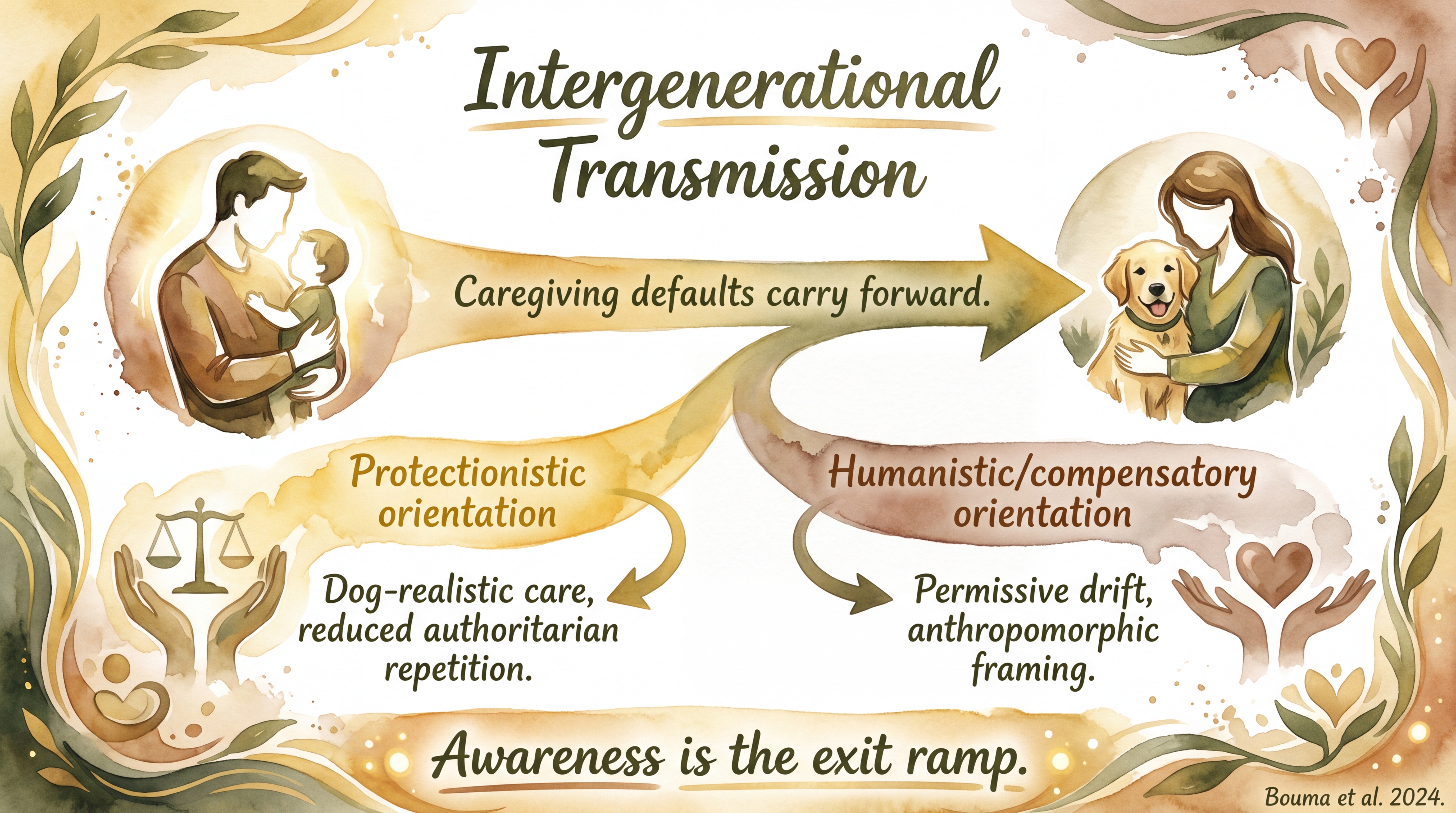
The way an owner was parented influences the caregiving patterns they bring to their dog, creating an intergenerational thread that crosses species.
Key Takeaways
- Families often bring inherited caregiving defaults into puppy raising rather than starting from a blank slate.
- Human-dog relationship research now suggests that broad parenting-style patterns can be reproduced with dogs as well as with children.
- This helps explain why good advice can feel emotionally difficult even when a family understands it intellectually.
- The answer is not blame. It is awareness early enough to choose a warmer and more structured path on purpose.
The Evidence
This entry uses observed claim-level tags beyond the dedicated EvidenceBlocks below. These tags mark JB program observation or practice-derived claims that need dedicated EvidenceBlock coverage in a later content pass.
This entry uses ambiguous claim-level tags beyond the dedicated EvidenceBlocks below. These tags mark claims where the literature remains unsettled or multiple interpretations coexist.
- Bouma, E. M. C. et al. (2024)humans and domestic dogs
Found evidence that adults reproduce broad parenting-style patterns in human-dog relationships, with meaningful consequences for attachment, sociability, and problem-solving outcomes in dogs. - Brubaker, L., and Udell, M. A. R. (2023)domestic dogs
Showed that authoritative caregiving aligns with stronger attachment and problem-solving outcomes than permissive or authoritarian alternatives.
- van Herwijnen, I. R. et al. (2018)domestic dogs
Recovered measurable dog-directed parenting-style dimensions, showing that caregiving patterns are stable enough to be studied rather than treated as anecdotal. - van Herwijnen, I. R. et al. (2020)domestic dogs
Linked dog-directed parenting styles to observed praise, correction, leash tension, and dog orientation behavior in a distraction-course setting.
- SCR-019 boundarydomestic dogs and humans
Broad caregiving-style patterns are documented, but the stronger claim that a given family history directly produces specific puppy-raising errors remains a bounded interpretation rather than a trialed causal pathway.
No published study has directly followed families from reported childhood caregiving history into specific breeder-transition and first-year puppy-raising decisions in the home.
SCR References
Sources
- Bouma, E. M. C., Vingerhoets, A. J. J. M., & van der Veld, W. M. (2024). Parenting styles and intergenerational transmission in human-dog relationships. Animals, 14(7), 1038. https://doi.org/10.3390/ani14071038
- Brubaker, L., & Udell, M. A. R. (2023). Does pet parenting style predict the social and problem-solving behavior of pet dogs? Animal Cognition, 26(1), 345-356. https://doi.org/10.1007/s10071-022-01694-6
- van Herwijnen, I. R., van der Borg, J. A. M., Naguib, M., & Beerda, B. (2018). The existence of parenting styles in the owner-dog relationship. PLOS ONE, 13(2), e0193471. https://doi.org/10.1371/journal.pone.0193471
- van Herwijnen, I. R., van der Borg, J. A. M., Naguib, M., & Beerda, B. (2020). Dog-directed parenting styles predict verbal and leash guidance in dog owners and owner-directed attention in dogs. Applied Animal Behaviour Science, 232, 105131. https://doi.org/10.1016/j.applanim.2020.105131