The Oxytocin-Gaze Loop
The oxytocin-gaze loop is one of the clearest demonstrations that the dog-human bond is not merely poetic language. In at least some dog-human dyads, mutual gaze changes owner oxytocin, experimentally increasing oxytocin in dogs increases their affiliative gazing, and the resulting pattern looks more like bond biology than mere familiarity. Documented
What It Means
Oxytocin is often reduced in popular writing to "the love hormone," but that phrase is too thin to be useful. Across mammals, oxytocin is involved in social salience, affiliation, parenting, touch, and aspects of stress regulation. In other words, it belongs naturally in attachment science. The dog literature matters because it shows that some of those same affiliative pathways are measurably active in dog-human relationships.
The modern centerpiece is Nagasawa et al. (2015). In that work, dog-human pairs spent time interacting, and dogs in the long-gaze group produced a significantly different pattern from dogs in the short-gaze group. More dog-to-owner gaze was associated with increased owner urinary oxytocin. That matters because it turns gaze into more than visual attention. It becomes a social action with endocrine consequences on the human side of the bond.
The study then pushed the story further. Documented When dogs received intranasal oxytocin, their affiliative gaze toward owners increased, and owner oxytocin rose in response. That is why the finding is called a loop rather than a one-way effect. Dog gaze influences the human, and experimentally shifting the dogs oxytocin system can influence the gaze that then affects the human in return. The bond is being tracked chemically from both sides.
This is also why the result is more than a familiarity test. A familiarity test would only show that dogs spend more time near people they know. The oxytocin-gaze work shows that a particular social signal, mutual gaze, is linked to measurable endocrine change and can recursively alter the interaction itself. Documented The dog is not only preferring the human. The dyad is entering a feedback process.
The wolf comparison is one reason the paper became so influential. Hand-reared wolves with extensive human exposure did not show the same mutual-gaze pattern and did not produce the same owner-oxytocin effect. Documented That comparison strongly suggests the loop is not just what any socialized canid does around humans. Something about domestic dogs appears different. The cautious version of that claim is strong. The stronger coevolution story, that this exact loop was a selected domestication mechanism, is still better treated as an interpretation rather than a finished proof.
That boundary matters because the paper is often over-read. What is documented is a modern physiological loop in dogs and humans. What is less finished is the full historical explanation for how that loop emerged, how universally it operates across breeds and ages, and how strongly it generalizes to every dog-human context. The existence of the loop is strong. The grand story built around it still deserves restraint.
Interaction quality matters too, though it should be handled carefully. The broader oxytocin literature and the related affiliative-touch work suggest that calm social contact is not interchangeable with constant activation. Documented Slow stroking, unhurried presence, and readable attention fit a different physiological profile than nonstop stimulation does. That is one reason JB pairs the oxytocin story with calmness instead of with excitement. The loop fits settled affiliation better than hyper-social theater.
The puppy boundary is also important. The famous oxytocin-gaze papers were conducted with adult dogs, not newly rehomed eight-to-ten-week puppies in the soft-landing window. That does not mean puppies are outside the bonding biology. It means the specific full loop, as demonstrated in the adult literature, has not been directly mapped across that exact rehoming phase. Category 12 can responsibly say the adult phenomenon is documented and that the puppy application is plausible but not fully traced.
This is what makes the loop so useful for the bond category. It gives a chemical layer to something JB otherwise describes behaviorally. When the dog seeks calm social contact through gaze and the human responds in a way that deepens affiliation, the relationship is not only subjectively meaningful. It is biologically active. That does not reduce the bond to one molecule. It does show that the bond is not only metaphor.
One reason families find this page helpful is that it corrects the common equation of bonding with excitement. Many people assume the strongest bond is built by constant chatter, stimulating touch, rough play, and high-energy interaction. The oxytocin-gaze literature points in a different direction. Quiet social availability, readable attention, and calm affiliative presence look more central to the documented pathway than spectacle does.
An everyday analogy is conversation with someone who feels deeply safe to talk to. The bond is not built by yelling over each other. It is built by the kind of shared attention that lets both sides stay socially open. The oxytocin-gaze loop is not identical to that, but it is closer to that kind of relational physics than to entertainment.
Why It Matters for Your Dog
For families, this entry matters because it gives a physiological reason to value calm connection. Bonding is not only about how much time you spend with the dog. It is also about what kind of relational state you create while spending it. A calmer, more readable style of engagement is not less bonded. It may be more consistent with the strongest documented affiliative chemistry we have.
The oxytocin-gaze loop helps explain why JB treats calm attention as formative. The dog does not only need interaction. The dog needs interaction that keeps the bond socially and physiologically usable.
This also helps families avoid overclaiming. The lesson is not that every quiet look releases identical amounts of oxytocin or that one chemical explains the whole relationship. The lesson is narrower and stronger: the dog-human bond has a documented affiliative endocrine component, and calm mutual attention is part of the pattern that expresses it.
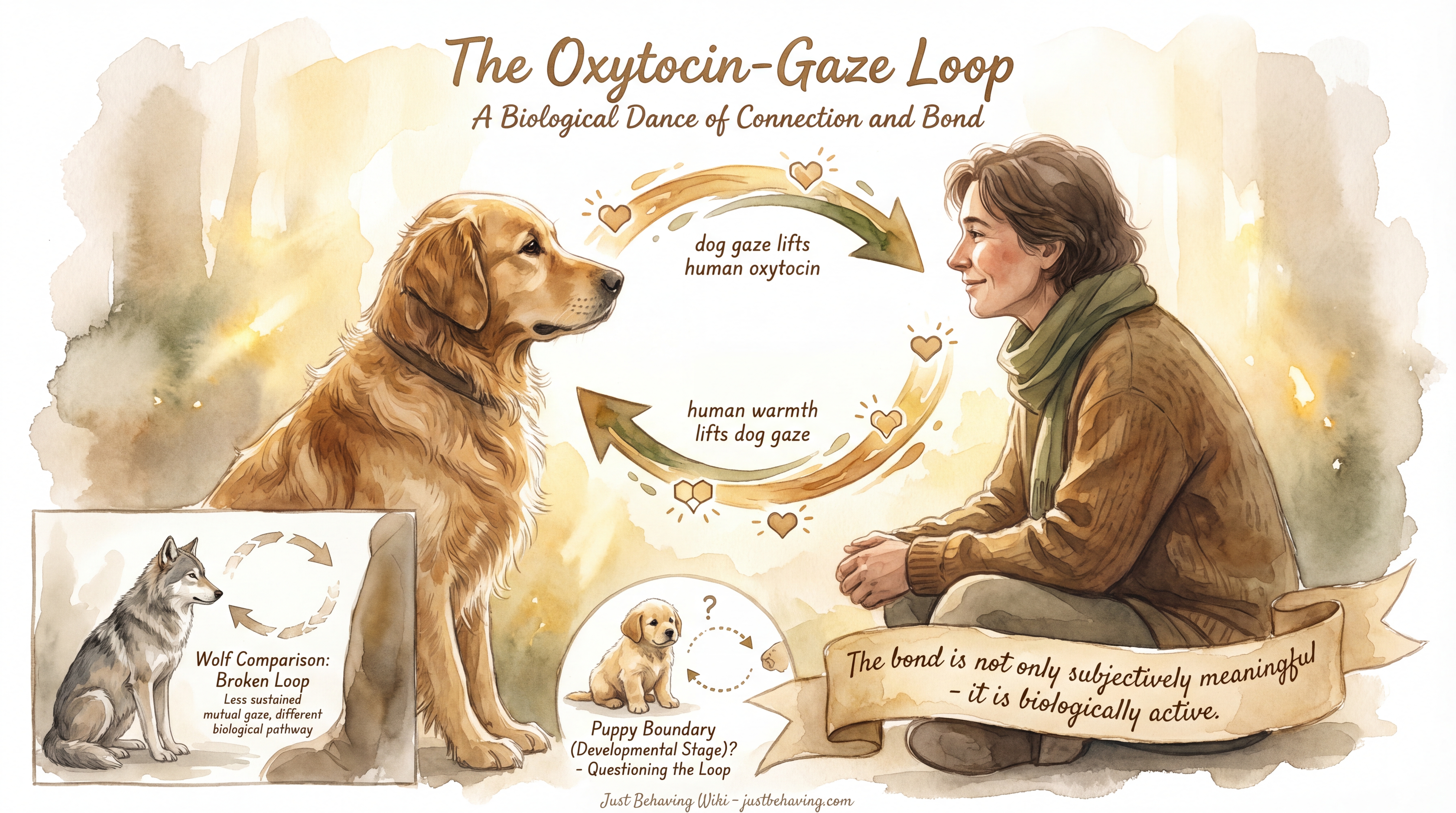
Mutual gaze between dog and owner triggers oxytocin release in both species, creating a cross-species bonding loop with no parallel in other domesticated animals.
Key Takeaways
- The oxytocin-gaze loop gives the dog-human bond a documented endocrine signature rather than leaving it only at the level of sentiment.
- Nagasawa showed that dog gaze can increase owner oxytocin and that oxytocin administration in dogs can increase affiliative gaze back toward the human.
- The wolf comparison suggests the loop is more dog-specific than generic canid familiarity, but the larger coevolution story still needs careful language.
- The strongest practical lesson is that calm affiliative attention fits the documented bond physiology better than high-arousal interaction does.
The Evidence
- Nagasawa, M. et al. (2015)domestic dogs and humans
Demonstrated that longer dog gaze was associated with increased owner urinary oxytocin and that intranasal oxytocin in dogs increased affiliative gazing, supporting a bidirectional loop. - Nagasawa, M. et al. (2009)domestic dogs and humans
Earlier work showed that dog gaze at the owner increased owner urinary oxytocin during social interaction. - Romero, T. et al. (2014)domestic dogs
Showed that intranasal oxytocin can increase affiliative social behavior in dogs, supporting the broader dog-side mechanism.
- SCR-042 boundarydomestic dogs and humans
The modern oxytocin-gaze loop is documented in at least some dog-owner dyads, but stronger claims about exact domestication selection pathways or full newly rehomed puppy expression remain more bounded than the adult physiology itself.
No published study has directly demonstrated the full oxytocin-gaze loop in newly rehomed eight-to-ten-week puppies living through the breeder-to-family transition.
SCR References
Sources
- Nagasawa, M., Kikusui, T., Onaka, T., & Ohta, M. (2009). Dog gaze at its owner increases owner urinary oxytocin during social interaction. Hormones and Behavior, 55(3), 434-441. https://doi.org/10.1016/j.yhbeh.2008.12.002
- Nagasawa, M., Mitsui, S., En, S., Ohtani, N., Ohta, M., Sakuma, Y., Onaka, T., Mogi, K., & Kikusui, T. (2015). Oxytocin-gaze positive loop and the coevolution of human-dog bonds. Science, 348(6232), 333-336. https://doi.org/10.1126/science.1261022
- Romero, T., Nagasawa, M., Mogi, K., Hasegawa, T., & Kikusui, T. (2014). Oxytocin promotes social bonding in dogs. Proceedings of the National Academy of Sciences, 111(25), 9085-9090. https://doi.org/10.1073/pnas.1322868111