Multi-Channel Emotional Contagion
Emotional contagion in dogs is easiest to misunderstand when it is reduced to one dramatic behavior. The stronger scientific picture is broader: dog-human affective transfer appears to operate through multiple channels at different timescales, including endocrine coupling, autonomic co-modulation, odor, and faster social signals such as distress response or contagious yawning. Mixed Evidence
What It Means
The phrase emotional contagion can sound soft or even mystical if it is not anchored carefully. In behavioral science, it usually means that the emotional or physiological state of one individual shifts the state of another without requiring explicit teaching or deliberate reasoning. The dog-human literature supports that happening, but through more than one pathway.
The slowest channel is chronic endocrine coupling. Long-term hair cortisol work shows that dogs and humans can carry linked stress profiles across seasons, especially in cooperative breeds. That is already a form of emotional contagion in the broad sense, but it happens on a long timescale and tells us more about shared physiological climate than about second-to-second interaction.
The medium-timescale channel is autonomic. Katayama et al. (2019) examined heart rate variability in dogs and owners during a human stress manipulation and found that the correlation of HRV parameters between dogs and owners increased with duration of ownership. Estimated The final sample was small, 14 pairs after heavy technical losses, so the paper should not be over-read. But the direction of the finding matters. Shared history strengthened the autonomic linkage. Emotional contagion looked more powerful in dyads that had lived together longer.
Koskela (2024) extends that picture with a more detailed task design. Documented There, HRV co-modulation appeared during free-behaving baseline periods, while activity synchronized more strongly during defined interaction tasks. That matters because it suggests dog-human contagion is not just shared motion or behavioral mimicry. The dyad can share autonomic organization as well.
The odor channel adds a different form of evidence. Wilson showed that dogs can discriminate human baseline odor from stress odor. Parr-Cortes then showed that stress odor from an unfamiliar person can bias dogs toward slower and more pessimistic responses in an ambiguous-task setup. This is one of the strongest reasons to think emotional contagion in dogs is genuinely multi-channel. The human does not need to perform distress visibly. The body can carry it chemically.
There are also faster social-signal studies that matter, even if they should be weighted a bit more carefully than the stronger endocrine and autonomic papers. Documented Yong and Ruffman (2014) reported that dogs and humans showed similar physiological response patterns to human infant crying. That matters because it suggests dogs are not only reading human distress cognitively. Their own bodies shift during exposure to a salient human distress cue.
Joly-Mascheroni et al. (2008) adds another classic but lower-weight channel: contagious yawning. Dogs yawned more after seeing human yawns than after control mouth movements. This result is important not because yawning proves full empathy, which would be too strong, but because it shows that rapid cross-species social signals can trigger a mirrored behavioral state. It belongs in the picture as a narrow signal, not as a total theory.
Taken together, these studies point to a layered system. Documented A dog may pick up a human state through chemistry in the air, through autonomic coupling built by relationship history, through longer endocrine calibration across months, and through immediate social cues such as distress vocalization or yawning. That is what makes the term multi-channel useful. No single paper has to carry the whole claim.
This also helps protect the category from a common error. Emotional contagion is not the same thing as mind-reading, and it is not proof that dogs understand human experience in the full reflective way humans do. A dog can share or absorb affective state through multiple mechanisms without possessing a human-like theory of mind about that state. The biology is real without needing the most inflated interpretation.
The ownership-duration result from Katayama is especially important for JB because it shows that contagion is not merely species-level capacity. It becomes stronger with lived relationship history. That aligns well with attachment, secure base, and general Category 12 logic. A bond is not only a doorway for information. It is also a magnifier of physiological influence.
This is one reason dogs can sometimes look more affected by the emotional room than by the explicit lesson. The adult may believe the important event is the cue, the correction, the treat, or the routine. The dog may be processing a wider channel stack at the same time, one that includes odor, autonomic state, movement quality, tension, and learned relationship meaning.
An everyday analogy is a surround-sound system rather than a single speaker. Human state reaches the dog through several inputs at once. Some are loud and obvious. Some are faint and hidden. The dog still receives the whole mix.
Why It Matters for Your Dog
For families, this entry matters because it explains why the dogs response to human state can look deeper than simple obedience or disobedience. The dog may be receiving the human emotionally before the dog receives the human instructionally. That makes adult regulation part of communication, not something separate from communication.
The multi-channel evidence supports JB insistence that calmness is not only a nice tone. It changes the full signal stack the dog has to live inside.
This does not mean families should become superstitious about every feeling. It means they should take the relationship seriously as a physiological medium. The dog is not only learning from what the adults do on purpose. The dog is often learning from what the adults are broadcasting all the time.
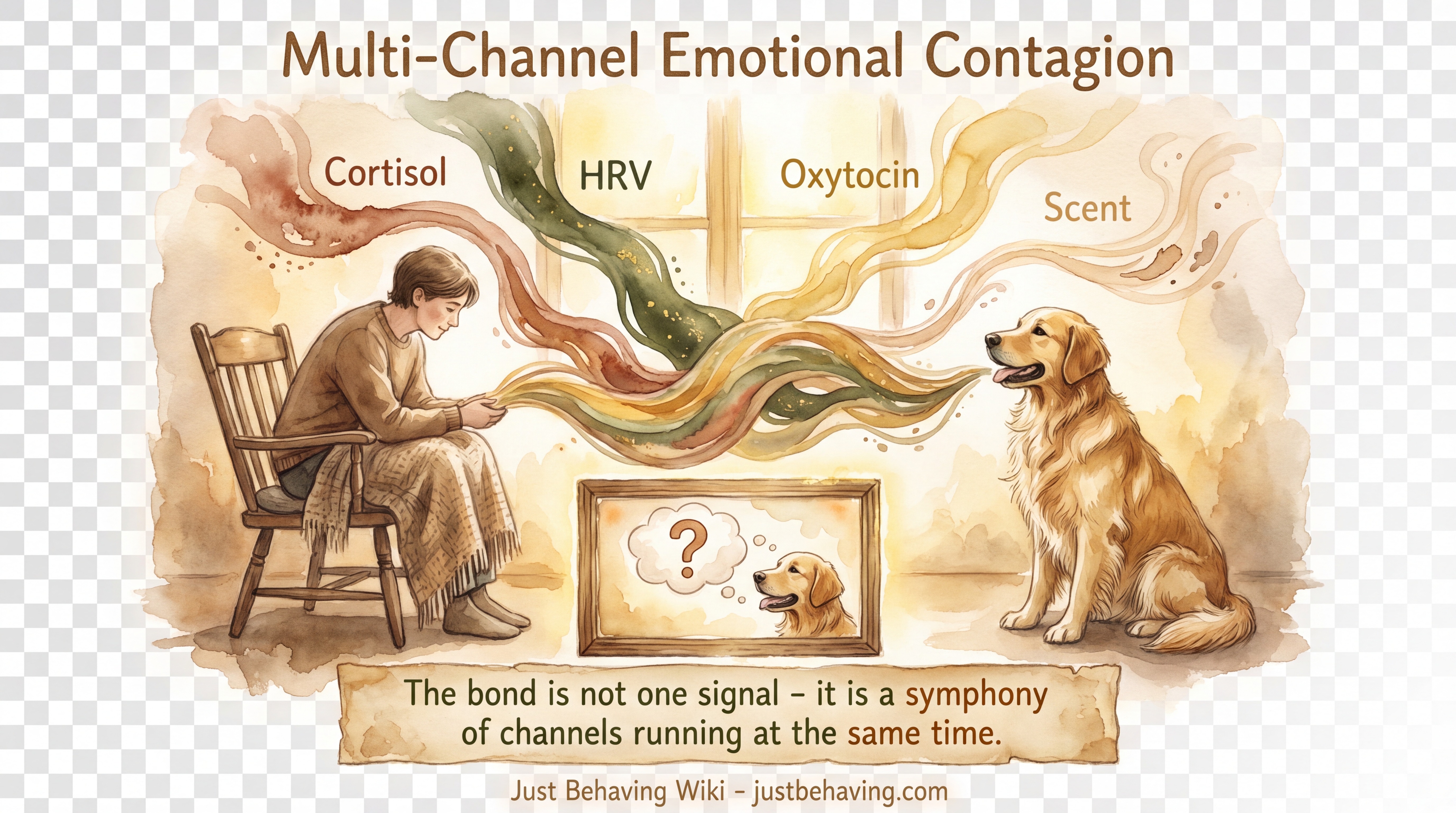
Emotional contagion between dog and owner operates across multiple biological channels simultaneously, not just through visible behavior.
Key Takeaways
- Dog-human emotional contagion is better understood as a stack of channels rather than as one single dramatic behavior.
- The literature now supports endocrine, autonomic, odor-based, and fast social-signal routes by which human state can reach the dog.
- Some channels, especially cortisol, HRV, and odor, are stronger and cleaner than others such as contagious yawning, which should be interpreted more modestly.
- The relationship matters because duration of ownership and dyad history appear to strengthen several forms of coupling.
The Evidence
This entry uses estimated claim-level tags beyond the dedicated EvidenceBlocks below. These tags mark approximate ranges or timing claims that should remain bounded by the cited sources.
This entry uses mixed-evidence claim-level tags beyond the dedicated EvidenceBlocks below. These tags mark claims that combine documented findings with observed practice, heuristic application, or unresolved gaps.
- Sundman, A.-S. et al. (2019)domestic dogs and humans
Found long-term hair cortisol synchronization between dogs and owners, showing a chronic endocrine channel of shared stress physiology. - Katayama, M. et al. (2019)domestic dogs and humans
Found that HRV correlation between dogs and owners increased with duration of ownership, supporting autonomic emotional contagion shaped by relationship history. - Koskela, A. et al. (2024)domestic dogs and humans
Showed task-sensitive HRV co-modulation in dog-owner dyads beyond simple shared activity.
- Wilson, C. et al. (2022)domestic dogs
Showed that dogs can discriminate human baseline odor from human stress odor. - Parr-Cortes, Z. et al. (2024)domestic dogs
Found that unfamiliar human stress odor biased dogs toward more pessimistic cognitive responses. - Yong, M. H., and Ruffman, T. (2014)domestic dogs and humans
Reported similar physiological responding in dogs and humans exposed to human infant crying, supporting a distress-transfer channel. - Joly-Mascheroni, R. M. et al. (2008)domestic dogs and humans
Found contagious yawning in dogs in response to human yawns, suggesting a narrower rapid social-signal pathway.
- SCR-012 and SCR-106 boundarydomestic dogs and humans
Multiple coupling channels are documented, but the stronger claim that dogs fully understand human feelings in a human-like reflective way goes beyond what these studies establish.
No published study has yet weighed the relative contribution of odor, autonomic coupling, long-term endocrine climate, and overt social cues in one unified dog-human emotional contagion model.
SCR References
Sources
- Joly-Mascheroni, R. M., Senju, A., & Shepherd, A. J. (2008). Dogs catch human yawns. Biology Letters, 4(5), 446-448. https://doi.org/10.1098/rsbl.2008.0333
- Katayama, M., Kubo, T., Mogi, K., Ikeda, K., Nagasawa, M., & Kikusui, T. (2019). Emotional contagion from humans to dogs is facilitated by duration of ownership. Frontiers in Psychology, 10, 1678. https://doi.org/10.3389/fpsyg.2019.01678
- Koskela, A., Tornqvist, H., Somppi, S., Tiira, K., Kykyri, V.-L., Hanninen, L., Kujala, J., Nagasawa, M., Kikusui, T., & Kujala, M. V. (2024). Behavioral and emotional co-modulation during dog-owner interaction measured by heart rate variability and activity. Scientific Reports, 14, 25201. https://doi.org/10.1038/s41598-024-76831-x
- Parr-Cortes, Z., Muller, C. T., Talas, L., Mendl, M. T., Guest, C., & Rooney, N. J. (2024). The odour of an unfamiliar stressed or relaxed person affects dogs responses to a cognitive bias test. Scientific Reports, 14, 16914. https://doi.org/10.1038/s41598-024-66147-1
- Sundman, A.-S., Van Poucke, E., Holm, A.-C. S., Faresjo, A., Theodorsson, E., Jensen, P., & Roth, L. S. V. (2019). Long-term stress levels are synchronized in dogs and their owners. Scientific Reports, 9, 7391. https://doi.org/10.1038/s41598-019-43851-x
- Wilson, C., Campbell, K., Petzel, Z., & Reeve, C. (2022). Dogs can discriminate between human baseline and psychological stress condition odours. PLOS ONE, 17(9), e0274143. https://doi.org/10.1371/journal.pone.0274143
- Yong, M. H., & Ruffman, T. (2014). Emotional contagion: Dogs and humans show a similar physiological response to human infant crying. Behavioural Processes, 108, 155-165. https://doi.org/10.1016/j.beproc.2014.10.006