Do As I Do Versus Shaping
The Do As I Do versus shaping comparison matters because it is one of the few places where dog science directly asks whether learning by watching produces a different result than learning by engineered stepwise reinforcement. The answer is not that one method wins everywhere. The answer is that socially demonstrated learning shows a real advantage in at least some task domains, and that difference has consequences for how JB thinks about development. Heuristic
What It Means
The first distinction to get clear is methodological. Shaping is an operant procedure. The trainer reinforces successive approximations until the dog gradually builds the target behavior. Do As I Do, usually shortened to DAID, is a social-learning procedure. The dog watches a human demonstrate an action and is then asked to reproduce what the human just did. One system engineers the path behavior by behavior. The other leans on observation and a generalized copying rule.
Topal, Byrne, Miklosi, and Csanyi helped establish the DAID framework in 2006. That paper mattered because it moved canine imitation research beyond casual anecdotes. Documented The point was no longer merely that a dog might happen to copy one demonstrated action. The point was that a dog could learn a broader rule: when the person does something and then gives the imitation cue, reproduce the demonstrated act.
Fugazza and Miklosi turned that framework into the most important direct comparison study for JB in 2015. Documented They enrolled 38 dog-caregiver pairs, with 20 pairs using the DAID route and 18 pairs using shaping or clicker-based instruction with professional trainers. The dyads were taught two different kinds of tasks: an object-related action involving a sliding door and a body-movement action involving jumping.
The object-task result was strong. DAID significantly outperformed shaping and clicker work on the sliding-door problem, with Fisher's exact test yielding P=0.001. That is not a soft directional trend. It is the cleanest documented evidence in this literature that a socially demonstrated route can be more effective than a conventional operant route for a certain kind of task.
The body-movement result is exactly where good science demands restraint. DAID dogs reached criterion faster, and that speed difference was statistically significant at P=0.038. But the overall number of dyads that successfully achieved the task did not differ significantly between groups, with P=0.1014. That means the study does not justify the broad slogan "social learning is better than shaping." Documented It justifies the narrower and stronger sentence that the advantage was task-dependent.
Why would object-related actions favor the observational route? The simplest answer is that objects externalize the demonstrated sequence. The dog can watch what the human does to the object, map the action to the environment, and then recreate that relation. Body movements may be harder because the dog has to translate the observed human motor pattern into its own very different body. The study itself does not fully prove that mechanistic explanation, but it is a reasonable reading of why the difference showed up where it did.
This is where the bond category adds something the generic methods debate usually misses. The important issue is not only success rate. It is what kind of representation gets built when the dog learns through a trusted model. A shaping route can produce reliable performance. A DAID route may produce a richer observational memory of how the task was organized. Later deferred-imitation and episodic-like-memory papers help fill in why that possibility is plausible.
Fugazza and Miklosi's 2014 deferred-imitation work and Fugazza, Pogany, and Miklosi's 2016 incidental-encoding paper both reinforce that picture. Dogs can observe an action, store it, and retrieve it later even when they were not expecting to be tested. That is not the same thing as saying shaping never builds durable learning. It is saying that the social-learning route appears to recruit a type of memory and representation that fits the mentorship model unusually well.
It also matters that DAID is not only about efficiency. It is about where information lives. In shaping, the information is largely in the trainer-controlled contingency structure. In DAID, more of the information is in the model and the observed event. That changes the role of the relationship. A technically skilled shaper can build behavior through timing and reinforcement even if the broader social life around the dog is thin. Social learning asks more of the demonstrator because the demonstrator is part of the message.
That is why this comparison is so relevant to JB but should not be weaponized into anti-training rhetoric. The evidence does not say clicker work is fake, ineffective, or useless. It says that when dogs learn from watching, the resulting learning can look different, and in some tasks it can outperform the operant route. The relationship-centered takeaway is not "never shape." It is "do not pretend shaping is the whole developmental picture."
The task-dependency caveat is especially important for credibility. Families deserve the exact claim the evidence supports. If the field found a strong object-task advantage and a speed-only body-task advantage, then that is what should be written. Overclaiming would only weaken one of the most interesting comparisons in the literature.
The deeper implication is developmental rather than competitive. During early puppyhood, much of what matters most is not a polished behavior topography but how the young dog encodes patterns: how adults move, how they approach problems, how they recover, how they settle, and what counts as worth copying. A social-learning route fits those questions more naturally than a narrow skill-engineering route does.
An everyday analogy is learning a household recipe. One person can hand you a step-by-step card and reward you for following it exactly. Another can cook the meal in front of you while you watch the pace, smell the timing, and notice the little decisions that are hard to write down. Both routes teach. They do not teach in the same way.
Why It Matters for Your Dog
For families, this entry matters because it protects against a false choice while still preserving the central JB claim. Heuristic Formal training methods can be useful and often are. But when the goal is broad developmental organization rather than only polished skill, the model the puppy lives with becomes unusually important. The adult example is not decorative around the learning process. It is part of the learning process.
The DAID comparison is one of the clearest reasons JB distinguishes between building a skill and building an animal. Social demonstration appears to carry different developmental information than stepwise contingency management alone.
This also softens the usual pressure families feel to narrate and reward every moment. The literature suggests that a calm adult demonstrating the pattern can sometimes do more than a louder adult trying to micromanage the puppy into the pattern. That is not an argument against good reinforcement timing. It is an argument for remembering that the relationship still carries its own teaching channel.
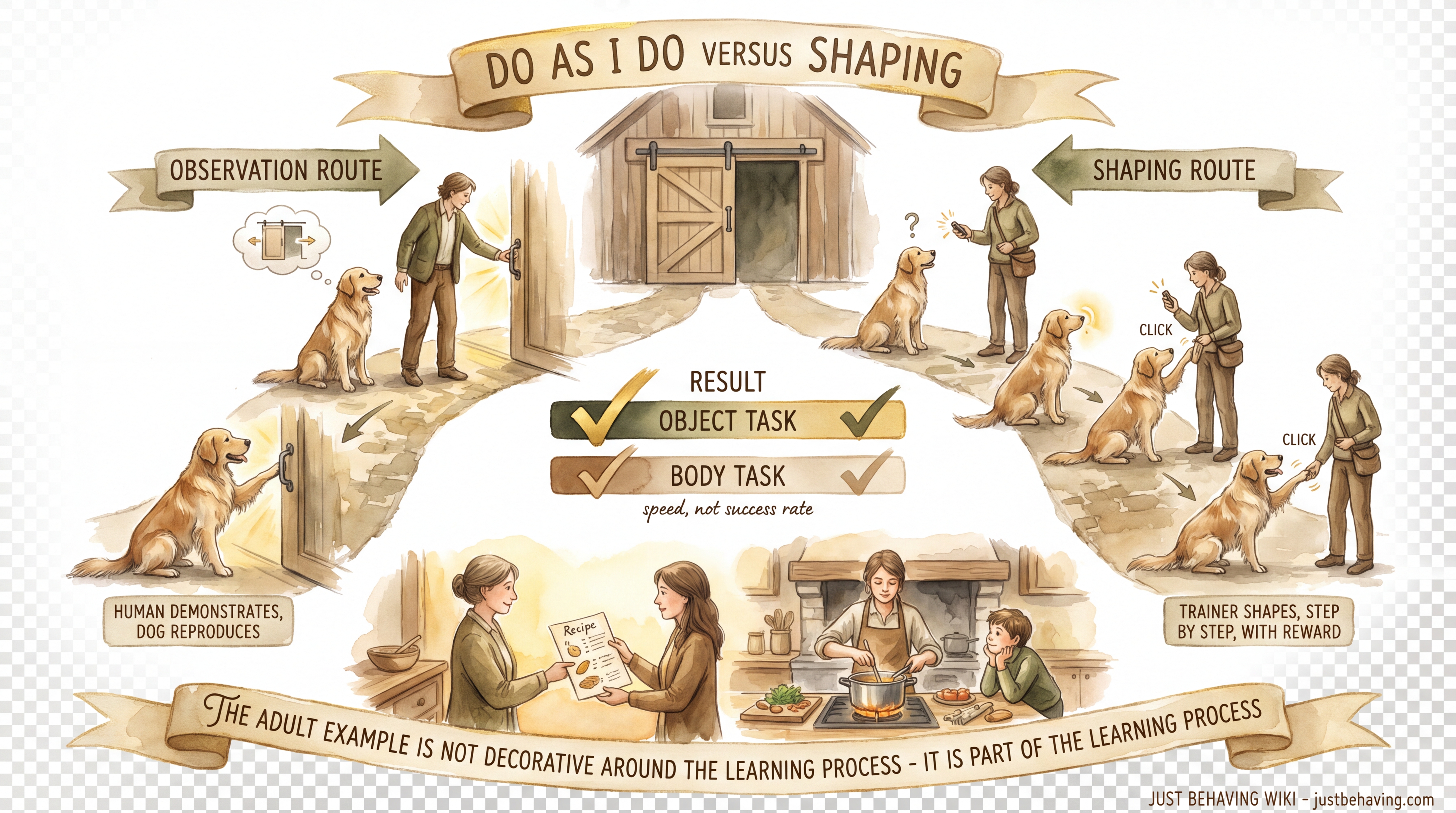
Social imitation and operant shaping are both valid learning pathways, but they engage different cognitive systems and carry different relational implications.
Key Takeaways
- Do As I Do and shaping are not identical learning routes: one centers observed action, and the other centers engineered reinforcement.
- The strongest direct comparison found a clear DAID advantage for object-related tasks and a speed advantage, but not a clear success-rate advantage, for the tested body movement.
- That pattern matters because it suggests social learning may build different kinds of representations rather than merely faster versions of the same thing.
- For families, the practical lesson is not to reject training, but to stop treating the adult model as irrelevant beside the formal training method.
The Evidence
- Fugazza, C., and Miklosi, A. (2015)domestic dogs
Compared 20 Do As I Do dyads with 18 shaping or clicker dyads and found a significant DAID advantage for an object-related task, plus a faster but not clearly more successful pattern for the tested body movement. - Topal, J. et al. (2006)domestic dogs
Established the modern Do As I Do framework by showing that dogs can reproduce demonstrated human actions and action sequences.
- Fugazza, C., and Miklosi, A. (2014)domestic dogs
Demonstrated deferred imitation, showing that observed action can be retained beyond immediate copying. - Fugazza, C., Pogany, A., and Miklosi, A. (2016)domestic dogs
Showed incidental encoding and later recall of others actions, supporting a broader observational-memory route than simple immediate mimicry.
- SCR-004 boundarydomestic dogs
The DAID comparison supports a distinctive social-learning route, but it does not justify claiming that operant learning is unreal or absent from all natural canine development.
No published breeder-to-family developmental trial has directly compared how much early household stability, emotional regulation, and social calibration come from observational learning versus formal operant teaching after rehoming.
SCR References
Sources
- Fugazza, C., & Miklosi, A. (2014). Deferred imitation and declarative memory in domestic dogs. Animal Cognition, 17(2), 237-247. https://doi.org/10.1007/s10071-013-0656-5
- Fugazza, C., & Miklosi, A. (2015). Social learning in dog training: The effectiveness of the Do As I Do method compared to shaping or clicker training. Applied Animal Behaviour Science, 171, 146-151. https://doi.org/10.1016/j.applanim.2015.09.011
- Fugazza, C., Pogany, A., & Miklosi, A. (2016). Recall of others actions after incidental encoding reveals episodic-like memory in dogs. Current Biology, 26(23), 3209-3213. https://doi.org/10.1016/j.cub.2016.09.057
- Topal, J., Byrne, R. W., Miklosi, A., & Csanyi, V. (2006). Reproducing human actions and action sequences: Do as I Do in a dog. Animal Cognition, 9(4), 355-367. https://doi.org/10.1007/s10071-006-0051-6