Social Learning From Eight Weeks
Social learning from eight weeks means that a puppy can watch an adult solve a problem and then use that observation to guide its own behavior before formal household training has barely begun. In dogs, that is not a poetic claim about impressionability. It is a documented developmental finding with direct relevance to the breeder-to-family transition. Documented
What It Means
The first point to understand is timing. Eight weeks is not "later puppyhood." It is the exact age at which many family-raised puppies are leaving the breeder and entering their new homes. A learning channel that is already working at that age is not a side issue. It is one of the main ways the puppy is going to make sense of the new world.
Fugazza, Moesta, Pogany, and Miklosi made that point unusually clear in their 2018 Scientific Reports study. Documented They tested 41 puppies from seven litters at eight weeks of age, before adoption and before individualized family training had any meaningful chance to accumulate. The puppies were not seasoned household dogs. They were right at the developmental doorstep.
The design matters because it was not a vague "puppies watched something and then did better" story. The puppies were assigned to demonstrator conditions that included their own mother, an unfamiliar adult dog, or a human. Each demonstrator opened a puzzle box to reach food while the puppy watched. The puppy then got a chance to solve the problem independently. That setup lets the field ask a much sharper question than older anecdotal work did: does the identity of the adult model actually change what the puppy can learn?
The answer was yes. Puppies that watched either a canine or human demonstrator outperformed no-demonstration controls. In plain language, seeing an adult solve the problem changed what the puppy did next. That is already enough to establish an early observational channel. But the study becomes more important because it did not stop at the first immediate attempt. Documented
After a one-hour delay, the puppies were tested again. They still retained the observed solution. No refresher demonstration. No shaping procedure during the delay. No external reinforcement keeping the memory alive. That retention result matters because it pushes the finding beyond momentary attraction to a location or object. The puppy did not simply become excited about a box another individual had touched. The puppy carried forward a usable memory of what had been observed.
That distinction is central to the bond category. A learning system that changes only first glance or first contact would still matter, but it would be weaker. A learning system that changes what the puppy remembers an hour later is much closer to the kind of developmental mechanism JB cares about. Family life is full of delayed reuse: the puppy watches a calm adult respond to a vacuum today and reacts differently to the vacuum later, after the adult is gone.
The unfamiliar-adult-dog result adds an important nuance. In the Fugazza study, puppies learned more readily from an unfamiliar adult conspecific than from their own mother. Documented The safest interpretation is not that mothers are unimportant. Maternal influence is heavily documented elsewhere. The safer read is that a puppy may watch an unfamiliar adult more analytically because the relationship is less saturated with comfort and proximity. The point stays heuristic, but it is useful. It suggests that attention is shaped not only by species, but also by relationship role.
That is part of why the three-demonstrator design is so important for JB. It does not force families into a false choice between canine mentor and human mentor. The early dog literature supports both channels. Puppies are open to conspecific demonstration, and they are open to human demonstration. The bond category then asks a more practical question: in a given breed and home, which channel is likely to carry more of the load after transition?
Earlier developmental work had already pointed in the same direction. Adler and Adler's 1977 split-litter study with Miniature Dachshund puppies found that observer puppies solved a food-cart task dramatically faster on first trial than naive controls. Documented Slabbert and Rasa's 1997 working-dog study showed that puppies who watched their trained mother perform narcotics-detection behaviors learned related tasks faster later. Those studies were less refined than Fugazza 2018, but they tell the same basic story. Observation changes the puppy's starting point.
What the literature does not show is that observation erases every role for consequences once the puppy begins acting. Most social-learning tasks still end with the puppy interacting with an object, a location, or a food reward. The strongest documented statement is therefore not "social learning replaces all other learning." It is "observation changes what the puppy tries, how quickly the puppy succeeds, and what the puppy retains." That is already a powerful developmental claim without any need for inflation.
This is why the entry belongs in Category 12 rather than only in Behavioral Science. The key issue here is not merely that puppies are capable of observational learning in the abstract. The key issue is that the relationship delivers the lesson. Someone the puppy is socially oriented toward does something, and the puppy carries that event into later behavior. The adult is not a backdrop. The adult is part of the mechanism.
For Golden Retriever families, this becomes even more important because it meets the transition window exactly where JB works. A Golden leaving the breeder at eight weeks is not arriving empty and waiting to be programmed. The puppy is arriving with a live observational channel already open. That means the first days at home are not a neutral holding period. They are active education.
An everyday analogy is moving into a new workplace on your first day. Before anyone gives you a handbook, you are already learning by watching the experienced people in the room. You notice how fast they move, how they greet people, what gets ignored, and what gets treated as important. Eight-week-old puppies appear to work that way too, only with even less separation between emotional safety and practical learning.
Why It Matters for Your Dog
For families, this entry changes the question from "when should teaching start?" to "what is already being taught the moment the puppy arrives?" If the observational channel is live from eight weeks, then every early household pattern becomes part of the developmental curriculum: how the adults move, how they respond to novelty, how quiet or chaotic the home feels, and how readable the routines are.
The eight-week social-learning literature is one of the clearest reasons JB treats mentorship as mechanism rather than metaphor. The puppy is already built to learn from an adult worth watching.
This also supports the soft-landing idea without overstating it. A calm, structured home does not magically solve every transition difficulty, but it does make better use of a learning channel the puppy already possesses. Documented A crash-landing home floods that same channel with noise. The puppy is still learning. The problem is what the puppy is learning from.
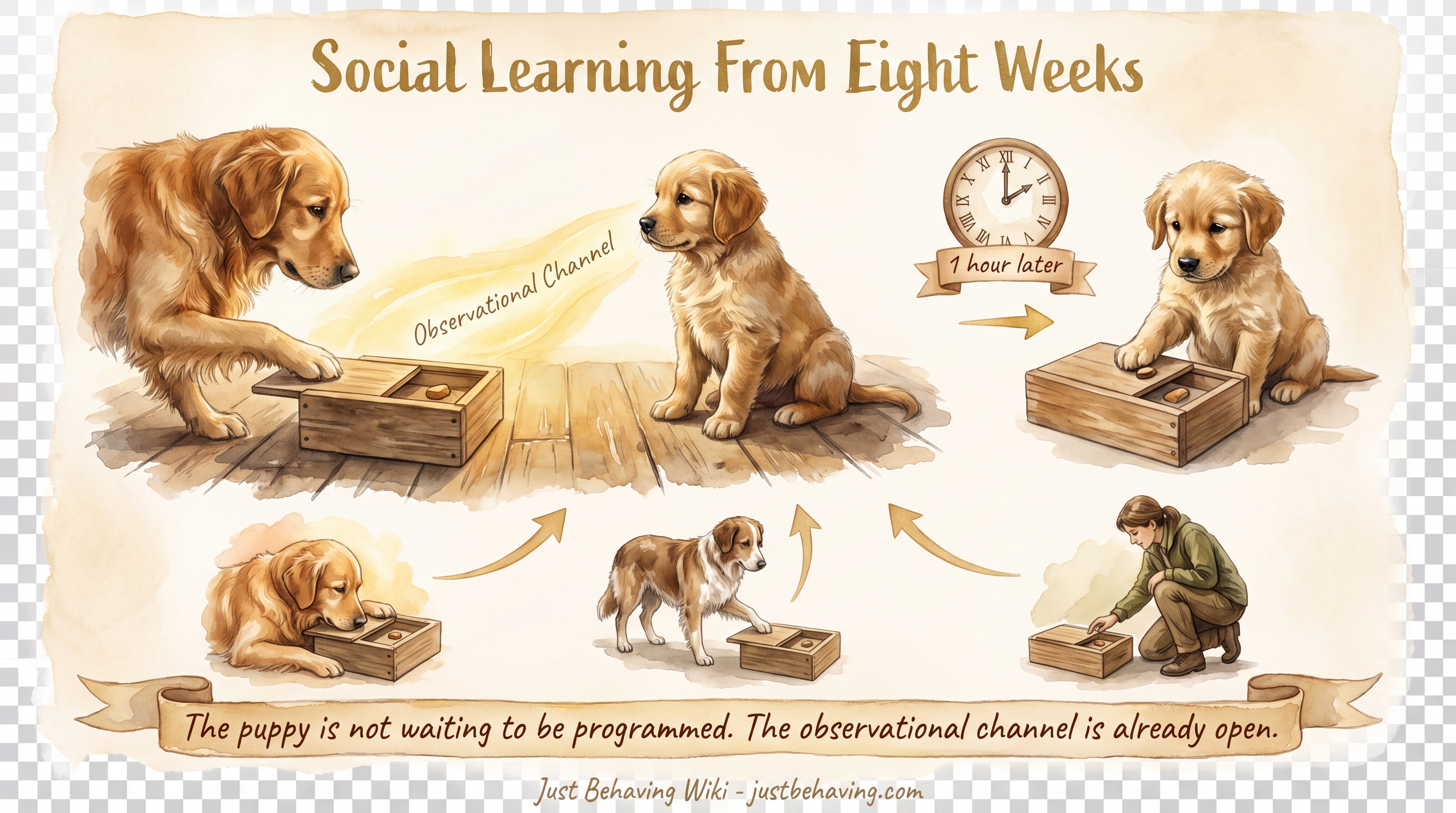
Puppies are capable of socially guided learning from eight weeks of age, making the first weeks in a new home a window of active observational intake.
Key Takeaways
- Eight-week-old puppies can already learn from both canine and human demonstrators, which makes social learning a day-one developmental mechanism.
- The strongest puppy work shows not only immediate copying effects but one-hour retention, meaning the observed event is carried forward in memory.
- Earlier puppy studies in companion and working-dog settings point in the same direction: observation changes the puppy starting point before formal instruction does.
- For families, this means the transition home is already teaching through adult example long before anyone thinks formal training has begun.
The Evidence
- Fugazza, C. et al. (2018)domestic dogs
Tested 41 eight-week-old puppies with mother, unfamiliar adult dog, and human demonstrators and found that puppies learned from observed demonstrations and retained the solution after a one-hour delay. - SCR-009 synthesisdomestic dogs
Summarizes the modern puppy literature as showing that social learning is already operational from eight weeks onward.
- Adler, L. L., and Adler, H. E. (1977)domestic dogs
Observed Miniature Dachshund puppies solved a demonstrated food-cart task faster than naive controls. - Slabbert, J. M., and Rasa, O. A. E. (1997)domestic dogs
Working-dog puppies who observed their trained mother later learned related tasks faster during formal training.
- SCR-009 boundarydomestic dogs
The puppy literature documents socially guided learning from demonstrators, but it does not justify claiming that observation eliminates all later consequence-based learning once the puppy begins acting in the task.
No published household study has yet tracked how much of the first month after rehoming is explained by observational learning from adult family routines versus other concurrent learning processes.
SCR References
Sources
- Adler, L. L., & Adler, H. E. (1977). Ontogeny of observational learning in the dog (Canis familiaris). Developmental Psychobiology, 10(3), 267-271. https://doi.org/10.1002/dev.420100310
- Bray, E. E., Gnanadesikan, G. E., Horschler, D. J., Levy, K. M., Kennedy, B. S., Famula, T. R., & MacLean, E. L. (2021). Early-emerging and highly heritable sensitivity to human communication in dogs. Current Biology, 31(14), 3132-3136. https://doi.org/10.1016/j.cub.2021.04.055
- Fugazza, C., Moesta, A., Pogany, A., & Miklosi, A. (2018). Social learning from conspecifics and humans in dog puppies. Scientific Reports, 8, 9257. https://doi.org/10.1038/s41598-018-27654-0
- Slabbert, J. M., & Rasa, O. A. E. (1997). Observational learning of an acquired maternal behaviour pattern by working dog pups: An alternative training method? Applied Animal Behaviour Science, 53(4), 309-316. https://doi.org/10.1016/S0168-1591(96)01163-X