The Golden Retriever Lifetime Study
Compound evidence detail1 SCR / 3 parts
- Documentedthe Baumrind authoritative-parenting literature in human child development
- Documentedthe canine correlational evidence linking dog-directed caregiving styles to attachment, attention, sociability, and problem-solving outcomes (van Herwijnen 2018/2020, Brubaker and Udell 2023)
- Heuristicthe JB inference that one specific caregiving style experimentally produces the best long-term developmental outcomes in dogs
The Golden Retriever Lifetime Study matters because it moves the caregiving conversation from generic dog samples into JB's own breed. In a cohort of 3,044 Golden Retrievers, household variables such as single-dog status, bed-sharing, and neighborhood density predicted meaningful behavior outcomes. The study is descriptive rather than a style experiment, but it confirms something important: even within a famously social breed, the household pattern is not neutral. Documented
What It Means
Breed-specific evidence always deserves special attention in the JB world because Golden Retrievers are not just any companion dog population. They are a highly cooperative breed with a strong human orientation and a reputation for social ease. If household variables still predict meaningful behavior differences inside that breed, the family environment is doing real work.
That is part of what makes the Golden Retriever Lifetime Study so useful conceptually. Many dog studies mix breeds with very different selection histories, body sizes, social tendencies, and work backgrounds. GRLS reduces some of that heterogeneity. It does not remove all confounding, but it lets us ask a cleaner question: within one famously affiliative breed, do ordinary household patterns still matter enough to show up? The answer appears to be yes.
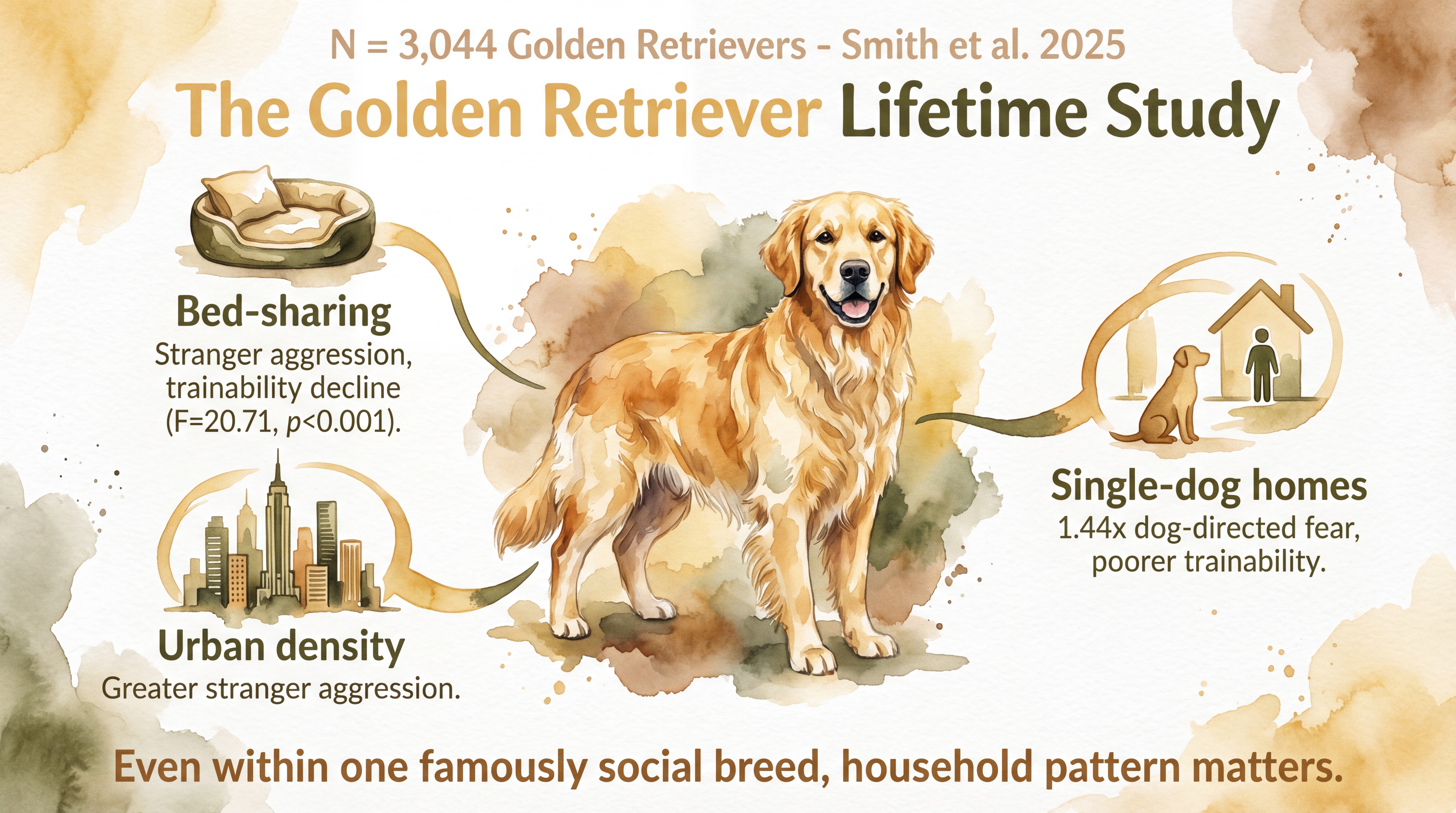
Smith and colleagues analyzed data from 3,044 Golden Retrievers in the Golden Retriever Lifetime Study and found that household factors predicted behavior with notable specificity. Documented Dogs in single-dog homes showed 1.44 times the odds of dog-directed fear and poorer trainability compared with dogs in multi-dog homes. That does not prove that every Golden needs another dog in the house. It does show that the broader social environment around the dog matters even inside one breed.
That single-dog-home result is especially interesting for a breed like the Golden because it reaches beyond simple sociability stereotypes. Goldens are widely assumed to be easy because they are so human-oriented. The GRLS result suggests that human orientation does not eliminate the developmental effects of social environment. Even a very affiliative breed may benefit behaviorally from a richer canine social context, or at least may show measurable costs when that context is thinner.
The bed-sharing result is one of the most attention-grabbing findings. Dogs sleeping in the caregiver's bed showed increased stranger aggression and a significant reduction in trainability over time, with the source synthesis noting F=20.71, p<0.001 for the trainability decline. This result is easy to misread if it is framed moralistically. The paper does not say that closeness is bad. It says that one highly intimate household variable tracked weaker outcomes on specific behavior measures.
That matters because it fits a broader pattern already visible in the caregiving-style literature. Warmth and intimacy are not automatically the same thing as developmental usefulness. A dog can be physically close, heavily included, and emotionally adored while still becoming less trainable or less well organized. The relationship question is not only how much contact exists. It is what kind of structure that contact lives inside.
It is also a good example of why descriptive household variables deserve serious attention even when they are not perfect causal levers. Bed-sharing is probably carrying more than one thing at once. It may reflect intimacy, boundary softness, owner anxiety about separation, convenience, or household habit. The study cannot fully separate those pathways. Documented But once the same variable starts tracking both stranger-related aggression and declining trainability, it becomes more than a lifestyle curiosity.
The urban-density result adds another layer. Dogs in the most densely populated neighborhoods showed greater odds of stranger aggression. Again, the finding is descriptive rather than deterministic. Urban life can bring noise, constraint, and stranger exposure patterns that differ sharply from lower-density settings. The study does not prove a single mechanism. It does show that environment and household structure matter enough to register clearly inside a large Golden-only dataset.
Together, the three GRLS findings form a useful pattern rather than three isolated headlines. Social composition, sleeping arrangement, and neighborhood density all point back to the same broad conclusion: life architecture matters. The dog's behavior is not emerging from breed essence alone. It is emerging from breed plus household pattern plus social environment over time.
One reason this entry belongs in the bond category rather than only in a breed or health category is that these are not simply demographic curiosities. They are household-pattern findings. They reinforce the larger Category 12 claim that the human side of the relationship and the life architecture around it help shape what the dog becomes. The Golden study makes that claim feel less abstract because it does so inside the exact breed JB raises.
The study also helps guard against a common fallacy in dog discussions: the idea that breed alone explains most of what families are seeing. Documented Breed matters. But inside one breed, with thousands of dogs, household variables still moved the needle. That means the family environment remains an active developmental variable, not an afterthought hidden behind genetics.
The scientific boundary is important here. The GRLS analysis is not a randomized trial of bed-sharing, urban density, or household composition. These variables are proxies for broader lifestyle patterns, and some of the real causal drivers may sit underneath them. The strength of the study is scale and breed specificity. The weakness is that descriptive household factors do not by themselves isolate mechanism.
Even so, the practical lesson is hard to miss. Goldens are not exempt from structure. Their sociability does not cancel the effects of household pattern. If anything, their strong human orientation may make the family environment even more consequential.
Why It Matters for Your Dog
For Golden families, this entry matters because it moves the conversation out of generalities. It says that in this breed, in a very large cohort, ordinary household decisions and social arrangements were associated with trainability, fear, and stranger-related outcomes. That is exactly the kind of evidence families need if they want to think developmentally rather than romantically.
The Golden study reinforces JB idea that household setup is preventive or non-preventive long before anyone starts talking about formal behavior work. The life pattern itself is already teaching something.
It also helps families hold the right level of caution. The answer is not to panic over one variable in isolation or to treat bed-sharing as a magic cause of every problem. The answer is to stop assuming that closeness, convenience, and developmental usefulness are always the same thing. The study gives Golden families a strong reason to examine the whole household pattern, not only the dog's temperament. Documented
The Morris Animal Foundation Golden Retriever Lifetime Study provides the largest prospective dataset on how environment, care, and genetics interact across a Golden Retriever's life.
Key Takeaways
- The Golden Retriever Lifetime Study shows that household variables predict meaningful behavior outcomes even within one highly cooperative breed.
- Single-dog homes, bed-sharing, and dense urban living were all associated with specific trainability, fear, or stranger-related patterns in the GRLS analysis.
- The findings are descriptive rather than fully causal, but they strongly support the idea that household architecture matters for Golden development.
- Golden Retrievers are not protected from weak structure simply because they are social and human-oriented.
The Evidence
- Smith, N., Luethcke, K. R., and Craun, K. (2025)Golden Retrievers
Analyzed 3,044 dogs in the Golden Retriever Lifetime Study and found that single-dog homes, bed-sharing, and neighborhood density predicted dog-directed fear, trainability, and stranger-related outcomes.
- Bouma, E. M. C. et al. (2024)domestic dogs
Showed that permissive caregiving aligns with weaker owner anchoring and higher obesity-related household patterns. - Brubaker, L., and Udell, M. A. R. (2023)domestic dogs
Found that authoritative caregiving aligns with stronger secure attachment, sociability, and problem-solving, making the household-pattern question developmentally meaningful rather than merely demographic.
- SCR-019 boundarydomestic dogs and Golden Retrievers
The GRLS findings support the broader importance of household structure and caregiving environment, but they do not by themselves constitute a direct parenting-style experiment.
No published Golden-specific trial has directly manipulated household variables such as sleeping arrangement or social composition to determine which underlying mechanisms drive the observed GRLS behavior associations.
SCR References
Sources
- Bouma, E. M. C., Vingerhoets, A. J. J. M., & van der Veld, W. M. (2024). Parenting styles and intergenerational transmission in human-dog relationships. Animals, 14(7), 1038. https://doi.org/10.3390/ani14071038
- Brubaker, L., & Udell, M. A. R. (2023). Does pet parenting style predict the social and problem-solving behavior of pet dogs? Animal Cognition, 26(1), 345-356. https://doi.org/10.1007/s10071-022-01694-6
- Smith, N., Luethcke, K. R., & Craun, K. (2025). The impacts of household factors and proxies of human social determinants of health on dog behavior (Golden Retriever Lifetime Study). Preventive Veterinary Medicine, 239, 106520.