Owner Personality and Dog Behavior
Owner personality is not background scenery around dog raising. It is a documented variable that predicts canine behavior-problem scores, stress flexibility, and the long-term physiological climate of the relationship. One of the most important parts of the evidence is what it does not show: most of the effect does not seem to be explained by formal training sessions alone. Documented
What It Means
The clearest behavioral paper here is Dodman et al. (2018), one of the largest owner-dog studies in this area. Documented Using 1,564 owner-dog pairs, the researchers measured owner personality with the Ten-Item Personality Inventory and dog behavior with the C-BARQ. The outcome pattern was broad rather than narrow. Lower owner agreeableness, conscientiousness, extraversion, and emotional stability were associated with higher canine behavior-problem scores across multiple domains.
The design of that paper matters because it was not only a personality survey. Dodman's team used an online battery that also measured depression, emotion regulation, aversive or confrontational training methods, and owner-reported dog behavior. Documented That gave the study a way to test an important alternative explanation: perhaps owner personality matters mainly because it changes the training tools people choose. The answer turned out to be, at most, only partly.
Some of the details are especially revealing. High emotional stability in the caregiver was associated with lower owner-directed aggression scores in dogs. Documented Men with moderate depression showed a 5.31-fold increase in the tendency to use aversive training methods. These are not findings about a single trick gone wrong. They are findings about the emotional and behavioral climate the dog lives inside.
The most important result for JB may be the weak mediation point. In the source synthesis, training method accounted for only a small portion of the association between owner personality and dog behavior problems. Documented That means the larger effect was not flowing primarily through formal lessons. It was flowing through ordinary life, through greetings, leash handling, frustration moments, recovery after barking, household tone, and the thousand small interactions that never get labeled as training at all.
That weak-mediation finding is philosophically central for JB because it widens the unit of analysis. Instead of asking only which reinforcement schedule or correction type is present, the literature pushes us to examine the relational atmosphere the dog inhabits all day. The adult's personality shows up in pacing, voice, predictability, irritability, follow-through, and whether the room itself feels organized or scattered. Those variables do not belong neatly to a ten-minute lesson plan, but the dog is still learning from them.
That matters because it shifts the center of gravity. If the main pathway were formal technique, then families could fix most of the issue by swapping methods or sharpening timing in short sessions. But if the larger pathway is daily relational climate, then the adult's personality becomes a developmental variable whether the family wants it to or not.
The physiology literature points in the same direction. Schoberl's 2017 work showed that owner Neuroticism predicted low individual cortisol variability, or low iCV, in dogs. In plain language, more neurotic caregivers tended to have dogs with more rigid stress systems, while caregiver Agreeableness aligned with more flexible canine stress responses. That does not mean personality is destiny. It means the dog's body is reading the adult's organization level, not only the adult's declared intentions.
The iCV detail is worth pausing on because it makes the physiology more interpretable. Intra-individual cortisol variability is not simply whether cortisol is high or low once. It reflects how flexibly the system moves across situations. A more flexible system can mount and recover. A less flexible one looks more stuck. When owner Neuroticism and insecure attachment variables align with lower canine iCV, the implication is not just "the dog is stressed." It is that the dog's stress system may be less adaptive in how it shifts.
Sundman's long-term cortisol-synchronization work strengthens the same story over a longer timescale. Owner personality traits moderated the strength of dog-human cortisol coupling across months, while dog personality did not significantly predict owner cortisol in the same way. That asymmetry matters. It suggests the long-term physiological flow is predominantly human-to-dog rather than simply mutual mood contagion.
That long-timescale point is important because it guards against a common simplification. This is not only about the dog catching a bad mood in a single room on a single day. The evidence suggests that months-long physiological climate can reflect the adult's organization more than the dog's. The owner becomes part of the dog's baseline world, not only the dog's momentary trigger.
This is why the bond category matters here. Personality is not being treated as a moral trait. It is being treated as part of the relationship mechanism. The dog does not experience the caregiver's conscientiousness or neuroticism as an abstract score. The dog experiences it as timing, steadiness, friction, predictability, and the amount of emotional weather in the room.
The family-level implication is strong but should stay honest. These studies do not prove that every difficult dog is the product of an anxious or disorganized adult. They do show that owner traits measurably shape the environment the dog develops inside. Personality becomes consequential because it expresses itself behaviorally and physiologically day after day.
That is one reason JB keeps treating human change as central rather than optional. The question is not whether personality matters. The question is whether the family is willing to treat its own style as part of the developmental work.
Why It Matters for Your Dog
For families, this entry can feel uncomfortable, but it is meant to be useful rather than accusatory. The takeaway is not that adults must become psychologically perfect before a dog can thrive. The takeaway is that adult steadiness, emotional regulation, and consistency are part of the dog's environment in a scientifically measurable way.
The owner-personality literature is one of the clearest reasons JB treats calmness as a developmental responsibility. The adult's internal style becomes part of the dog's physiological and behavioral world.
This also explains why some progress feels strangely uneven. A family may apply good advice for ten minutes and still spend the other fourteen waking hours transmitting tension, inconsistency, or diffuse emotional noise. That is not a reason for despair. It is a reason to move the human variable out of the margins and into the center of the work.
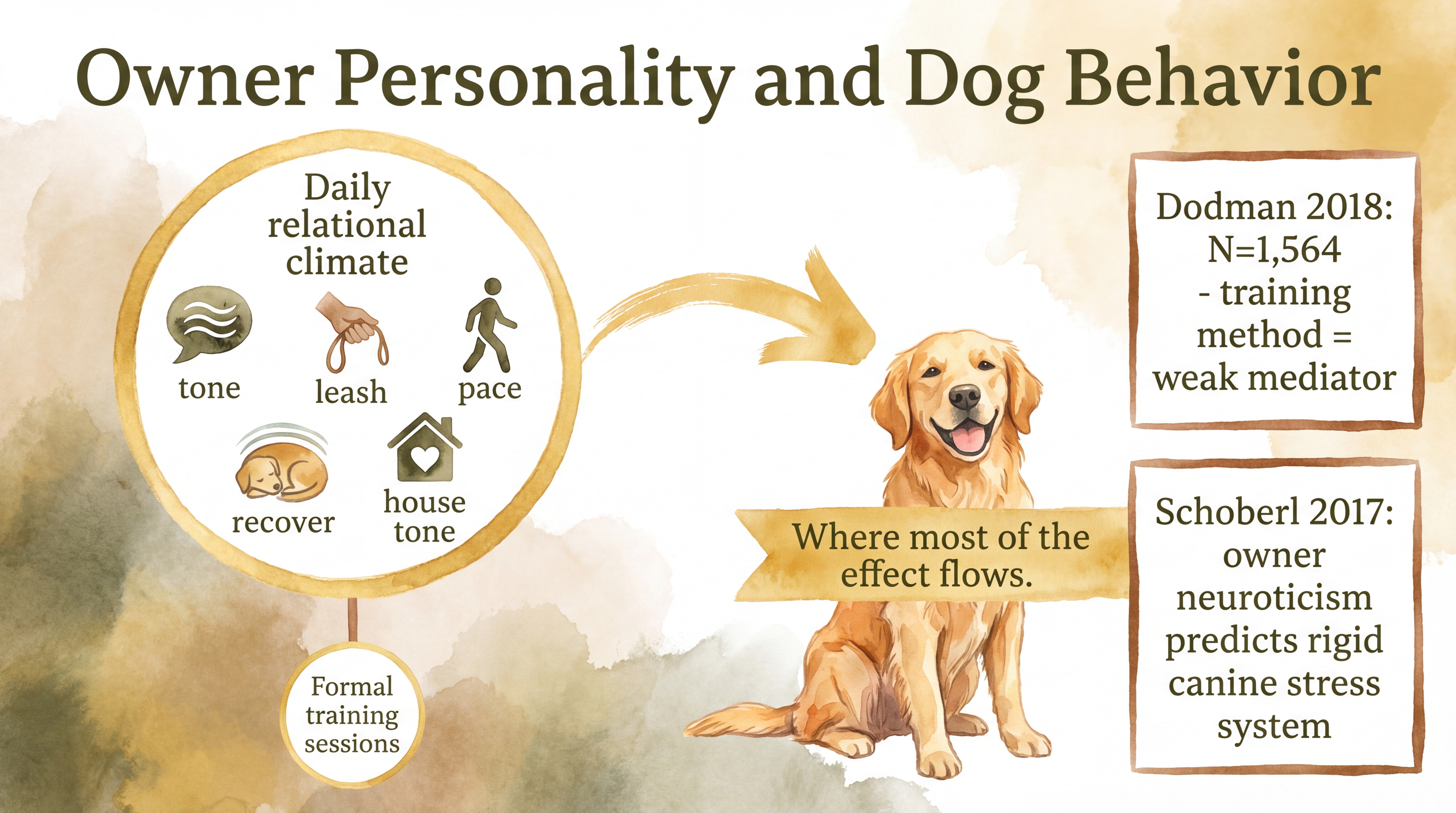
Owner personality traits including neuroticism, conscientiousness, and emotional stability are statistically associated with measurable differences in dog behavior.
Key Takeaways
- Large-scale dog studies show that owner personality predicts behavior-problem scores across multiple domains.
- Most of that influence does not appear to run through formal training sessions alone, but through daily life and relational climate.
- Owner Neuroticism and Agreeableness are also linked to canine stress-system flexibility, which means personality reaches physiology as well as behavior.
- The practical message is not blame. It is that adult calm, steadiness, and consistency are real developmental variables for the dog.
The Evidence
- Dodman, N. H. et al. (2018)domestic dogs and humans
Used 1,564 owner-dog pairs and found that lower owner agreeableness, conscientiousness, extraversion, and emotional stability were associated with higher canine behavior-problem scores, with only weak mediation through training method. - Schoberl, I. et al. (2017)domestic dogs and humans
Found that owner Neuroticism and insecure attachment variables predicted lower canine HPA-axis flexibility, while owner Agreeableness predicted higher flexibility. - Sundman, A.-S. et al. (2019)domestic dogs and humans
Reported long-term cortisol synchronization in dog-human dyads and found that owner personality traits moderated the coupling more strongly than dog personality traits did.
- SCR-059 boundarydomestic dogs and humans
Owner personality and dog outcomes travel together in documented ways, but no controlled intervention has yet shown that therapeutically altering owner traits directly remakes canine physiology or behavior. - SCR-012 boundarydomestic dogs and humans
Owner-to-dog physiological coupling is documented, but not every household outcome can be reduced to one personality variable in isolation.
No published randomized study has shown that changing caregiver personality traits or baseline psychological organization directly improves canine behavior outcomes through a controlled treatment pathway.
SCR References
Sources
- Dodman, N. H., Brown, D. C., & Serpell, J. A. (2018). Associations between owner personality and psychological status and the prevalence of canine behavior problems. PLOS ONE, 13(2), e0192846. https://doi.org/10.1371/journal.pone.0192846
- Schoberl, I., Wedl, M., Bauer, B., Day, J., Mostl, E., & Kotrschal, K. (2017). Effects of owner-dog relationship and owner personality on canine cortisol modulation. PLOS ONE, 12(2), e0170707. https://doi.org/10.1371/journal.pone.0170707
- Sundman, A.-S., Van Poucke, E., Holm, A.-C. S., Faresjo, A., Theodorsson, E., Jensen, P., & Roth, L. S. V. (2019). Long-term stress levels are synchronized in dogs and their owners. Scientific Reports, 9, 7391. https://doi.org/10.1038/s41598-019-43851-x