The Ego Depletion Debate
Families often describe the same experience in almost identical language: "We were calm all day and then by evening we just had nothing left." That subjective experience is real. The scientific question is whether the classic ego-depletion story, a limited willpower resource that gets used up, is the right explanation. At this point, that explanation is contested enough that it should not be treated as settled. Ambiguous
What It Means
The original ego-depletion model was intuitively appealing because it matched lived experience. Self-control felt effortful, later effort often felt harder than earlier effort, and failure seemed to arrive after repeated demands. In puppy life, that story is even more seductive because the day is full of micro-demands: interrupt the jumping again, stay quiet at the door again, resist the urge to overtalk again, notice your own arousal again, follow the bedtime routine again.
For a long time, psychology often described these failures as if people were drawing from a limited internal fuel tank. Observed-JB Use enough self-control in one domain and less remained for the next task. That interpretation was influential because it turned the evening collapse into a neat mechanism. Unfortunately, a neat mechanism is not the same thing as a durable one.
Carter et al. (2015) reanalyzed the evidence base with bias-correction methods and concluded that the depletion effect might be near zero once publication bias was addressed. Documented That alone was enough to put the field on notice. Then Hagger et al. (2016) delivered the larger shock. In a preregistered multilab replication across 23 laboratories with about 2,141 participants, the estimated effect was d = 0.04 and the confidence interval crossed zero. The flagship replication did not support the classic strong version of the theory.
That does not mean the ordinary family experience was imagined. It means the explanation may have been wrong or at least too simple. Inzlicht's revision is useful here because it preserves the reality of failure while changing the underlying machinery. On that account, what shifts over a day is not a literal tank of self-control running dry. What shifts are attention, motivation, reward valuation, and willingness to keep prioritizing effortful regulation.
That reframe maps onto puppy evenings surprisingly well. At 8 a.m. the adults may still value consistency more than comfort. At 8 p.m. rest, emotional relief, and social ease may outrank structure in the internal competition for attention. The dog has not necessarily become harder in any absolute sense. The adult's motivational landscape has changed.
This matters because it changes what problem the family thinks it has. Ambiguous Under the classic depletion story, the implied solution is to become tougher, more stoic, or better at rationing inner fuel. Under the motivational-shift story, the better solution is to redesign the context so that the right response remains easier to choose when the adult is tired. That is a very different kind of intervention.
Dang's 2018 updated meta-analysis is the reason this entry stays ambiguous rather than fully discarded. The paper argued that depletion effects may depend on task features and analytical choices, which means the entire concept has not been cleanly erased from the literature. The safer conclusion is narrower. Strong claims that willpower literally drains like a fuel tank are not on solid consensus ground. More modest claims that self-control failures vary with task architecture and competing motives remain plausible.
That distinction is important for JB because the philosophy does not need a magical willpower theory. It only needs the much more ordinary observation that adults are less consistent when tired, overloaded, embarrassed, or emotionally saturated. That observation is not controversial. The controversial part is the resource metaphor.
Once that metaphor loosens, family shame often loosens with it. The adults did not necessarily fail because they are weak. They may have asked tired, distracted brains to make fresh wise decisions in an environment that still favored the old response. If the leash is not staged, the gate is not closed, the evening routine is undefined, the children are loud, and guests arrive unpredictably, the wrong response is not only emotionally tempting. It is structurally easier.
The entry also needs a second boundary. Rejecting a strong ego-depletion claim does not mean that effort is irrelevant or that every difficult moment can be solved by better furniture placement. Some moments really do require deliberate restraint and recovery. The point is proportionality. The family should not build a raising system that depends on winning dozens of fresh effort battles every day when behavior-change science keeps suggesting that routines and defaults carry more of the load.
This is why the notebook frames the evening collapse as predictable rather than shameful. Predictability is leverage. If evenings are a known weak point, then the solution is advance design: fewer decisions after dinner, simpler scripts, less verbal density, fewer exciting transitions, and more already-decided responses. That is not coddling. It is good engineering.
An everyday analogy is trying to eat well at 10 p.m. after grocery shopping was skipped, the house is full of snacks, and no dinner plan exists. The later lapse feels like weak character because it happens in a body already wanting relief. In practice, the larger failure happened earlier when the environment was left to chance. Puppy evenings often work the same way.
Why It Matters for Your Dog
For the dog, this debate matters because adult inconsistency has behavioral consequences whether the cause is a depleted resource or a motivational shift. Ambiguous The dog experiences the outcome, not the theory. If greetings are structured in the morning and permissive at night, the dog is learning from a split environment that is harder to read and easier to test.
The debate also protects families from adopting the wrong emotional posture. A household that believes it simply "ran out of willpower" may resign itself to inevitable evening chaos. A household that understands evenings as a predictable design problem is much more likely to put friction in front of the bad pattern and support under the good one.
Calmness becomes more realistic when the family stops treating evening regulation as a heroic act and starts treating it as an engineered condition. The goal is not tougher adults. The goal is fewer moments that require adult heroics.
That shift matters because the dog needs the Pillars most when the adults are least naturally inclined to deliver them. Fatigue, time pressure, and emotional saturation are exactly when structure tends to soften and arousal tends to spread. A good family system anticipates that vulnerability instead of pretending it will not happen.
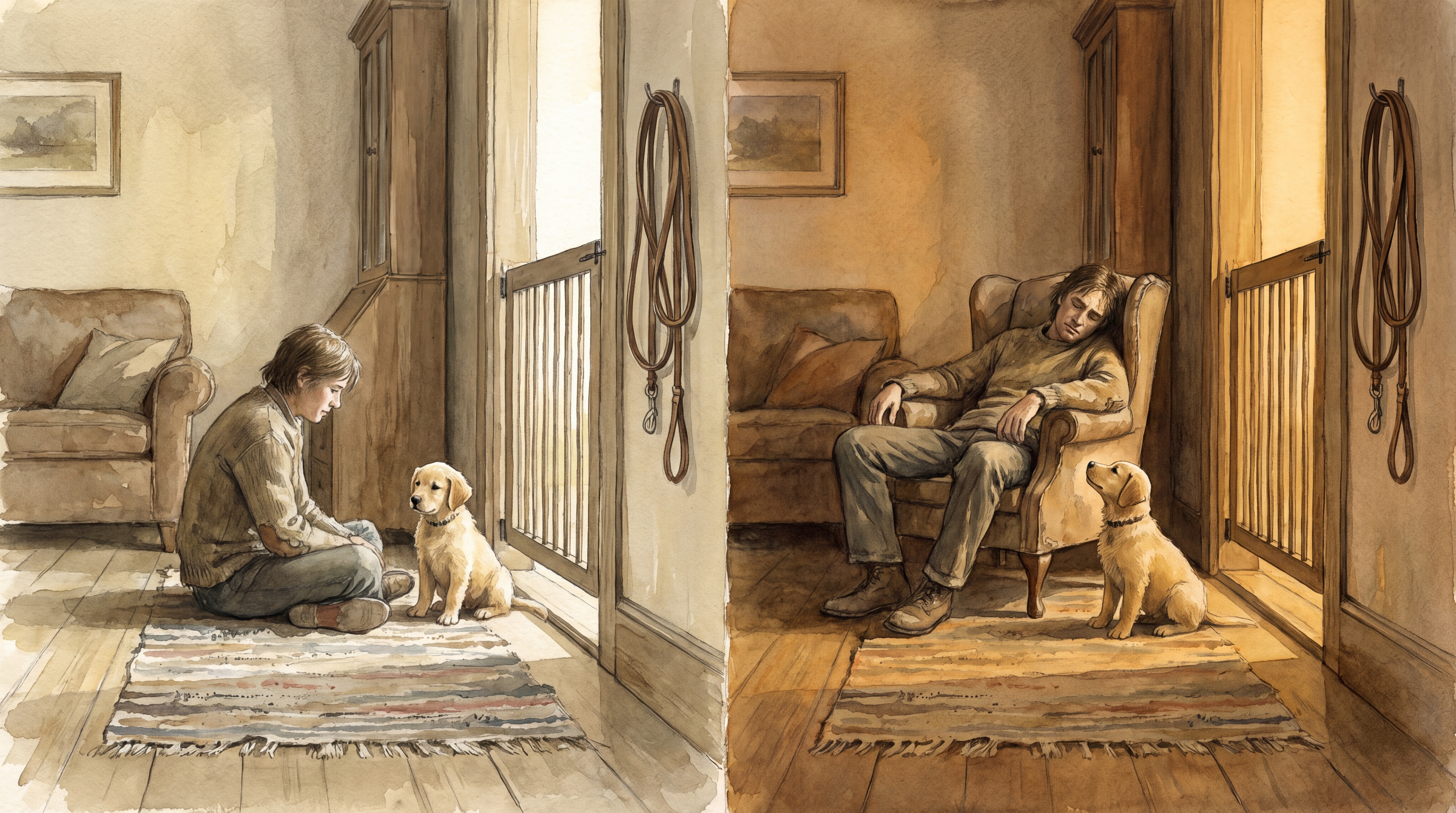
The evening collapse families describe is real, but the classic willpower-tank explanation is contested. The better response is environmental design, not tougher resolve.
Key Takeaways
- The evening collapse families describe is real, but the classic strong version of ego depletion as an emptying willpower tank is scientifically contested.
- Large meta-analytic and multilab work weakened the original depletion story, while motivational-shift accounts offer a more plausible practical explanation.
- The safest operational lesson is to design puppy routines so the right response does not depend on repeated heroic effort, especially late in the day.
- Families should treat tired inconsistency as an engineering problem to solve, not as proof of weak character or lack of love.
The Evidence
This entry uses observed claim-level tags beyond the dedicated EvidenceBlocks below. These tags mark JB program observation or practice-derived claims that need dedicated EvidenceBlock coverage in a later content pass.
- Carter, E. C. et al. (2015)humans
Bias-corrected meta-analytic tests suggested that the depletion effect may be near zero after publication-bias adjustment. - Hagger, M. S. et al. (2016)humans
A preregistered 23-lab replication with about 2,141 participants estimated a depletion effect of d = 0.04 with a confidence interval crossing zero.
- Inzlicht, M. (2012)humans
Proposed that apparent depletion is better explained by shifts in motivation and attention than by a limited-resource tank model. - Dang, J. (2018)humans
Updated meta-analytic work argued that depletion effects may depend on task characteristics, preserving ambiguity around the broader concept.
- SCR-250 related anchorhuman-dog household context
Even if the exact willpower mechanism is disputed, a dog-family plan should still be judged by whether tired real households can sustain it. - SCR-020 related anchormultiple mammals
Predictable environments and learned controllability remain a stronger practical framing for resilience than assuming adults should simply overpower every vulnerable moment by force of will.
No published study has directly tested whether puppy-family evening routines improve more when framed through motivational-shift and environmental-design strategies than when framed through classic willpower language.
SCR References
Sources
- Carter, E. C., Kofler, L. M., Forster, D. E., & McCullough, M. E. (2015). A series of meta-analytic tests of the depletion effect: Self-control does not seem to rely on a limited resource. Journal of Experimental Psychology: General, 144(4), 796-815.
- Dang, J. (2018). An updated meta-analysis of the ego depletion effect. Psychological Research, 82(4). https://doi.org/10.1007/s00426-017-0862-x
- Hagger, M. S., et al. (2016). A multilab preregistered replication of the ego-depletion effect. Perspectives on Psychological Science, 11(4), 546-573. https://doi.org/10.1177/1745691616652873
- Inzlicht, M. (2012). What is ego depletion? Toward a mechanistic revision of the resource model of self-control. Perspectives on Psychological Science, 7(5), 450-463. https://doi.org/10.1177/1745691612454134