Relapse Prevention and the Evening Collapse
The family who slips for one night and the family who abandons the whole plan are not experiencing the same event. Relapse-prevention science exists because behavior change is rarely a straight line, and because the interpretation of a lapse often matters more than the lapse itself. That science is documented in humans. The dog-family extension is bounded, but it is hard to ignore because adult instability has consequences for the dog too. Mixed Evidence
What It Means
Marlatt's relapse-prevention model changed the tone of behavior-change work by insisting that relapse is a process rather than a moral collapse. Documented People do not usually go from perfect consistency to permanent failure in one leap. They move through high-risk situations, coping breakdowns, and interpretive mistakes that make one lapse more likely to become a pattern.
The most relevant piece for puppy households is the Abstinence Violation Effect, or AVE. This is the tendency to interpret one slip as proof that the whole effort has failed. A family has one chaotic visitor evening, shouts too much at the door, abandons the threshold pause, lets the dog rehearse everything they have been trying to reduce, and then concludes, "We cannot do this anyway." The practical damage often comes less from the bad evening than from the story told afterward.
That insight matters because puppy households live in frequent high-risk conditions. Documented Evenings are dense. Children are tired. Adults are tired. Guests arrive. Work spills over. Weather narrows exercise options. The puppy may be entering the most activated portion of the day. In other words, the risk context is built into normal family life. A plan that treats lapses as extraordinary failures will produce unnecessary collapse.
Kwasnicka's review helps by separating initiation from maintenance. The drivers that help people begin a new behavior are not always the same drivers that help them continue it months later. Early motivation decays. What takes over are satisfaction, identity integration, environmental support, and a sense that the new behavior still fits real life. That maps cleanly onto families who begin enthusiastically and then struggle once novelty fades.
The practical implication is that relapse prevention should be designed in advance, not invented after the first bad week. Families need a reset script before they need recovery. What happens after a chaotic reunion, a guest disaster, a week of work stress, or a regression in adolescence? If the answer has not been decided, the old pattern usually returns because it is already more available.
A reset script can be surprisingly modest. For one day, reduce goals to calm greetings, quiet meals, and one clean bedtime sequence. Re-stage the leash and the gate. Re-establish the threshold pause. Drop unnecessary verbal commentary. Use the mat again at arrivals. The aim is not to compensate with a bigger emotional speech. The aim is to rebuild cue structure fast enough that the lapse does not become a new routine.
This is one place where habit science and relapse science meet. Habits become easier with repetition, but older patterns also remain available, especially under stress. That means families do not need to panic when a previous reactive style resurfaces. They need to notice it early and deliberately re-strengthen the newer sequence before the old one recaptures too much ground.
There is also a physiological reason this matters. The coupling literature in Category 12 suggests that long-term regulatory influence in the dyad runs more from human to dog than the reverse. Documented That does not mean one rough night biologically imprints the dog forever. It does mean adult stress and disorganization are not private events. They alter the environment the dog is living inside, which makes recovery more urgent and more meaningful.
This is why the notebook calls relapse prevention a kind of physiological protection. When adult structure decays during stress, the dog often needs the Pillars more, not less. The family tends to feel least capable of offering them at precisely that moment. A pre-planned reset protects the dog from having to absorb a prolonged stretch of human drift just because the adults had one hard week.
The second boundary is important. Relapse-prevention science in humans does not prove that every puppy-family lapse follows the same mechanism or that AVE explains every rough period. Documented-Cross-Species It also does not mean adults should become casual about inconsistency. The point is not leniency. The point is accuracy. Shame-driven overinterpretation is often a worse recovery strategy than honest fast correction.
A family that understands this stops asking, "How do we make sure we never slip?" and starts asking, "What will we do the day after we slip?" That is a more mature question, and it fits how real behavior change works.
An everyday analogy is a car that skids on a wet road. The decisive factor is often not the first loss of traction. It is whether the driver overcorrects, freezes, or calmly regains the lane. Puppy lapses work the same way. Recovery skill often determines whether a rough moment stays rough or becomes a new direction.
Why It Matters for Your Dog
For the dog, relapse prevention reduces adult volatility. Instead of living under long swings between ideal structure and complete drift, the dog experiences shorter, more repairable disruptions. That matters because predictability is easier to regulate inside than inconsistency that lingers for weeks.
It also changes how families feel about themselves, which is not a side issue. Adults who see a lapse as recoverable are less likely to flood the dog with frustrated energy, panic, or hopelessness. That emotional steadiness is itself part of the intervention because the dog is living inside the adult's state as well as their overt actions.
Calmness includes how a family recovers from its own mistakes. A house is not calm because nothing goes wrong. It is calm when wrong turns do not spiral into prolonged dysregulation.
The dog benefits because a recoverable household teaches resilience better than a perfectionistic one. Repair is part of structure too.
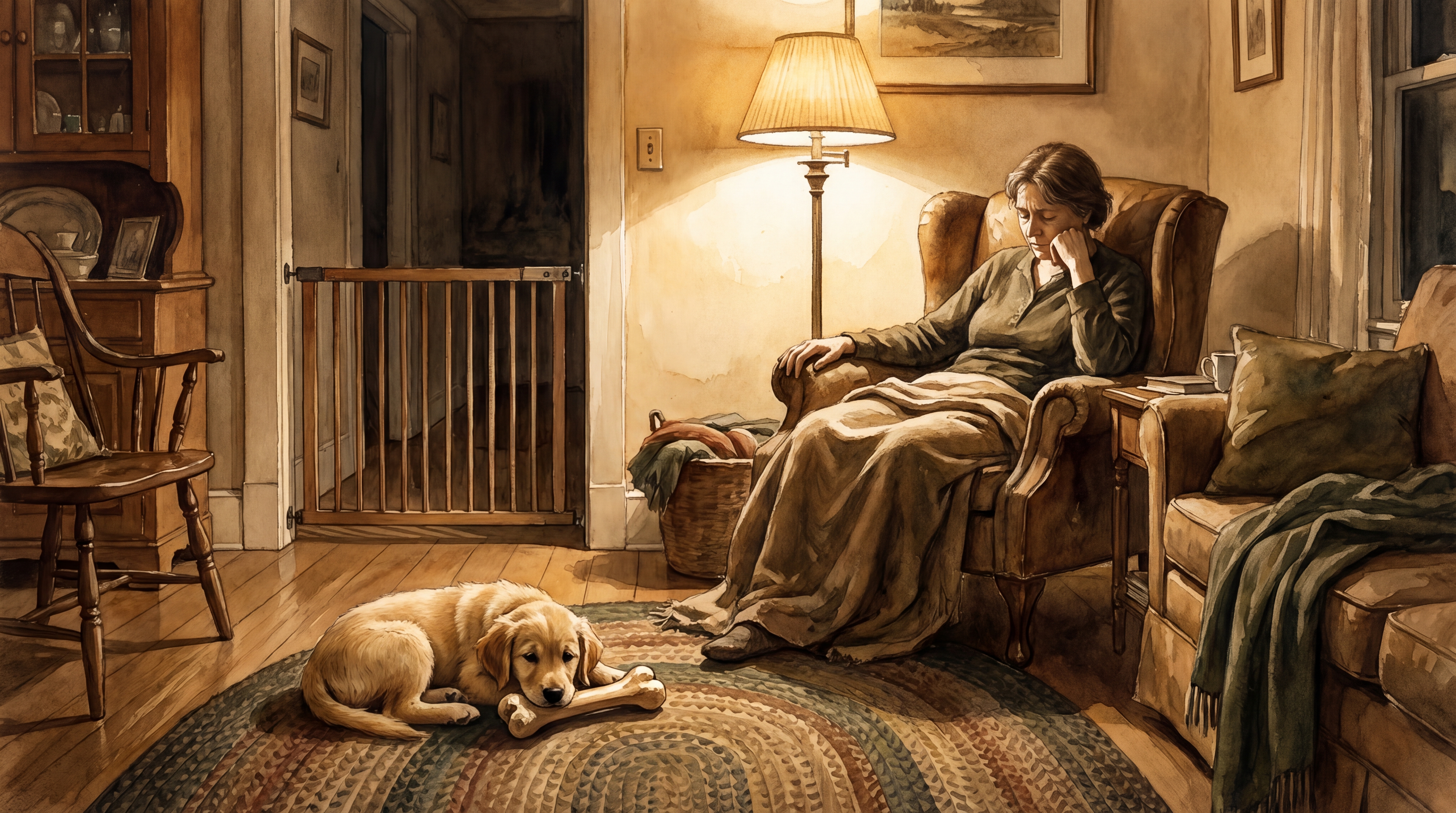
Lapses are predictable, not catastrophic. Relapse-prevention science teaches families to plan recovery into the system instead of treating every slip as proof of failure.
Key Takeaways
- Relapse-prevention science treats lapses as expected events in long-term change, not as proof that the whole effort has failed.
- The Abstinence Violation Effect matters in puppy homes because one chaotic evening is often followed by a hopeless story that does more damage than the lapse itself.
- Maintenance depends on identity, satisfaction, and environmental support, which is why reset scripts should be designed before they are needed.
- Fast calm recovery protects the dog because adult stress and disorganization are part of the dog\u0027s lived environment, not private human events.
The Evidence
This entry uses documented cross-species claim-level tags beyond the dedicated EvidenceBlocks below. Species and application scope should be checked during the next evidence-chain authoring pass.
This entry uses mixed-evidence claim-level tags beyond the dedicated EvidenceBlocks below. These tags mark claims that combine documented findings with observed practice, heuristic application, or unresolved gaps.
- Marlatt, G. A. (1984)humans
Defined relapse as a process with identifiable triggers and highlighted the Abstinence Violation Effect, in which one lapse is misread as total failure. - Kwasnicka, D. et al. (2016)humans
Systematic review showed that maintaining behavior change relies on different drivers than initiating it, especially identity integration, satisfaction, and environmental support.
- SCR-105 synthesisdomestic dogs and humans
The strongest long-term physiological coupling evidence suggests that influence in the dyad is weighted from human to dog, which supports taking adult relapse seriously as a dog-environment event.
- SCR-250 related anchorhuman-dog household context
A realistic puppy plan has to include recovery architecture because household sustainability is part of intervention quality. - SCR-105 boundarydomestic dogs and humans
Adult dysregulation matters to the dog, but the current physiology literature does not prove that every short family lapse produces a measurable canine physiological shift.
No published study has directly tested whether dog families given formal relapse-prevention coaching maintain calm routines longer or recover faster after setbacks than families given ordinary puppy advice.
SCR References
Sources
- Kwasnicka, D. (2016). Theoretical explanations for maintenance of behaviour change: A systematic review of behaviour theories. Health Psychology Review, 10(3). https://doi.org/10.1080/17437199.2016.1151372
- Marlatt, G. A. (1984). Relapse prevention: Introduction and overview of the model. British Journal of Addiction, 79(3), 261-273.