Environmental Design -- Making Calm the Default
The family that succeeds with the Pillars is usually not the family with the strongest burst of motivation. It is the family whose house, routines, and prompts make the calm structured response easier to perform than the excited reactive one. That principle is well documented in human behavior-change science. The direct dog-family application is interpretive, but it is one of the most immediately useful interpretations in this entire category. Mixed Evidence
What It Means
Environmental design starts from an unglamorous premise. People often fail to do what they endorse not because the value is wrong, but because the environment keeps favoring the old sequence. Puppy households are full of such traps. The leash is in the wrong room. Guests arrive before a gate is closed. Toys that predict frenzy are left in communal spaces. There is no designated handler during arrivals. The crate is set up in a high-traffic zone that makes settling harder. Every one of those details changes what the adult is most likely to do under pressure.
Fogg's Behavior Model gives a clean starting frame: behavior depends on motivation, ability, and prompt. Documented Families routinely over-focus on motivation. They try to want calm more intensely. The model suggests a different question. Is the calm, structured response actually easier to perform than the reactive one at the moment the prompt appears? If the answer is no, the house is still biased against the stated philosophy.
That is why staging matters. A leash hanging by the exact exit where it is needed does not merely save time. It increases ability at the moment of cue. A gate closed before guests arrive is not only management. It removes the need for a live wrestling match with the environment. A quiet sleep space is not only a comfort choice. It supports the default possibility of recovery instead of building arousal into the architecture. Mixed Evidence
Default-effect research makes the same point at scale. Documented Jachimowicz's meta-analysis of 58 studies with a pooled sample near 73,675 found a substantial default effect, around d = 0.68. People often follow the path the environment quietly marks as normal. In a puppy household, that means the default matters more than the lecture. If the home is arranged so that greetings begin only after the adult reaches a station spot, calm becomes easier. If the default is direct chaotic entry with no staging, reactivity remains the path of least resistance.
Michie's COM-B model expands the frame in a way that is especially useful for families who think they have a motivation problem. Behavior depends on capability, opportunity, and motivation. Documented Many puppy-household failures are really capability or opportunity failures wearing the mask of weak commitment. The adults may know exactly what they intend. They may still not have the physical layout, time buffers, gear placement, or shared household agreement needed to enact it.
This is one reason JB often feels more realistic than methods that rely on perfect timing in emotionally hot moments. The philosophy is not only a list of responses. It is a way of arranging life so the desired response begins earlier. Guests are managed before they enter. Toys are chosen before frenzy erupts. Sleep conditions are protected before dysregulation blooms. Threshold pauses are embedded into arrival architecture rather than performed as a last-second rescue.
Environmental design also explains why prevention is often more compassionate than correction. A family that pre-installs a gate, removes the highest-arousal toy from the busiest room, and has one adult handle arrivals is not being cold or mechanical. It is reducing the number of moments in which the dog and the adult have to fail each other live. Good design makes conflict less necessary.
There is also a deep link to controllability science. Predictable, well-structured environments are easier for organisms to navigate without helplessness or frantic trial-and-error. The human behavior-change literature and the controllability literature converge here more than they first appear to. A house with readable routines, accessible tools, and low-friction calm sequences helps the adult stay organized and helps the dog experience the world as less chaotic.
The most practical examples are almost boring, which is a sign that the concept is working. A leash by the door. A mat already positioned where guests will enter. High-value chew options prepared before the evening witching hour. A designated puppy-safe rest area. Family agreement that one person handles reunion and the others ignore the dog until the first calm beat appears. None of this sounds heroic. That is the point. Good defaults reduce the need for heroics.
A second distinction matters. Environmental design is not the same as emotional distance. Families sometimes hear "make calm the default" and picture a sterile house with no delight in it. That is not what the evidence suggests. The goal is warm clarity, not cold control. Joy remains welcome. What changes is whether the house rewards impulsive escalation as its ordinary baseline.
The evidence boundary is straightforward. Default effects, B = MAP, and COM-B are human behavior frameworks. They do not prove that every specific household design element in JB has been experimentally validated in dog-family trials. What they do show, clearly, is that human follow-through improves when the desired action is made easier, clearer, and more available at the moment of need. Since the family behavior being engineered is human behavior, the bridge is strong even while still inferential.
An everyday analogy is a well-designed kitchen. A person who wants to cook at home is more likely to do it when the tools are visible, the ingredients are accessible, and the counters are usable. The same person is less likely to cook when every step requires searching, moving clutter, and improvising. Puppy calmness works similarly. A home can either help the right sequence happen or quietly sabotage it.
Why It Matters for Your Dog
For the dog, environmental design changes the emotional climate long before a formal lesson begins. A house that is set up for calmer arrivals, cleaner exits, quieter sleep, and fewer surprise escalations is a house the dog can read more easily. That readability itself is a relationship gift.
It also prevents adults from needing to correct as much. The more the environment quietly blocks the most predictable mistakes, the less often the dog is asked to live through human inconsistency followed by frustrated repair. In that sense, good design is one of the kindest forms of leadership.
Making calm the default is Prevention expressed through architecture. The best time to improve a difficult moment is often ten minutes earlier, when the room, tools, and roles can still be arranged before arousal arrives.
The practical implication is simple. Families should stop asking whether they are motivated enough and start asking whether the home is helping them. If the answer is no, the next improvement is usually not a stronger pep talk. It is a better setup.
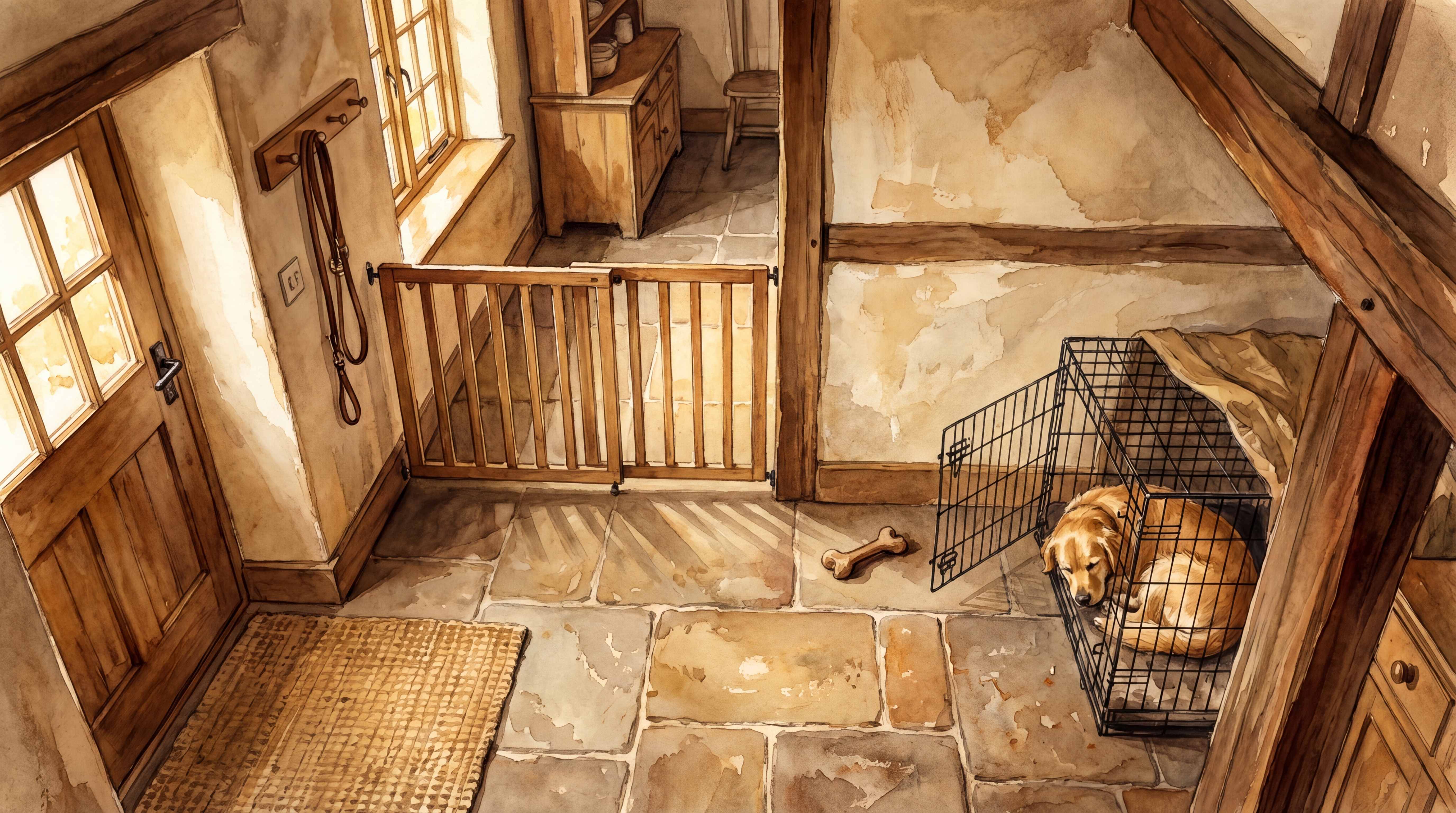
A well-designed home makes the calm structured response easier than the reactive one, reducing the number of moments that depend on heroic adult effort.
Key Takeaways
- Behavior-change science repeatedly shows that defaults and friction matter, which means household setup often predicts follow-through better than motivation alone.
- A dog-family home can be arranged so that calm greetings, structured exits, and quieter evenings are easier to deliver under stress.
- Many family failures are really capability or opportunity failures, not proof that the adults do not care enough.
- Environmental design is not emotional coldness. It is warm structure that reduces the number of moments requiring live rescue or frustrated correction.
The Evidence
This entry uses mixed-evidence claim-level tags beyond the dedicated EvidenceBlocks below. These tags mark claims that combine documented findings with observed practice, heuristic application, or unresolved gaps.
- Fogg, B. J. (2009)humans
Behavior Model argued that behavior depends on motivation, ability, and prompts, highlighting the practical importance of reducing friction. - Jachimowicz, J. M. et al. (2019)humans
Meta-analyzed 58 default-effect studies with a pooled sample near 73,675 and found a substantial overall default effect around d = 0.68.
- Michie, S. et al. (2011)humans
COM-B framework showed that capability, opportunity, and motivation jointly shape behavior, cautioning against treating all nonadherence as weak desire.
- SCR-250 related anchorhuman-dog household context
A raising plan is only as useful as its real-world sustainability, which is why household architecture matters alongside philosophy. - SCR-020 related anchormultiple mammals
Predictable environments support learned controllability, making the general JB emphasis on readable structure biologically coherent even though individual home-design elements have not all been trialed directly.
No published intervention study has directly compared ordinary puppy advice with a fully engineered JB-style household design package measuring calm greeting rates, verbal reduction, or long-term adherence over the first months at home.
SCR References
Sources
- Fogg, B. J. (2009). A behavior model for persuasive design. Proceedings of Persuasive '09. https://doi.org/10.1145/1541948.1541999
- Jachimowicz, J. M. (2019). When and why defaults influence decisions: A meta-analysis of default effects. Behavioural Public Policy, 3(2), 159-186. https://doi.org/10.1017/bpp.2018.43
- Michie, S., van Stralen, M. M., & West, R. (2011). The behaviour change wheel: A new method for characterising and designing behaviour change interventions. Implementation Science, 6, 42. https://doi.org/10.1186/1748-5908-6-42