Habit Formation -- The Real Timeline
One of the most quietly damaging myths in puppy raising is that a family should be able to decide on a better way of living with the dog and then simply start doing it immediately. Habit-formation science says otherwise. The underlying human mechanism is well documented. The application to families raising dogs is the bounded but highly practical extension. Mixed Evidence
What It Means
The Five Pillars ask adults to change default behavior, not just adopt a few opinions. Documented Calm greetings, fewer repeated cues, more spatial clarity, more prevention, less emotional flooding, and steadier evening routines are all examples of repeated daily actions that must become automatic if they are going to survive ordinary family life. That makes habit science directly relevant.
Lally et al. (2010) remains the best-known modern automaticity study for a reason. Documented Adults chose a simple daily behavior and repeated it in a stable context over twelve weeks while researchers tracked the growth of automaticity through the Self-Report Habit Index. The headline number, a median of 66 days to reach 95 percent of asymptotic automaticity, matters. The more important detail is that the distribution was wide, with an interquartile range of 39 to 102 days and an observed range of 18 to 254 days. That is not a motivational slogan. It is a warning against false expectations.
The behavior itself changed the timeline. Drinking water with lunch automated much faster than doing fifty sit-ups after morning coffee. That matters for dog families because "stay calm when the puppy jumps on guests" is behaviorally closer to a complex, emotionally loaded routine than to drinking water at lunch. It depends on timing, restraint, body control, and the ability to act against impulse while the room is socially busy. Families should expect that kind of change to sit on the slower end of the spectrum.
Lally's single-missed-day finding is just as important as the median. One lapse did not meaningfully break the trajectory. That is a crucial corrective to perfectionism. The science does not support the idea that one rough evening destroys progress. What does disrupt automaticity is instability over time, not one imperfect repetition. In dog-family language, the household does not need saintly purity. It needs enough repetition in the same direction that the desired response stops requiring fresh deliberation every time.
Fournier et al. (2017) sharpens the timing issue further. Documented In that work, morning stretching habits took a mean of 106 days to automate, and evening routines took 154 days. The contrast matters because evenings are where many puppy households fail. By then people are tired, the dog is often activated, transitions are dense, and motivation has shifted toward rest. If evening routines take longer to automatize in ordinary health behavior, it is reasonable to expect that calm, structured puppy-evening routines will also require patience rather than quick self-judgment.
Van der Weiden's longitudinal work helps explain why some families make the change faster than others. The strongest predictor of automaticity growth was not heroic self-control or personality alone. It was repetition in stable contexts. Gardner's review reaches the same practical point from another angle. Habits are cue contingent. They attach to the same doorway, the same kitchen threshold, the same leash hook, the same arrival sequence. If the cue structure changes constantly, the habit has no reliable place to attach.
That is why the small details in JB matter. A repeatable threshold pause, leash location, guest setup, and bedtime sequence are how the brain gets enough cue-response pairings to stop improvising.
Wood and Runger's review adds another necessary correction to family shame. Documented People with high trait self-control do not primarily win by grinding harder in moments of temptation. They win by relying on habits and environmental arrangements that reduce the number of hard moments requiring conscious suppression. The disciplined person is often the person with the better life architecture, not the person with the more punishing inner monologue.
Most families initially interpret inconsistency as a character flaw. Habit science offers a less accusatory answer. The response is still under effortful control, the cues are not yet stable enough, and the household has not repeated the sequence often enough for automaticity to take over. Early adherence to the Pillars is skill acquisition under cognitive load, not a referendum on love or commitment.
A second boundary matters here. Human habit-formation data does not prove that a dog household will follow the exact same numerical curve. The documented claim is about human automaticity. The heuristic extension is that families living with puppies are human beings, and the Pillar-consistent patterns they must adopt are human behaviors. That extension is strong enough to guide practice, but it is still an extension.
Once that distinction is kept clean, the practical message becomes reassuring rather than discouraging. If the median human habit takes weeks to months, then a family who is still working to make calm greetings, clear exits, and quiet evenings feel natural after ten days is not failing. They are behaving exactly like the literature says humans behave when building real habits.
An everyday analogy is learning to drive a manual transmission. At first every start, shift, and stop requires conscious attention. The person is not weak because the sequence feels awkward. The nervous system is still paying full price for the task. After enough repetitions in the same contexts, the sequence compresses. Good dog raising asks for the same kind of compression in the adult.
Why It Matters for Your Dog
For the dog, the difference between a family intention and a family habit is enormous. Dogs live inside the adult's repeated pattern, not inside the adult's preferred story about the pattern. If the home is calm only when everyone remembers to try, then the dog experiences calm as a mood-dependent event. If the home reliably pauses at doors, greets quietly, and settles consistently after stimulation, the dog experiences those things as the shape of reality.
That distinction also protects families from one of the biggest relationship mistakes, which is rushing the timeline and then abandoning the process. When adults expect instant naturalness, they interpret the normal awkward phase as proof that the method does not fit their family. The literature suggests a different interpretation. The awkward phase is the method becoming expensive before it becomes easy.
Prevention depends on household habits, not occasional good intentions. If adults do not make the preventive response automatic, the old reactive response will keep winning in real life because it is cheaper and more practiced.
This is why JB places so much weight on repeatable routines instead of dramatic one-off interventions. A routine can become automatic. A speech, an emotional promise, or a burst of motivation usually cannot. Families help the dog most when they stop asking, "Did we mean well?" and start asking, "What did we repeat often enough to become normal?"
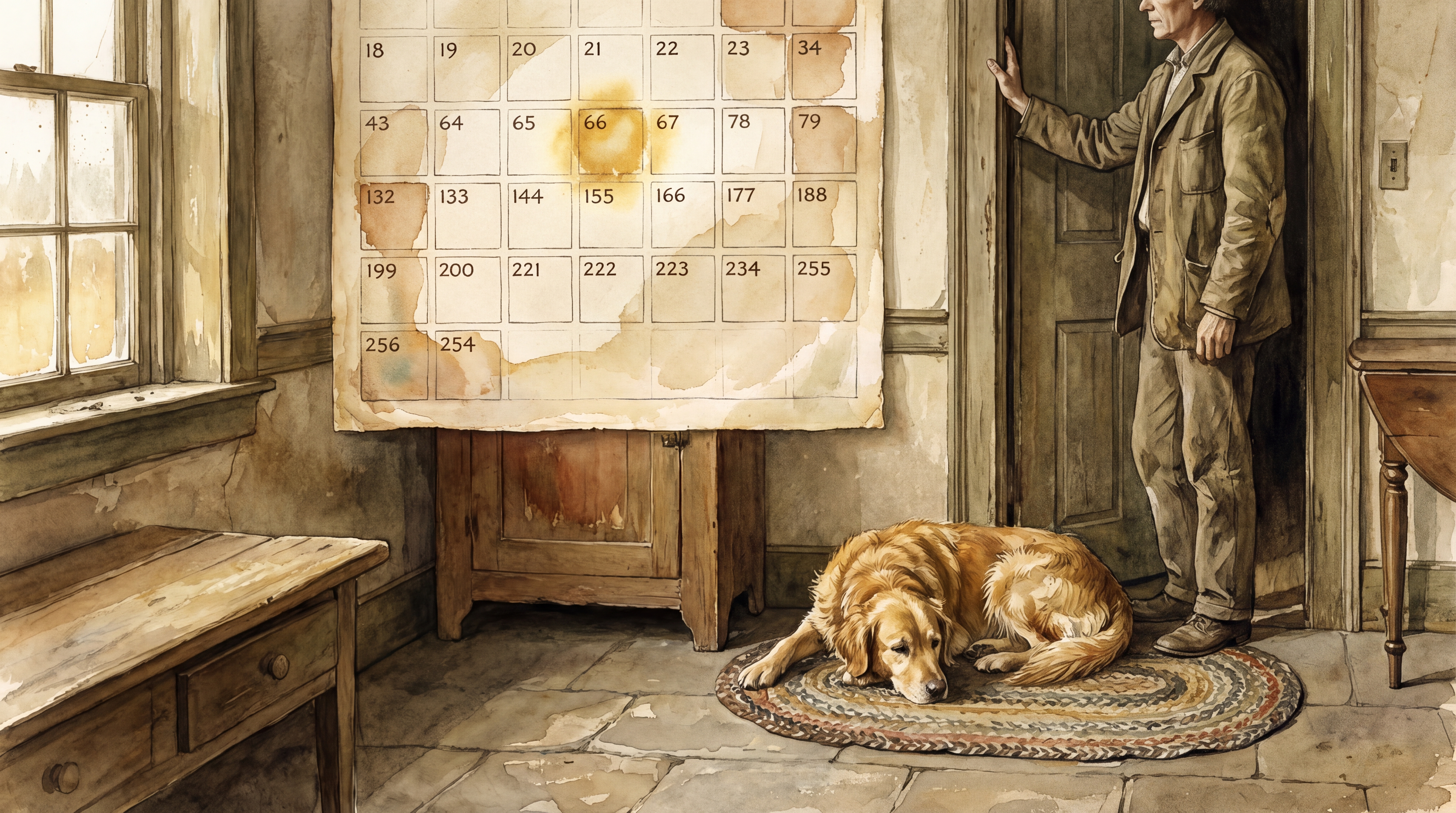
Habit formation takes a median of 66 days with wide individual variation, meaning families should plan for months of deliberate practice rather than expecting quick automation.
Key Takeaways
- Human habit formation takes weeks to months, not days, and the best-known automaticity study found a median of 66 days with a very wide real-world range.
- Complex emotionally loaded routines, like calm responses to puppy arousal, should be expected to automate more slowly than simple health habits.
- Stable context cues matter more than white-knuckled effort because habits attach to repeated places, sequences, and prompts.
- Families should read the early awkward phase of the Pillars as normal skill acquisition under cognitive load, not as evidence that the approach is failing.
The Evidence
This entry uses mixed-evidence claim-level tags beyond the dedicated EvidenceBlocks below. These tags mark claims that combine documented findings with observed practice, heuristic application, or unresolved gaps.
- Lally, P. et al. (2010)humans
Found a median of 66 days to reach near-asymptotic automaticity, with an interquartile range of 39 to 102 days and a full observed range of 18 to 254 days. - Fournier, M. et al. (2017)humans
Found that morning stretching habits took a mean of 106 days to automate and evening routines took 154 days, showing that context and behavior type extend timelines.
- van der Weiden, A. (2020)humans
Reported that repetition in stable contexts was the strongest predictor of automaticity growth in longitudinal habit formation. - Gardner, B. (2015)humans
Reviewed health-behavior habit research and emphasized cue stability as central to habit expression. - Wood, W., and Runger, D. (2016)humans
Argued that effective self-control is often expressed through habits and environmental design rather than constant effortful inhibition.
- SCR-023 related anchormultiple mammals, direct evidence in rats and macaques
Rehearsed behaviors become more automatic and more resistant to modification with repetition, which is consistent with JB emphasis on not rehearsing unwanted human and dog routines. - SCR-250 related anchorhuman-dog household context
A plan should be judged partly by whether ordinary families can realistically sustain it, not only by whether it sounds correct in theory.
No published dog-owner study has directly measured how long it takes families to automatize specific Pillar-consistent routines such as calm greetings, reduced verbal flooding, or threshold pauses after bringing a puppy home.
SCR References
Sources
- Fournier, M., d'Arripe-Longueville, F., Rovere, C., et al. (2017). Effects of circadian cortisol on the development of a health habit. Health Psychology, 36(11), 1059-1064. https://doi.org/10.1037/hea0000510
- Gardner, B. (2015). A review and analysis of the use of habit in understanding, predicting and influencing health-related behaviour. BMC Public Health, 15, 1540. https://doi.org/10.1186/s12889-015-1540-2
- Lally, P., van Jaarsveld, C. H., Potts, H. W., & Wardle, J. (2010). How are habits formed: Modelling habit formation in the real world. European Journal of Social Psychology, 40(6), 998-1009. https://doi.org/10.1002/ejsp.674
- van der Weiden, A. (2020). Habit formation and personality: A longitudinal study. Frontiers in Psychology, 11, 560. https://doi.org/10.3389/fpsyg.2020.00560
- Wood, W., & Runger, D. (2016). Psychology of habit. Annual Review of Psychology, 67, 289-314.