The Dominance Retirement
Compound evidence detail1 SCR / 2 parts
- Documentedthe wolf-side scientific record on the dominance model - Schenkel 1947 captive-pack methodology limitations, Mech 1999 wild-pack family-unit field data, and the AVSAB 2008 position statement against dominance-based training
- Heuristicthe JB application transferring the wolf family-unit framing to the dog-human relational architecture, an interpretive bridge that Mech's wolf data does not directly test in training contexts
The dominance model did not disappear because dog culture became softer. It lost explanatory power because the science underneath it weakened while attachment-based and welfare-based frameworks got stronger. In the dog-human bond, the retirement of dominance matters because it changes the relationship from rivalry to caregiving. Documented
What It Means
The most important distinction is between a corrected wolf story and a corrected relationship story. Mech clarified that wild wolf packs are usually family units rather than endless rank contests among unrelated adults. That did not automatically prove anything about human households, but it removed one of the main biological stories the alpha model had leaned on.
The historical correction matters most when the sequence is kept straight. The popular alpha model drew force from a captivity-based wolf story, then spread into household dog culture as if family dogs were waiting to contest rank. Those early wolf observations often came from artificial groups of unrelated adults confined together in limited space, a setup that makes overt conflict and status sorting more likely. Mech's Ellesmere Island field observations looked at free-living packs in a very different ecology and found something much more ordinary: a breeding pair moving with offspring of different ages, coordinating travel, hunting, and care as a family unit. In that setting, the old alpha label starts to look more like parental status than like a constant struggle for political control.
That does not erase all asymmetry. Wolves and dogs can still show patterned status relationships, deference, and access differences. What it erases is the jump from canid asymmetry to the claim that ordinary human-dog friction is best understood as a rank battle. Once that jump fails, jumping on guests, guarding food, pulling on leash, or adolescent pushback stop looking like miniature coups and start looking like behavior problems with more ordinary causes. Documented
The dog-human relationship then shifted further through institutional consensus. Modern veterinary and professional organizations moved away from dominance-based training explanations and toward humane, relationship-centered guidance. The significance of that shift is not only methodological. It is relational. The human stops being framed as a rival whose job is to win status and starts being framed as the secure, organizing adult in the bond.
That institutional shift also had a welfare logic behind it. AVSAB guidance specifically warns that dominance-oriented interpretations tend to pull families toward coercion, forced submission, and other needlessly confrontational methods. ACVB referral guidance makes the same practical point from the clinical side by telling veterinarians to avoid trainers who preach alpha maneuvers and submission rituals. The retirement of dominance was therefore not only a debate about words. It was a correction aimed at what families were actually being told to do.
The timeline here is broader than one paper. Mech's wolf correction is historically important, and Bradshaw later argued directly that dominance had become a bad explanatory habit in companion-dog work. Their point was not that social asymmetry never exists. It was that the term had been stretched far beyond its useful range and then used to explain everything from jumping to recall problems to human-directed tension. In companion dogs, where humans control food, movement, resting places, and routine to an extraordinary degree, rank language usually explains less than people think it does.
By the 2020s, AVSAB, ACVB guidance for veterinarians, and APDT were all pointing in the same direction. That matters because it shows dominance retirement was not a cultural mood swing. It was a narrowing scientific claim that kept losing explanatory ground until professional guidance stopped treating it as a useful household framework.
The dog-human context itself also weakens dominance as a master explanation. In a household, the person already controls food, space, schedules, doors, transport, and access to most meaningful resources. The asymmetry is built in. The dog does not need to be "beaten" into lower rank for the adult to occupy the organizing position. What matters is whether that asymmetry is expressed as calm caregiving or as theatrical rivalry.
Savalli and Mariti make this replacement explicit. The contemporary scientific conversation about the dog-human relationship is better grounded in attachment language than in hierarchy language. Documented That is a major intellectual change. The bond is no longer best described as a political problem to solve. It is better described as a developmental relationship to build and maintain.
The ACVB piece is especially important because it translates theory into professional triage. In the guidance cited by the JB source layer, veterinarians are warned away from trainers who tell families to act like alpha leaders or to force dogs into submission. That is a strong institutional sign that the retirement is not only academic. It has reached the level of practical consumer and referral guidance.
This is also where precision matters. Dominance has not vanished as a descriptive term for all canine social life. Dogs can still show asymmetry, deference, and patterned access relationships with one another. What has been retired is the claim that ordinary dog-human tension is best explained as rank struggle requiring alpha behavior from the person.
That boundary protects against a common overcorrection. Dominance retirement does not mean dogs have no social structure, no asymmetry, and no resource-access patterns. It means those facts do not automatically diagnose the human-dog bond as a political contest. A family can still set boundaries, control space, interrupt behavior, and manage resources while understanding the relationship primarily through caregiving and attachment rather than status warfare. Documented
That is exactly why JB can reject dominance language without becoming permissive. The adult still leads. The adult still controls access, interrupts unsafe behavior, and maintains standards. The difference is interpretive. The adult is doing those things as a parent and regulator, not as a rival trying to prove superiority.
That shift in interpretation matters because people behave toward the story they believe. If the dog is seen as a political opponent, routine guidance easily becomes charged, symbolic, and punitive. If the dog is seen as a developing social mammal in need of organized leadership, the same moment is more likely to be handled with steadiness and proportion. The retirement of dominance therefore changes more than vocabulary. It changes emotional posture.
That is why attachment is not only a critique of dominance. It is a positive replacement model. It tells families what kind of adult to become once rivalry has been removed from the picture.
It replaces conflict theater with developmental responsibility.
That replacement gives families somewhere constructive to stand. Once dominance is retired, steadiness, structure, and caregiving clarity can move into the center of the relationship instead.
One everyday analogy helps. In a healthy family, the parent is not locked in a constant power duel with the child. The parent still leads, sets rules, and controls access, but the relationship is organized around responsibility rather than contest. That is much closer to the attachment model JB uses than to dominance theater.
Why It Matters for Your Dog
Families who keep the old dominance story tend to misread ordinary problems. Excitement, resource guarding, adolescent pushback, and poor greeting behavior get turned into status challenges. Once that happens, the family is more likely to choose confrontation, symbolic rituals, or force instead of reading the behavior more accurately. Documented
Retiring dominance does not retire leadership. It retires rivalry and leaves room for a calm parental model in which the adult is the secure base, safe haven, and organizer of the household.
That is the practical value of the dominance retirement. It lets the family be clear without becoming adversarial. A dog can be interrupted, blocked, redirected, and held to a boundary without the moment turning into a contest over status. The adult stays adult. The dog stays dog. The relationship stays developmental rather than political.
It also improves diagnosis. The same leash pulling, greeting chaos, or adolescent pushback will produce very different responses depending on the story wrapped around it. A dominance story tends to intensify conflict. A developmental story tends to ask what skill, structure, or regulation is actually missing.
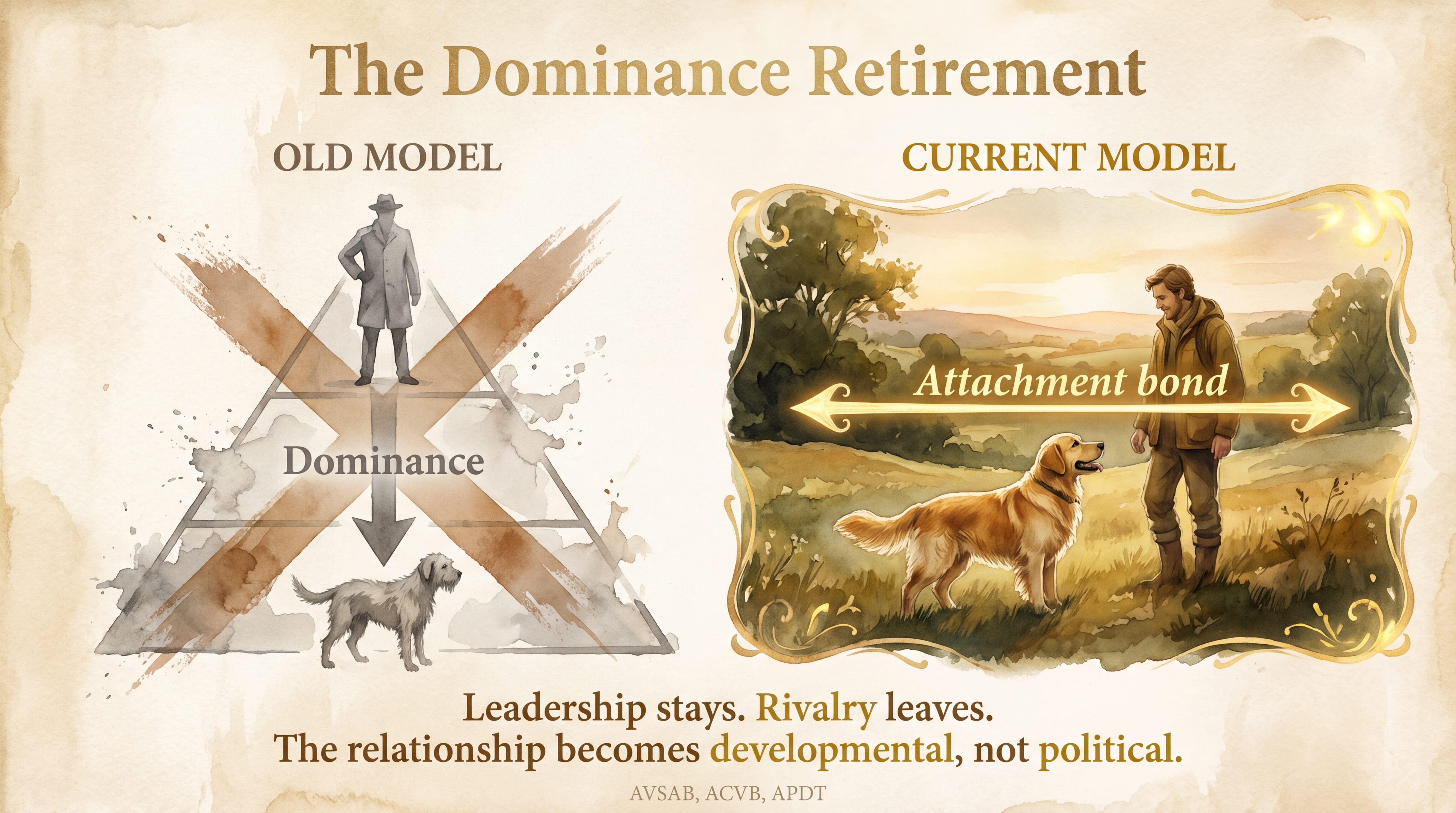
Modern behavioral science has moved beyond dominance hierarchies toward attachment, affiliation, and relational models for understanding pet dogs.
Key Takeaways
- The scientific correction to the wolf alpha story weakened one of the main supports for dominance-based explanations of the dog-human bond.
- Institutional guidance increasingly moved away from dominance language and toward relationship-centered, welfare-conscious frameworks.
- Leadership and asymmetry can remain without treating the dog as a rival.
- The practical gain for families is simpler and safer: read behavior developmentally, not as a status war.
The Evidence
- Mech, L. D. (1999)wild wolves
Clarified that wolf packs are primarily family units rather than the kind of chronic rank struggles earlier alpha stories had implied. - Bradshaw, J. W. S., Blackwell, E. J., and Casey, R. A. (2009)domestic dogs
Argued that dominance is a weak master explanation for companion-dog behavior and training.
- AVSAB (2021, 2025)domestic dogs
Issued humane-training guidance that moves the field away from dominance-centered household explanations and toward welfare-conscious relationship framing. - American College of Veterinary Behavioristsdomestic dogs and veterinary referral guidance
Public guidance for veterinarians advises avoiding trainers who frame the relationship in alpha and submission terms, showing that dominance retirement has reached clinical referral language. - APDT (2023)domestic dogs
Published a dominance position statement reflecting the broader professional retreat from alpha-based household framing. - Savalli, C., and Mariti, C. (2020)domestic dogs
Argued that the modern dog-human bond is better interpreted through attachment theory than dominance hierarchy language.
- SCR-157 boundarywild wolves and domestic dogs
The scientific narrative about the collapse of the dominance model is documented, but leadership without rivalry remains an interpretive relationship framework rather than a directly tested intervention label.
No single controlled study can isolate exactly how much household difficulty is created by dominance ideology itself rather than by broader handling habits and environmental inconsistency.
SCR References
Sources
- American College of Veterinary Behaviorists (ACVB). (n.d.). How to Select a Dog Trainer - A Guide for Veterinarians. ACVB.
- American Veterinary Society of Animal Behavior (AVSAB). (2021). Position Statement on Humane Dog Training. AVSAB.
- American Veterinary Society of Animal Behavior (AVSAB). (2025). 2025 AVSAB Board Statement. AVSAB.
- Association of Professional Dog Trainers (APDT). (2023). Dominance Position Statement. APDT.
- Bradshaw, J. W. S., Blackwell, E. J., and Casey, R. A. (2009). Dominance in domestic dogs: Useful construct or bad habit? Journal of Veterinary Behavior, 4(3), 135-144. https://doi.org/10.1016/j.jveb.2008.08.004
- Mech, L. D. (1999). Alpha status, dominance, and division of labor in wolf packs. Canadian Journal of Zoology, 77(8), 1196-1203. https://doi.org/10.1139/z99-099
- Savalli, C., and Mariti, C. (2020). Would the dog be a person's child or best friend? Revisiting the dog-tutor attachment. Frontiers in Psychology, 11, 576713. https://doi.org/10.3389/fpsyg.2020.576713