The Coupling Direction
The most important directionality question in this whole subcategory is simple: when dog and human physiology couple, who is shaping whom more strongly? The strongest long-term evidence does not support a perfectly symmetrical answer. It supports a human-to-dog dominant direction, especially in breeds selected for close human cooperation. Documented
What It Means
Coupling by itself is not enough. Two organisms can covary for many reasons, including shared environment, common routine, or bidirectional influence. The deeper scientific question is whether one side appears to exert the stronger influence. That is why SCR-105 is one of the most important anchors in Category 12.
The best starting point is the long-term hair cortisol work. Sundman showed that dog and owner chronic cortisol levels synchronized across seasons in cooperative-breed dyads. Documented But the more revealing detail was not the correlation alone. Owner personality traits helped predict dog HCC more strongly than dog personality traits predicted owner HCC. That finding pushes the result from generic co-exposure toward directional asymmetry.
In practical terms, that means the dog looks less like an equal co-author of the long-term endocrine climate and more like the more permeable partner in the dyad. Documented That is still not absolute one-way causation. But it is stronger than the softer phrase "they affect each other." The chronic physiology appears to lean human-to-dog.
Hoglin 2021 refines the same issue by adding breed history. The authors examined ancient breeds and solitary hunting breeds and compared them with previous herding-dog findings. They found no direct owner-HCC-to-dog-HCC effect in the less cooperative groups, while the earlier herding work did show synchronization. Documented That is important because it suggests the direction is not only about living in the same home. It may also depend on how strongly the breed has been selected to attend to human social cues and human working partnership.
This is exactly the kind of result JB needs. The human-to-dog asymmetry is not being asserted as philosophy first and evidence later. It is emerging from measurable breed-sensitive physiology. The dog is not simply a generic mammal in a generic bond. Some dogs appear especially shaped by the human side because their selection history made them especially open to that shaping.
The Schoberl literature points the same way even when the exact outcome variable changes. In the HPA-flexibility paper, the human partner emerged as more influential in shaping cortisol variability and flexibility in the dyad. Again, that is not total one-way control. But it is another case in which the adult psychological organization appears to matter more to the dogs physiology than the reverse.
The broader autonomic and contagion work supports a similar directional reading. Katayama found that duration of ownership strengthened HRV coupling. Documented Koskela showed live HRV co-modulation in cooperative-breed dyads. Neither paper by itself proves the human always dominates the direction of influence in every second of interaction. But taken alongside Sundman and Schoberl, they fit a coherent pattern: the dog-human bond is real, reciprocal in some respects, and still weighted toward the human side as the more powerful long-term organizer.
This is one place where precise language protects against exaggeration. Human-to-dog dominance does not mean dogs never influence humans. Of course they do. Dogs can soothe, energize, distress, burden, and reorganize human behavior every day. The claim is narrower. In the strongest current physiology literature, the chronic and developmental influence appears more powerful from human to dog than from dog to human.
That distinction matters enormously for the bond category because it justifies why JB talks so much about the adult. If the relationship were fully symmetrical, the program emphasis might be more evenly split. But if the human side is generally the heavier long-term lever, then asking the adult to change first stops sounding moralistic and starts sounding scientifically proportionate.
Breed selection gives the point even more depth. Herding and other cooperative breeds were not just selected to follow cues. They were selected to remain tuned to humans across repeated work, guidance, and social partnership. It therefore makes sense that they would also be more permeable to human physiological state. The dog who was bred to work beside us may also be the dog who carries us more deeply.
This is one reason Golden Retrievers matter so much to JB. Goldens are not herding dogs, but they are a highly human-oriented cooperative breed with long histories of close partnership. The broader category logic would predict that the adult side of the relationship matters a great deal for them too, even if exact synchronization magnitude varies by lineage or household.
An everyday analogy is parenting a young child on a small boat. The child can move the boat, react to the water, and affect the adults. But the adult still carries more of the steering force. In the strongest dog-human physiology work, the adult often looks more like the steering side.
Why It Matters for Your Dog
For families, this entry matters because it tells them where the most realistic leverage sits. If the strongest long-term influence is generally human-to-dog, then waiting for the dog to settle first may be the wrong order of operations. The adult has to become the steadier side of the dyad on purpose.
The coupling-direction literature supports JB instinct that the adult should behave like the more regulating partner in the bond. The science suggests that this is not only philosophically appropriate. It is physiologically appropriate too.
This also protects against resentment toward the dog. A dysregulated dog may be contributing to a difficult household, but the strongest evidence still points back toward the adult as the larger long-term lever. That is demanding, but it is also hopeful. Families do not have to wait passively for the dog to become different before the system can improve.
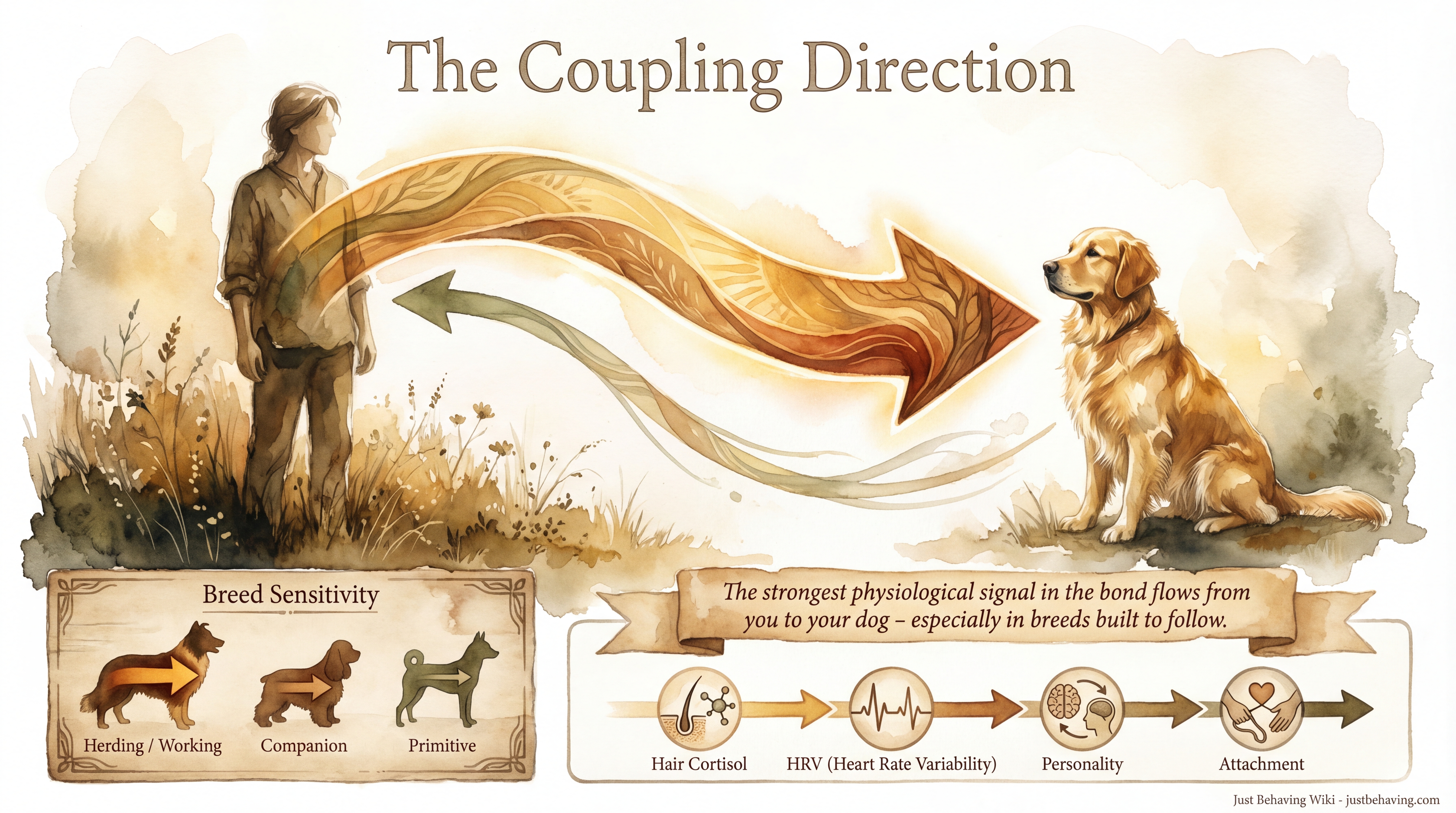
Physiological coupling flows primarily from owner to dog, making the human's internal state the upstream variable that shapes the shared emotional climate.
Key Takeaways
- The key question is not only whether dog and human physiology couple, but which side appears to carry more long-term influence.
- The strongest chronic cortisol work suggests that the heavier direction of influence runs from human to dog.
- Breed history matters, with cooperative breeds showing stronger synchronization than more independent breed groups.
- This is why JB keeps treating adult regulation as the first lever rather than as an optional extra around the dog.
The Evidence
- Sundman, A.-S. et al. (2019)domestic dogs and humans
Showed long-term cortisol synchronization and found that owner personality affected dog HCC more than dog personality affected owner HCC. - SCR-105 synthesisdomestic dogs and humans
Summarizes the strongest chronic physiology pattern as predominantly human-to-dog.
- Hoglin, A. et al. (2021)domestic dogs and humans
Found no direct owner-HCC-to-dog-HCC effect in ancient and solitary hunting breeds, suggesting that stronger human-to-dog coupling is linked to breed histories shaped by human cooperation. - Schoberl, I. et al. (2017)domestic dogs and humans
Found that owner-side psychological variables predicted canine HPA flexibility, reinforcing the broader asymmetry in influence.
- SCR-105 boundarydomestic dogs and humans
Human-to-dog is the strongest long-term directional pattern in the literature, but this does not mean dogs never influence humans or that every dyad shows the same magnitude of asymmetry.
No published study has yet quantified how strongly the direction of influence differs across newly rehomed puppies, pet dogs, working dogs, and less human-cooperative breed groups using the same physiological design.
SCR References
Sources
- Hoglin, A., Van Poucke, E., Katajamaa, R., Jensen, P., Theodorsson, E., & Roth, L. S. V. (2021). Long-term stress in dogs is related to the human-dog relationship and personality traits. Scientific Reports, 11, 8612. https://doi.org/10.1038/s41598-021-88201-y
- Schoberl, I., Wedl, M., Bauer, B., Day, J., Mostl, E., & Kotrschal, K. (2017). Psychobiological factors affecting cortisol variability in human-dog dyads. PLOS ONE, 12(2), e0170707. https://doi.org/10.1371/journal.pone.0170707
- Sundman, A.-S., Van Poucke, E., Holm, A.-C. S., Faresjo, A., Theodorsson, E., Jensen, P., & Roth, L. S. V. (2019). Long-term stress levels are synchronized in dogs and their owners. Scientific Reports, 9, 7391. https://doi.org/10.1038/s41598-019-43851-x