Long-Term Cortisol Synchronization
Long-term cortisol synchronization is one of the strongest physiological findings in the modern dog-human bond literature. Hair cortisol studies show that chronic stress levels in dogs and humans can move together across seasons, and the best-supported reading of that pattern is not simply "everyone in the house is stressed," but that the human partner is often the more influential side of the dyad. Documented
What It Means
To understand why this finding matters, it helps to start with the measure itself. Hair cortisol concentration, often shortened to HCC, is not an in-the-moment stress marker like a quick saliva sample after a startling event. Observed-JB Cortisol becomes incorporated into growing hair over time, which means a hair sample gives a longer-window picture of the stress biology the body has been carrying. It is closer to climate than weather.
That is why the Sundman study matters so much. Documented In 58 dog-human dyads, the researchers measured hair cortisol at two separate sampling points reflecting previous summer and winter months. The dyads were not drawn from a generic mixed-breed pool. They were Shetland Sheepdogs and Border Collies, both breeds with long histories of close human cooperation. Across those dyads, human and dog HCC values were significantly correlated at both sampling points. That means the physiological linkage was not a one-day mood effect. It was a chronic pattern visible across seasons.
The details make the result even more important for JB. Dog activity level did not explain the effect. Nor did the weekly amount of formal training. Dog personality had comparatively little impact on dog HCC, while owner personality traits, including Neuroticism, Conscientiousness, and Openness, significantly affected dog HCC. That pattern is exactly why SCR-105 exists. The dog was not simply carrying its own isolated stress profile. The dog was living downstream of the adult in measurable ways.
That distinction matters because it changes the interpretation of the bond. If dog cortisol and human cortisol only rose together because both happened to live in the same noisy world, the finding would still be interesting but less philosophically decisive. Sundman points toward something stronger: the human side of the relationship helps shape the dog side of the physiology. The adult is not merely another stressor in the environment. The adult is part of the environment.
One useful way to think about this is to separate acute contagion from chronic calibration. Acute contagion is when a dog reacts to a tense room, a sharp voice, or a sudden human stress spike. Chronic calibration is what happens when the dog lives inside that human state for weeks and months. Hair cortisol is telling us more about the second process than the first. It is measuring what kind of physiological atmosphere the dog has been inhabiting.
Hoglins 2021 follow-up is important because it asks whether this pattern is equally true across all breed groups. The answer was no, and that boundary matters. In that study, 24 ancient breed dogs and 18 solitary hunting dogs were compared with the earlier herding-dog findings. Documented No effect of owner HCC on dog HCC was found in the ancient or solitary hunting groups. The strong long-term synchrony signal that appeared in herding dogs did not generalize cleanly across those less human-cooperative breed histories.
That is not a weakness in the bond story. It is a refinement of it. The result suggests that recent selection for close human cooperation may make some dogs more physiologically permeable to the human partner than others. Herding dogs appear especially sensitive to human state in this long-window way. Ancient breeds appear less so. Solitary hunting dogs fall somewhere in between, with owner relationship and personality still mattering, but without the same direct owner-HCC-to-dog-HCC synchronization.
Hoglins paper also keeps the story from collapsing into one single mechanism. Even when direct owner HCC did not predict dog HCC in ancient and solitary hunting dogs, aspects of the human-dog relationship still did. The MDORS perceived-cost subscale related to dog HCC across tested breed groups, and owner personality traits still mattered for solitary hunting dogs. In other words, the human still shows up in the dog physiology, but not always through the same exact synchronization pattern.
This is why the coupling story has to be told with precision. The documented claim is not that every dog mirrors every human equally. The documented claim is that long-term dog-human cortisol synchronization exists, is especially strong in cooperative breeds, and is shaped more by human-side variables than by dog-side personality in the most replicated herding-dog work. That is already a major result.
It also helps explain why the adult state in JB cannot be treated as a private matter. A chronically hurried, dysregulated, or emotionally noisy adult may still be loving, generous, and well-intentioned. The hair-cortisol work says the dog does not only receive the adult intentions. The dog receives the adult physiology. That gives the Calmness pillar a harder scientific edge than families often expect.
The practical interpretation should still stay honest. Synchronization is not mind control. It does not mean a calm adult guarantees a calm dog, or that every tense dog is the product of a tense family. Genetics, breed history, health, household structure, sleep, adversity, and attachment all still matter. But within that fuller developmental map, long-term cortisol synchronization is strong evidence that the human side belongs in the causal picture rather than outside it.
One everyday analogy is central heating. A room still has local drafts, cold corners, and open doors, but the thermostat sets the general climate everyone inside must live with. In the cooperative-breed cortisol literature, the adult often looks less like one more weather event and more like part of the thermostat.
Why It Matters for Your Dog
For families, this entry matters because it reframes the dog from a creature who merely witnesses household stress into one who may physiologically absorb it over time. That is not blame language. It is leverage language. If the adults lower the chronic stress load in the household, they may be improving more than manners or emotional tone. They may be changing part of the dogs long-term endocrine environment.
Long-term cortisol synchronization is one of the clearest reasons JB treats calm adults as part of the dogs biology, not just part of the dogs schedule.
This also helps families avoid two opposite mistakes. The first is fatalism, the idea that stress is invisible and therefore irrelevant. The second is oversimplification, the idea that every dog problem can be read straight off the adult mood. The research supports neither extreme. Documented What it supports is a more mature view in which chronic human state is one real developmental input among several, and often a more important one than families assume.
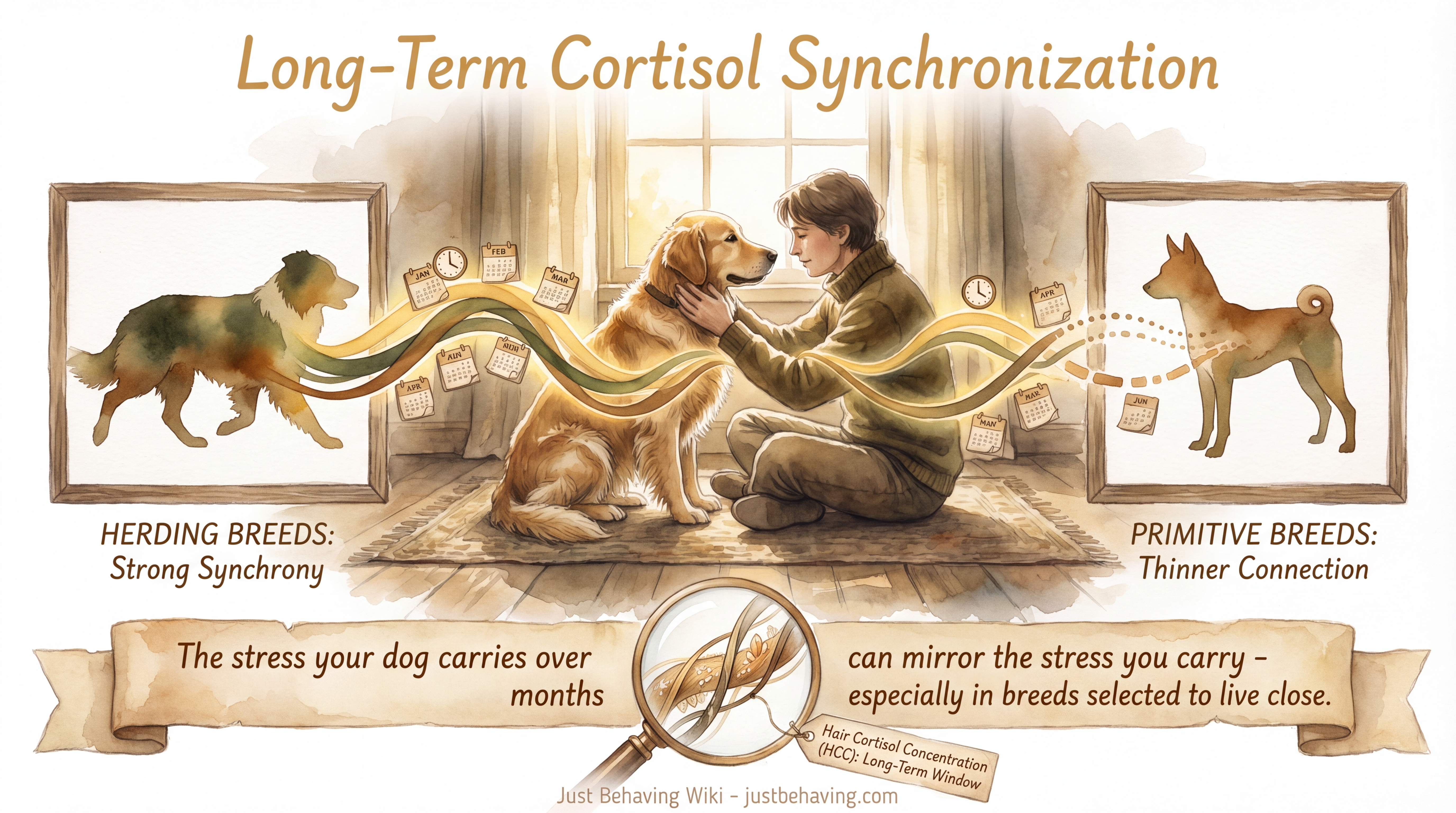
Owner and dog cortisol levels synchronize over time, meaning the human's chronic stress state becomes part of the dog's biological environment.
Key Takeaways
- Hair cortisol captures chronic stress load over time, which makes it useful for studying physiological climate rather than momentary upset.
- In herding and other cooperative breeds, long-term cortisol levels in dogs and humans can synchronize across seasons.
- The strongest replicated pattern is not simple symmetry but greater human-side influence, with owner personality affecting dog cortisol more than dog personality affects owner cortisol.
- This is why JB treats adult calmness as a biological responsibility as well as a behavioral one.
The Evidence
This entry uses observed claim-level tags beyond the dedicated EvidenceBlocks below. These tags mark JB program observation or practice-derived claims that need dedicated EvidenceBlock coverage in a later content pass.
- Sundman, A.-S. et al. (2019)domestic dogs and humans
Studied 58 dog-human dyads and found significant long-term hair cortisol synchronization across summer and winter sampling, with owner personality affecting dog HCC more than dog personality did. - SCR-105 synthesisdomestic dogs and humans
Interprets the strongest long-term physiological pattern as predominantly human-to-dog rather than balanced bidirectionality.
- Hoglin, A. et al. (2021)domestic dogs and humans
Compared 24 ancient breed dogs and 18 solitary hunting dogs against earlier herding findings and found no owner-HCC-to-dog-HCC effect in the less cooperative groups, while relationship measures and owner personality still affected dog HCC.
- SCR-012 boundarydomestic dogs and humans
Long-term cortisol synchrony is documented, but it does not mean every individual dog mirrors every individual human to the same degree or through one single mechanism.
No published household study has yet mapped how quickly cortisol synchronization changes after a family substantially reduces chronic stress load or improves day-to-day regulation.
SCR References
Sources
- Hoglin, A., Van Poucke, E., Katajamaa, R., Jensen, P., Theodorsson, E., & Roth, L. S. V. (2021). Long-term stress in dogs is related to the human-dog relationship and personality traits. Scientific Reports, 11, 8612. https://doi.org/10.1038/s41598-021-88201-y
- Sundman, A.-S., Van Poucke, E., Holm, A.-C. S., Faresjo, A., Theodorsson, E., Jensen, P., & Roth, L. S. V. (2019). Long-term stress levels are synchronized in dogs and their owners. Scientific Reports, 9, 7391. https://doi.org/10.1038/s41598-019-43851-x