Heart Rate Variability Co-Modulation
Heart rate variability, or HRV, is one of the clearest ways to see the dog-human bond operating in real time rather than only across weeks and months. The strongest recent work shows that dog and owner autonomic state can co-modulate during interaction, with the pattern extending beyond simple shared movement. Documented
What It Means
HRV measures the variation in time between heartbeats. That sounds like a small technical detail, but it is one of the best non-invasive windows into autonomic regulation. In broad terms, higher HRV is associated with stronger parasympathetic influence and better regulatory flexibility, while lower HRV is often associated with greater arousal or reduced flexibility. Observed-JB The key point is that HRV is not only about how fast the heart is beating. It is about how flexibly the system is functioning.
That makes HRV especially useful for the bond category. Hair cortisol tells us something about long-term physiological climate. Documented HRV can tell us something about moment-to-moment co-regulation. If cortisol is the seasonal weather pattern, HRV is the live pulse of the room.
Koskela et al. (2024) is the current anchor paper here. The study used a pseudorandomized cross-over design and measured heart rate variability plus physical activity in dogs and owners during two resting baselines and several positive interaction tasks, including stroking, training, sniffing, and playing. The initial sample included 29 dog-owner dyads drawn from co-operative breed types. After exclusions for technical and physiological reasons, the final analytical sample was 25 dyads.
That design matters because it let the researchers separate autonomic coupling from mere shared movement. If dog and owner hearts only looked similar because both were moving at the same time, then the phenomenon would be less relational and more mechanical. Koskela found something more specific. HRV in dogs and owners correlated most clearly during free-behaving baseline periods, while activity correlated more strongly during predefined interaction tasks such as stroking and playing. In plain language, the autonomic signal and the motion signal were partly independent.
That is a very important result. It means the dog is not only physically matching the human. The dog is also entering a related arousal state with the human, even when both are not engaged in exactly the same outward action. The bond appears in the physiological organization of the dyad, not only in visible synchronization.
The study also found that characteristics of the dog, the owner, and the relationship modified the pattern. Documented Ownership duration, owner negative affectivity, and dog-owner interaction scores all predicted dog overall HRV. That matters because it turns HRV co-modulation into more than a universal reflex. The physiology of the dyad depends partly on how long the pair has lived together and what kind of relationship they have built.
The ownership-duration effect is especially useful for interpretation. Emotional coupling appears to strengthen over time. That fits with the broader bond literature, including Katayama and the long-term cortisol work. The dog-human relationship is not just a fixed capacity switched on at adoption. It is something that develops, accumulates, and becomes physiologically richer or more influential with lived history.
The task structure helps make that finding more believable. Koskela did not simply strap monitors onto dogs and owners during one vague play session. The design included pre- and post-baselines plus multiple interaction types with different activation levels. That matters because stroking, training, sniffing, and playing are not the same social event. The fact that activity synchronized more clearly during the defined tasks while HRV synchronized more clearly during the freer baseline periods helps separate behavioral coordination from autonomic coordination.
There is also an important nuance in the direction of the findings. Some of the predictors, such as more shared interaction and longer history, were associated with lower dog HRV during the study, which can initially sound negative. Documented Koskela is careful here. Lower HRV in that context may reflect arousal related to anticipation, emotional engagement, or the particular testing setup rather than simple pathology. This is why HRV should never be interpreted lazily as "high good, low bad" without context.
That nuance becomes especially important when families try to translate the science into daily life. A dog who drops into lower HRV during an eagerly anticipated outing or a highly social test is not necessarily distressed. The system may simply be more activated. What matters is whether the activation is organized, recoverable, and legible within the relationship. JB is not chasing the lowest possible arousal at all moments. It is chasing better regulation.
That nuance is one reason this page belongs in a deep-dive category rather than in a quick advice post. Physiological coupling is real, but physiology is not moral language. A more aroused dog in a social test may be excited, engaged, expecting activity, or stressed, depending on the context. The value of the paper lies in showing that the dog and human autonomic systems are linked and that relationship characteristics modify the linkage.
The breed boundary matters too. Koskela studied co-operative breed types, and many of the owners were active in dog sports. That makes the result especially relevant for breeds bred for human responsiveness, but it also limits clean generalization to all dogs. Ancient breeds or more independent types may show different patterns, just as the long-term cortisol literature shows stronger synchronization in herding breeds than in some other groups.
It also means the page should be read as evidence of what the bond can do under favorable relational conditions, not as a universal automatic rule. These were mostly committed dyads willing to participate in a demanding monitoring study. That makes the result useful for understanding the upper end of dog-human co-regulation, while still leaving open how much noisier, more conflicted, or less cooperative households might differ.
This is why the right sentence is stronger than the simple slogan. The evidence does not say that dogs always mirror human HRV beat for beat in every context. It says that dog and owner autonomic state can co-modulate, that the signal cannot be reduced to shared motion alone, and that the nature of the relationship helps shape the strength and meaning of that coupling.
An everyday analogy is a duet rather than a metronome. The two sides are not mechanically identical, and they are not playing the same note at the same volume all the time. But they are adjusting around each other in a shared live structure. HRV gives us a measurable trace of that shared structure.
Why It Matters for Your Dog
For families, this entry matters because it makes calmness more immediate. Long-term stress work can sound distant or cumulative. HRV reminds us that the bond is also happening in the present tense. The state you bring into greetings, rests, play, handling, and recovery after novelty can shape the dyad in real time.
HRV co-modulation is one reason JB treats adult regulation as something the dog feels now, not only something the dog slowly absorbs over months.
This does not mean families should obsess over every heartbeat. It means they should respect the room. A calm adult can help make the room more physiologically settleable. An activated adult can make the room more physiologically expensive. The dog often registers that before any explicit lesson begins.
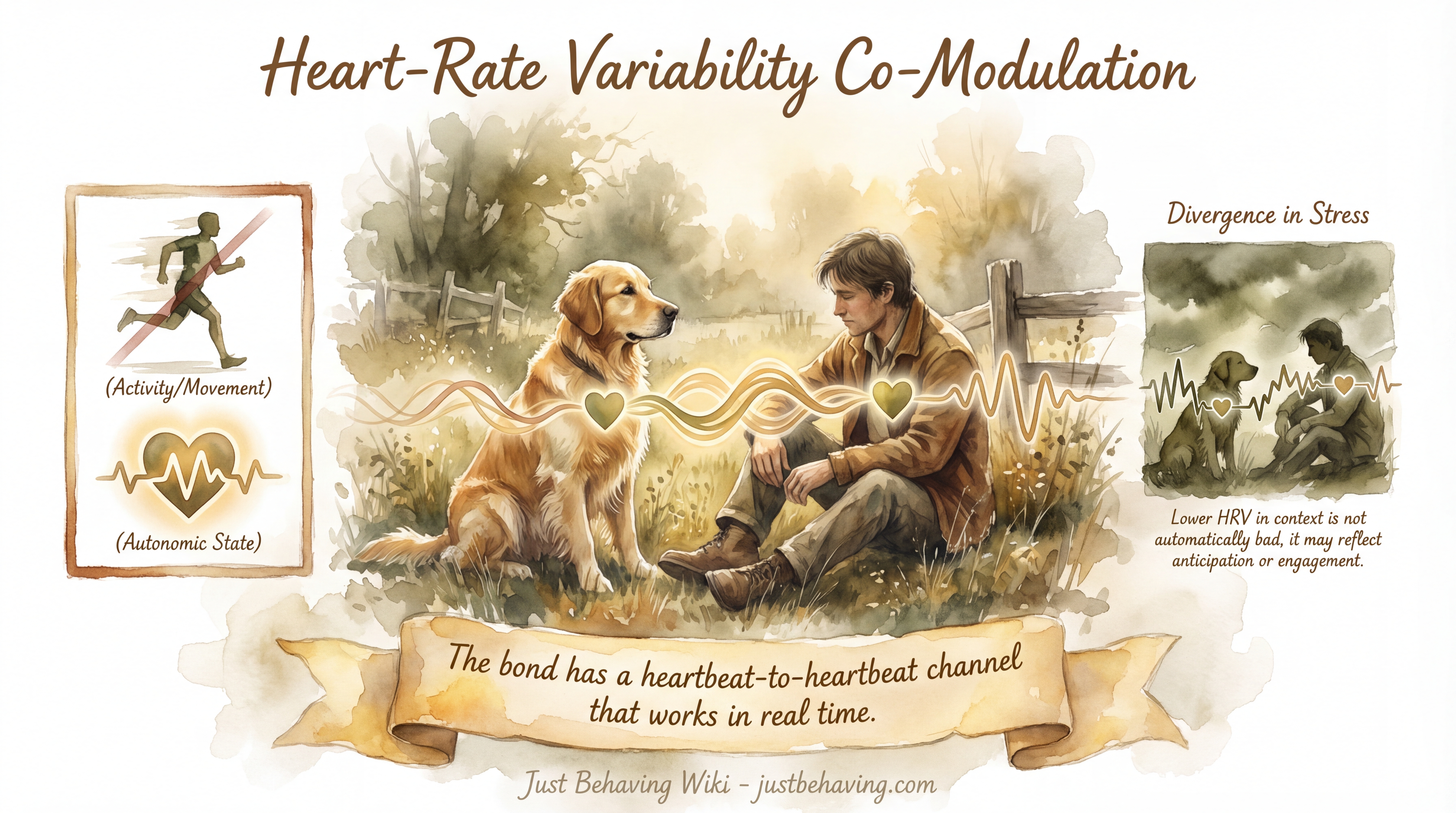
Owner and dog heart rate variability patterns influence each other during shared proximity, suggesting a physiological channel beneath conscious awareness.
Key Takeaways
- Heart rate variability gives the bond a moment-to-moment physiological layer rather than only a long-term endocrine one.
- Koskela found that dog and owner HRV correlated most clearly during free-behaving baseline periods, while shared activity peaked during specific tasks.
- That separation matters because it shows the dyad is not only matching movement. It is also sharing autonomic organization.
- The strength and meaning of the pattern depend partly on breed type, relationship history, and the nature of the dog-human bond.
The Evidence
This entry uses observed claim-level tags beyond the dedicated EvidenceBlocks below. These tags mark JB program observation or practice-derived claims that need dedicated EvidenceBlock coverage in a later content pass.
- Koskela, A. et al. (2024)domestic dogs and humans
Studied co-operative breed dog-owner dyads using HRV and activity measures across baseline and interaction tasks and found that HRV correlated during free-behaving periods while activity correlated more strongly during defined tasks. - SCR-106 synthesisdomestic dogs and humans
Frames the result as dyad-specific autonomic co-modulation rather than simple shared motion.
- SCR-106 boundarydomestic dogs and humans
The HRV result is documented in co-operative breed dyads, but HRV values still need context and should not be simplistically translated into a one-number emotional diagnosis for every household.
No published study has yet mapped comparable HRV co-modulation across a wider set of ancient, independent, or newly rehomed puppy populations using the same task design.
SCR References
Sources
- Koskela, A., Tornqvist, H., Somppi, S., Tiira, K., Kykyri, V.-L., Hanninen, L., Kujala, J., Nagasawa, M., Kikusui, T., & Kujala, M. V. (2024). Behavioral and emotional co-modulation during dog-owner interaction measured by heart rate variability and activity. Scientific Reports, 14, 25201. https://doi.org/10.1038/s41598-024-76831-x