The Canine Communication System
Compound evidence detail1 SCR / 2 parts
- Observed-JBthe ethological evidence that adult dogs deploy specific social signals with situational selectivity and brief contextual deployment (Abrantes, Bekoff, Mech) together with the Bray, MacLean et al. 2021 retriever puppy demonstration that canine attention to human gestural cues is biologically pre-loaded
- Heuristicthe JB application generalizing the dog signal-precision pattern into a universal social-signaling principle and the corollary claim that high-frequency human verbal praise categorically degrades communicative information in household contexts
Dogs communicate through a multi-modal social system in which posture, orientation, distance, timing, facial movement, vocalization, scent, and contact all carry relationship information. The strongest parts of that claim are documented in the canine communication literature. The main thing families usually miss is not whether the system exists, but how precise it is. Documented
What It Means
Most people picture dog communication as a handful of obvious events: barking, growling, tail wagging, maybe a play bow if they are more attentive than average. That picture is too small. Dogs are operating inside a larger social language in which the meaning often comes from pattern rather than from one dramatic sign. Where the body is angled, how long the pause lasts, whether the dog comes directly or curves, whether the head turns away or stays fixed, whether contact is offered or withdrawn, all of that changes what the interaction means.
The system is also multi-modal. Visual signals are the easiest for humans to notice, so the literature often begins with posture, gaze, tail carriage, facial expression, and movement pattern. But the dog is not relying on vision alone. Acoustic signals such as barks, growls, whines, and short vocal interruptions matter. Olfactory signaling matters through scent marking and chemical information. Tactile contact matters through leaning, body placement, physical proximity, and the withholding of contact. In real interaction, these channels often work together rather than one at a time.
The functional categories in the notebook are useful because they organize communication by social job rather than by body part. Some signals reduce distance or tension. Play bows, lip licking, gaze aversion, body lowering, and other softening behaviors tend to make approach safer or keep arousal from tipping upward. Other signals increase distance or control access. Direct stare, high posture, forward weight shift, growling, and piloerection belong on that side. Still other signals clarify play or restart it after a pause. Others cut off, disengage, or lower the intensity of the whole exchange.
That matters because it prevents the folk mistake of treating each signal like a dictionary entry. A lip lick is not a magical word that always means one thing in every context. A body turn is not automatically fear. A play bow is not merely a stretch. The system is better understood as graded social regulation. Dogs are adjusting the distance, tempo, ambiguity, and emotional tone of interaction. The signal gets its meaning from what just happened, who is present, and what the dog appears to be trying to change. Documented
Play-signal research makes the precision unusually visible. Documented Bekoff had already shown that play signals in canids function as behavioral modifiers around rough or potentially ambiguous actions. Horowitz then sharpened the audience point in domestic dogs by showing that play signals are sent almost entirely to partners who are actually oriented toward the signaller. When the partner is not paying attention, dogs are more likely to use attention-getting behavior first. The dog is adjusting communication based on whether the receiver is ready to receive it.
Byosiere and colleagues added a timing layer that matters just as much. Documented Play bows were not scattered randomly throughout social play. They clustered around pauses and transitions, especially moments when play needed to be restarted or clarified. In other words, the bow tended to appear where the interaction risked losing coherence. That is what real signaling systems do. They spend information where the social moment is uncertain, not where everything is already obvious.
Once you see that pattern, the broader system becomes easier to recognize. A head turn after crowding, a still pause at a doorway, a curved approach instead of a direct one, or a brief freeze before re-engagement all stop looking like trivial motions. They look like placement decisions inside a communication economy. Dogs are not built to flood every moment with maximum output. They are built to use signals in relation to circumstance.
This is also why the spatial channel matters so much. Approach angle, body orientation, and positioning are not neutral geometry. The literature summarized in SCR-110 treats them as communicative variables. Documented A direct line can feel different from a curve. Standing over can carry different meaning than standing near. Blocking a path is different from chasing a dog down that path. Space is not just where communication happens. Space is one of the things being used to communicate.
The system extends into dog-human interaction as well. Firnkes and colleagues documented that dogs use appeasement-type signals such as lip licking, turning away, and sitting in response to human approach. That does not mean every human-dog moment is identical to a dog-dog exchange. It does mean dogs do not reserve their social language for conspecifics alone. They recruit parts of the same repertoire when navigating us, especially when uncertainty, pressure, or social asymmetry is present.
A second boundary matters here. Calling this a communication system is not the same as claiming scientists have closed every interpretive question. There is still disagreement about exact ethogram boundaries, about how broad some signal categories should be, and about whether certain signals are best treated as fixed units or as components inside larger sequences. What matters is that the system is real enough, structured enough, and context-sensitive enough that families should stop treating canine body language as vague atmosphere.
For JB, the most important implication is simple: the bond is maintained in real time through this language. A dog is not only responding to whether the family is kind or unkind in some abstract sense. The dog is reading whether the humans are legible. A household full of abrupt movement, crowded approaches, constant reaching, and conflicting body cues may still love the dog deeply while remaining hard for the dog to read. A calmer, clearer household speaks the bond more fluently.
An everyday analogy is conversation in a quiet room versus conversation at a party where everyone is talking over each other. The words may be equally sincere in both places. The quiet room still carries more usable information because timing, direction, and pause remain intact. The canine communication system works similarly. Meaning depends on contrast, placement, and context, not just on emotional intensity.
Why It Matters for Your Dog
For families, this entry changes the practical target. The goal is not to memorize a giant chart of body-language trivia. The goal is to become more sensitive to the structure of interaction itself. If dogs are using a real multi-modal communication system, then family life improves most when adults learn to notice how space, pace, posture, and timing are already shaping the bond.
That has a calming effect on households almost immediately. People stop assuming every problem is a command problem and start asking whether their own movement, timing, or crowding changed the interaction before the problem became obvious.
Indirect Correction depends on this communication system being real. Body blocking, spatial pressure, quiet disengagement, and brief low-threat signals only make sense if dogs already treat posture, orientation, timing, and distance as meaningful information.
This also protects families from one of the most common bond mistakes, which is replacing readability with affection theater. A dog can be showered with warmth and still receive muddy signals. The better goal is warm clarity: a home where the dog experiences stable emotional availability and a body language it can actually follow.
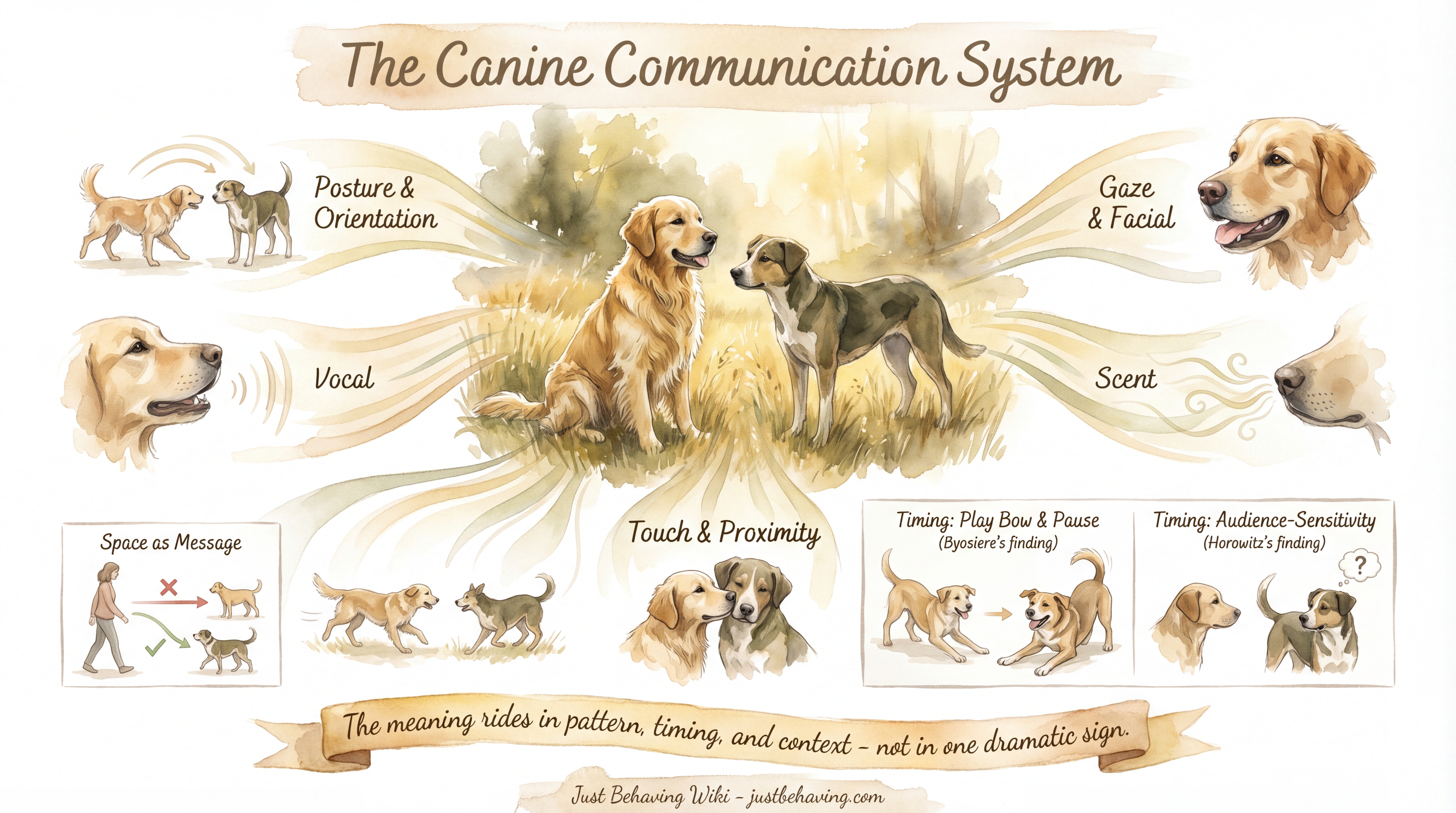
Dogs communicate through a multi-channel system of visual, auditory, olfactory, and postural signals that operates with more precision than most owners realize.
Key Takeaways
- Dogs communicate through a multi-modal social system that includes posture, orientation, timing, vocalization, scent, and contact.
- Research on play signals shows audience sensitivity and timing specificity, which means canine signals are deployed strategically rather than emitted randomly.
- Approach angle, body orientation, and spatial positioning are part of the message, not just the stage on which the message happens.
- Families strengthen the bond when they become more legible in space, pace, and timing instead of relying only on words.
The Evidence
- Horowitz, A. (2009)domestic dogs
Showed that dogs direct play signals primarily toward attentive partners and use attention-getting behavior when the partner is not oriented. - Byosiere, S.-E. et al. (2016)domestic dogs
Showed that play bows cluster around pauses and transitions in play, supporting a timing-specific communicative interpretation. - Bekoff, M. (1995)canids
Earlier canid play work showed that play signals function as behavioral modifiers around potentially ambiguous actions.
- SCR-110 synthesisdomestic dogs
Summarizes the literature showing that approach angle, body orientation, and spatial positioning function as communicative variables rather than as meaningless movement. - Firnkes, A. et al. (2017)domestic dogs
Documented context-linked appeasement signals during dog-human interaction, including lip licking, turning away, and sitting. - Goodwin, D. et al. (1997)domestic dogs
Defined standard agonistic visual signals such as stand over and displace, reinforcing that body pattern and social positioning carry functional meaning.
- SCR-003 boundarydomestic dogs
The documented core is contextual precision and timing. The stronger habit of assigning one fixed emotional meaning to every signal across every context goes beyond what the literature actually establishes.
No large sequence-analysis program has yet produced a fully settled, universally adopted canine social-signal dictionary across household, shelter, free-ranging, and working contexts.
The literature documents that dogs use a real communication system, but it has not yet quantified which human readability changes improve dog-family interaction fastest in ordinary homes.
SCR References
Sources
Bekoff, M. (1995). Play signals as punctuation: The structure of social play in canids. Behaviour, 132(5-6), 419-429.
Byosiere, S.-E., Espinosa, J., Cruz-Romero, R., Carballo, F., & Bentosela, M. (2016). Investigating the function of play bows in adult pet dogs. Behavioural Processes, 125, 106-113. https://doi.org/10.1016/j.beproc.2016.02.018
Firnkes, A., Bartels, A., Bidoli, E., & Erhard, M. (2017). Appeasement signals used by dogs during dog-human communication. Journal of Veterinary Behavior, 19, 35-44. https://doi.org/10.1016/j.jveb.2017.02.004
Goodwin, D., Bradshaw, J. W. S., & Wickens, S. M. (1997). Paedomorphosis affects agonistic visual signals of domestic dogs. Animal Behaviour, 53(2), 297-304. https://doi.org/10.1006/anbe.1996.0370
Horowitz, A. (2009). Attention to attention in domestic dog dyadic play. Animal Cognition, 12(1), 107-118. https://doi.org/10.1007/s10071-008-0175-y