Spatial Communication and Body Blocking
Compound evidence detail1 SCR / 2 parts
- Observed-JBthe ethological evidence that adult dogs deploy specific social signals with situational selectivity and brief contextual deployment (Abrantes, Bekoff, Mech) together with the Bray, MacLean et al. 2021 retriever puppy demonstration that canine attention to human gestural cues is biologically pre-loaded
- Heuristicthe JB application generalizing the dog signal-precision pattern into a universal social-signaling principle and the corollary claim that high-frequency human verbal praise categorically degrades communicative information in household contexts
Dogs do not use space only as a physical container for behavior. They use space as part of the behavior itself. Approach angle, posture, proximity, blocking, yielding, and displacement all carry social meaning in the canine ethogram. That makes spatial communication a documented part of the bond. The stronger step, treating a human body block as the same thing a dog does biologically, remains a functional analog rather than a proven identity claim. Mixed Evidence
What It Means
Families often think of body language and space as separate topics. In dog life they are tightly linked. A dog does not merely stand somewhere while communication happens through some other channel. Where the dog stands, how the dog moves into or away from space, whether the path is open or closed, and whether another body permits or denies access are themselves part of the message.
That becomes especially clear in conflict-adjacent or access-regulation situations. One of the useful contributions of the agonistic ethogram literature is that it names spatial acts as real social behaviors. Documented Goodwin and colleagues defined behaviors such as stand over and displace as part of the domestic-dog signal set. That matters because it means researchers were not forced to treat spatial acts as accidental movement surrounding the real event. The movement itself was part of the event.
Van der Borg and colleagues add a complementary angle. In group-housed domestic dogs, posture dynamics such as high posture, low posture, and posture change functioned as formal social-status signals. Documented Again, the important point is not whether every dog household resembles a group-housing study. The point is that spatial and postural variables are doing communicative work in dogs. They are not empty choreography.
Once that is established, a series of familiar household moments becomes easier to read. A direct path toward a resource communicates differently than a curved path. Standing in a doorway communicates differently than calling from across the room. Leaning into a dog without leaving an exit communicates differently than quietly occupying the path and letting the dog choose to yield. The dog may not have words for any of this, but the dog does not need words. The meaning rides in orientation and access.
This is also why body blocking can make sense without needing to be inflated into rank theater. The cleaner reading is not "I am proving I am alpha." The cleaner reading is "this path is closed" or "that access is not available right now." In a social species that already reads body placement and movement as information, that is a very different event from grabbing, chasing, pinning, or otherwise turning the boundary into a force contest.
Livestock guardian dog literature makes the same principle vivid in a working context. Guardian dogs often protect through spatial denial before they ever need to escalate. They patrol, occupy ground, bark from position, and place their bodies between livestock and threat. The practical function is nonlethal boundary communication. What changes is not only the predator's risk calculation. The spatial field itself is reorganized by the dog.
That working example matters because it shows how much behavior can be changed through placement rather than collision. Documented The guardian dog does not need to bite every predator to be effective. The dog often succeeds by altering what movement is available. That is an unusually clear example of communication through space.
The same logic scales down to domestic life. A calm adult stepping into the line between puppy and doorway, puppy and couch, puppy and food bowl, or puppy and visitor is not performing a random human ritual. The adult is changing the map. If the movement is quiet and proportionate, the dog receives a legible message: not through here, not now, choose a different line.
The distinction between blocking and pursuit is crucial. Blocking closes a path while preserving an exit. Pursuit drives the dog deeper into movement and often into arousal. Blocking is easiest for dogs to read when it is sparse, still, and over quickly. Pursuit is what happens when the human adds too much body, too much emotion, or too much repetition and accidentally converts information into pressure.
That is where SCR-003 becomes useful. Dogs do not deploy socially meaningful signals as constant output. Precision matters. A body that is always looming, always crowding, always over-managing space stops being informative in the useful sense. It becomes environmental noise or threat. A block works as communication only when it stays contextual and ends once the dog has yielded.
The evidence ceiling changes at the human analog step. The literature supports canine spatial signaling very well. It also supports the idea that dogs can read human body movement and use appeasement-type behaviors in dog-human contexts. What it does not yet show is that a bipedal human body block is processed through the same neural pathway or with the same internal meaning as a quadrupedal canine spatial block. That stronger claim is tempting. It is also unverified.
JB does not need that stronger claim to justify the practical use of body blocking. Heuristic It only needs the more careful one. Dogs are already a species for whom space, orientation, and path control are communicative media. A quiet human can therefore make itself more legible by using space well, especially if the household already maintains a calm baseline and leaves the dog room to choose a readable exit.
An everyday analogy is a person quietly standing in the doorway of a room while another person is about to enter. No speech may be needed. The closed path is already understood. The message did not come from force. It came from placement.
Why It Matters for Your Dog
For families, spatial communication is one of the clearest ways to set boundaries without turning the bond into a stream of grabbing and talking. A puppy who can read where access opens and closes does not need every limit translated into hands, leash tension, or repeated verbal correction.
That usually makes the home calmer. The adult becomes more readable, and the dog gets a boundary that is small enough to understand without feeling hunted. It also reduces accidental escalation, because the correction ends when the dog yields rather than continuing through emotional follow-through.
Body blocking works best when it behaves like information. Close the path, keep the exit open, end the signal when the dog changes line, and do not turn a spatial message into a chase.
This is also one of the strongest examples of why JB prefers relationship legibility over dominance theater. The practical gain does not come from proving status. It comes from making boundaries visible in a form dogs are already built to read.
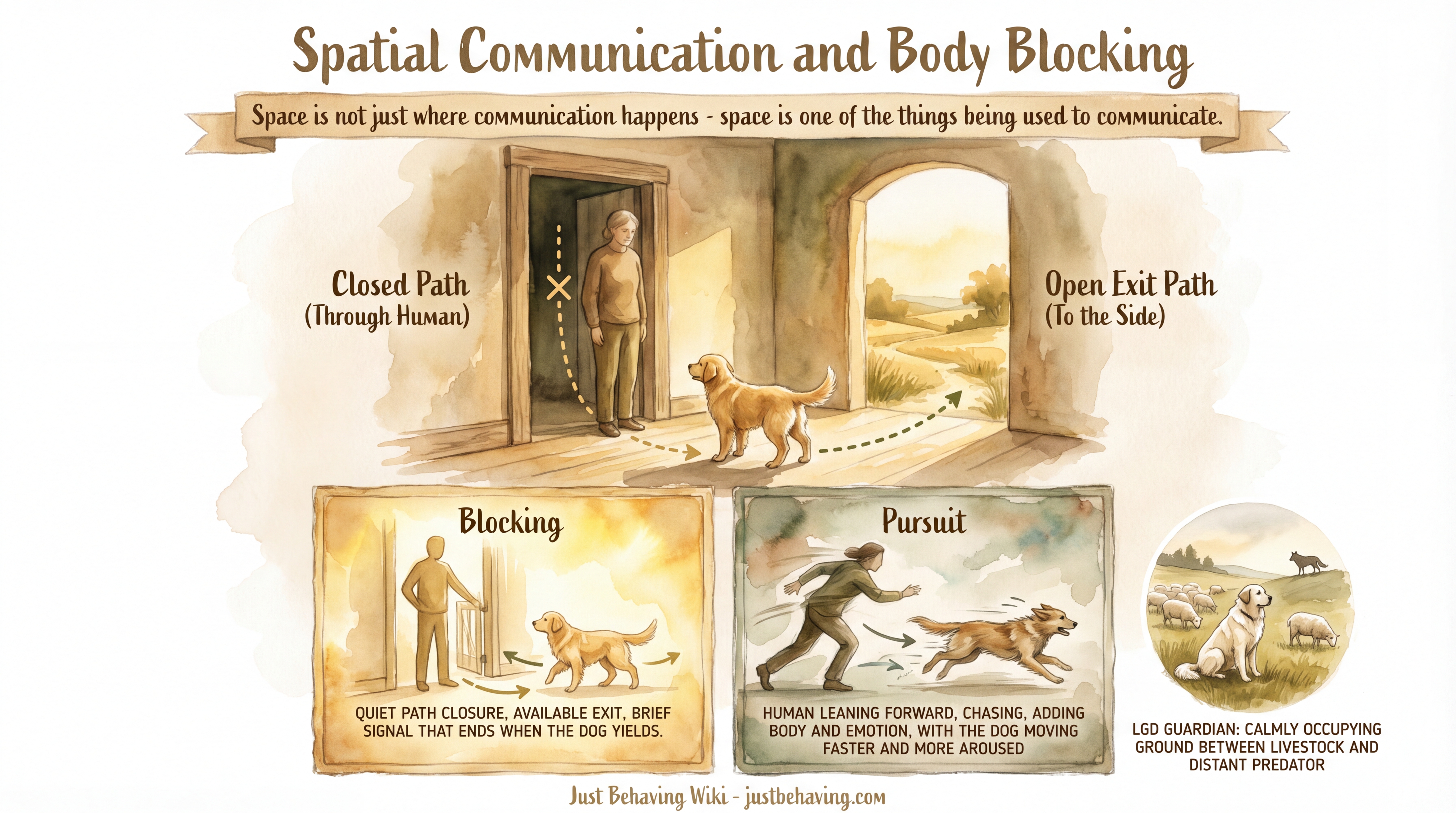
Spatial pressure, proximity shifts, and body positioning are core communication tools in canine social life that humans can learn to use without force or confrontation.
Key Takeaways
- Dogs use space as part of communication, which means approach angle, posture, and path control are meaningful social variables.
- Ethogram and group-housing studies support the claim that displacement, stand over, and posture dynamics are communicative rather than accidental movements.
- Body blocking is most coherent when it is treated as quiet path closure with an available exit, not as looming or pursuit.
- The documented evidence supports spatial communication strongly, while the claim of full biological equivalence between canine and human blocking remains heuristic.
The Evidence
This entry uses mixed-evidence claim-level tags beyond the dedicated EvidenceBlocks below. These tags mark claims that combine documented findings with observed practice, heuristic application, or unresolved gaps.
- Goodwin, D. et al. (1997)domestic dogs
Defined stand over and displace as standard agonistic visual behaviors, reinforcing that spatial acts are part of the signal set. - van der Borg, J. A. M. et al. (2015)domestic dogs
Showed that posture dynamics such as high posture, low posture, and posture changes function as quantifiable social-status signals in group-housed dogs. - SCR-110 synthesisdomestic dogs
Summarizes the broader literature as showing that approach angle, body orientation, and spatial positioning carry communicative meaning.
- Coppinger, R., and Coppinger, L. (2001)livestock guardian dogs
Described guardian function as emerging through placement and ambient work that often relies on presence, occupation of space, and nonlethal interruption. - Rigg, R. (2001, 2002)livestock guardian dogs
Reviewed traditional LGD use across pastoral settings where patrolling, blocking, and spatial disruption are central to protection. - Gehring, T. M. et al. (2010)livestock guardian dogs
Summarized modern conservation and livestock-protection evidence showing that guardian dogs often work through deterrence and access disruption rather than direct combat.
- SCR-003 and SCR-110 boundarydomestic dogs and humans
The canine evidence supports spatial communication as a real medium. The stronger claim that a human body block is biologically identical to a canine block remains an ethological analog rather than a directly demonstrated equivalence.
No controlled canine study has directly compared physiological and behavioral responses to quiet human body blocking versus more verbal or more manual forms of household interruption.
The literature documents the spatial medium well, but it has not yet mapped which exact human blocking variables most reliably keep the interaction informational rather than threatening.
SCR References
Sources
Coppinger, R., & Coppinger, L. (2001). Dogs: A New Understanding of Canine Origin, Behavior, and Evolution. University of Chicago Press.
Gehring, T. M., VerCauteren, K. C., & Landry, J.-M. (2010). Livestock protection dogs in the 21st century: Is an ancient tool relevant to modern conservation challenges? BioScience, 60(4), 299-308. https://doi.org/10.1525/bio.2010.60.4.8
Goodwin, D., Bradshaw, J. W. S., & Wickens, S. M. (1997). Paedomorphosis affects agonistic visual signals of domestic dogs. Animal Behaviour, 53(2), 297-304. https://doi.org/10.1006/anbe.1996.0370
Rigg, R. (2001). Livestock guarding dogs: Their current use worldwide. IUCN/SSC Canid Specialist Group Occasional Paper, 1, 1-31.
van der Borg, J. A. M., Schilder, M. B. H., Vinke, C. M., & de Vries, H. (2015). Dominance in domestic dogs: A quantitative analysis of its behavioural measures. PLOS ONE, 10(8), e0133978. https://doi.org/10.1371/journal.pone.0133978