Calming Signals -- The Evidence
The phrase "calming signals" entered dog culture through observation long before it entered peer-reviewed ethology. Today the safest scientific statement is narrower but still meaningful: pilot domestic-dog data support the idea that candidate calming signals are real conflict-management behaviors associated with de-escalation. That is enough to move the topic out of folklore, while still keeping the pilot qualifier where it belongs. Documented
What It Means
This entry matters because calming signals are one of the places where popular dog language and peer-reviewed science partially converged instead of fully colliding. Turid Rugaas popularized the term in the practical dog world, using it to describe behaviors such as head turning, lip licking, curving, freezing, and other low-intensity social maneuvers that appear to lower tension. For years the concept circulated largely as trainer observation. The question was whether controlled description would support any of it.
Mariti and colleagues supplied the most important empirical step so far. In their 2017 pilot study they analyzed 96 off-leash encounters involving 24 dogs and coded 2,130 instances of candidate calming-signal behavior. Documented That number matters because it shows this was not based on a few anecdotes or a handful of dramatic fights. The researchers were working with a large coded set of micro-behaviors across ordinary encounters.
The coded repertoire was broad enough to reflect real interaction complexity. It included head turning, turning away, nose licking, freezing, slow movements, play bow, sitting or lying down, yawning, ground sniffing, curving, paw lifting, and related behaviors. That list is important because it prevents an oversimplified picture. The study was not asking whether one iconic sign, such as a lip lick, magically predicts peace. Documented It was asking whether a family of low-intensity behaviors appears in social tension contexts with a pattern that looks communicative rather than random.
The first answer was yes. These behaviors appeared more during interaction than during non-interaction. That may sound modest, but it is a key threshold. If the behaviors were scattered equally across all conditions, the calming-signal idea would weaken immediately. Their concentration within interaction supports the claim that they belong to the social channel rather than to meaningless background movement.
The familiarity findings add a second layer. Unfamiliar dog pairings produced more head turning, nose licking, freezing, and paw lifting. That is exactly what you would expect if the signals are involved in managing uncertainty. The unfamiliar dog is where negotiation matters more. Mouth licking, by contrast, occurred mainly toward familiar dogs, which makes sense because it requires closer access and a different level of trust. The pattern is not random at all. Different signals seem to become more or less likely depending on the relationship context.
The aggression findings are the part most often repeated, and they deserve careful handling because they are genuinely striking. Across 109 aggression episodes in the pilot dataset, the target dog did not emit a calming signal before aggression in any recorded instance. Documented Zero cases. That does not prove a calming signal can prevent every aggressive event in the species. It does mean that in this dataset, aggression initiation did not follow a target-dog calming signal. For a pilot study, that is a strong directional finding.
The post-aggression numbers are just as important. When calming signals occurred after aggression, the interaction de-escalated in 79.4 percent of cases. Aggression increased in 5.5 percent and remained unchanged in 15.1 percent. Those are not trivial margins. They suggest that these behaviors are not merely decorative side effects appearing after the real social work has already been done. In this pilot sample, they were associated with the interaction moving back toward baseline.
The pilot qualifier must still stay attached to every summary. Mariti and colleagues were explicit that their work was a pilot study and that larger, more rigorous quantitative sequence-analysis research is still needed. Documented That caveat does not erase the finding. It tells us how hard we are allowed to lean on the percentages. The honest sentence is not "science has finally proven the whole calming-signal doctrine." The honest sentence is "science has supplied meaningful pilot evidence that these behaviors function as conflict-management signals in domestic dogs."
Another useful extension comes from dog-human work. Firnkes and colleagues documented appeasement-type signals during dog-human interaction, including lip licking, turning away, and sitting in response to human approach. That is not identical to the Mariti question, but it matters because it shows the same broad signal families are not limited to dog-dog encounters. Dogs appear to use them when navigating us as well, especially when our approach carries uncertainty or social pressure.
The hardest mistake to avoid is turning all of this into a simplistic dictionary. A yawn is not always a calming signal. A head turn is not always a peace treaty. Ground sniffing can mean many things. Context is still decisive. The literature is describing probabilities, sequences, and functional associations, not handing families a one-to-one translation chart. That is why the best use of the concept is observational humility, not certainty theater.
This distinction matters even more for JB because the program uses the idea philosophically. If dogs really do possess a low-intensity de-escalation repertoire, then correction does not need to default to force, volume, or conflict inflation. A relationship can stay clearer and safer by leaning into the kind of communication dogs already appear built to recognize. The science supports that possibility. It does not yet give a finished manual for every household situation.
An everyday analogy is traffic merging in a crowded lane. Small changes in speed, spacing, and direction can prevent a whole conflict from ever becoming dramatic. A blaring horn is not the only way information moves. The Mariti data suggest dogs may often be doing the same thing with social tension.
Why It Matters for Your Dog
For families, calming-signal evidence changes what counts as "something happened." A small head turn, a pause, a soft curve, or a brief freeze can be part of the conversation, not empty filler between louder events. Once people notice that, they stop stepping on the quiet repair attempts that dogs are already making.
That matters most in the exact moments where the bond is vulnerable: greetings, dog-dog introductions, crowding around resources, overexcited play, and tense human approaches. Families often intervene too late because they are waiting for a bark, a snap, or a visible explosion. The calming-signal literature suggests the real conversation often started much earlier.
If dogs already use low-intensity de-escalation signals to manage conflict, then JB is right to treat readable, low-threat correction as more biologically plausible than turning every boundary into a loud confrontation.
This does not mean families should become mystical body-language interpreters. It means they should become slower, quieter, and more observant. The practical gain is not theatrical expertise. The practical gain is catching tension while it is still small enough to resolve cleanly.
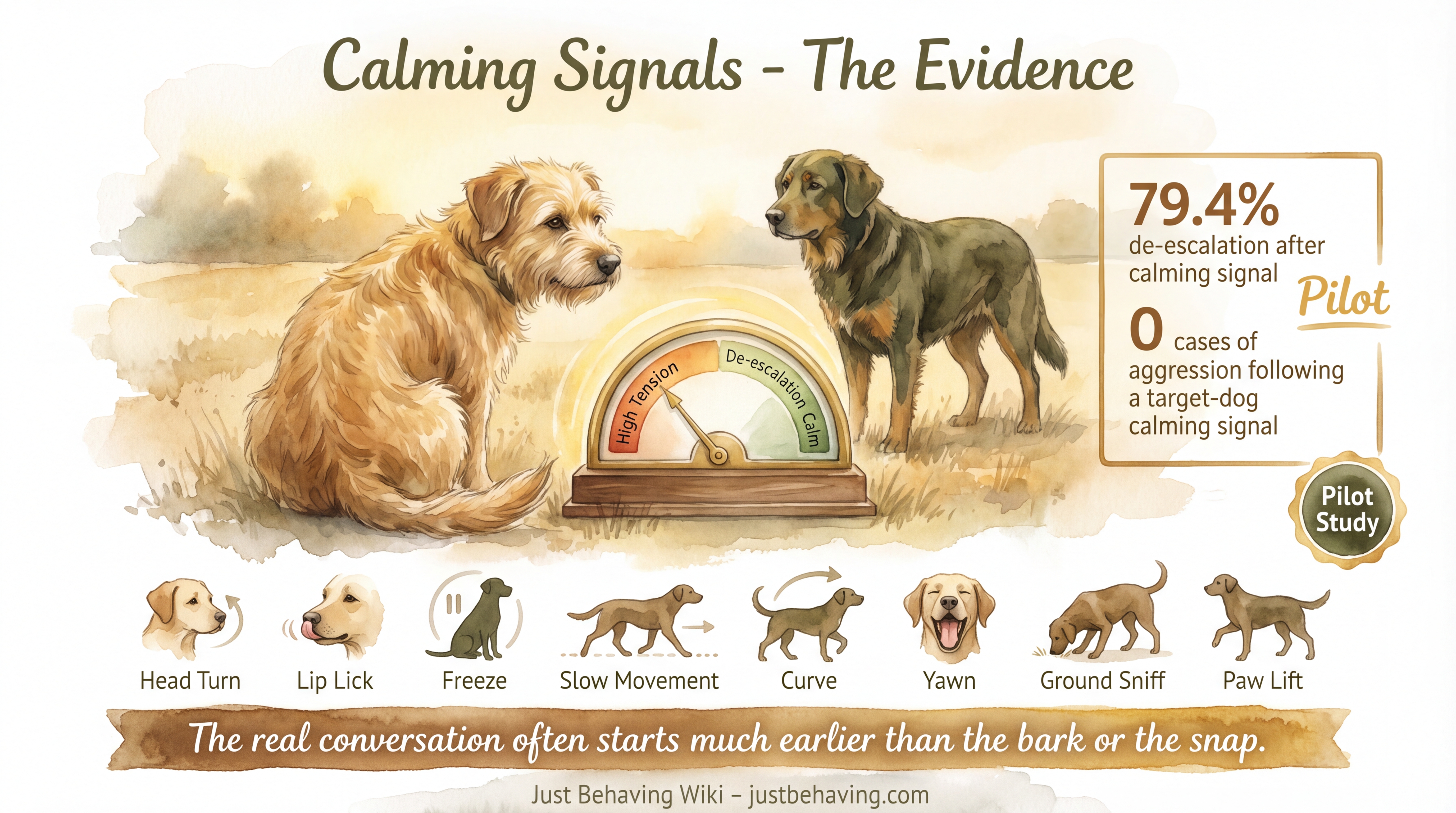
Calming signals are real observable behaviors, but the evidence for their systematic de-escalation function is still limited to pilot-level studies.
Key Takeaways
- Mariti et al. provided meaningful pilot evidence that candidate calming signals are associated with conflict management in domestic dogs.
- In the pilot dataset, target-dog calming signals did not precede aggression initiation and post-aggression calming signals were associated with de-escalation in 79.4 percent of cases.
- Signal deployment differed by familiarity, which supports the idea that these behaviors are context-sensitive rather than random motions.
- The evidence supports careful use of the concept, not a magical one-signal dictionary or a claim that every household application has already been proven.
The Evidence
- Mariti, C. et al. (2017)domestic dogs
Analyzed 96 off-leash encounters involving 24 dogs and 2,130 candidate calming-signal instances, finding that these behaviors were more likely during interaction than non-interaction. - Mariti, C. et al. (2017)domestic dogs
Across 109 aggression episodes, no target-dog calming signal preceded aggression, and post-aggression calming signals were associated with de-escalation in 79.4 percent of cases.
- Firnkes, A. et al. (2017)domestic dogs
Documented appeasement-type behaviors such as lip licking, turning away, and sitting during dog-human communication. - SCR-050 synthesisdomestic dogs
Summarizes the best current evidence as supporting calming signals as meaningful social behavior while preserving the pilot-study ceiling.
- SCR-050 boundarydomestic dogs
The data support conflict-management relevance for candidate calming signals, but they do not justify treating every occurrence of a listed behavior as a fixed emotional dictionary item across all contexts.
No large replicated sequence-analysis program has yet confirmed whether the exact Mariti percentages generalize across broader domestic-dog populations and more diverse social settings.
No controlled household trial has tested whether training families to notice and respect low-intensity calming signals measurably improves dog-family conflict recovery over time.
SCR References
Sources
Firnkes, A., Bartels, A., Bidoli, E., & Erhard, M. (2017). Appeasement signals used by dogs during dog-human communication. Journal of Veterinary Behavior, 19, 35-44. https://doi.org/10.1016/j.jveb.2017.02.004
Mariti, C., Falaschi, C., Zilocchi, M., Fatjo, J., Sighieri, C., Ogi, A., & Gazzano, A. (2017). Analysis of intraspecific visual communication in the domestic dog (Canis familiaris): A pilot study on the case of calming signals. Journal of Veterinary Behavior, 18, 49-55. https://doi.org/10.1016/j.jveb.2016.12.009